


Wellington Region rewards travelers who pick their sleep strategically. On paper, the distances look small. In practice, hills, wind, commuter traffic, limited late-night transport, and the simple friction of parking can turn “easy day trips” into long days that feel more like transit than travel. After multiple overnights across the region, I’ve come to treat accommodation as an itinerary tool: one base for museums and nightlife, another for beaches and low-effort coastal mornings, and a third for wine country where you can walk to tastings instead of counting driving minutes. WellingtonNZ’s current self-drive guidance backs that approach, explicitly recommending a Wellington itinerary that includes two nights in the central city plus an extra night in either the Kāpiti Coast or the Wairarapa, instead of trying to do everything as a city day trip.
How To Choose A Base In Wellington Region (Before You Pick A Hotel)
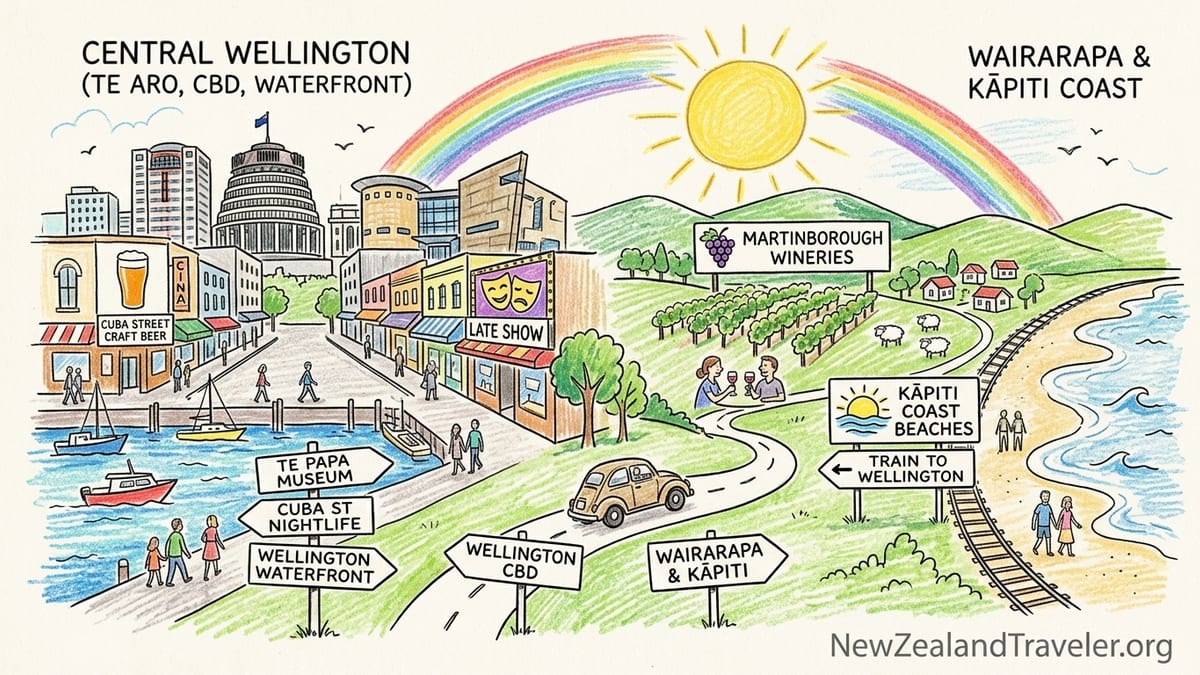
The first question I ask is not “Which property is nicest?” but “What do I want to do after dinner?” If you want to finish a craft beer on Cuba Street, catch a late show, and still be able to walk back without thinking about transport, central Wellington is the clear win. If you want to wake up to sea air, do an unhurried beach walk, and still have a train back to the capital for an afternoon at Te Papa, the Kāpiti Coast changes the texture of the trip. If your must-do is Martinborough Pinot Noir and a long lunch without a designated driver, sleeping in Martinborough stops wine tasting from becoming a stopwatch exercise.
Next, I look at the friction points that quietly shape a trip: parking costs and height limits, whether you can walk to dinner without battling hills, and whether you can reasonably avoid driving after a few glasses of wine. In the Wellington CBD, I’ve found that having a car can feel like an extra task you keep revisiting, especially if you’re staying near Te Aro where popular garages fill and on-street rules can be finicky. In the Wairarapa and much of the Kāpiti Coast, the “where do I put the car?” question tends to fade into the background, which is its own kind of luxury.
Finally, I plan around the kind of day trips each base makes genuinely easy. Central Wellington is brilliant for the city itself and for short hops: the airport is close, the waterfront is walkable, and you can structure your days around museums, food, and harbor views. But WellingtonNZ’s self-drive itinerary advice is a reminder that the region isn’t meant to be consumed only from the city. Adding a night in the Wairarapa or on the Kāpiti Coast is often what turns “we squeezed it in” into “we actually experienced it.”
Base 1: Central Wellington (Te Aro, CBD, Waterfront) For Walkability And Nightlife
Central Wellington is the base that makes the city feel effortless. On nights I’ve stayed in the CBD or Te Aro, the trip becomes less about logistics and more about momentum: museums by day, then a long dinner and a spontaneous cocktail without needing a plan. The biggest practical advantage is what happens after 9 p.m. When your day ends with a film, a gig, or a last wander along the waterfront, you can simply walk home. That seems obvious, but it’s the difference between “let’s see where the night goes” and “we should probably start thinking about driving back.”
Walking to dinner is the central-city superpower. Even if you don’t set foot on Cuba Street, you’ll feel the density: ramen, modern New Zealand menus, bakery windows still glowing, and bars that don’t require a car key. This is also the best base if your group has mixed interests. One person can disappear into Te Papa for half a day while another heads to a coffee roastery or shops along Lambton Quay, then you reconvene without anyone spending their energy on transport.
The trade-off is parking and driving. The CBD’s paid parking ecosystem is real, and if you arrive with a rental car you may find yourself adapting your itinerary to the car rather than the other way around. I’ve paid for secure garages for peace of mind, and I’ve also used CBD car parks with published rate boards when I needed a predictable daily cost. It works, but it’s not romantic. My central Wellington rule is simple: if you’re staying in town for city experiences, consider going car-light. Use public transport for airport transfers and trains for outer suburbs, then rent a car just for the day you leave the city. You’ll feel the difference instantly.
When Wellington Makes Day Trips Easy (And When It Doesn’t)
Sleeping in Wellington makes certain “big ticket” days surprisingly easy because the city is compact and the morning start is clean. On a trip where my priority list included Te Papa, the cable car, a waterfront walk, and a Zealandia-style nature fix, the city base meant I wasn’t spending any energy on packing up or highway time. The other practical benefit is airport proximity: if you’re landing late or leaving early, a CBD or nearby-inner suburb stay keeps arrival and departure days from turning into half-days of driving.
Wellington also works well for structured tours that remove the driving question. If your plan is a set pickup time for a Martinborough wine day or a guided outing, the city is a convenient launchpad. You can have breakfast, meet your driver, and let someone else handle the Remutaka Range while you watch the landscape change from harbor to valley. In that scenario, Wellington is not only workable, it’s comfortable.
Where Wellington becomes less efficient is when you’re trying to stack multiple regional experiences into consecutive day trips with long return drives. The Wairarapa over the Remutaka Range can be a full day even before you add a winery lunch. The Kāpiti Coast as a day trip can be done, but it often turns a beach morning into a “drive up, do a quick loop, drive back” pattern. After doing it both ways, I’ve found that staying in Wellington is ideal when the city itself is the main event, but it’s a compromise when the point of the trip is countryside pace.
Base 2: Martinborough (Wairarapa) For Wineries Without A Stopwatch
Martinborough is the base that transforms wine country from a scheduled excursion into an actual weekend. The village is compact, and the experience I keep coming back to is the simple pleasure of walking: walk to breakfast, walk to a cellar door, walk to dinner, then stroll back under quiet streets. When you sleep in Martinborough, you stop asking, “How many tastings can we fit before we have to drive back over the hill?” and start asking, “Which place do we want to linger?” That change alone improves the trip.
Transport is the reason to stay here. Yes, you can day trip from Wellington by car, and yes, there are wine tours that pick up in Wellington and do the driving for you. But the overnight is what makes winery logistics feel natural. If you’re tasting, you want options: hire bikes, book a local driver for a shorter loop, or choose walkable cellar doors and keep it slow. The best part is what happens at the end of the day. Instead of a long drive back, you’re choosing dessert.
Parking is easy compared with the city. Most stays I’ve used in and around Martinborough made parking a non-issue, and that removes a constant mental tab. It also makes Martinborough a good base for more than wine. From here you can commit to Wairarapa experiences that are annoying as a day trip from Wellington: a longer loop into Greytown for shopping and heritage streets, or a bigger coastal run toward Cape Palliser when weather and daylight cooperate. The key is not to overpack the day. Overnighting gives you the slack to do one thing properly instead of three things quickly.
Base 3: Kāpiti Coast (Paraparaumu, Waikanae, Paekākāriki) For Beach Mornings And Train Ease
The Kāpiti Coast is the base I pick when I want the region to feel like a coastline, not just a capital city with a few side trips. Overnighting here creates a different rhythm: early beach walks, cafés that are local rather than destination dining, and the kind of simple “we’ll see how the day feels” planning that’s hard to achieve when you’re committed to driving back to the CBD. The coast also suits travelers who want to pair nature with easy access back into Wellington.
Train access is the practical advantage that makes this base unusually flexible. The Kāpiti Line connects coast towns with Wellington, and that means you can have two trips at once: a coastal stay, plus a low-stress city day without hunting for a CBD park. On trips where I’ve stayed near a station, I’ve been able to do a full Wellington day with a waterfront walk and dinner, then ride back up the line rather than drive. It feels like cheating in the best way.
Beach access is the other reason Kāpiti is different. When you stay here, the beach isn’t something you schedule, it’s something you step into. A quick sunset walk becomes a normal part of the day. For many travelers, this is the missing ingredient in a Wellington itinerary: the feeling of space. It’s also an easy base for low-effort scenic drives and coastal trails, including short strolls where the payoff is simply an open horizon and a calmer night than the CBD.
Base 4: Hutt Valley (Petone, Lower Hutt, Upper Hutt) As A Practical, Budget-Smart Hub
The Hutt Valley is the base I’ve used when I needed practicality: easier parking than the city, a straightforward commute into Wellington by train, and a convenient jump-off point for drives north or east. It’s not as instantly “holiday” as the Kāpiti Coast or as storybook as Martinborough, but it can make a multi-stop itinerary smoother, especially if you’re picking up a car, traveling with family, or trying to keep accommodation costs down while staying connected.
Petone in particular has been a sweet spot for me as a sleeper base. You can find dinner options within an easy walk, and it’s close enough to Wellington that you can still do the city at night if you want to, while avoiding the CBD parking puzzle. If your trip includes a Wairarapa drive, the Hutt Valley also reduces the feeling that you’re battling city traffic just to reach the highway. You’re already on the corridor.
Upper Hutt and the valley further north become interesting if you’re prioritizing outdoors time. They can also make the Wairarapa feel closer. But the trade-off is nightlife. If late dinners, bars, or spontaneous live music matter to you, you may feel the distance more at night than you do during the day. My practical takeaway: the Hutt Valley can be the most efficient base for drivers, but it’s not the most atmospheric base for travelers who want to wander after dark.
Property Picks By Base (After The Base Decision Is Made)
Once you’ve chosen the right base, selecting a property becomes easier because you can shop by the experience you want, not by vague star ratings. In central Wellington, I prioritize two things: a genuinely walkable address (so you don’t “accidentally” turn every outing into a ride) and a clear parking plan if you have a car. If you’re driving, look for accommodations that either include parking or can point you to a nearby garage with consistent overnight access. If you’re not driving, prioritize being near the waterfront or Te Aro so your dining and museum time is effortless.
In Martinborough, I choose places that let me stay in village mode. Being able to walk to dinner changes the evening, and being able to store purchases safely matters more than people admit. Some properties also make the winery day easier by helping organize bikes or recommending local drivers and tour operators. If you’re traveling as a couple, a quiet cottage-style stay can make the weekend feel like a retreat. If you’re traveling with friends, a larger home where you can share a bottle after dinner is part of the point of being here.
On the Kāpiti Coast, I shop for beach proximity and train convenience. Being able to walk from your room to the sand in minutes is what you’re paying for. If you plan to commute into Wellington for a day, staying within a short ride or walk of a station makes the coast-to-city connection feel easy. In the Hutt Valley, I prioritize parking, quick motorway access, and a straightforward train link. It’s the base where the property is less about romance and more about removing friction from a busy itinerary.
The Takeaway
If you want Wellington to feel effortless, sleep in the CBD and lean into walking and nightlife. If you want the region to feel bigger than the city, do what WellingtonNZ’s self-drive guidance suggests and add a night outside the capital, either in the Wairarapa or on the Kāpiti Coast. The payoff is not just time saved, it’s a different style of travel: slower, more local, and less defined by return drives.
My most repeatable formula is three sleeps split across two bases: two nights central Wellington for museums, food, and the waterfront, then one night in Martinborough or on the Kāpiti Coast depending on whether your trip’s core memory should be Pinot Noir and cellar doors or salty air and beach walks. The Hutt Valley is the practical wildcard: not as glossy, but often the smartest base if you want parking, train access, and easy highway positioning.
In the Wellington Region, the best stay is the one that makes your evenings simple. When you can walk to dinner, park once, and wake up already where you want to be, the whole itinerary stops feeling like a series of errands and starts feeling like a trip.
FAQ
Q1. Is central Wellington the best base if I don’t have a car?
Yes. Central Wellington is the easiest place to rely on walking and public transport, especially for museums, dining, and nightlife.
Q2. When does it make sense to add an overnight outside Wellington?
If you want wineries or beach time to feel relaxed rather than rushed, add a night in either the Wairarapa (Martinborough area) or the Kāpiti Coast.
Q3. Can I do Martinborough as a day trip from Wellington?
You can, but it often becomes a long day with a return drive over the Remutaka Range. Staying overnight in Martinborough makes tastings and dinner far simpler.
Q4. What’s the easiest way to do Martinborough wineries without driving?
Stay in Martinborough and plan to walk, bike, or use a local driver for a short loop. Alternatively, book a Wellington-based wine tour that provides transport.
Q5. Is the Kāpiti Coast realistic without a car?
It can be, especially if you stay near a Kāpiti Line train station and choose a beach area you can reach on foot, but having a car adds flexibility for exploring.
Q6. Which base is best for beaches?
The Kāpiti Coast is the most beach-forward base for morning and sunset walks, with the advantage of train access back to Wellington for city time.
Q7. Which base is best for nightlife?
Central Wellington. Staying in the CBD or Te Aro makes it easy to walk to late dinners, bars, and live entertainment.
Q8. Is the Hutt Valley a good place to stay for visiting Wellington?
Yes if you want easier parking and a straightforward train ride into the city. It’s a practical hub, though it’s quieter at night than central Wellington.
Q9. How should I plan if I’m flying in late or leaving early?
Sleep in central Wellington or near the airport side of the city to keep arrival and departure days simple, then shift to a regional base after you’ve settled in.
Q10. If I only have three nights total, how should I split them?
A strong plan is two nights in central Wellington plus one night in either Martinborough (for wine) or the Kāpiti Coast (for beaches and a slower pace).