


I started my Kāpiti Island day in Paraparaumu Beach with that slightly nervous feeling you get before any protected-wildlife trip: I had my boots scrubbed, my bag zipped, my lunch packed, and a quiet hope that the weather would hold long enough for the ferry to run. Kāpiti Island sits about 5 kilometers offshore, and because it is a strictly managed nature reserve, you cannot simply turn up with your own boat and land. You go through approved operators, you follow biosecurity rules like they matter (because they do), and then you earn your time in one of New Zealand’s most famous bird sanctuaries.
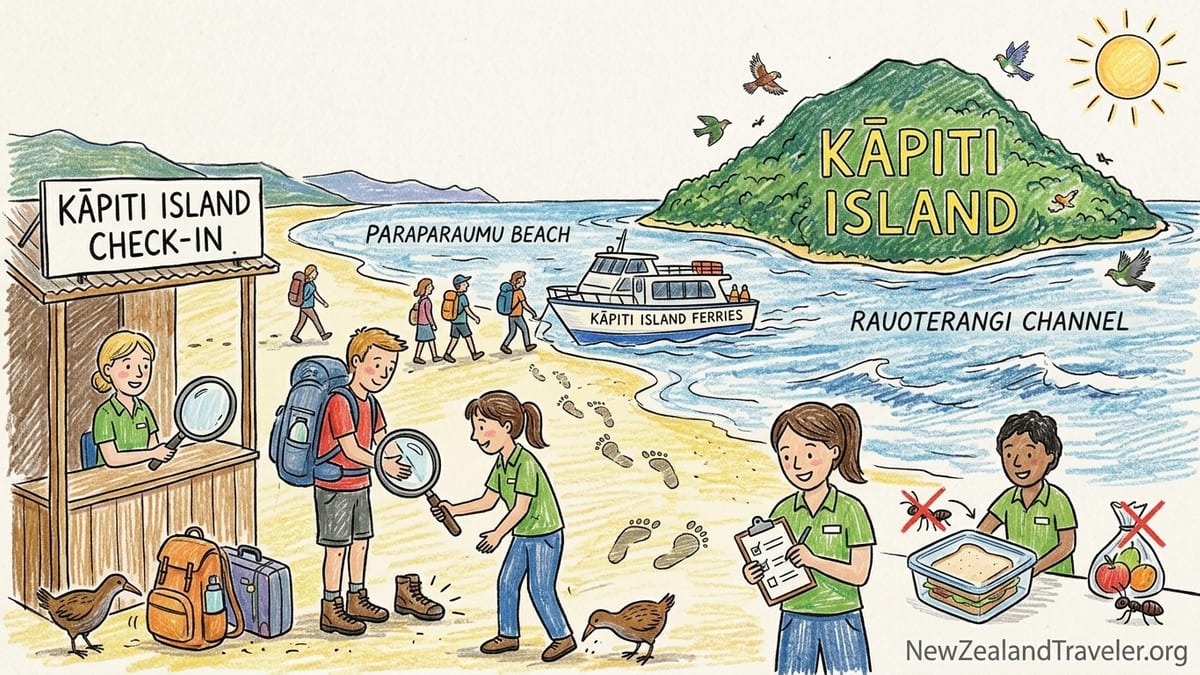
Paraparaumu Beach: Getting There, Where You Actually Check In, and Why Timing Matters
Paraparaumu Beach is not a “remote expedition” vibe at all. It feels like a lived-in coastal suburb with a real shoreline, a boating club, and the kind of morning calm where locals are walking dogs while visitors double-check their daypacks. For Kāpiti Island trips, the practical geography is straightforward: boats depart from the Kāpiti Boating Club at 1 Manly Road, Paraparaumu Beach, which keeps the whole operation focused on a single, easy-to-find waterfront departure point.
Before you even think about taking photos of the island sitting offshore, the first travel task is confirming your sailing. Conditions in the Rauoterangi Channel can change quickly, and both the Department of Conservation guidance and operators emphasize that safe passage is the operator’s responsibility. In practice, that means you should treat your sailing as “probable, not promised” until the morning confirmation is done. The day I went, I planned my morning around being flexible. I arrived early enough that a late change would not derail the rest of my day on the Kāpiti Coast.
If you are coming from Wellington without a car, it is still doable, but it adds pressure. There are train and bus options into Paraparaumu and Paraparaumu Beach, yet the island sailing timetable is not something you want to gamble on with tight connections. The last thing you want is to arrive after the check-in deadline and watch the boat leave. Operators are explicit that deadlines may be strictly enforced and late arrival can mean losing your trip fare.
Check-In and Biosecurity: The Part Everyone Underestimates Until They’re Standing There
Check-in for Kāpiti Island is not just “show your ticket.” It is the gateway to a predator-free island, and the tone is closer to an airport security mindset than a casual beach boat ride. DOC’s visitor material is clear that you should expect a biosecurity inspection and a boat safety briefing before you arrive on the island. That matched what I experienced: staff focused on footwear, bags, and anything that could carry seeds, insects, or stowaway pests.
The most important thing I did right was preparing before the day. The operator guidance is blunt: arrive with clean footwear and gear because cleaning on the day slows the process. I had scrubbed boot treads and checked pockets and Velcro seams at home, then kept my pack closed. At check-in, I watched the same pattern repeat with other guests: the people who arrived with muddy trail shoes or loosely packed food spent the longest time repacking and rechecking.
Food and packaging mattered more than I expected. Pest-free island protocols across DOC sites commonly emphasize sealed containers. On Kāpiti, you do not want to be the person unpacking a soft grocery bag of snacks while staff try to ensure nothing hitchhikes across. Even if you are doing a day trip, treat your lunch like something you would pack for a long train ride: sealed, tidy, and easy to inspect.
This is also where the “approved operator only” rule becomes real. DOC’s position is simple: access to Kāpiti Island Nature Reserve is through approved tour operators only, private boats may not land, and summer bookings should be made well in advance. You are not just buying a boat seat, you are buying a managed permission structure that keeps the island functioning as a sanctuary.
The Boat Ride: Size, Seating, Sea Conditions, and the Reality of a 20-Minute Crossing
From the Kāpiti Boating Club, the operation moved with purpose. Safety briefing first, then boarding, then a short push away from the beach into open water. The channel crossing is often described as roughly 20 minutes, and that is exactly how it felt: long enough to register you are on the ocean, short enough that you should not plan to “settle in” with a book.
Boat size can vary by operator and day, and schedules can shift without notice in response to weather, technical issues, sea state, or minimum passenger numbers. On my trip, the boat felt like a practical, workmanlike passenger vessel rather than a scenic cruise craft. The focus is transport, not luxury. I had enough room to sit comfortably and keep my daypack close, but you should not expect sprawling deck space.
Sea conditions are the wild card. Even on a “fine” day, the water can have enough movement to make you brace with your legs and keep one hand free. If you get motion-sick, treat this as a real ocean crossing and plan accordingly. I kept my gaze up, stayed hydrated, and avoided fussing with my bag while we were moving.
As Kāpiti Island grew larger ahead, the mood onboard shifted. People stopped chatting and started scanning the coastline. It is a short ride, but it feels like you are entering a different rulebook, which you are.
Arrival and Briefing: What You’re Told, What Facilities Exist, and What Doesn’t
Stepping off onto Kāpiti is not a marina experience. You should be ready for beach landings and uneven ground because operators note that access can involve a ramp and a stony beach. That is a small detail that matters: sturdy footwear is not optional, and neither is balance. I watched people who wore soft city sneakers immediately move more cautiously.
After arrival, the briefing put boundaries around the day. The island is a nature reserve with clear track expectations, limited facilities, and no casual “wander anywhere” freedom. Operators emphasize staying on designated tracks, and the island’s predator-free status is treated as something visitors actively protect, not something you passively benefit from.
Facilities exist, but they are basic. Operator information notes toilets and a shelter are available, and that there is no general shop on the island. That matched the feel on the ground: you can use the toilet, take shelter, and then you are on your own with what you carried in, unless your booking includes catered food at the lodge side of operations.
One DOC detail that helped frame the day is the island’s range of walking options. DOC describes walks from a few minutes to a full day, with tracks mostly well formed but with some steep, rough, or muddy sections. That “mostly well formed” line is accurate, but do not let it fool you: it is still real bush walking, and the climb can bite if you go for height.
The Day-Trip Walk: Trails I Actually Took, Elevation I Felt, and the Birds I Genuinely Noticed
On a day trip, your biggest decision is not what you pack, it is what you prioritize. Kāpiti rewards patience, but day-trip time is limited by scheduled return crossings and the reality that you cannot see “everything.” DOC highlights two signature choices: wandering forest-fringed tracks or climbing to the island’s high point, Tūteremoana, at 521 meters. That summit number is not abstract. You feel it in your calves, especially if you are trying to do it efficiently between boat times.
I chose a mid-intensity day: enough elevation to earn views and enough slower sections to actually look and listen. The island’s forest has a layered soundscape that can trick you into walking too fast. When I slowed down, the birdlife became more obvious, even when it stayed partially hidden. DOC specifically names birds visitors may encounter across habitats, including kākā, kōkako, takahē, hihi, tīeke, and weka. I did not treat those as a checklist, but as a cue to pay attention to where I was: forest edges for certain calls, open flats for others, and coastal margins for seabirds.
The birds I felt most confident identifying during the day were the ones that either presented clearly or were distinctive in behavior. I saw weka moving with that bold, ground-focused energy that makes them feel like they own the track. I also had several moments where large native pigeons moved through the canopy with heavy wingbeats, the kind of sighting that makes you stop mid-step. In the forest, I repeatedly heard and then spotted parrots that moved fast and noisy, sometimes giving you only a quick look before they slipped back into greenery.
Weather shaped what I saw and how far I went. Kāpiti is exposed to coastal changeability, and the day’s light oscillated between bright patches and softer cloud cover. When the sun came out, the forest edges felt alive. When cloud rolled through, bird activity seemed to shift toward quieter movement. I carried a light jacket even though it started mild, and I was glad I did.
For readers who want a specific track example rather than generic “walk the trails,” DOC’s brochure maps out defined loops and short connectors. One of the named options is the Okupe Valley Loop Track, described as a 4.8 kilometer loop taking about 1 hour 30 minutes, climbing gently to a lookout above western cliffs at about 198 meters. That kind of route is a good day-trip anchor because it gives you structure without consuming the whole schedule in a single summit push.
Lunch, Timing, and the Big Question: Summit Climb or Easier Tracks?
I ate lunch like I was on a serious hike, not a casual tour. There is something about Kāpiti that makes you burn more energy than expected: the salt air, the uneven footing, the small climbs that add up, and the constant stopping to look and listen. Because there is no general shop, your lunch needs to be something you will actually want to eat even if the weather turns cooler. I kept it simple and packable, then took my time in a sheltered spot rather than rushing and losing the afternoon’s best walking window.
So, is the summit the best use of limited time? It depends on what you came for. If your priority is a physical achievement and a wide, panoramic payoff, the 521-meter summit climb is the headline. If your priority is birds, I found the easier and mid-elevation tracks to be the better use of time because they allowed me to stop often, move quietly, and stay in habitats where bird encounters were more continuous. Racing to the top can turn your day into a cardio event where you miss the very thing you came to see.
My honest recommendation for most first-timers is this: if you are on a strict day-trip timetable, prioritize a loop or out-and-back that keeps you in forest and edge habitats, then add elevation only if you are moving comfortably and the weather is stable. If you have already done major New Zealand viewpoints elsewhere, Kāpiti’s uniqueness is the density of native birdlife in a predator-free setting, not a single “best view” photo.
If you are traveling with mixed fitness levels, the “easier track” choice also keeps the group happier. Kāpiti’s tracks are not paved, and operators clearly warn that a reasonable level of fitness is required, especially for climbing to the highest point. A day-trip is not the moment to discover someone’s ankles are not happy on uneven ground.
Overnight vs Day Trip: Where You Sleep, What the Kiwi Outing Feels Like, and Why It’s a Different Article Inside the Same Island
It is important to separate experiences: a Kāpiti day trip is one thing; an overnight stay is another. DOC’s own brochure notes that overnight stays are not allowed within the DOC-managed area of the reserve, but can be arranged at a private lodge at Waiorua Bay run by Kāpiti Island Nature Tours. In other words, “overnight on Kāpiti” exists, but as a specific accommodation offering within private operations, not as general camping in the nature reserve.
The overnight product is built around what you cannot get in a day: darkness, silence, and the chance to encounter nocturnal wildlife. Kāpiti Island Nature Tours positions its overnight experience as including accommodation choices such as glamping tents and cabins, with cooked meals included, plus a guided kiwi spotting night tour. That bundled structure matters because it simplifies logistics in a place with no casual dining and strict movement expectations.
From a traveler’s perspective, accommodation on an island like this is less about luxury and more about proximity. A cabin or glamping tent means you can finish your day walk, eat a hot meal, and then go back out with a guide when the island’s energy shifts. The kiwi outing is not something you should treat as guaranteed, but the entire point of being there overnight is that you are finally awake at the same time as some of the most iconic wildlife.
If you are debating whether to spend the extra money and time, the cleanest way to decide is this: if your dream is “I want to see the forest and birds,” day trip. If your dream is “I want to experience Kāpiti after dark and have a real shot at a wild kiwi encounter,” overnight. They are fundamentally different pacing and different emotional experiences, even though they share the same boat ride and the same biosecurity gatekeeping.
Booking Rules, Permits, Weather Cancellations, and the Reality of Planning This in 2026
Kāpiti Island access is controlled. DOC states that access to Kāpiti Island Nature Reserve is through approved operators only, and that the island is popular year-round, with summer bookings needing to be made well in advance. It also notes the reserve lies about 5 kilometers offshore, which helps explain why weather can quickly reshape schedules and why private landings are restricted.
For travelers, the most practical “rule” is to treat your chosen operator as the single source of truth for day-of sailing decisions. Even if the forecast looks decent, the skipper can cancel for safety. Kāpiti Island Nature Tours makes this plain in its terms: schedules may change without notice due to weather, sea conditions, technical disruptions, or minimum passenger numbers. That is not a scare tactic; it is an honest description of running small-boat operations on a changeable coast.
Cancellation and refund rules are not something to skim. For example, Kāpiti Island Nature Tours publishes a detailed cancellation policy, including a full refund for cancellations more than 14 days out, partial refunds inside that window, and clear consequences for last-minute no-shows. Importantly, it also states that if the ferry skipper cancels due to unsafe sea or weather conditions, you can transfer to another date or request a full refund. That is the policy detail that should shape your booking strategy: build at least one buffer day into your Wellington or Kāpiti Coast itinerary if Kāpiti Island is a must-do.
One more very current operational detail: Kāpiti Island Nature Tours publicly posts ferry status updates and notes when bookings open for the season. On the day this piece was prepared for publication, the operator indicated that bookings were open from 5 September 2026 and displayed a same-day ferry status update. That kind of live status communication is useful for travelers, but it also underlines the core truth: do not build a non-refundable, tightly sequenced itinerary around a single Kāpiti crossing.
If you want the simplest planning path, book directly with an approved operator, read the check-in deadline carefully, arrive early, and keep your schedule flexible enough to shift by a day. Kāpiti is worth it, but it demands cooperation.
The Takeaway
Kāpiti Island felt like the rare wildlife experience that is both accessible and genuinely protected. Starting from Paraparaumu Beach, everything about the day signaled that this is not a casual sightseeing stop: check-in is punctual, biosecurity is thorough, the crossing is short but real, and the island’s rules exist for reasons you can hear in the forest as much as you can read on a sign.
If you have only one day, I would spend it on the easier and mid-elevation tracks, moving slowly enough to actually observe birds, rather than turning the visit into a summit race. The summit climb is a worthy goal, but the sanctuary’s magic is in the living detail: rustles in the undergrowth, sudden wingbeats overhead, and the feeling that the ecosystem is functioning the way it is supposed to.
If you can stay overnight, treat it as a separate decision with its own purpose: you are buying darkness on a predator-free island, a hot meal, and the possibility of a guided kiwi outing. It is not the same product as a day trip, and it should not be compared only on price.
Most of all, plan Kāpiti with humility. Book well ahead for peak season, prepare your gear like biosecurity matters, and build a buffer for weather. Do that, and the island gives you something that is increasingly hard to find: a close, respectful encounter with native wildlife in a place designed to keep it wild.
FAQ
Q1. Can you visit Kāpiti Island without a tour operator?
Access to Kāpiti Island Nature Reserve is through approved operators only, and private boats may not land.
Q2. Where do Kāpiti Island boats depart from?
Boats depart from the Kāpiti Boating Club at 1 Manly Road, Paraparaumu Beach.
Q3. How long is the boat crossing to Kāpiti Island?
The crossing is roughly 20 minutes, depending on sea conditions and loading.
Q4. What is the biosecurity check like?
Expect staff to inspect your footwear and bags for dirt, seeds, and anything that could carry pests, plus a safety briefing before boarding.
Q5. What should I pack for a day trip?
Bring sturdy walking shoes or boots, layers and a light jacket, sun protection, a water bottle, and a packed lunch in tidy, inspectable packaging.
Q6. Are there shops or cafes on the island?
There is no general shop for day-trippers, so plan to be fully self-sufficient with food and water unless your booking includes catering.
Q7. Is the summit climb worth doing on a day trip?
If you want a fitness challenge and views, yes, but many travelers get better wildlife value by spending limited time on easier forest and edge tracks.
Q8. Can you stay overnight on Kāpiti Island?
Overnight stays are not allowed in DOC-managed areas, but overnight accommodation can be arranged at a private lodge at Waiorua Bay via an approved operator.
Q9. What happens if weather cancels the sailing?
Operators may cancel for safety; for example, Kāpiti Island Nature Tours states you can transfer to another date or request a full refund if the skipper cancels due to unsafe conditions.
Q10. How far in advance should I book?
DOC advises summer bookings should be made well in advance because the island is popular year-round and capacity is managed.