


Wellington is a city you can “do” on foot and by cable car, but the Wellington Region rewards anyone willing to leave the CBD for a day. Over a week of guided experiences and independent exploring, I kept coming back to a simple question: what did paying for a tour actually solve? In the best cases, it wasn’t about convenience for its own sake. It was about unlocking places with access rules, stitching together scattered film sites with context, making wine tasting possible without a designated driver, or turning a sanctuary walk into a wildlife-spotting masterclass. Below are the Wellington Region tours and day trips that genuinely earned their place in my itinerary, plus the moments when a rental car, public transport, or a self-guided plan would have been the smarter move.
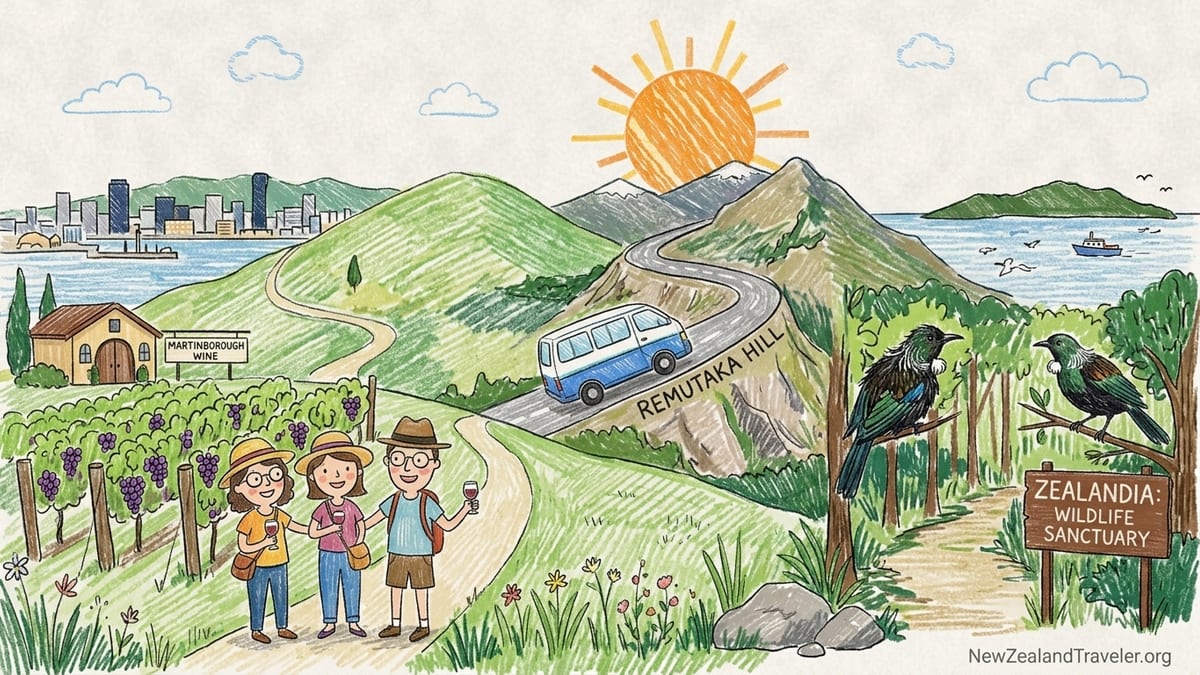
Martinborough and Wairarapa Wine Trips: When the Tour Is the Point
My most decisively “worth it” guided day was a Martinborough wine trip from Wellington, because it solved the one problem you can’t finesse with planning: you can’t safely taste all day and still drive back over the Remutaka Hill. On a typical full-day itinerary, the morning starts with a Wellington CBD pickup point or hotel pickup depending on operator, then you settle into an air-conditioned minivan or small coach for the run out to the Wairarapa. The transit time isn’t just dead time. A good guide uses it to explain the region’s geography and the logic behind the day’s pacing, which matters once you’re working around tasting room time slots and lunch rushes.
On the guided version of this day, the group size felt like the sweet spot: small enough that winery staff actually talked to us, large enough that the day had social energy. Expect structured stops rather than wandering. You’ll typically do several tastings, then a long lunch stop where you can buy food, often something like a gourmet platter at a cellar door (lunch is commonly an extra cost even on well-priced tours). Waiting time exists, but it’s managed: a few minutes here and there for restroom breaks, purchases, and latecomers. Weather matters less than you’d think because tastings are indoors, but a windy Wellington departure can still set the tone. I left glad I didn’t have to concentrate on the hill road in squalls after a glass, or three.
What paying for the tour solved was not only transport, but sequencing. Martinborough looks compact on a map, yet a self-guided day can easily fall apart if you arrive at peak times and discover your preferred tasting is booked, or you burn an hour cycling between venues in gusty conditions. The guided route removed that friction. It also removed the mental overhead of “who’s staying sober enough to drive,” which, if you’re traveling as a couple or trio, is the real hidden cost of going independently.
When a rental car would have been better: if you want to build the entire day around one long winery lunch, a specific producer, or a slow shop-and-stroll in Greytown or Featherston. The Wairarapa Connection train can also work for a more independent day if you’re happy to taste lightly, use local taxis, or focus on one or two stops rather than a full circuit. But if your goal is a classic Wellington-to-Martinborough tasting day with multiple cellar doors, the guided option is the cleanest way to do it.
Zealandia: Guided Day and Night Walks vs Going Solo
Zealandia is close enough to feel like a city attraction, but it rewards the mindset of a tour. It’s a fully fenced wildlife sanctuary with regenerating forest and rare native species, and it’s marketed heavily for good reason. The difference between a self-guided visit and a guided walk isn’t the path. It’s the pace and the attention. On my guided tour, the “activity time” was genuinely active: we weren’t just strolling. We were stopping often, scanning, listening, and learning what to look for in the canopy and undergrowth.
Logistics were easy compared with most day trips. I made my own way there rather than using a pickup, which is one reason Zealandia is a great “half guided, half DIY” experience. Entry is structured with timed guided departures during the day, and general admission is straightforward. Recent published pricing has highlighted a meaningful detail for travelers: general admission has been promoted as valid for two consecutive days, and international adult pricing has been listed higher than local pricing. That two-day validity changes how I recommend visiting: do one guided tour, then use the re-entry window to come back independently when you’re not keeping up with a group.
Group size on my guided walk felt medium: enough people to keep the guide in “projection voice,” but still manageable on narrow sections. The guide was the value. They called birds before I saw them, explained behavior, and turned quick sightings into stories with context. Waiting time was minimal aside from a short pre-departure gather. Food wasn’t part of the tour itself, but Zealandia’s on-site cafe made it easy to plan a hot drink after, which matters when Wellington’s weather does what it does.
When going independently is better: if you’re a confident wildlife spotter, have time to linger, and want your own quiet pace for photography. If you’re doing only one visit and you’re short on time, I’d still pick guided, because the guide compresses the learning curve into two hours and you leave feeling like you actually saw something rather than just walked a beautiful loop.
Wētā Workshop in Miramar: The Tour That Makes Wellington’s Film Story Real
Wellington’s film reputation can feel like lore until you sit inside a workshop space and hear how physical effects are built. Wētā Workshop Experiences in Miramar is one of the region’s signature bookable attractions, and the simplest way to do it is to get yourself to Miramar and join a tour. But the experience that truly earned its place in my itinerary was the version with guided transfers included, because it solved timing, navigation, and the “should we bus, rideshare, or rent a car” friction that tends to nibble away at half-days.
On the transfer-and-tour combo, the pickup point is in central Wellington, and you ride out and back in a dedicated shuttle. The ride itself becomes part of the experience, with film-industry storytelling en route and a chance to spot a few local landmarks. The published duration for that experience is about three hours including transport, which is a realistic planning block for a travel day when you’re trying to fit Te Papa, a waterfront wander, and dinner reservations into the same 24 hours.
Inside, the guided component is the whole point. The tour is curated and paced, with the guide keeping the group moving while still giving time to absorb the details. My group felt like a standard tour size rather than an intimate workshop class, and that’s fine because the content is designed to be seen and explained rather than hands-on. Waiting was mostly limited to check-in and the few minutes it takes to assemble everyone. Food isn’t part of the tour; my practical advice is to eat before you go or plan a snack after. Wellington weather didn’t matter much on the day I went because most of the experience is indoors, which makes Wētā an excellent “bad weather” anchor activity.
When a rental car is better: if you want to combine Miramar with scattered film locations at your own pace and you’re comfortable driving and parking in the suburbs. When public transit is better: if you’re staying near the CBD and simply want the cheapest route, because Miramar is reachable without paying for a shuttle. What paying for the guided transfer solved was not the ride itself, but the mental load of coordinating transport around a timed entry, and the temptation to skip Miramar entirely because it feels “a bit out of the way.”
Kāpiti Island: The Day Trip Where Paying Solves Access, Permits, and Biosecurity
Kāpiti Island is not a casual beach hop. It’s a protected nature reserve with strict access rules, and that’s why it stands out. You generally can’t just show up and wander ashore; permits are required and operators structure trips around those rules and around biosecurity checks. This is a day trip where the tour is not a luxury add-on. It’s the mechanism that makes the visit possible and responsible.
My day started on the Kāpiti Coast rather than in Wellington city. That meant no city pickup for me, but it also meant I could pair the island day with a relaxed morning in Paraparaumu. The operator process is part of the experience: a biosecurity briefing and inspection before boarding, then a short boat crossing. Published operator information has described crossings on the order of minutes rather than hours, but what you should budget for is not the boat time. Budget for the pre-boarding checks, the group organization, and the fact that island schedules run to nature’s pace rather than yours.
Group size felt intentionally limited and managed, which matches the island’s controlled visitation approach. Once on the island, the activity time is real walking time: you’re not just stepping off for a photo. You’re on trails, listening for birds, and moving slowly enough to notice. Food varies by product, but the key is to plan like you’re going to a remote place. Even when lunch is included or available as an add-on, you don’t want to rely on last-minute options the way you might in the CBD. Weather is a bigger factor here than at Zealandia or Wētā: the coast can be bright and calm at breakfast and then gusty by midday, and boat travel adds a layer of exposure.
What paying for the tour solved was threefold: permit logistics, biosecurity procedure, and the confidence that you’re visiting in a way that aligns with conservation rules. When going independently is better: in most cases, it isn’t, because access is structured through approved operators. The best independent alternative is to treat the Kāpiti Coast itself as your DIY nature day, while saving Kāpiti Island for a guided booking on another date when seas and schedules line up.
Wellington Film and Sightseeing: Guided Context Beats “Stand Here, Imagine It”
Wellington is full of film references that can feel vague if you’re doing them from a blog post screenshot. The best guided film day trips solve a surprisingly specific problem: the region’s iconic locations are real places, but they don’t always look like the finished scenes, and the distances between them add up. A guide turns “this is roughly where it was” into something you can actually visualize, and stitches together city viewpoints, forested trails, and suburban edges into one coherent narrative.
On my guided film outing, pickup was in central Wellington, with the group traveling in a comfortable van sized for a day tour rather than a big bus. Group size was small enough that everyone could ask questions, and the guide took the role of storyteller, navigator, and timekeeper. The activity time was split between short walks to viewpoints or wooded paths and drive time with commentary. Waiting time showed up mainly at photo stops, because film fans move at different speeds once they spot a familiar angle.
Food was not a formal inclusion on my day, but the tour stopped in a way that made grabbing lunch practical rather than frantic. This mattered because Wellington weather was classic Wellington: changeable, breezy, and prone to turning a “quick snack” plan into “we need somewhere indoors now.” The best part of paying for the tour was not transportation, although that helped. It was that I did not need to manage parking, route optimization, or the awkwardness of arriving at a trailhead and wondering if I was even in the right place.
When DIY is better: if your only goal is one or two easy city sites, like a viewpoint and a waterfront wander. You can do those with your own legs and a short rideshare. But if you want a proper story-driven overview, especially one that links city, bush, and workshop culture, a guided film experience is the difference between a day of guesses and a day of “oh, now I see it.”
Hutt Valley Outdoors: When a Shuttle Beats a Second Car
The Hutt Valley is where Wellington starts behaving like a playground. It’s also where the logistics of a point-to-point trail day can quietly become your biggest obstacle. On my outdoor day, I mixed independent travel by train with paid trail support, and it felt like the most practical way to do it. Metlink trains connect Wellington with the Hutt Valley and the Wairarapa corridor, and that train backbone makes it easy to build a day without renting a car.
The experience that earned a place in my itinerary was using a dedicated shuttle service for the Remutaka Cycle Trail area. Operators in the region advertise daily shuttle vans with bike trailers covering trail endpoints and wider connections, which is exactly what you need when your ride doesn’t naturally loop back to your start. My day had a simple flow: train to the start area, ride for the core activity time, then shuttle back rather than spending hours backtracking. The “waiting” you pay for here is minimal and predictable, because shuttles run to scheduled pickup times and bike loading is quick when the driver does it all day.
Food on a trail day is on you, and that’s not a downside. It’s part of the fun. The difference is that a shuttle-supported plan lets you pack what you want and focus on riding rather than timing your entire day around getting back to your car. Weather, again, is the decider. If the wind is aggressive or rain rolls in, having a booked pickup and a dry vehicle waiting at the end can turn a potentially miserable finish into a controlled, safe exit.
When a rental car is better: if you have a group that wants full flexibility, you’re carrying a lot of gear, or you’re combining trails with multiple off-route stops. When a train is better: if your outdoor day is out-and-back on one trail and you don’t need point-to-point support. What paying for a shuttle solved for me was the classic Wellington Region problem of linear adventures in a place where the landscape begs you to keep moving forward.
Coastal and Wairarapa Excursions I Did Independently: When “Just Go” Wins
Not every great Wellington Region day needs a guide. Some of my favorite hours were the simplest: a DIY coastal wander, a slow lunch in a small town, or a spontaneous weather-based pivot. On days like this, a rental car can be excellent, but it’s not required. The region’s public transport and walkable pockets can support a travel style that’s less curated and more responsive.
The key advantage of independent exploration is timing. You can leave early to beat crowds, linger when the light is good, or bail out when the wind makes a beach feel like a sandblaster. I built one Wairarapa day around the idea of seeing just one place well rather than trying to “do it all.” That’s where DIY shines: you can commit to a long cafe lunch, detour into a bookshop, or spend an hour photographing an empty road under big skies without worrying about holding up a group.
The tradeoff is that you give up someone else’s local knowledge and you take on all the micro-decisions: where to park, what’s open, whether you’re allowed on a given track, and how to route around closures. If you’re the kind of traveler who enjoys that puzzle, independent days can feel richer than tours. If you’re on a short trip and you want guaranteed outcomes, guided experiences are the safer bet.
My rule after this trip was simple: I booked tours when access, safety, or complex routing was the core challenge (Kāpiti Island, wine days, point-to-point outdoor rides, multi-site film itineraries). I went independently when the joy was in unstructured time and the consequences of a wrong turn were minor.
The Takeaway
The Wellington Region’s strongest tours aren’t trying to replace independent travel. They’re designed to remove the specific friction points that tend to sabotage day trips: driving after tastings, piecing together scattered film locations, managing trail logistics without a second vehicle, and navigating conservation access rules. In my itinerary, the tours that earned their keep were the ones that gave me something I couldn’t easily buy with a map and good intentions: sequencing, access, and expertise.
If you’re building your own week in Wellington, mix styles on purpose. Use guided experiences for the days where structure and context create the value, then give yourself at least one fully independent day where the only plan is to follow the weather and your appetite. Wellington is at its best when you let it be both: a city you can wander and a region that rewards you for booking the right help.
FAQ
Q1. What’s the single best guided day trip from Wellington if I can only pick one?
For most visitors, a Martinborough wine tour is the most “complete” day out because it bundles transport, tastings, and a full-day regional experience without requiring a designated driver.
Q2. Is Zealandia better as a guided tour or self-guided?
Guided is better for your first visit because the guide dramatically improves wildlife spotting and context; self-guided is ideal as a second lap if you have the time.
Q3. How long should I budget for Wētā Workshop in Miramar?
Plan around three hours if you book the guided transfer-and-tour option, which includes transport time and the guided experience.
Q4. Do I need a car to do these Wellington Region experiences?
No. You can do many days with a mix of city walking, trains to the Hutt Valley, and targeted tours or shuttles for the places where transport is the main hurdle.
Q5. What does paying for a Martinborough wine tour actually solve?
It solves safe transport after tastings and also solves scheduling, by pre-arranging a sensible sequence of cellar doors and lunch timing.
Q6. Is Kāpiti Island doable without a tour?
In practice, access is managed with permits and approved operator processes, so booking through an operator is the realistic path for most travelers.
Q7. Are Wellington film location tours worth it if I’m not a hardcore fan?
Yes, if you enjoy storytelling and scenery; the best tours work as a sightseeing day with a film layer, not just a fan pilgrimage.
Q8. What’s the best way to handle point-to-point trail days in the Hutt Valley?
Use trains to reach the start area, then book a bike shuttle for the end so you’re not forced into long backtracking or a second car plan.
Q9. How weather-sensitive are these day trips?
Kāpiti Island and outdoor trail days are the most weather-sensitive; Zealandia and Wētā Workshop are more resilient because much of the experience is sheltered or forest-based.
Q10. When is a rental car the better option in the Wellington Region?
A rental car is best when you want total flexibility for small-town browsing, coastal detours, and slow pacing, especially outside peak tour departure times.