

There’s a certain kind of quiet that only arrives when a city attraction locks its gates and hands you a torch. At Zealandia Te Māra a Tāne in Wellington, that moment comes just before sunset, when the last daytime visitors drift back to the Visitor Centre and a guide begins counting heads for Zealandia by Night. The tour material promises nocturnal wildlife and the possibility, not the guarantee, of kiwi. I came for the honest version of that promise: What does it really feel like to walk a predator-fenced valley after dark, and what, exactly, shows up when you do?
Getting To Zealandia, And What “After Hours” Actually Means
Zealandia sits at the end of Waiapu Road in Karori, a short drive from Wellington’s city centre. The approach feels suburban until it suddenly doesn’t: the road narrows, the forest closes in, and the carpark arrives like a small clearing at the edge of something much larger. Zealandia is a 225-hectare valley protected by an 8.6-kilometre pest-exclusion fence, and even before you step inside you get the sense that the night tour is not a zoo visit. It’s a walk through functioning habitat.
I arrived early on purpose. Zealandia asks tour guests to check in at the Visitor Centre at least 15 minutes before departure, and in practice that buffer matters. There are waivers and reminders, toilets, and the small logistical shuffle that happens whenever strangers become a group: people comparing layers, asking whether gloves are overkill, and trying to decide if they should buy a snack now or wait until after.
The “after hours” part is real. Once standard operating hours end, entry is only for people booked on a tour, and the sanctuary feels more private than it does in daylight. The night tour is capped at small-group size, and Zealandia’s own terms state that after-hours tours are limited to 12 people per tour. That cap changes the tone immediately: it’s easier to hear your guide without everyone bunching up, and easier to stop quietly without creating the kind of crowd noise that sends wildlife deeper into the bush.
Check-In, Group Size, And The Red-Light Torch Briefing
Check-in began inside the Visitor Centre, where the evening had the low-key efficiency of a well-run operation. A staff member confirmed names, and the tour group gradually assembled in that slightly awkward half-circle familiar to anyone who has taken a guided walk: strangers in hiking shoes, a couple on a date, a family with teenagers who looked excited and skeptical at the same time.
The guide introduced themselves, outlined the route in broad strokes, and delivered the night-walk essentials in plain language: stay together, keep voices down, and watch your footing because the tracks include slopes, gravel, and uneven terrain. Zealandia’s own guidance for tours is consistent with that reality: it’s not a strenuous hike, but it is two-plus hours on your feet, and the ground is not an indoor floor.
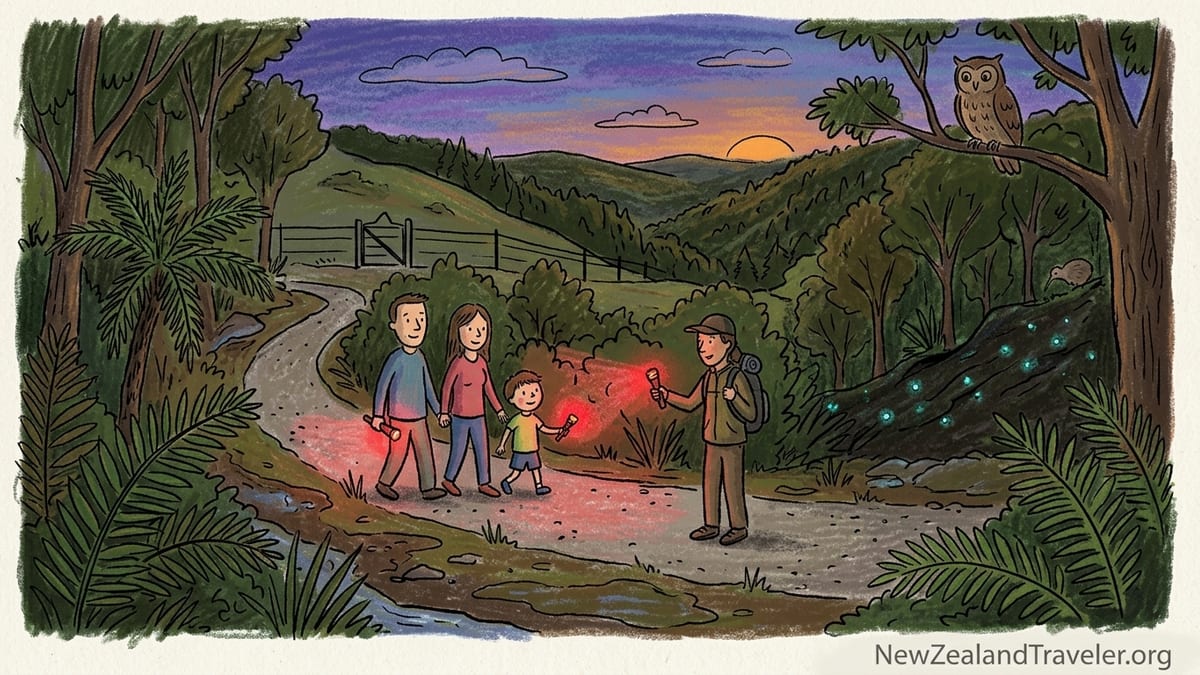
Then came the detail that shapes the whole experience: the torches. Torches are provided, and they’re designed with red filters to reduce disturbance to wildlife and to help protect your night vision. The guide demonstrated how to angle the beam low and wide rather than sweeping it around at eye level. It sounds like a small thing, but in practice it sets the etiquette for the group. Red light makes the bush feel closer, darker, and more textured, and it forces you to slow down and look for movement rather than relying on brightness to reveal everything at once.
Walking Into Dusk: Weather, Temperature, And The First Sounds
Our start time was aligned with sunset. Zealandia by Night is scheduled to depart around dusk, and published information for third-party listings often describes it as starting about 30 minutes before sunset, with the exact time shifting through the year. That variability is part of the night-tour rhythm: in summer you can be starting late, while in winter darkness arrives earlier and so does your meet time.
Dusk in Wellington has its own personality. The city can be windy and sharp even when the day looked gentle, and the sanctuary valley can hold cool air that settles as the light drains away. I was glad I’d followed the standard advice to bring warm layers and a waterproof jacket. Even without rain, the temperature felt like it dropped once we moved away from the Visitor Centre lights and into the trees.
The first thing I noticed was not an animal at all, but a soundscape shift. Daytime Zealandia is famous for birdsong. At dusk, the chorus thins and becomes more selective. You hear single calls rather than a constant wall of sound. Footsteps on gravel become louder. Water becomes a reference point: every small stream and damp edge starts to matter, not just for scenery but as a place where nocturnal life might be active.
Our guide encouraged us to use our ears before our torches. At night, wildlife watching becomes an exercise in listening and waiting. The group naturally spaced out a little more, each person trying to keep their light low while still avoiding roots and small drop-offs. That tension between moving safely and moving quietly is, in a way, the night tour’s defining challenge.
The Track Underfoot: Where We Walked, And Why It Mattered
Zealandia has an extensive network of tracks, with current visitor materials emphasizing a large, varied system across the valley. In practice, a guided night walk does not try to “do” the whole sanctuary. Instead, it threads through lower-valley routes where the footing is more predictable and the group can stop frequently without turning the evening into a time trial.
One reason the lower valley works well for night touring is that it includes a mix of sealed and unsealed surfaces, with enough open edges, damp gullies, and vegetation transitions to make wildlife spotting plausible. Zealandia’s maps and accessibility materials show that some routes are suitable for people of all abilities, including wheelchair users and mobility scooters, while other tracks are steeper or rougher. Even if you are fully mobile, the presence of accessible routes is a good indicator of where the night tour can move smoothly as a group without constant bottlenecks.
As we walked, the guide pointed out the practical markers you might ignore during the day: where the gravel gets loose after rain, where the path narrows, where a bridge changes the acoustics. The red-filter torchlight made every texture more noticeable. Fern fronds became silhouettes. Mud patches reflected a dull, dark sheen. And when we stopped, the darkness made distance hard to read, which is exactly why guides insist on staying together.
We also crossed sections where the night tour could pause without blocking the track, which might sound trivial until you try to keep 10 or 12 people quiet and still. The guide used these “pull-over” spots to reset the group’s attention, listen for calls, and aim lights only when there was something worth looking at.
What We Actually Saw: The Honest Species List From One Night
Wildlife tours are where writers get tempted to polish reality into a guarantee. I’m not doing that here. On my Zealandia by Night walk, we did not see little spotted kiwi. The guide framed that possibility correctly from the start: kiwi are a chance, not a promise, and even in strong habitat, a shy nocturnal bird can simply choose a different patch of bush.
What we did see felt true to Zealandia’s own night-tour highlights in spirit, even if the order and drama were quieter than marketing copy suggests. We saw cave wētā in damp, sheltered spots where the torchlight picked up their long legs and stillness. They were easier to notice once the guide taught the group what to look for: the reflective glint of a body tucked into a crevice, the shape that doesn’t match leaf litter, the sudden awareness that the “empty” wall has life on it.
We also encountered glowworms, visible as small points of blue-green light in darker, moist areas. Glowworms never feel like a “big animal” sighting, but they are one of the most emotionally effective ones. They turn a bank or overhang into a night sky at ankle height. Under red light, you don’t lose your night vision, and the glow seems more pronounced as your eyes adjust.
The bird highlight of the evening was ruru, the native morepork owl. We heard a ruru call first, and only later, after a quiet pause and careful scanning, did we spot it perched and watching. It was not a long, cinematic view. It was a moment of confirmation: the shape in the branches was real, the call had a source, and the sanctuary after dark was doing what it is supposed to do.
Beyond the signature nocturnal species, the night tour also delivered smaller, more grounded observations: movement in leaf litter that never fully revealed itself, rustles that reminded me how many animals can remain unseen even when they are close. At night, “not seeing” becomes part of the story, and it’s worth saying plainly that much of the experience is inference: tracks, calls, habitat clues, and brief glimpses rather than prolonged viewing.
Did The Guide Materially Improve Wildlife Spotting?
Yes, in ways that surprised me. I’ve done enough self-guided walks to know that independence can be enjoyable, but night wildlife watching has a steep learning curve. The guide improved our odds not by magically producing animals, but by shaping our behavior: where to stop, how long to wait, which micro-habitats to scan, and when to keep the torches down entirely and listen.
The biggest difference was species literacy. Without a guide, I would have walked past multiple cave wētā locations without noticing anything. The guide’s pattern recognition, knowing the likely damp recesses and the angles that reveal legs and bodies, turned a “nothing here” moment into a clear sighting. The same applied to glowworms: I might have seen one or two by accident, but the guide knew where the conditions were consistently right.
Group management also mattered. In the wrong group, noise and impatience can erase your chances. Here, the guide set expectations early, reminded people when whispering carried, and made the pauses feel purposeful rather than awkward. With a maximum of 12 people, the tour stayed nimble enough to stop quickly when a call was heard and to let everyone cycle through a viewing position without chaos.
And then there’s the torch factor. Zealandia provides red-filter torches, and the guide actively coached how to use them. That might sound like a minor service, but it’s actually one of the most practical tools for a better night experience. Proper light discipline makes your eyes better and keeps the forest calmer. If you arrive with your own high-powered white beam and no technique, you can degrade your own experience and everyone else’s.
The Takeaway
Zealandia by Night is not a scripted wildlife show, and that’s exactly why it works. You walk into a dark sanctuary valley with a small group, guided by someone who understands the habitat and the etiquette of moving through it. The experience is as much about learning how to look as it is about what you find when you do.
If you want a guaranteed kiwi photo, this is not that product and it doesn’t pretend to be. On my tour, we did not see little spotted kiwi, and the evening was still worth it. Cave wētā and glowworms are not consolation prizes. They are part of the real nocturnal ecosystem. Hearing and then spotting ruru felt like a legitimate night-wildlife payoff, the kind that comes from patience rather than performance.
Practically, the tour is long enough to feel like an outing rather than a quick loop. Zealandia lists Zealandia by Night at around 150 minutes, and you should plan your evening around that. Dress warmer than you think you need, wear sturdy shoes, and treat the red-light torch as a tool rather than a toy. Arrive early, follow the guide’s pace, and accept that the best moments might be quiet: a pause in the dark, a call in the trees, the glow of a bank you would never notice in daylight.
For travelers deciding between a self-guided day visit and a guided night walk, my honest answer is that the guided format matters more at night than it does during the day. Darkness makes the sanctuary harder to read. A good guide doesn’t manufacture wildlife, but they do help you enter the environment in a way that gives wildlife a chance to stay visible. And sometimes, that’s the whole point of going after dark.
FAQ
Q1. How long is the Zealandia Night Tour?
Zealandia by Night is listed at approximately 150 minutes, so it’s roughly a 2.5-hour guided experience.
Q2. What does the Zealandia Night Tour cost?
Current public pricing commonly lists Zealandia by Night from NZD $120 per adult when booked through Zealandia’s official booking system, with child pricing available on some channels.
Q3. What time does the night tour start?
Start times vary through the year because the tour is scheduled around dusk and sunset. Your exact departure time is shown when you book, and it can shift seasonally.
Q4. Are kiwi guaranteed on the night tour?
No. Little spotted kiwi are a possibility, not a guarantee. On my tour we did not see kiwi, even though we searched and listened.
Q5. What wildlife is most likely to be seen at night?
Commonly highlighted nocturnal species include ruru (morepork), cave wētā, and glowworms, but sightings depend on conditions and animal behavior.
Q6. Do they provide torches?
Yes. Zealandia provides torches for the night tour, and red filters are used to help protect night vision and reduce disturbance to wildlife.
Q7. What should I wear for Zealandia by Night?
Wear sturdy walking shoes and bring warm layers plus a waterproof jacket. Even if the day feels mild, the sanctuary can cool quickly after sunset.
Q8. What is the weather policy for the night tour?
Tours can proceed in rainy or windy conditions, but Zealandia can cancel if weather is unsafe. If Zealandia cancels, their published terms indicate a full refund.
Q9. Is Zealandia by Night accessible for visitors with mobility needs?
Parts of the sanctuary have accessible routes and the Visitor Centre has accessible facilities. If you have specific mobility or accessibility requirements, Zealandia asks that you contact them in advance, especially for night tours, so accommodations can be discussed.
Q10. How big are the groups on Zealandia night tours?
Zealandia’s terms for after-hours tours state a maximum of 12 people per tour, which helps keep the walk quiet and manageable in the dark.