

Whakaari / White Island remains one of New Zealand’s most dramatic natural sights, but travel here has changed profoundly since the 2019 eruption. Today, visitors can no longer set foot on the island. Instead, scenic flights from nearby Whakatāne offer the primary way to experience this active marine volcano, circling its steaming crater from the air before returning along the Bay of Plenty coastline. For travellers who remember old brochures advertising walking tours on the crater floor, it is important to understand the new reality, what is possible now, and how to plan a safe, rewarding flight experience with realistic expectations.
Current Access to Whakaari / White Island
In the years before the December 2019 eruption, Whakaari / White Island was famous for guided walking tours inside the crater, reached by boat or helicopter. Those products no longer operate. New Zealand’s official tourism guidance now makes it clear that there is currently no public access to the island itself. Travellers should not expect to step ashore, walk past sulphur vents or visit the former mining ruins. Any information suggesting otherwise is out of date.
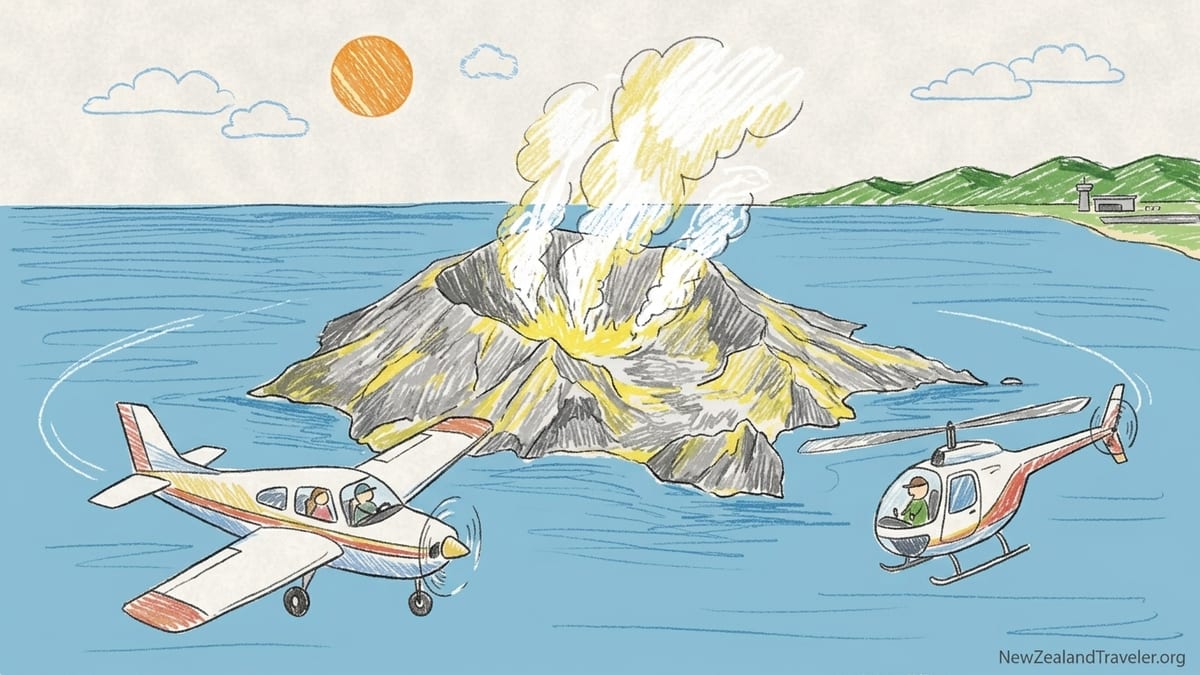
What remains possible, and officially promoted, are scenic flights that view Whakaari from the air. National tourism channels and the Whakatāne regional destination site now describe flightseeing as the way to experience the volcano, explicitly noting that visitors “cannot set foot” on the island but can still enjoy overflights in small aircraft or helicopters. For most visitors, the practical choice is to fly with an operator based at Whakatāne Airport who specialises in Whakaari and neighbouring volcanic landscapes.
Because access rules and volcanic monitoring can change, operators build up-to-date safety requirements into their briefings. Expect to hear a clear explanation of why landings are not offered, how close the aircraft can approach under current aviation guidance, and what contingency plans exist if volcanic activity or weather mean the pilot must remain further offshore. This emphasis on transparency is part of the post-2019 safety culture around the island.
It is also worth noting that Whakaari is privately owned and uninhabited. The combination of private land status, ongoing criminal proceedings that followed the 2019 tragedy, and updated risk assessments has effectively removed public landings from the tourism landscape for the foreseeable future. When you book a “White Island tour” today, you are booking an aerial experience, not a landing, no matter how nostalgic older reviews or photos may look.
Who Operates Scenic Flights from Whakatāne Airport
Whakatāne Airport, a small regional airport about a ten minute drive from Whakatāne town centre, is the main aviation hub for trips to Whakaari. The airport hosts scheduled services with Air Chathams and general aviation activity, alongside dedicated scenic flight providers. Local tourism information lists White Island Flights and helicopter operators such as Kahu NZ as key names associated with flights around Whakaari and the Eastern Bay of Plenty coastline. These companies have long histories in the region and are familiar with the unique conditions over the volcano.
One of the most visible brands for fixed-wing tours is White Island Flights. Marketing materials highlight Whakaari as their signature product, with departures from the Whakatāne Airport terminal building and flight paths that typically include Moutohorā / Whale Island and sweeping views of Ohope Beach and the mainland hills before circling the volcano. On many booking platforms, you will see offerings such as a one hour Whakaari / White Island scenic flight priced in the region of several hundred New Zealand dollars per person, reflecting both the aircraft costs and the specialist nature of the experience.
Helicopter companies based at or operating from Whakatāne Airport provide an alternative format, often under brands associated with “Kahu” or similar names. Their flights may be shorter but more agile, with the ability to hover and reposition more precisely around features like the crater lake, gas plumes and eroded lava domes. Pricing for helicopter flights is usually higher per person than for small plane tours, particularly if you charter the entire aircraft, but many travellers value the open views and the sense of hovering in place while they photograph.
In addition to Whakatāne-based operators, there are regional aviation companies in Tauranga and elsewhere that advertise scenic flights to or over White Island, sometimes as part of longer volcanic circuits that include Mt Tarawera or Mt Ruapehu. These tend to appeal to travellers already staying in larger centres but come at a premium, with extra flight time spent reaching and returning from Whakaari. For most visitors who have intentionally based themselves in Whakatāne, a locally operated flight departing from Whakatāne Airport will be the most straightforward and cost-effective option.
Comparing Aircraft Types and Flight Formats
When you search for Whakaari scenic flights, you will typically be choosing between small fixed-wing aircraft and helicopters. Fixed-wing flights are commonly operated in four to ten seat light aircraft with high wings, which provide good downward visibility. Seats are usually in pairs, but the aircraft are narrow enough that even passengers on the “wrong” side can still see the island as the pilot circles in both directions. These flights generally offer the best value per minute in the air, and are well suited to travellers who are more budget conscious or prefer a gentler flying style.
Helicopters, often configured for four to six passengers, deliver a more immersive and flexible experience. Pilots can slow to a hover, climb and descend quickly to give better perspectives on steaming vents and crater walls, and adjust position to account for wind and sun. Many helicopters used in scenic operations feature large bubble windows or door-off options on special photography departures, significantly enhancing views. The trade-off is price: per-person costs can be notably higher, especially on private charters where you are booking the whole helicopter rather than sharing with others.
A third variation you may encounter is the “combo” scenic flight, where Whakaari is one highlight among several. An example would be a 90 minute flight that departs Whakatāne, tracks along Ohope Beach and the East Cape, circles Mt Hikurangi or Mt Tarawera, and then finishes with multiple orbits around White Island before returning to the airport. These longer circuits offer a broader sense of the Bay of Plenty’s volcanic story and can be good value for photographers who want varied landscapes in a single outing.
Whichever format you choose, it is useful to ask in advance about seating arrangements, whether weight limits might affect where you sit, and how the operator handles balancing views between sides of the aircraft. Reputable companies are accustomed to rotating the aircraft so both sides see the crater equally and will explain how they plan to maximise visibility for everyone on board.
Weather, Cancellations and Safety Considerations
Whakaari sits about 48 kilometres offshore, and weather over the island can differ markedly from conditions on the mainland. Even on apparently fine days in Whakatāne, low cloud, coastal fog or strong winds around the volcano can make sightseeing unsafe or unrewarding. Local guidance and operator booking pages emphasise that all flights are weather dependent and may be delayed, rerouted or cancelled at short notice if pilots are not confident of safe visibility and smooth conditions.
In practice, this means that morning flights are often preferred, when the air is typically calmer and visibility sharper. However, sea breezes can pick up as the day progresses, and in some seasons afternoon flights may be clearer if early fog needs time to burn off. Operators keep close watch on aviation forecasts specific to the marine area around Whakaari, and will often make a go or no-go call an hour or two before departure. Travellers should build flexibility into their Whakatāne stay, ideally allowing a backup morning or afternoon to rebook if their first choice is cancelled.
Safety is governed not only by weather but also by current volcanic monitoring. Whakaari has remained active since the 2019 eruption, with intermittent ash emissions and changing gas levels. Civil aviation rules and internal company protocols require pilots to keep defined horizontal and vertical distances from the crater based on the current alert level. On some days flights may need to circle further back from the island than on others. When booking, it is wise to choose operators who speak openly about these restrictions and how they prioritise safety over getting slightly closer for a photograph.
If your flight is cancelled outright due to weather or volcanic conditions, most operators offer a choice between rebooking and a refund. Policies vary, so read the terms carefully. A common pattern is full refunds for operator-initiated cancellations and partial or no refunds for last-minute customer cancellations on flyable days. Travel insurance that covers weather-related activity cancellations can be useful, particularly if you are travelling in shoulder seasons when unsettled conditions are more common.
Private vs Shared Departures and Practical Logistics
Most visitors will book shared scenic flights, joining other travellers on a scheduled departure time that runs whenever minimum numbers are met. For example, a Whakaari fixed-wing flight may require three or four paying passengers to go ahead at the advertised rate. If you are travelling as a couple, you might be paired with another pair who book the same time. Shared flights keep prices reasonable and provide a social element, with fellow passengers trading photo tips and reactions during the flight.
Private departures, where you charter the entire aircraft, are available from many Whakatāne operators and can be worthwhile for small groups, photographers, or anyone with specific timing needs. A family of four might find that paying a slightly higher per person rate secures them a dedicated departure, control over seating allocation and more flexibility about circling patterns around the island. Specialist photography charters may involve custom routes, slower orbits and door-off configurations in helicopters, typically priced on an hourly aircraft rate rather than per seat.
Hotel pickup is another aspect to consider. Whakatāne is compact, and the airport lies roughly ten minutes’ drive from central motels and waterfront accommodation. Some operators offer complimentary transfers from selected hotels at set times, while others expect you to arrange your own transport via taxi or local shuttle. If you are arriving on a morning Air Chathams service from Auckland and hoping to connect directly into a scenic flight, discuss this with the operator in advance. They can advise on realistic turnaround times and whether they are comfortable holding a departure if your inbound flight is slightly late.
Check-in procedures at Whakatāne Airport for scenic flights are usually straightforward but time sensitive. Operators often ask guests to arrive 30 minutes before departure to complete safety briefings, weigh passengers and bags, and seat everyone according to weight and balance requirements. Bringing only essential items that you can stow securely, such as a camera, extra battery and a light jacket, helps speed up this process. Large daypacks and loose hats are often left on the ground to avoid cabin clutter and the risk of objects interfering with controls.
Photography Tips for Capturing Whakaari from the Air
Photographing an active volcano from a small aircraft is a rare opportunity, but it can also be technically challenging. The combination of vibration, reflections from aircraft windows and fast-changing light over water demands some preparation. A mid-range zoom lens, such as a 24–70 mm or 24–105 mm on a full-frame camera, is ideal for fixed-wing flights, allowing you to frame both wide crater shots and tighter details of fumaroles without constantly changing lenses. On helicopters, slightly wider focal lengths can be useful if you are sitting close to a bubble window.
Shutter speed is your friend. To counter vibration and the movement of the aircraft, aim for speeds of at least 1/1000 second if possible, especially when shooting at the longer end of your zoom. Set your camera to aperture priority with a moderately wide aperture, such as f/4 or f/5.6, and increase ISO as needed to keep shutter speeds high. For travellers relying on smartphones, use burst mode as the aircraft circles, then later select the sharpest frames. Consider wiping the inside of your window with a clean cloth before take-off if the crew permit it, and hold the lens close to the glass without touching it to reduce reflections.
Timing matters as much as settings. Morning flights often give softer, angled light that sculpts the crater walls and reveals textures in ash slopes, while reducing glare on the surrounding sea. Late afternoon departures can produce warm, golden tones but may also result in strong contrast between bright steam plumes and shaded interior features. When you book, ask the operator which departures typically deliver the best photographic conditions at the time of year you are visiting. Their pilots see the island daily and can offer practical advice grounded in current conditions.
Be realistic about the limits of what you can see and shoot. Safety rules may keep you higher or further back from the crater than older photos on the internet suggest, particularly when gas emissions are heavy or the volcano is at an elevated alert level. Instead of chasing a single postcard-style shot, aim to tell a broader story: the approach across the Bay of Plenty, the contrast between the green mainland and the stark ash slopes, and the way plumes of steam drift downwind. Shots looking back toward Whakatāne and Ohope Beach as you return can be just as memorable as close-ups of the crater itself.
Planning Your Visit to Whakatāne Around a Flight
Given the volatility of both weather and volcanic conditions, it is sensible to make Whakaari flights the centrepiece of at least one full day in Whakatāne, rather than something you attempt to squeeze between long drives. Many travellers opt for a two night stay, arriving in the afternoon, flying the next morning, and keeping the second afternoon as a backup slot in case the first attempt is cancelled. If conditions cooperate on your first attempt, you are free to spend the rest of your time exploring local walks, Ohope Beach or the town’s cultural sites.
Whakatāne offers a range of accommodation within a short drive of the airport, from simple motels along The Strand to family-run lodges near Ohope. When you book, mention that you are planning a scenic flight, as staff are often familiar with operator pickup routines and can suggest reliable local transport if needed. Some properties keep an eye on daily conditions and can pass on informal updates about sea fog or wind, which can help you anticipate whether your flight is likely to proceed.
Price-wise, you can expect Whakaari scenic flights to sit at the premium end of Bay of Plenty activities. A couple booking a shared fixed-wing flight might budget several hundred New Zealand dollars each, while private charters and helicopter experiences can climb from there, especially on weekends and during peak holiday periods. Booking in advance is advisable in summer and school holidays, but last-minute seats sometimes open up when small groups do not quite fill an aircraft. Keeping your schedule flexible and staying in regular contact with operators gives you the best chance of securing a window in good conditions.
Finally, be mindful that some visitors to Whakatāne have personal or emotional connections to the 2019 eruption. Memorials and commemorative references around town acknowledge the tragedy and those who lost their lives. Approaching your flight with a sense of respect, and recognising that Whakaari is both a powerful natural spectacle and a site of contemporary loss, aligns with the way local communities and operators now frame the experience.
The Takeaway
Visiting Whakaari / White Island today is a very different experience from the pre-2019 era of crater walks and boat landings. With all on-land tours currently suspended, the realistic way to encounter this restless marine volcano is from the air, on a scenic flight that departs from nearby Whakatāne Airport and circles safely above the steaming crater. For travellers willing to embrace this updated reality, the rewards are still considerable: sweeping views of the Bay of Plenty coastline, a vivid sense of the island’s raw geology, and a deeper appreciation of how closely New Zealand lives with its volcanic landscape.
Success comes from planning carefully around weather and safety constraints, choosing an operator and aircraft type that match your priorities, and arriving with realistic expectations about what you will see and photograph. Whether you opt for a value-focused fixed-wing flight or a more flexible helicopter charter, it pays to allow extra time in Whakatāne, keep your schedule flexible, and treat any cancellation as a sign of a company putting safety first. In return, you gain an experience that is current, respectful and firmly grounded in the post-2019 context.
For photographers, the combination of careful camera settings, smart seat choices and a willingness to adapt to light and volcanic conditions will deliver images that go far beyond the standard postcard view. For everyone, the memory of circling over an active crater, watching plumes of steam twist into the sky above a cobalt sea, is likely to stay with you long after you have landed back at Whakatāne’s small coastal airport.
Whakaari remains dynamic, both geologically and in how it is managed. By focusing on scenic flights that respect the current restrictions, travellers can still connect with this extraordinary place, support local aviation businesses and engage with the region’s evolving story in a way that is both responsible and rewarding.
FAQ
Q1. Can I currently land on Whakaari / White Island as a tourist?
At present, on-land tourist tours to Whakaari are not operating. Visitors experience the island via scenic flights only, viewing the crater from the air without landing.
Q2. Where do Whakaari scenic flights depart from?
Most flights depart from Whakatāne Airport, a small regional airport about ten minutes’ drive from central Whakatāne. Some operators in other cities offer longer itineraries that include overflights of the island.
Q3. How long does a typical Whakaari scenic flight take?
Standard flights from Whakatāne usually last around one hour, including the transit out to the island, multiple circuits around the crater area and the return along the coast.
Q4. Are scenic flights to Whakaari safe given the volcano is still active?
Flights operate under strict aviation and volcanic monitoring guidelines. Pilots must maintain set distances from the crater and will cancel or alter routes if conditions are not considered safe.
Q5. What is the difference between a fixed-wing and a helicopter flight?
Fixed-wing flights are usually better value and offer stable, high-wing views, while helicopters are more agile, can hover for photos and may offer door-off options on special charters at a higher cost.
Q6. How likely is my flight to be cancelled because of weather?
Weather over the island can change quickly, and cancellations are not uncommon, especially in unsettled seasons. Operators monitor marine forecasts closely and typically make final decisions a few hours before departure.
Q7. Can I book a private photography charter over Whakaari?
Yes. Several operators offer private charters where you book the entire aircraft, specify timing and request slower orbits or particular angles tailored to photography needs, subject to safety and conditions.
Q8. Do operators provide hotel pickup in Whakatāne?
Some companies offer pickups from selected central hotels or motels, while others expect guests to arrange their own transport to Whakatāne Airport. It is important to confirm this when booking.
Q9. What camera gear is recommended for a Whakaari flight?
A mid-range zoom lens on a DSLR or mirrorless camera, or a recent smartphone used in burst mode, works well. Fast shutter speeds and careful positioning near the window help reduce blur and reflections.
Q10. How far in advance should I book a scenic flight?
In peak summer and school holidays, booking several weeks ahead is sensible. At quieter times, a few days’ notice is often enough, but flexibility in your schedule remains important in case of weather changes.