


Arriving in the Bay of Plenty with your own set of wheels is one of the easiest ways to unlock Tauranga, Mount Maunganui and the coast through to Whakatāne. Tauranga Airport is a compact regional hub, but it punches above its weight when it comes to on-site rental choice, making it a natural starting point for a Bay of Plenty self-drive holiday or business trip.
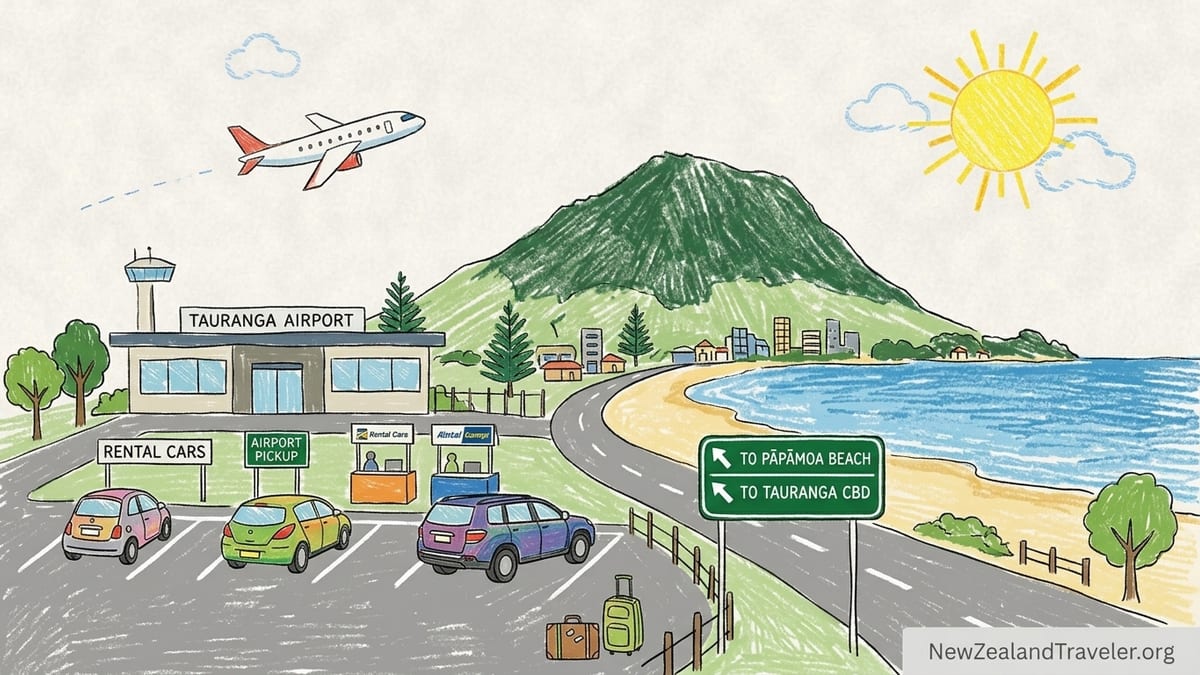
Why Start Your Bay of Plenty Road Trip at Tauranga Airport
Tauranga Airport sits on the edge of Mount Maunganui, just a short drive from the beach and around 10 to 15 minutes from central Tauranga in light traffic. For most visitors who are flying in from Auckland, Wellington or Christchurch, picking up a hire car directly at the terminal is the most time-efficient way to get moving. Flights are typically short and frequent, so it is quite realistic to arrive on a mid-morning service and be driving toward Pāpāmoa Beach or the Tauranga CBD by late morning.
The airport has seven on-site car rental operators with counters inside the arrivals area, so you can walk off your flight, collect your luggage and step straight up to your chosen brand without a shuttle transfer. Operators commonly include well-known national brands such as Budget, Avis, Hertz, Thrifty, Ezi and similar competitors, covering everything from compact hatchbacks to family SUVs. Because these companies compete directly in a small terminal, prices are often competitive and there are frequent weekend or off-peak deals.
For a typical visitor arriving in the Bay of Plenty for three to five days, airport pickup is usually the smoothest option. A compact car might cost somewhere in the region of NZD 60 to 90 per day in shoulder seasons, with SUVs higher, although prices move significantly with school holidays, public holidays and major events in Mount Maunganui. Booking ahead is sensible if you plan to travel around busy periods such as Christmas and New Year, or when cruise ships are in port and day-trippers snap up extra vehicles.
Because Tauranga Airport is relatively small, rental car returns are also straightforward. Most operators use the car park immediately outside the terminal, with clearly marked signed bays for each brand. If you are leaving on an early morning flight, the close proximity between the forecourt and the departure area makes it realistic to drop your car, walk a few dozen metres and be at check-in within minutes.
On-site Tauranga Airport Car Hire: Counters, Fleet and Opening Hours
Inside the arrivals hall you will usually find the rental counters grouped along one wall, with branding clearly visible as you exit the baggage carousel. Most national companies align their desk hours with the main flight schedule, opening before the first departures and staying on until the last evening arrivals. Late-night pickups are sometimes available by pre-arrangement and may incur a fee, so if you are on a last-flight-of-the-day schedule, it is worth confirming your arrival time when you book.
Fleet choice runs from small economy hatchbacks similar to a Toyota Yaris or Kia Rio through to mid-size sedans such as a Toyota Corolla, compact SUVs in the RAV4 class and larger seven-seat SUVs or people-movers. For couples staying mostly in Tauranga or Mount Maunganui, a compact or mid-size car is usually sufficient. Families or groups planning to surf, carry golf clubs, or road trip around the wider Bay of Plenty may appreciate the extra boot space and height of an SUV.
Many companies also offer all-wheel-drive or higher-clearance vehicles, which can be useful if you are heading inland over the Kaimai Range toward Waikato or down to Rotorua and the central North Island, especially in winter when weather is more changeable. However, for the standard Pāpāmoa to Whakatāne coastal stretch, the roads are sealed and generally well maintained, so two-wheel-drive cars manage perfectly well.
Because Tauranga Airport is a regional hub rather than a massive international gateway, car stocks can be limited during peak travel moments. If you have specific needs, such as a child seat, a guaranteed SUV, or a vehicle suitable for carrying sports gear, it is wise to add those requests at the time of booking instead of leaving them until you arrive at the counter.
City Pickups and Auckland-origin Rentals into Tauranga
Not every traveler arrives in Tauranga by air. If you are already in town for work or staying with friends, picking up a car from a city depot can be convenient. Major rental brands operate from central Tauranga locations and in or near Mount Maunganui, often on Maunganui Road or near key shopping areas like Bayfair. City depots can be handy if you only need a car for a day trip, such as a spur-of-the-moment drive to Waihī Beach or Rotorua, or if you prefer to avoid paying for parking while you are mainly walking around town.
Another popular pattern is to arrive in New Zealand through Auckland Airport, spend a couple of days there, then drive down to Tauranga and continue exploring the Bay of Plenty by car. In this case, a one-way hire from Auckland to Tauranga or Whakatāne is straightforward with most major national brands. You might collect a mid-size SUV near Auckland Airport, drive down via the Hobbiton Movie Set or the Karangahake Gorge, spend several days based at Mount Maunganui and then drop the vehicle at Tauranga Airport before flying onward.
One-way fees between Auckland and Tauranga can vary widely. Sometimes they are waived entirely during low-demand periods or when rental companies are trying to move fleet between regions; at other times a one-way surcharge could easily add NZD 100 to 200 or more to your rental. When you compare quotes, calculate your total cost including any relocation fees so you can decide whether it is cheaper to do a loop back to Auckland or finish your trip in Tauranga.
If you are basing yourself in Auckland for a week and only want a short break in the Bay of Plenty, some travelers choose to drive from Auckland, spend two or three nights at Mount Maunganui or Pāpāmoa, then return the same car to Auckland. The trade-off here is the extra driving time of roughly three to four hours each way, but you avoid one-way fees and the complexity of connecting flights.
Compact Car vs SUV: What Works Best in the Bay of Plenty
Deciding between a compact car and an SUV is one of the most common rental questions for the Bay of Plenty. The region has a mix of urban streets, coastal highways and gently winding roads through orchards and farmland. Most routes are sealed, two-lane roads, and there is no requirement for four-wheel drive for typical visitor itineraries such as Tauranga to Waihī, Tauranga to Whakatāne or Tauranga to Rotorua.
Compact cars are ideal if you plan to spend most of your time around Tauranga, Mount Maunganui and Pāpāmoa, with perhaps a single day trip to Waihī Beach or Rotorua. They are usually cheaper to rent and more economical at the fuel pump. Navigating tight beachside streets, supermarket car parks and city centre paid-parking zones can be less stressful in a smaller vehicle. If you are a solo traveler or a couple with two suitcases, an economy or compact class car will likely feel sufficient.
An SUV becomes more compelling if you are traveling as a family, carrying surfboards or bulky luggage, or driving longer distances across the North Island. The added ground clearance can be reassuring on rural side roads and unsealed access tracks to holiday parks or viewpoints. In wet or windy conditions, the slightly heavier feel and higher ride of an SUV can also make some drivers more comfortable, especially on sections of road that skirt the coast between Pāpāmoa and Whakatāne.
For a week-long circuit that includes Tauranga, Mount Maunganui, Pāpāmoa, Waihī Beach and Whakatāne with three or four people on board, a compact or mid-size SUV offers a good balance of space and running costs. If your plans are limited to the Mount and short hops around the city, the extra cost of an SUV might not deliver significant benefits beyond carrying capacity.
Parking in Tauranga, Mount Maunganui and Coastal Towns
Parking rules differ noticeably between Tauranga’s city centre and the beach suburbs. In central Tauranga, the council operates a mix of on-street paid parking and off-street car parks and parking buildings. Hourly rates in the core streets are typically a few dollars per hour on weekdays during business hours, with a higher rate once you stay longer than two hours, and capped daily prices in car parks and parking buildings. Even in the most central locations, daily charges often remain in single or low double digits in New Zealand dollars, which is relatively moderate compared with larger international cities.
Mount Maunganui, by contrast, still has a high proportion of free parking at the time of writing, especially around residential streets and some sections close to the beach. Time limits apply in some of the busiest spots to encourage turnover, and during peak summer days it can still be challenging to find a space near the Mount Maunganui Main Beach or at the base of Mauao. Locals often recommend arriving before mid-morning on sunny weekends or public holidays if you want to park close to the sand, or being prepared to walk 5 to 10 minutes from quieter side streets.
Private and commercial car parks also operate around Mount Maunganui and Tauranga, including at some shopping centres and near popular dining precincts. These run on a mix of ticket machines and app-based payment, including platforms that allow you to start and stop sessions on your phone. If you are staying in a central hotel or apartment, always check whether on-site parking is included, and whether it is secure covered parking or outdoor street parking. Factoring in parking charges can influence whether a larger SUV is practical or whether a smaller car is easier to tuck into compact bays.
Further along the coast at Waihī Beach, Pukehina or Ōhope near Whakatāne, parking is generally easier and still largely free, though you should keep an eye out for signed time limits, loading zones and mobility spaces near the beach reserves and town centres. During peak summer holidays these smaller towns can still feel busy, but you are unlikely to face the same parking pressure as at Mount Maunganui’s most famous beachfront streets.
Is a Car Worthwhile for Mount Maunganui Only?
If your plans are tightly focused on Mount Maunganui itself, you might wonder whether a rental car is worth the hassle. The Mount is compact and very walkable, with the beach, cafes, Mauao walking tracks and much of the accommodation all within a relatively small radius. In high summer, some visitors happily spend three or four days on foot, only using taxis, rideshares or local buses if they need to head into Tauranga’s CBD or to the airport.
For a short break of two or three nights where you plan to relax on the beach, climb Mauao, eat at local restaurants and perhaps visit Bayfair Shopping Centre, you can realistically manage without a car, especially if your accommodation is a short taxi ride from Tauranga Airport. This arrangement works particularly well for solo travelers or couples who prefer not to drive on holiday or who are unfamiliar with driving on the left.
However, once you add even one or two day trips, a rental car starts to feel more worthwhile. A half-day drive to Pāpāmoa Beach or a winery, an inland excursion to McLaren Falls Park, or an afternoon exploring Tauranga’s waterfront and shopping areas all become simpler with your own vehicle. Families with children often value the flexibility to carry beach gear, snacks and changes of clothes without relying on public transport timetables.
In practice, many visitors choose a hybrid approach: they pick up a compact car at Tauranga Airport for just part of their stay. For example, you might spend two car-free days at Mount Maunganui at the start of your trip, then collect a hire car from a nearby city depot for a one- or two-day coastal drive before returning it and flying out.
When a Car Really Pays Off: Pāpāmoa – Waihī – Whakatāne and Beyond
The moment your plans extend beyond Mount Maunganui to include the wider Bay of Plenty coast, a hire car moves from a nice-to-have to almost essential. Public transport between smaller coastal settlements is limited, and while shuttles and tours exist for some specific activities, they rarely cover the full range of beaches, cafes and scenic stops you are likely to want.
For example, driving from Mount Maunganui to Waihī Beach along the coast lets you stop in Pāpāmoa for a beach walk or coffee, then continue via Te Puke kiwifruit country and the historic mining area near Waihī. Along the way you can divert into local reserves, pull over for unplanned viewpoints, or linger at a roadside berry farm or orchard shop. With a car, this becomes an easy day trip; without one, the logistics involve multiple bus legs or expensive private transfers.
Similarly, a road trip from Tauranga or Mount Maunganui to Whakatāne is one of the most scenic drives in the region. The route passes through Pāpāmoa, rolling farmland and coastal stretches before dropping into Whakatāne township, where you can explore the riverfront, visit Ōhope Beach, or join boat tours when available. Stirring all of that into a single day is only realistic with your own vehicle. Many travelers choose to stay overnight in Whakatāne or Ōhope, using their rental car to carry supplies and explore side roads in their own time.
Once you have a car, it also opens up cross-country links from the Bay of Plenty, including Tauranga to Rotorua for geothermal attractions, or Tauranga to the Coromandel Peninsula via the Karangahake Gorge. For these multi-stop itineraries, booking a rental at Tauranga Airport that you can later return in Rotorua, Auckland or even Wellington can make your route much more efficient.
Insurance, Fuel and One-way Rentals: Keeping Costs Under Control
Rental car insurance in New Zealand usually starts with a standard excess, which can be relatively high compared with the daily rate. At Tauranga Airport counters, the agent will normally offer you optional excess-reduction cover that significantly lowers your liability in the event of damage or theft. This add-on can roughly double the base daily rate in some cases, so it is important to examine whether it is included or excluded when comparing online deals.
Some travelers prefer to accept the standard excess and rely on a standalone rental car insurance policy or a credit card that includes rental car coverage, but these often come with conditions such as the need to pay the rental company first and claim later. If you do choose the rental company’s own full cover, it can simplify the process if something goes wrong, though you should still read the fine print regarding windscreens, tyres and single-vehicle accidents.
Fuel costs are another factor. Petrol prices in New Zealand tend to fluctuate and can be higher in smaller coastal towns. Compact cars generally use less fuel, which becomes noticeable on longer itineraries. An economy hatchback doing a loop from Tauranga to Waihī, then down to Whakatāne and back might use significantly less fuel than a large SUV on the same route. If you are renting a vehicle for one or two weeks, selecting a fuel-efficient model can free up budget for activities or dining.
As noted earlier, one-way rentals between cities such as Auckland and Tauranga, or between Tauranga and Rotorua or Wellington, can carry relocation fees. These fees are not always obvious in the headline daily rate, so ensure your quote shows the full cost. Occasionally, you may find promotional relocation deals where the rental company needs vehicles moved, effectively turning a one-way trip across the North Island into a very good-value road adventure.
The Takeaway
Tauranga Airport is one of the most convenient gateways to the Bay of Plenty, and its cluster of seven on-site rental car operators makes it a practical place to start a self-drive exploration of the region. For a purely Mount Maunganui-focused escape, you can get away without a car, especially for short stays, but the moment you add Waihī Beach, Pāpāmoa, McLaren Falls, Rotorua or Whakatāne into the mix, having your own vehicle makes the trip significantly more flexible and rewarding.
Choosing between a compact car and an SUV comes down to group size, luggage, and how far you plan to roam. Compact cars are cost-effective and easy to park, while SUVs suit families and longer, more varied itineraries. Be mindful of parking conditions, insurance choices, fuel use and any one-way fees if you are linking Tauranga with Auckland or other North Island hubs.
Whether you are rolling your suitcase across the small Tauranga Airport forecourt to your waiting hatchback or loading surfboards into the back of an SUV outside a Mount Maunganui apartment, the right rental car can turn the Bay of Plenty into an easy, scenic and memorable open-road adventure.
FAQ
Q1. Do I need to book a Tauranga Airport rental car in advance?
It is strongly recommended, especially in school holidays, long weekends and the summer peak, when on-site fleets can sell out or choice becomes limited.
Q2. How far is Tauranga Airport from Mount Maunganui and Tauranga city?
Tauranga Airport is only a few minutes’ drive from Mount Maunganui and roughly 10 to 15 minutes from central Tauranga in typical traffic conditions.
Q3. Is parking free at Mount Maunganui?
Many streets around Mount Maunganui still offer free parking, although time limits apply in busy areas and finding a space can be challenging on peak beach days.
Q4. Is a compact car enough for a Bay of Plenty road trip?
For couples or solo travelers staying mostly around Tauranga, the Mount and nearby beaches, a compact car is usually sufficient and more economical than an SUV.
Q5. When is an SUV worth paying extra for?
An SUV is worthwhile for families, groups with lots of luggage or sports gear, and travelers planning longer drives to Whakatāne, Rotorua or other North Island regions.
Q6. Can I do a one-way rental from Auckland to Tauranga?
Yes, many major brands allow one-way rentals between Auckland and Tauranga, though a relocation fee may apply depending on dates and vehicle type.
Q7. What kind of insurance should I choose for my Tauranga rental?
Most travelers either take the rental company’s excess-reduction cover for peace of mind or use separate rental insurance; check conditions and costs carefully before deciding.
Q8. Are there petrol stations near Tauranga Airport?
Yes, there are several service stations within a short drive of the airport and around Mount Maunganui, making it easy to refuel before returning your vehicle.
Q9. Do I need a car if I am only staying in Mount Maunganui?
If you are staying a few days and plan to relax locally, you can manage without a car using taxis and walking, but even one or two day trips make a rental more useful.
Q10. Is it easy to drive in Tauranga and along the Bay of Plenty coast?
Most visitors find driving straightforward, with sealed two-lane roads, clear signage and moderate traffic, though extra care is needed in peak holiday periods and on winding sections.