


New Zealanders have been sneaking away to the Bay of Plenty for generations, chasing long beaches, surf breaks, sunshine and relaxed coastal towns. For first-time international visitors, this stretch of North Island shoreline can be confusing on the map: Tauranga, Mount Maunganui, Pāpāmoa, Waihī Beach, Te Puke and Maketū, Whakatāne and Ōhope all blur into one long golden coast. This guide connects those dots, explains how the Bay fits between Auckland, the Coromandel and Rotorua, and highlights the beaches, waves, wildlife and Māori culture that make Te Moananui ā Toi, the Coastal Bay of Plenty, such a rewarding stop on a New Zealand itinerary.
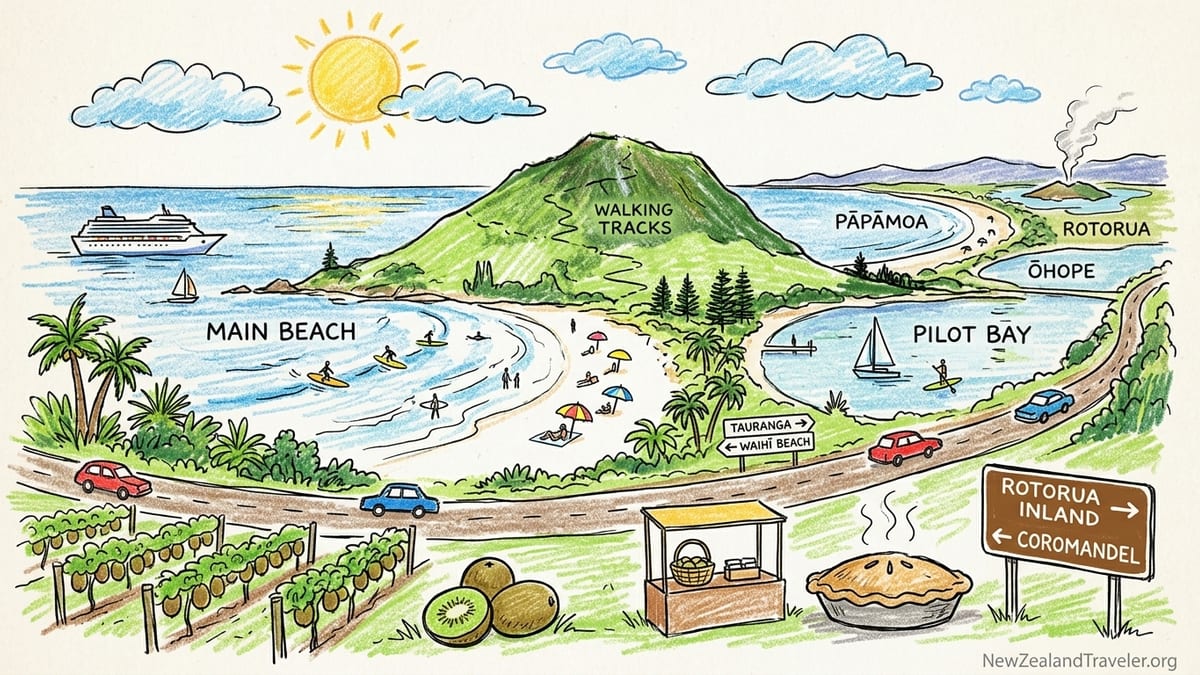
Getting Your Bearings: Where the Bay of Plenty Fits
The Bay of Plenty curves along the northern coast of New Zealand’s North Island, east of the Coromandel Peninsula and roughly south of the Bay of Islands. Tauranga is the region’s main city and practical hub. It sits about 2 hours 30 to 3 hours by car from Auckland, depending on traffic and where you start in the city, and roughly 45 to 60 minutes from Rotorua, which lies inland. Many visitors treat Tauranga and Mount Maunganui as the coastal leg of a wider loop that links Auckland, the Coromandel, the Bay of Plenty and Rotorua.
From the traveller’s point of view, you can imagine the Bay of Plenty coast as a chain running from Waihī Beach in the north, through Tauranga, Mount Maunganui and Pāpāmoa in the centre, then out to Te Puke and Maketū, and on to Whakatāne and Ōhope further east. Distances are modest: Tauranga to Waihī Beach is about 40 to 60 minutes by car, depending on which part of the beach you are heading to, while Tauranga to Whakatāne is around 1 hour 15 minutes. This makes it easy to base yourself in one spot and explore others on day trips.
The Bay of Plenty sits naturally between two of the North Island’s headline regions. To the northwest, the Coromandel Peninsula offers rugged bush walks and coves like Cathedral Cove and Hot Water Beach. Inland, Rotorua is famous for geothermal activity, lakes and Māori cultural experiences. This guide keeps Rotorua as an onward destination, focusing on the Bay of Plenty’s coastal highlights: beaches, surfing, marine wildlife, relaxed towns and kiwifruit country.
For a classic first visit, many travellers either drive from Auckland to Tauranga via State Highway 2, continue down the coast toward Whakatāne and then cut inland to Rotorua, or they come in reverse, dropping down from the Coromandel through Waihī and Waihī Beach before following the shoreline toward Mount Maunganui. Rental car companies in Auckland and Rotorua generally allow one-way hires, so you can build the Bay of Plenty into a flexible route rather than backtracking.
Tauranga & Mount Maunganui: Heart of the Bay
Tauranga is the Bay of Plenty’s commercial centre and a busy port city, but for travellers the real magnet lies across the harbour at Mount Maunganui. Known locally as “The Mount,” this beach suburb sits on a narrow peninsula beneath Mauao, a green volcanic cone that rises above a sweep of white sand. On one side is the open-ocean Main Beach, with consistent surf and a mellow boardwalk of cafés and ice-cream shops; on the other is Pilot Bay, a calmer harbour beach where families paddle and cruise ships dock in summer.
Climbing Mauao is a priority for most first-time visitors. Several tracks wind to the summit in around 30 to 60 minutes, depending on your fitness and the route. The reward is a panorama across the whole Bay of Plenty coastline, from Waihī Beach in the distance to Pāpāmoa and the long line of dunes stretching southeast. Early morning and late afternoon are especially beautiful, with soft light over the harbour and offshore islands. Access paths can change due to maintenance or slip repairs, so it is worth checking local information boards at the base or asking at your accommodation before you set out.
Mount Maunganui’s Main Beach regularly appears on lists of New Zealand’s favourite beaches, and you can see why on a summer weekend. Surfers cluster around the sandbanks near the Mount’s base, beginners book lessons through local surf schools, and families stake out spots near the surf club where lifeguards patrol in the warmer months. Board and wetsuit hire is straightforward; expect to pay a moderate hourly or half-day rate similar to other New Zealand beach towns. For those who prefer calmer water, Pilot Bay offers stand up paddleboarding rentals and sheltered swimming just a few minutes’ walk away.
Tauranga city itself is worth at least a few hours. The compact downtown on the harbour has restaurants, bars and a growing number of small galleries. Accommodation runs from waterfront hotels like Trinity Wharf to backpacker hostels aimed at younger travellers and working-holiday makers. Staying in the city suits visitors who want nightlife, harbour views and easier access to day trips by tour operator, while staying at Mount Maunganui is better if you want to walk straight from your room to the sand.
Pāpāmoa, Te Puke & Maketū: Beaches and Kiwifruit Country
South of Mount Maunganui, the sand barely breaks as it runs into Pāpāmoa, one of Tauranga’s fastest-growing suburbs. Pāpāmoa Beach feels more residential and spread out than the Mount, with clusters of cafés and supermarkets rather than a single dense strip. For visitors, it offers a quieter base while still providing easy beach access and surf. The waves here are often a little less crowded than at Main Beach, and the long, straight shoreline makes it popular with local dog walkers, joggers and families escaping the summer bustle.
Behind the dunes, Pāpāmoa Hills Regional Park offers a change of scene. From the car park a steep but rewarding track leads up to former pā (fortified village) sites. On a clear day, you can look back toward Mauao and along the Bay’s curve, with the checkerboard of kiwifruit orchards and lifestyle blocks stretching inland. Many travellers do this as a half-day outing: a morning beach swim, a mid-morning walk in the hills, then lunch at one of the suburban cafés close to Papamoa Plaza.
Drive 20 to 30 minutes southeast of Tauranga and you reach Te Puke, widely known as the kiwifruit capital. This small town is surrounded by orchards, packhouses and rural communities that power a significant part of New Zealand’s horticultural export industry. Roadside stalls in season sell trays of kiwifruit at prices often lower than city supermarkets, and several operators run orchard tours where you can walk under the vines, learn how kiwifruit are grown and packed, and sample products like kiwifruit ice cream or juice.
From Te Puke, it is a short hop to Maketū, a small coastal settlement at the edge of an estuary. Maketū has a strong Māori history and remains important to local iwi. For many New Zealanders the name is also synonymous with takeaway pies; Maketū Pie shops are a familiar sight on road trips. Grabbing a hot steak and cheese or seafood pie from a local bakery, then carrying it down to the shore to watch the estuary, is a simple but very Bay of Plenty experience. Nearby holiday parks and baches (holiday homes) make Maketū an appealing, low-key base for those seeking a slower pace.
Waihī Beach: Classic Kiwi Holiday Town
At the northern end of the Bay of Plenty coast, Waihī Beach delivers a postcard version of a New Zealand seaside town. The main settlement sits behind about 9 kilometres of sand, stretching from the village shops down to Bowentown at the harbour entrance. From Tauranga it is roughly 40 to 60 minutes’ drive, so many visitors treat it as a day trip from Mount Maunganui or as a stop on the road between the Coromandel and Tauranga.
The beach itself offers rolling waves that are friendly for beginner and intermediate surfers, with lifeguard patrols in the busier summer months. Surf schools operate during peak season, and board hire is easy to arrange through local shops near the beachfront. Inland from the sand, the town has a relaxed main street with cafés, small galleries and ice-cream stands that fill with families in January. Accommodation options range from holiday parks with cabins and camping sites to several well-established motels and a handful of boutique stays in the streets closest to the water.
Bowentown, at the southern end of Waihī Beach, feels calmer and more residential, with walking tracks to headlands overlooking Tauranga Harbour. Here you will also find marae associated with local iwi, a reminder that this coastline has deep Māori roots long predating surfboards and bach culture. A short drive inland leads to Waihī town, where the historic Martha open-cast gold mine offers guided tours explaining the area’s gold-mining past. Many travellers pair a morning mine walk with an afternoon swim back at Waihī Beach.
Waihī Beach works well as a bridge between the Coromandel Peninsula and the rest of the Bay of Plenty. Travellers driving down from Whangamatā or Whitianga often pause here for a night or two, then continue to Tauranga and Mount Maunganui. If you prefer smaller towns and plan to split your time between the Coromandel and the Bay, a few nights at Waihī Beach and a few around Mount Maunganui make a natural combination.
Whakatāne & Ōhope: Eastern Bay Wildlife and Māori Heritage
Whakatāne, about 85 kilometres southeast of Tauranga, is the main centre of the Eastern Bay of Plenty and a gateway to some of the region’s most rewarding coastal landscapes. The town hugs a river mouth backed by low hills, with a compact main street of shops and eateries. It has a reputation within New Zealand for sunshine, boating and access to offshore islands, although land-based visitor access to Whakaari / White Island remains closed following the 2019 eruption. Today, most marine trips focus on wildlife watching, fishing or scenic flights rather than landing on the island itself.
Ōhope Beach, just over the hill from Whakatāne, consistently features on lists of New Zealand’s most-loved beaches. The golden sand runs for many kilometres, with safe swimming conditions in most weather and views across Ōhiwa Harbour and out to offshore islands. In summer, the main section near the surf club can be lively with families and surf lessons; further along, you quickly find quieter stretches for walking and beachcombing. Holiday parks such as the long-established Ohope Beach Top 10 provide cabins, powered sites and simple beachfront accommodation that suit road-trippers and families.
The Eastern Bay is also a strong centre of Māori culture. In Whakatāne, the beautifully restored Mataatua Wharenui is a focal point for Ngāti Awa and offers guided experiences that explain local history, carvings and traditions. Visitors who join a tour may hear stories of the Mataatua waka (canoe) and the early settlement of the region, and gain a sense of how contemporary Māori life continues along this coast. It is respectful to book in advance, arrive on time and follow the protocols your hosts explain.
Nature lovers are drawn to the region’s marine life. Several operators run dolphin and wildlife cruises from the Bay of Plenty, with Whakatāne and Tauranga both acting as departure points depending on the season and company. Typical trips might spend half a day searching for common and bottlenose dolphins, seabirds and sometimes orca. Tours usually emphasise responsible wildlife viewing and do not guarantee sightings but enjoy good success in the summer and autumn months when conditions are settled. Serious anglers can also arrange deep-sea fishing charters targeting species like snapper and kingfish in offshore waters.
Beaches, Surfing and Marine Wildlife Experiences
Tourism marketing for the Bay of Plenty rightly leans heavily on beaches and ocean adventures. For first-time visitors, the key names to remember are Mount Maunganui Main Beach and Pilot Bay, Pāpāmoa Beach, Waihī Beach and Ōhope Beach. All offer different moods along the same spine of coast, and you can realistically swim at more than one in a single day if you have a car.
Surfing is accessible for all levels. Mount Maunganui Main Beach and Pāpāmoa are the most obvious choices for lessons, with several surf schools and rental shops close to the sand. Prices for a group beginner lesson are typically aligned with other New Zealand surf towns and can include board and wetsuit hire. Waihī Beach is another good option, especially for families who like to mix gentle surf with dune walks and time at the local playgrounds. In winter, you will still see dedicated locals in thick wetsuits enjoying the swells, even when visitors prefer to stay on shore.
For those more interested in simply being in the water, sheltered spots like Pilot Bay and parts of Ōhope are ideal. Stand up paddleboard rentals, sea kayaks and pedalo-style craft are common in peak season, and you can also join organised evening kayak trips on sheltered harbours and estuaries that highlight glowworms after dark. Lifejackets are typically provided, and basic instruction is included, so even first-timers can participate. If you are renting a car, keep an eye out for small, independently run kayak outfitters around Tauranga Harbour and Ōhiwa Harbour that may not appear prominently on generic booking sites.
Marine wildlife experiences are a major draw. Dolphin and wildlife cruises typically depart Tauranga or Whakatāne early in the morning and last four to six hours. On board, you can expect commentary about local history and ecology, chances to photograph pods of dolphins when they appear and sometimes opportunities, under the skipper’s discretion and within regulations, to enter the water alongside the animals without disturbing them. Wildlife regulations change over time, so operators adjust their practices accordingly and brief guests before any in-water activity. Seas can be choppy, especially on afternoon trips, so motion-sickness remedies are worth considering if you are prone to seasickness.
Driving, Accommodation and Practical Tips
Driving is the easiest way to connect Tauranga, Mount Maunganui, Pāpāmoa, Waihī Beach, Te Puke and Maketū, Whakatāne and Ōhope. The main coastal roads are sealed and straightforward, but they can be busy in the peak summer holiday period from late December to early February. Distances may look short on the map, but allow extra time for slow traffic near beach towns, particularly on Friday evenings and Sunday afternoons when locals are coming and going.
Most international visitors pick up a rental car in Auckland or Rotorua and follow one of two broad patterns. One is to drive from Auckland to Waihī and Waihī Beach, continue to Tauranga and Mount Maunganui, then head inland to Rotorua before looping back to Auckland. The other is to travel Auckland to Rotorua, then drive to Tauranga and along the Bay toward Whakatāne, exiting via the eastern routes. Both options give you coastal time without needing to backtrack, and both connect easily with long-distance buses if you prefer not to drive every leg.
Accommodation across the Bay of Plenty covers the full spectrum. In Tauranga and Mount Maunganui you will find modern waterfront hotels, mid-range motels, backpacker hostels and serviced apartments. Pāpāmoa, Maketū, Waihī Beach and Ōhope feature classic New Zealand holiday parks with cabins, powered and unpowered sites, as well as private baches listed on major booking platforms. Whakatāne offers motels and small hotels suited to travellers heading out on early-morning marine tours. In the peak school holiday period, it is wise to book well ahead, especially for January weekends, public holidays and Easter.
Daily costs vary, but the Bay broadly sits in line with other North Island coastal destinations. A café breakfast in Mount Maunganui or Tauranga might cost a moderate amount per person, plus coffee. Mid-range motel rooms in summer often price similarly to those in popular Coromandel or Northland beach towns, with holiday park cabins offering a more budget-friendly alternative. Fuel prices can be a little higher in smaller settlements than in Tauranga, so most travellers top up in the city before exploring further afield.
Weather in the Bay of Plenty is generally mild, with warm, sometimes humid summers and cool, damp winters. The region enjoys many sunny days, which is part of its domestic appeal, but conditions can change quickly. Even in mid-summer you will occasionally encounter strong easterly swells, wind or cloud that make swimming less appealing. Pack layers, a light rain jacket and strong sun protection; the New Zealand sun feels intense, and long days by the water can easily result in sunburn if you are not prepared.
Connecting Auckland, Coromandel and Rotorua
For first-time visitors, one of the biggest questions is how to fit the Bay of Plenty into a wider North Island trip that may also include Auckland, the Coromandel and Rotorua. A practical starting point is to consider the Bay as the coastal counterpoint to Rotorua’s geothermal and cultural focus. Rather than trying to squeeze everything into a single long day trip from Auckland, most travellers find it more satisfying to allocate at least two to three nights somewhere between Tauranga, Mount Maunganui and Waihī Beach, plus one or two nights if they also want to reach Whakatāne and Ōhope.
If you are beginning in Auckland and heading south, one logical route is to drive to the Coromandel Peninsula first for bush walks and sheltered coves, then continue via Waihī town to Waihī Beach and Tauranga. From there you can carry on to Rotorua and either loop back to Auckland via Hamilton or continue further south toward Taupō and Wellington. Another approach is to go Auckland to Rotorua, then head over to Tauranga and Mount Maunganui for a few days of beach time before returning to Auckland via Waihī Beach and the southern edge of the Coromandel.
Public transport exists but is less flexible. Intercity-style buses link Auckland, Tauranga and Rotorua on scheduled routes, and local bus networks connect Tauranga with Pāpāmoa and Te Puke. However, services along more dispersed beach settlements can be infrequent or non-existent, which is why many overseas visitors choose to rent a car or campervan for at least part of their Bay of Plenty visit. For those keen to minimise driving, basing yourself at Mount Maunganui or Tauranga and joining organised day tours to Waihī Beach, Ōhope or wildlife cruises is a workable compromise.
However you structure the route, try not to rush. The appeal of the Bay of Plenty lies far less in ticking off a list of sights than in slowing down: lingering over coffee after an early swim at Main Beach, buying fruit from a roadside stall outside Te Puke, or spending a long golden evening on the sand at Ōhope as the sun sinks behind the hills. Building in spare days allows you to shuffle beach plans if the weather turns and to respond when a local suggests a favourite fish and chip shop or a short walking track not marked on your original map.
The Takeaway
For a first-time visitor, the Bay of Plenty can look like a blur of similar sandy bays on the map. On the ground, though, each stretch of coast has its own personality. Tauranga and Mount Maunganui feel energetic and social, with busy surf, cruise ships and a skyline of cranes and harbour lights. Pāpāmoa and Maketū move slower, backed by kiwifruit orchards and holiday parks where barefoot kids wander between caravans. Waihī Beach feels like a classic family beach town linking naturally to the Coromandel, while Whakatāne and Ōhope blend sun, wildlife and Māori heritage in the Eastern Bay.
What ties these places together is the sea. Whether you are learning to surf on Mount Maunganui’s Main Beach, drifting on a stand up paddleboard at Pilot Bay, scanning the horizon for dolphins off Whakatāne or simply sitting on the dunes at Ōhope with fish and chips, you are always aware of the Pacific rolling in. Add in the orchards of Te Puke, the easy drives between towns and the proximity to Rotorua’s geothermal world inland, and the Bay of Plenty becomes a natural anchor point for any North Island journey.
Allow enough time, choose one or two bases rather than changing beds every night, and lean into the rhythm of the coast. The Bay of Plenty rewards travellers who slow down long enough to notice the way the light changes on Mauao, the calls of seabirds around Ōhiwa Harbour and the stories shared on a marae in Whakatāne. With thoughtful planning, your first visit will feel less like a rushed detour and more like the relaxed, sunlit heart of your New Zealand trip.
FAQ
Q1. How many days should I spend in the Bay of Plenty on a first visit?
Most first-time visitors find that three to five days works well, giving time for Tauranga and Mount Maunganui, at least one day trip to Waihī Beach or Ōhope, and some flexibility for weather.
Q2. Do I need a car to explore Tauranga, Mount Maunganui and nearby beaches?
You can manage without a car if you base yourself at Mount Maunganui or central Tauranga and use local buses and organised tours, but having a rental car makes it much easier to reach Pāpāmoa, Waihī Beach, Maketū, Whakatāne and Ōhope on your own schedule.
Q3. When is the best time of year to visit the Bay of Plenty for beaches and surfing?
Late spring to early autumn, roughly November to April, usually provides the warmest water and most settled weather. Peak summer from late December to early February is busiest but also has the liveliest beach atmosphere and the widest choice of surf lessons and marine tours.
Q4. Can I combine the Bay of Plenty and Rotorua in a short trip?
Yes. Many travellers spend two or three nights around Tauranga and Mount Maunganui for beaches and marine wildlife, then move inland for two or three nights in Rotorua to focus on geothermal areas and lakes. The drive between Tauranga and Rotorua is typically under an hour.
Q5. Are there safe swimming spots for children along this coast?
Yes. Pilot Bay at Mount Maunganui, parts of Ōhope Beach and sections of Waihī Beach and Pāpāmoa offer relatively gentle conditions in suitable weather. Look for surf club flags in summer, supervise children carefully and always check local advice about currents and conditions.
Q6. What are typical prices for surf lessons and accommodation?
Group beginner surf lessons at Mount Maunganui, Pāpāmoa or Waihī Beach are usually priced in line with other New Zealand surf towns, including board and wetsuit hire. Accommodation ranges from budget-friendly holiday park cabins and hostels to mid-range motels and higher-end waterfront hotels, with prices rising in peak holiday periods.
Q7. Can I still visit Whakaari / White Island from Whakatāne?
Since the 2019 eruption, land-based tours to Whakaari / White Island have not been operating for general visitors. Operators based in Whakatāne now typically focus on wildlife viewing, fishing trips and scenic flights that stay within current safety regulations rather than landing on the island.
Q8. Is the Bay of Plenty suitable for travellers without strong swimming skills?
Yes, provided you choose sheltered spots, follow safety advice and stay within your comfort zone. Beaches like Pilot Bay and some sections of Ōhope and Waihī Beach can be suitable for wading and shallow swimming in calm conditions, and there are also harbour cruises and coastal walks that do not require getting into the water.
Q9. How does the Bay of Plenty compare with the Coromandel for beaches?
The Coromandel tends to have more small coves backed by bush, while the Bay of Plenty offers longer, open stretches of sand and a slightly warmer, more settled feel. Places like Mount Maunganui Main Beach, Pāpāmoa, Waihī Beach and Ōhope offer big, walkable beaches with consistent surf and a strong local holiday culture.
Q10. Is it necessary to book activities and accommodation in advance?
Booking ahead is strongly recommended for late December, January, public holiday weekends and Easter, especially for popular holiday parks, beachfront motels, dolphin cruises and surf lessons. Outside those peak times you often have more flexibility, but it is still sensible to reserve key activities a few days in advance.