

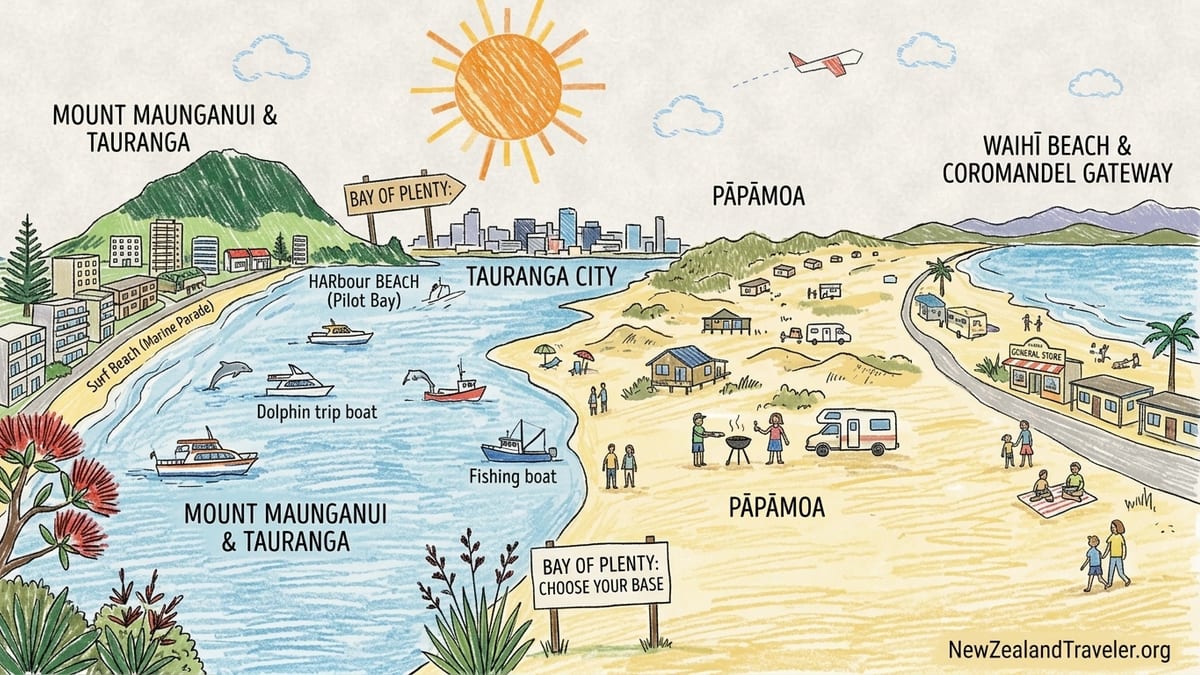
The Coastal Bay of Plenty runs from laidback Waihī Beach in the west through Tauranga, Mount Maunganui and Pāpāmoa to Whakatāne and Ōhope in the east. On a map the towns look close together, yet they deliver very different holidays once you factor in beach access, parking, restaurants, nightlife and how far you want to drive for day trips. Tourism Bay of Plenty currently lists far more accommodation around Mount Maunganui and Tauranga than in the smaller coastal settlements, so it is worth choosing your base with care instead of simply booking the first beachfront apartment that appears in your search results.
How to choose your Bay of Plenty base
Most visitors end up choosing between three main styles of stay: walkable beach life at Mount Maunganui, city hotels and value in Tauranga, or quieter family beach houses in Pāpāmoa. Further along the coast, Waihī Beach works well as a relaxed western base close to the Coromandel, while Whakatāne and Ōhope anchor the eastern end of the region with easier access to wildlife cruises and less developed stretches of sand. The drives between these hubs are short by New Zealand standards, but the feel on the ground can be surprisingly different from one town to the next.
Accommodation supply reflects this split. Around Mount Maunganui and downtown Tauranga you will find the largest concentration of hotels, motels and serviced apartments, from high-rise oceanfront suites opposite the Mount Maunganui surf beach to business hotels a block back from Tauranga’s waterfront Strand. In Pāpāmoa, Waihī Beach and Ōhope, the picture shifts toward holiday homes, classic Kiwi motels and holiday parks with powered sites and simple cabins. If you are travelling at peak times such as New Year or long weekends, that can mean booking a Mount Maunganui hotel with on-site parking months ahead, or deliberately targeting a quieter beach where there is still space at a campground a few weeks out.
Tour departures and driving time are another part of the equation. Harbour cruises, dolphin trips and fishing charters cluster around Tauranga and Mount Maunganui, while Whakatāne is the launch point for wildlife cruises towards Moutohorā Island and other eastern Bay excursions. If you plan to mix Rotorua’s geothermal sights with the coast, staying at the western end near Tauranga or Mount Maunganui keeps the drive to around 60 to 70 minutes each way rather than a much longer return from Whakatāne.
Mount Maunganui: walkable beach life and holiday buzz
Mount Maunganui, wrapped around the base of Mauao, delivers the most classic “park the car and forget about it” Bay of Plenty beach holiday. Many motels and apartments sit either on Marine Parade facing the surf beach or around Pilot Bay on the harbour side, so you can walk from your room to the sand in a couple of minutes. Options range from modern self-contained apartments with balconies overlooking the ocean to retro two-level motels a block back from the main strip. A long-established holiday park at the base of Mauao offers cabins and powered sites that are steps from both the harbour and the surf, which suits campervans and families who want to wake to the sound of waves.
Parking near the beach is relatively straightforward on a normal winter weekday but becomes competitive on sunny summer afternoons and weekends, especially close to the main cafes and the base of Mauao. Many newer apartment-style properties include at least one secure car park per unit, which is valuable if you arrive back late from a day trip to Rotorua or the Kaimai ranges and do not want to circle for street parking. If you are driving in just for the day, plan to use the longer beachfront car parks further along Marine Parade and walk ten minutes back to the cafes rather than trying to squeeze into a space right by the roundabout.
The appeal of staying here comes from having restaurants, bars and the beach all within a compact, walkable area. Around the main intersection at the base of Mauao you will find casual brunch spots, gelato bars, burger joints and smart-casual restaurants that spill onto the footpath in summer. In the evening the atmosphere is lively rather than wild, with bar patios busy on Friday and Saturday but relatively quiet during the week outside of peak season. If you do want nightlife, you can walk between several small bars and craft beer venues without needing a taxi, which makes Mount Maunganui a strong choice for couples and groups of friends who want to go out at night then stroll home along a well-lit promenade.
At the time of writing, the main walking tracks up Mauao have been subject to periodic closures after landslides, so visitors are relying more on the long, flat beach and harbour promenade for exercise and views rather than the traditional summit walk. That has not dampened demand for accommodation near the base, however, especially in late December and January when domestic visitors book beachfront apartments a year in advance. If you like a busy promenade, sunrise swimmers and a constant trickle of coffee-toting locals, this is the Bay of Plenty base that feels most like a classic New Zealand surf town in high season.
Tauranga: city hotels, parking and value for money
Staying in Tauranga itself gives you a very different experience to Mount Maunganui even though the two are only a short drive apart over the harbour bridge. Tauranga’s compact CBD lines the inner harbour, with mid-range hotels and serviced apartments a street or two back from the water. These properties tend to attract a mix of business travellers and leisure guests, so you are more likely to find year-round availability and moderate prices than at comparable standard accommodation right on the Mount Maunganui beachfront. For travellers watching their budget, a city hotel with free or low-cost parking can be noticeably cheaper than an ocean-view room.
Parking is generally easier here than at the beach. Several hotels include on-site or underground spaces, and there are public car parks and metered bays around the CBD that do not fill as quickly as the Mount’s beachfront. That makes Tauranga a practical base if you plan to drive each day to different parts of the region, such as spending one day at Waihī Beach, another at Pāpāmoa and a third on a day trip inland to Rotorua or to waterfalls in the Kaimai ranges. You can usually be on the state highway out of town within a few minutes of leaving your hotel, which keeps overall driving time down.
In terms of food and nightlife, Tauranga’s harbourfront Strand is the main focus. Here you will find a run of bars, cafes and restaurants overlooking the water, with outdoor seating busy on warm evenings. The atmosphere is more “small city” than “resort town,” with after-work crowds on weekdays and a local scene at weekends. Nightlife is livelier than in smaller coastal settlements such as Ōhope or Waihī Beach, but it rarely runs late into the early hours other than on New Year’s Eve and occasional event weekends. If you want a drink and dinner within walking distance of a modern hotel, Tauranga delivers that without the holiday-town premium you pay at the Mount.
The trade-off is that you will likely drive to the surf every day rather than wandering down barefoot. The harbourfront has pleasant walking paths and small beach areas, but the long open ocean beach belongs to Mount Maunganui and Pāpāmoa. For travellers who prioritise day trips, value and on-site parking over having sand literally across the road, Tauranga is an efficient base that still keeps you within a fifteen to twenty minute drive of some of the region’s best swimming and surf.
Pāpāmoa: quieter family beach stays
South of Mount Maunganui, Pāpāmoa stretches along a wide, dune-backed beach that feels more residential than resort. Most accommodation here is made up of holiday homes, baches and a handful of motels and holiday parks rather than high-rise hotels. Families frequently rent three or four-bedroom houses with fenced yards, barbecues and space to park a couple of cars or a boat, often at prices that compare favourably with smaller apartments right at the Mount. It is a popular choice for multi-generational trips where grandparents, parents and children all want to stay under one roof without feeling crowded.
Beach access is excellent, with a string of marked paths and boardwalks over the dunes leading to long, open sand that rarely feels busy outside peak holiday dates. A well-established holiday park beside the beach offers powered sites, cabins and access straight through the dunes, which works well for road-trippers and campervans. Parking along the coastal streets and at official beach access points is generally easier than in Mount Maunganui’s core, especially if you are staying a little further from the busiest shopping nodes.
While Pāpāmoa is quieter at night than Mount Maunganui, you will still find a growing number of cafes, restaurants and takeaways clustered around its main shopping centres. You can pick up groceries at a large supermarket, grab fish and chips to eat on the beach, or sit down for brunch without driving into Tauranga. After dark, however, entertainment is limited to local bars and casual eateries, and most visitors retreat to their rental houses or campsites. If you want live music and pub-hopping, you will likely end up taking a taxi or driving to the Mount or Tauranga.
The main trade-offs with Pāpāmoa are time and atmosphere. Driving to the base of Mauao for a harbour cruise or to meet a guided tour can take ten to twenty minutes depending on traffic, and you will be using the car more than a visitor staying directly at the Mount. In exchange, you gain a calmer, more local-feeling beach experience with easier parking, more space on the sand and good value for longer stays. For many families, that combination makes Pāpāmoa arguably the best compromise in the western Bay of Plenty.
Waihī Beach: relaxed western base near the Coromandel
Waihī Beach sits at the western edge of the Bay of Plenty region and feels like a classic Kiwi holiday town, with a single main street, a low-rise beachfront and a friendly, low-key atmosphere. The beach itself is a long curve of white sand that draws families from Auckland and Waikato over summer, yet outside of peak holiday weeks the town quickly returns to a slower rhythm. Accommodation ranges from waterfront motels and small apartments along Seaforth Road to holiday parks with cabins and powered sites, and a large number of holiday homes on quiet residential streets a few minutes’ walk from the water.
Parking is generally manageable here. Beachfront motels usually provide off-street spaces for one car per unit, and the main public car parks beside the surf club and village shops turn over frequently outside of school holidays. On hot January days the busiest sections near the surf club can feel crowded, but it is usually possible to drive a little further along the coast and find quieter access points with room to park. Many visitors choose to walk or cycle instead, particularly those staying in rentals within a couple of blocks of the sand.
The village has a compact but useful selection of cafes, a few restaurants, a supermarket and takeaways. Nightlife tends to be limited to relaxed dinners and a drink at local bars; most people are in bed soon after dark, ready for early swims and surf sessions. That makes Waihī Beach a comfortable choice for couples and families who value quiet evenings, starry skies and morning walks more than late-night entertainment. In practical terms, you can expect to cook at your accommodation more often here, so choosing a place with a decent kitchen and outdoor area can make a real difference.
As a base, Waihī Beach works particularly well if you are combining the Bay of Plenty with the Coromandel Peninsula or the Karangahake Gorge. Driving times to places like Whangamatā or the coastal walks further north are shorter from here than from Tauranga, yet you are still close enough to day trip into the city for shopping or a harbour cruise. For visitors arriving from Auckland, Waihī Beach is also one of the first true surf beaches you reach, which adds to its popularity for long weekends and short breaks.
Whakatāne and Ōhope: eastern Bay excursions and beachfront stays
On the eastern side of the Bay of Plenty, Whakatāne and nearby Ōhope Beach offer a more low-key and regionally focused alternative to Tauranga and Mount Maunganui. Whakatāne itself sits on a river and harbour where several operators run wildlife and coastal cruises, including trips that view offshore islands and local marine life. The town centre has a compact grid of streets with supermarkets, cafes, basic hotels and motels, and it is the practical base if you want to join early-morning boat tours, visit local cultural sites or stock up on supplies before heading down the East Coast.
Ōhope, a short drive over the hill, is where you come for the long, gently shelving beach and true beachfront accommodation. Here you will find a string of low to mid-rise apartment complexes, classic motels and holiday homes facing directly onto the sand, some with balconies looking out toward Moutohorā Island. Properties like small beachfront motels and apartment-style complexes offer self-contained units where you can cook your own meals, walk directly across a quiet road or dune track to the beach, and fall asleep to the sound of waves. A long-established holiday park on the harbour side provides powered sites, cabins and simple motel units close to sheltered water that is popular with young families.
Parking in both Whakatāne and Ōhope is generally easier than in Tauranga or Mount Maunganui. Town motels usually include dedicated spaces outside each unit, while beach apartments and motels at Ōhope provide at least one off-street park per room. Public parking areas at the main beach access points can fill on sunny summer afternoons, but the scale is smaller, and you are rarely more than a few minutes’ walk from the sand even when you park further away. For many travellers, that relaxed feel is a major part of the appeal; you spend more time strolling along the shore and less time circling for a space.
The dining and nightlife scene here is modest. Whakatāne offers a mix of cafes, casual restaurants and bars that cater primarily to locals, with a handful of spots along the riverfront where you can sit outside on warm evenings. Ōhope has a café or two near the main beach and small eateries attached to some accommodation complexes, but visitors often cook at their rentals or drive into Whakatāne for dinner. If your priority is easy access to tours and a quieter, more small-town New Zealand atmosphere, this corner of the Bay of Plenty is a strong choice, especially for repeat visitors who have already stayed around Tauranga in the past.
Driving, parking and tour logistics across the region
Although these towns sit along the same stretch of coast, practical details like driving time, parking and tour departures can shape which base makes the most sense. Tauranga and Mount Maunganui function as the main transport hub, with frequent intercity buses, regional flights into Tauranga Airport and the largest cluster of tour operators. Harbour cruises, dolphin and wildlife trips, fishing charters and some diving excursions typically depart from wharves around the harbour and port, which are a short drive or taxi ride from accommodation in either Tauranga’s CBD or the Mount.
If you stay in Pāpāmoa or Waihī Beach, you should expect to drive to meet most organised tours in Tauranga or Mount Maunganui and allow extra time for summer traffic and parking. Visitors based in Whakatāne will instead join wildlife and coastal cruises from the town’s riverfront, which can be more convenient if your itinerary focuses on the eastern Bay and the coastal road towards Ōpōtiki. In all cases, it pays to check the exact departure point and parking options when booking; some operators have reserved spaces or recommend nearby car parks that fill more slowly than the main waterfront areas.
Within the towns themselves, driving is generally straightforward, but congestion can build around bottlenecks such as the Tauranga–Mount Maunganui harbour bridge and key beach access roads on hot days. Many locals time their trips to the beach earlier or later in the day to avoid the busiest midday period, and visitors can do the same. Where possible, look for accommodation that lets you walk to at least some of the places you will visit most often, whether that is the Mount’s main beach and cafe strip, Pāpāmoa’s local shops or the Ōhope seafront.
Public transport exists in the form of regional buses linking Tauranga, Mount Maunganui, Pāpāmoa and surrounding suburbs, but services are designed primarily for commuters and students rather than visitors with luggage. If you plan to rely on buses rather than a car, staying close to Tauranga’s CBD or the Mount’s central area will make life easier, and you should factor in walking time between bus stops and the beach. For most travellers, especially those exploring both ends of the region from Waihī Beach to Whakatāne, having a car remains the most practical way to move between bases and reach trailheads, waterfalls and quieter sections of coast.
The Takeaway
Choosing where to stay in the Bay of Plenty is less about finding the single “best” town and more about matching the feel of each place to the holiday you want. Mount Maunganui is for those who want to step out of a beachfront apartment and be among cafes, surf and a lively promenade within a few footsteps. Tauranga works well if you value hotel comforts, easier parking and sharper room rates while still being a short drive from the beach. Pāpāmoa offers the sweet spot for many families, with relaxed residential streets, long quiet sands and good-value holiday homes that make longer stays more comfortable.
Further along the coast, Waihī Beach appeals as a peaceful western base and gateway toward the Coromandel, while Whakatāne and Ōhope deliver a slower, more small-town seaside atmosphere with strong access to wildlife cruises and less crowded beaches. Because Tourism Bay of Plenty listings lean heavily towards Mount Maunganui and Tauranga, it is easy to overlook these smaller settlements, yet they often provide exactly what repeat visitors end up seeking: space, quieter evenings and the feeling of being part of a local community rather than a resort strip.
For many itineraries, a mix of bases works best. You might spend two nights at the Mount for walkable beach life and harbour tours, then shift to Ōhope or Waihī Beach for a few slower days where driving is minimal and time on the sand stretches out. Whichever combination you choose, paying attention to parking, driving times, restaurant access and tour departure points when you book will help ensure your Bay of Plenty stay matches the holiday you pictured when you first saw that sweep of golden coastline on the map.
FAQ
Q1. Is it better to stay in Tauranga or Mount Maunganui for a first visit?
For a first coastal holiday most visitors prefer Mount Maunganui, as you can walk from many accommodations straight to the surf beach, cafes and harbour. Tauranga suits those who prioritise hotel-style comfort, parking and value, and do not mind driving to the beach.
Q2. Where should families with young children stay in the Bay of Plenty?
Families often gravitate to Pāpāmoa, Ōhope or Waihī Beach, where holiday homes, motels and holiday parks sit close to long, relatively uncrowded beaches, parking is easier and evenings are quiet. Many parents appreciate having a full kitchen and outdoor space rather than a compact hotel room.
Q3. Which area has the best nightlife?
Mount Maunganui and Tauranga have the most consistent nightlife, with small bars and restaurants around the Mount’s main strip and Tauranga’s Strand. Pāpāmoa, Waihī Beach, Whakatāne and Ōhope are much quieter after dark, with most visitors choosing relaxed dinners and early nights.
Q4. Do I need a car if I stay at Mount Maunganui?
If you plan to spend most of your time on the beach and around the local cafes, you can manage without a car, especially if you arrive by bus or shuttle. However, a car makes day trips to places like Waihī Beach, Pāpāmoa, Whakatāne or Rotorua far easier and gives you flexibility if weather changes.
Q5. Is parking difficult in summer?
Parking can be challenging at Mount Maunganui and, to a lesser extent, Tauranga on sunny summer days, particularly near the main beach and harbour. In Pāpāmoa, Waihī Beach, Whakatāne and Ōhope, parking is usually more straightforward, though key beach car parks still fill at peak times.
Q6. Where do most boat tours and cruises depart from?
Harbour cruises, dolphin trips and fishing charters typically depart from Tauranga and Mount Maunganui, while wildlife and coastal cruises in the eastern Bay often leave from Whakatāne. When choosing a base, check which town your preferred tour uses to avoid long early-morning drives.
Q7. How far is Rotorua from the Bay of Plenty beaches?
Rotorua is roughly a 60 to 70 minute drive from Tauranga or Mount Maunganui under normal conditions, making day trips feasible from the western Bay. From Whakatāne or Ōhope the drive is longer, so travellers focused on combining geothermal sights with beach time usually base themselves near Tauranga.
Q8. Are there good options for campervans and tents?
Yes. Holiday parks with powered sites and basic cabins operate at Mount Maunganui, Pāpāmoa, Waihī Beach, near Ōhope and in other parts of the region. These parks often sit very close to the beach and can sell out over peak summer, so advance bookings are strongly recommended.
Q9. Which area feels least touristy?
Ōhope, Whakatāne and, outside peak holiday weeks, Waihī Beach tend to feel more like everyday New Zealand coastal towns than resort centres. You will mostly share the beach with locals, and the dining and nightlife scene remains modest and community focused.
Q10. Can I split my stay between two bases in the Bay of Plenty?
Splitting your stay works well because driving distances are relatively short. A common approach is to spend a couple of nights at Mount Maunganui for walkable beach life and tours, then move on to Ōhope or Waihī Beach for quieter days by the sea before continuing your North Island journey.