


Tauranga and Mount Maunganui sit on opposite sides of the same harbour in New Zealand’s Bay of Plenty, only about a 10 minute drive apart, yet they offer two very different feels. Add nearby Pāpāmoa to the mix and travellers suddenly have three distinct bases to choose from: a lively surf town, a practical small city, and a quieter beachfront suburb. This guide sets them side by side so you can decide where to stay for your Bay of Plenty trip.
Tauranga vs Mount Maunganui: The Essential Difference
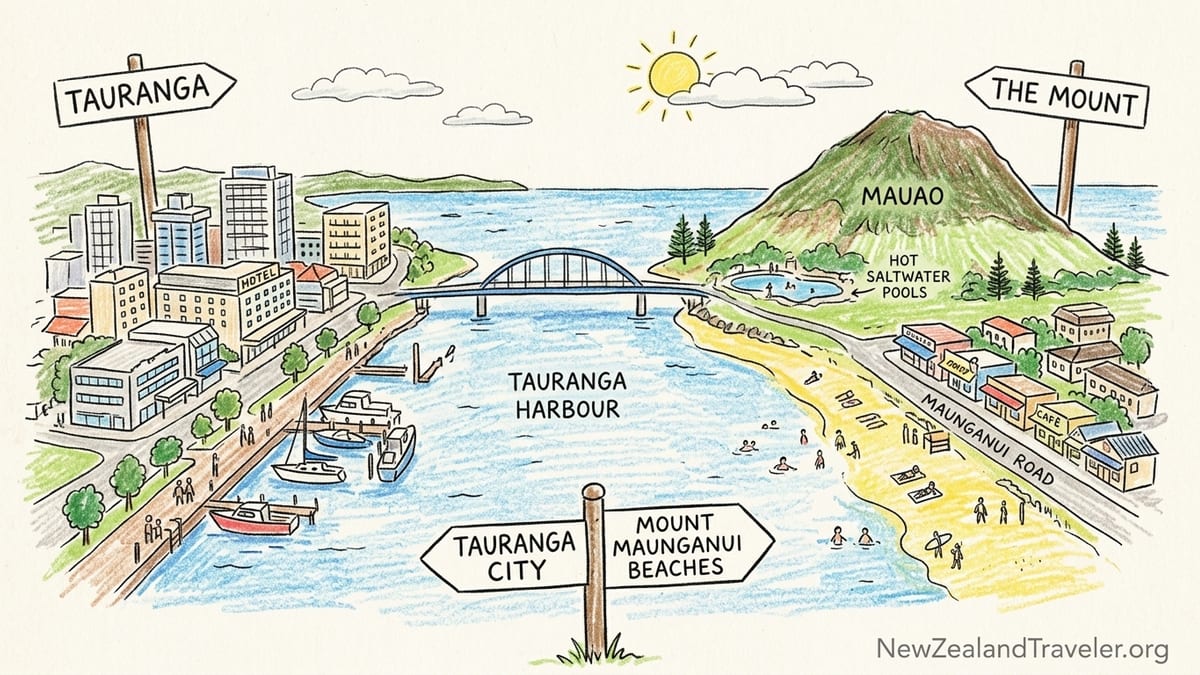
When people ask whether to stay in Tauranga or Mount Maunganui, they are really deciding between a beach town and a small city. Mount Maunganui, usually called “The Mount,” is the classic holiday strip: a long, white sand surf beach, a compact, walkable centre, and the volcanic cone of Mauao at the end of the peninsula. Tourism New Zealand describes it as a relaxed beach town just 10 minutes from Tauranga, which is exactly how it feels once you arrive.
Tauranga, by contrast, is the region’s main city and commercial hub. It has apartment hotels and motels spread across the CBD and suburbs, a revitalised harbourfront promenade, and easy road access for day trips inland to Rotorua or along the Bay of Plenty coast. You will not step out of your hotel room straight onto a surf beach, but you will find supermarkets, chain hotels, and more consistently lower room rates, especially outside peak summer.
The two are close enough that your choice is really about your default setting. A couple staying at The Mount can still drive over the harbour bridge into Tauranga for shopping or a night out. Someone booked into a Tauranga CBD aparthotel can easily drive or bus to the Main Beach in Mount Maunganui for a swim. Many locals commute across the bridge daily, so as a visitor it is entirely realistic to dip into both places during a stay.
Pāpāmoa adds a third option. This long, quieter suburb stretches along the coast east of Mount Maunganui with the same white sand, fewer apartment blocks, and family holiday parks tucked behind the dunes. It suits travellers who want a beach on their doorstep but do not need the Mount’s nightlife or café density.
Staying in Mount Maunganui: Beachfront, Walkability and Holiday Vibe
Mount Maunganui is the obvious choice if you imagine waking to the sound of waves and wandering barefoot across the road to the sand. The Main Beach and adjacent Omanu and “front beach” areas form one continuous curve of surf that regularly appears on “best New Zealand beaches” lists. Many accommodations are directly opposite the sand, from waterfront apartments like The Reef and Belle Mer through to compact motels and Airbnb guest suites tucked a block back.
Walkability is The Mount’s strongest card. If you stay near Maunganui Road or along the beachfront, you can forget about your car for days. From most hotels and motels it is a 5 to 10 minute flat walk to a cluster of cafés, ice cream shops, surf stores and small supermarkets. A guest suite near the central streets might be only a 2 or 3 minute walk to the nearest beach access and 7 minutes to the main café strip, which illustrates how compact the area really is. For many travellers that ability to stroll everywhere is exactly what makes it feel like a holiday.
The food and coffee scene in Mount Maunganui punches above its size. Along Maunganui Road and surrounding streets you will find busy brunch spots, all day cafés and buzzy restaurants that stay lively on summer evenings. Editorial guides published in 2025 and 2026 consistently highlight the Mount’s concentration of quality cafés and casual dining in a walkable area, calling out specific venues on Maunganui Road that locals treat as daily hangouts rather than tourist traps. In practice this means you can wander out in flip-flops and have multiple good options within a few blocks, from acai bowls and flat whites in the morning to wood fired pizza or craft beer later on.
The holiday atmosphere is particularly strong during New Zealand’s peak summer season, roughly late December through February. Families arrive with surfboards strapped to cars, backpackers share dorms in the main Mount hostel right on the high street, and sunset sees people circling the Mauao base track or soaking in the hot saltwater pools at the foot of the mountain. If you like a lively beach town feel, with street buskers on busy nights and queues for gelato after dinner, Mount Maunganui in summer delivers that postcard experience.
Pros and Cons of Mount Maunganui for Different Travellers
Mount Maunganui is close to ideal for certain types of visitor. Couples on a short break often choose it because they want to park the car and forget about logistics: an ocean swim in the morning, brunch along Maunganui Road, a walk up Mauao in the afternoon, then wine and tapas without needing to drive. Solo travellers and digital nomads often talk about the Mount as somewhere that feels safe, compact, and easy to meet people, especially when staying in centrally located hostels or smaller apartment complexes.
Families appreciate the mix of safe swimming areas, surf lifesaving patrols along busier parts of the beach in peak season, and kid friendly amenities like fenced playgrounds near the shore and simple takeaway options for beach picnics. Many family friendly motels and apartment hotels directly face the sand, so a parent can watch older children bodyboard while cooking dinner in a self contained unit. The presence of Tauranga Airport just a short drive away in the Mount suburb also makes arrival straightforward if you are flying in from Auckland or Wellington.
However, there are trade offs. Prices in Mount Maunganui usually climb significantly in peak school holiday periods. A standard one bedroom apartment near the water that might be relatively affordable in May can cost markedly more in January. Parking near the Main Beach can be tight on hot weekends. Noise from bars and late night diners may affect street facing rooms around the heart of Maunganui Road in the height of summer. Travellers who prefer quiet evenings or are on a tighter budget sometimes find The Mount’s most convenient accommodation slightly beyond their ideal range at those times.
Seasonality matters too. In winter the Mount is far calmer, which some visitors love, but the lively holiday buzz drops away and certain seasonal businesses may reduce hours. If you are visiting primarily to surf or enjoy cooler weather coastal walks, that quieter off season Mount can be appealing. If you expect a Gold Coast level of constant nightlife year round, you may be surprised by how village like it can feel in the shoulder months.
Staying in Tauranga: City Services, Choice and Often Better Value
Tauranga is first and foremost a working city, home to the country’s busiest port and a growing population. For visitors, that translates into a wider range of everyday services, from large supermarkets and shopping centres to medical clinics, banks, cinemas and chain stores. If you are in the Bay of Plenty for business, visiting family, or planning to explore a broader radius including Rotorua, Waihi Beach and inland hikes, a base in Tauranga can be more practical than the Mount.
The city centre and its inner suburbs host everything from modern boutique hotels in restored heritage buildings to international style apartment hotels and budget friendly motels. Room rates in Tauranga CBD and suburbs are frequently lower than comparable properties on the Mount beachfront, especially for last minute midweek stays or outside of school holidays. For example, a compact studio in a Tauranga chain hotel might undercut a similar sized Mount Maunganui room by a noticeable margin during busy beach weekends, simply because you are a short drive rather than a short walk from the surf.
Harbourfront dining is one of Tauranga’s key drawcards. The downtown waterfront, stretching along The Strand and the seaward edge of the CBD, has undergone steady improvement, with a boardwalk, small parks and a cluster of restaurants and bars overlooking anchored yachts and the harbour bridge. On a still evening in late summer, eating on a deck here feels very different from the oceanfront bustle at the Mount. The water is calm, the views look across to the port and hills, and you are more likely to see office workers relaxing after hours than surfers rinsing off sand.
For travellers who like a more urban feel, Tauranga’s grid of streets, office buildings and apartment towers may be more familiar than the Mount’s low rise beach strip. You can walk from downtown hotels to galleries, live music venues, farmers markets on certain weekends, and a wider choice of chain and independent restaurants than the Mount can support. Bus services link Tauranga with Mount Maunganui and Pāpāmoa, so even without a car you can reach the beach fairly easily, though journey times and frequencies vary by route and time of day.
How Tauranga and Mount Maunganui Compare on Cost and Convenience
In broad terms, Tauranga offers better value in accommodation, while Mount Maunganui offers better value in time and convenience if your main goal is beach time. Visitors scanning booking sites for a January weekend will often notice that Tauranga motels and hotels quote lower nightly rates than Mount Maunganui properties with similar facilities. This difference grows for large events or long weekends when the Mount’s limited beachfront inventory is heavily in demand.
If you are travelling with a car and plan to explore, Tauranga’s road connections are excellent. State Highway routes fan out from the city towards Rotorua, Hamilton and the Coromandel, and the main shopping centres with big box stores and supermarkets are easy to reach. A self catering family might, for instance, base in a Tauranga motel with kitchenettes, pick up supplies from a large supermarket nearby, and still drive 15 minutes to Mount Maunganui for afternoon swims. The daily cost in that scenario can be lower than staying right at the Mount, especially over a week or more.
On the other hand, if your vision of a Bay of Plenty trip involves multiple swims per day, sunrise walks around the base of Mauao, and spontaneous café stops without parking stress, the Mount’s higher room rates can be worth it. You trade some cash for the ability to do everything on foot. This is particularly valuable if you do not have a car. A traveller arriving on the InterCity bus or a domestic flight can stay in a central Mount hostel or apartment and manage perfectly well, whereas a car free stay in Tauranga often feels more constrained if you want daily ocean time.
Parking and traffic are shared weaknesses. Both Tauranga and Mount Maunganui experience congestion at peak times, especially commuter hours on the harbour bridge. In summer weekends, day trippers heading to the Mount can create queues from the Tauranga side. If you are staying in Tauranga and planning to visit the Mount frequently, allow extra time for those trips and be prepared to circle for beach parking during the busiest afternoons.
Pāpāmoa: The Quieter Beach Alternative
Pāpāmoa stretches east from the suburban edge of Mount Maunganui and is officially part of greater Tauranga, but on the ground it feels like its own low rise coastal community. Its defining feature is a long, largely residential strip backing a white sand beach that runs for many kilometres, with dunes separating most houses and holiday parks from the water. Compared with the Mount’s tight cluster of mid rise apartments, hostels and cafés, Pāpāmoa feels more spread out and suburban.
The main appeal for visitors is a quieter beach experience. While sections of Pāpāmoa Beach can still be busy on blue sky summer days, the density of people is generally lower than at Mount Maunganui’s Main Beach. Holiday parks and campgrounds along Pāpāmoa Beach Road, including long running family parks, market themselves on being relaxed and not overly crowded, with guests commenting on the calm atmosphere and easy beach access. For travellers who prefer reading under a beach umbrella to people watching on a packed promenade, that difference can be significant.
Accommodation in Pāpāmoa ranges from self contained baches and modern holiday homes to cabins, motel style units within holiday parks, and a smaller number of standalone motels. Many sit directly behind the dunes, so beach access is still a short walk, but you are less likely to have sweeping balcony views than in some Mount Maunganui apartment blocks. Prices are often more moderate than the Mount beachfront, particularly for families booking simple cabins or powered sites and using shared camp facilities.
The trade off is that you do not get the Mount’s concentrated café culture or Tauranga’s city buzz. Pāpāmoa now has its own shopping centres and clusters of eateries, including modern pubs and cafés near developments such as The Sands town centre, but distances between them can be larger and walking at night feels more like moving through a residential suburb. It suits travellers who are happy to hop in the car for a special café breakfast or evening out, in exchange for quieter days on the sand right outside their accommodation.
Which Area Is Best for You?
Choosing between Tauranga, Mount Maunganui and Pāpāmoa comes down to your priorities, budget and travel style. If you are planning a classic summer holiday focused on swimming, surfing, sunset walks and lingering in beach cafés, Mount Maunganui is usually the strongest choice. Being able to leave your room, cross the road and be on one of the country’s most loved surf beaches within minutes is something Tauranga cannot replicate. For a short three day break or a romantic weekend, many travellers regard the Mount’s higher prices as worthwhile for that immediacy.
If your stay is longer, your budget tighter, or your plans centred on exploring the wider Bay of Plenty and central North Island, Tauranga can make more sense. A business traveller attending meetings in the CBD, a family visiting relatives in the suburbs, or a road tripper wanting a flexible base for drives to inland hot pools and waterfalls might find Tauranga’s accommodation range and access to everyday services more practical. From there, the Mount becomes a day trip rather than your front yard.
Pāpāmoa is a good compromise if you want a beach location without the Mount’s summer crowds and do not need to be in the thick of city life. It is particularly popular with families, campers and those renting holiday homes for a week or more. You might, for example, spend mornings on a quiet stretch of Pāpāmoa Beach, then drive 15 to 20 minutes to Mount Maunganui for an afternoon climb up Mauao and dinner in the café strip, returning to a peaceful holiday park cabin at night.
Remember that you are not locked into one experience. Because Tauranga, the Mount and Pāpāmoa sit so close together, it is entirely feasible to split a week between two of them, or to base in one and sample the others by bus or car. Some travellers even book two or three nights at the Mount for the pure beach town atmosphere, then shift to a better value Tauranga motel for the remainder of a longer regional trip.
The Takeaway
If you picture your Bay of Plenty stay as a beach holiday first and everything else second, stay in Mount Maunganui. You will pay more on average, especially in peak season, but in return you get walkable access to a celebrated surf beach, a dense strip of cafés and bars, and a distinctly holiday atmosphere with Mauao looming over the end of the peninsula.
If you value affordability, city conveniences and an easy driving base for wider exploration, choose Tauranga. You will trade immediate beach access for a broader choice of accommodation, supermarkets and services, plus a calm harbourfront dining scene that feels more like a small city than a resort. The Mount is still only about 10 minutes away by car, so you can visit as often as you like.
For travellers who want sand on their doorstep without the liveliest crowds, Pāpāmoa offers a quieter strand of the same coastline. Holiday parks, cabins and family homes back a long, relaxed beach where there is usually space to spread out, and you can still reach the Mount or Tauranga within a short drive for meals and activities.
Ultimately, the decision comes down to whether you want the beach at your door or the city around you. In the Bay of Plenty, you rarely have to choose just one for your entire stay, but deciding your main base with these differences in mind will help your trip feel exactly the way you imagined.
FAQ
Q1. Is Tauranga or Mount Maunganui better for a first visit to Bay of Plenty?
For a classic holiday focused on beach time and coastal walks, Mount Maunganui usually suits first timers better. If your trip is more about business, visiting friends or exploring the wider region by car, Tauranga can be a more practical base.
Q2. How far is Mount Maunganui from central Tauranga and is it easy to get between them?
The drive between Tauranga’s CBD and Mount Maunganui is roughly 10 to 15 minutes in normal traffic via the harbour bridge. Local buses also run between the city, the Mount and Pāpāmoa, although journey times can be longer and timetables vary during evenings and weekends.
Q3. Which area is best if I do not have a car?
Mount Maunganui is generally the easiest without a car, because the beach, cafés, basic groceries and walking tracks are tightly clustered. You can arrive by intercity bus or taxi from Tauranga Airport and then walk almost everywhere. Tauranga can work, but you may rely more on buses or taxis to reach the surf beaches.
Q4. Where will I find the best value accommodation overall?
Tauranga often offers the best value for money, especially for midweek stays and longer trips. Room rates in Tauranga CBD and surrounding suburbs are frequently lower than similar properties on Mount Maunganui’s beachfront, particularly in peak summer when the Mount is in high demand.
Q5. Is Pāpāmoa a good alternative to staying at Mount Maunganui?
Yes, Pāpāmoa is a strong option if you want a quieter beach setting. It has a long white sand beach, relaxed holiday parks and many holiday homes, with fewer high rise buildings and crowds than the Mount, but you will usually drive to reach most cafés and restaurants.
Q6. Which area has the best cafés and restaurants?
Mount Maunganui has the densest cluster of cafés and casual dining in a small, walkable area, which is ideal if you want to stroll between coffee, ice cream and dinner. Tauranga offers a wider overall number of venues, including harbourfront restaurants and bars, spread across a larger city centre. Pāpāmoa has a smaller but growing selection around its shopping hubs.
Q7. Is Mount Maunganui too busy in summer?
In the peak holiday weeks from late December through January, Mount Maunganui is very lively and can feel crowded, especially around the Main Beach and café strip. Many travellers enjoy that energy, but if you prefer quieter beaches, consider staying in Pāpāmoa or visiting the Mount outside the busiest weekends.
Q8. Where should families with children stay?
Families who want easy, frequent beach access usually do well in Mount Maunganui or Pāpāmoa, where many motels, holiday parks and apartments are close to the sand. Families on a tighter budget, or those visiting relatives across the region, might prefer Tauranga motels with kitchenettes and then drive to the beach for day trips.
Q9. Which base is better for exploring Rotorua and other nearby regions?
Tauranga is slightly more convenient as a driving base for day trips to Rotorua, the Coromandel and the Waikato because of its position on key highway routes. That said, Mount Maunganui is only a short drive further, so many travellers happily base at the Mount and accept a small extra driving time in exchange for a beachside stay.
Q10. Is it worth splitting my stay between Tauranga and Mount Maunganui?
For trips of a week or more, splitting can work very well. Some visitors spend a few nights in Mount Maunganui to enjoy the full beachfront, car free experience, then move to a better value Tauranga hotel or a quieter Pāpāmoa holiday park for the remainder of their time in the Bay of Plenty.