


The Bay of Plenty stretches along New Zealand’s North Island coast as a chain of beaches, harbours and holiday towns that look similar on a map but feel very different once you arrive. Rather than trying to tick off another long list of things to do, it pays to choose a base that matches the kind of trip you actually want: classic surf-town buzz, city comforts, quiet family swimming, or a low-key base for wildlife and walks. This guide compares Mount Maunganui, Tauranga, Pāpāmoa, Waihī Beach, Whakatāne and Ōhope so you can decide where to stay, where to day-trip, and how to stitch them together into a relaxed Bay of Plenty itinerary.
How to choose a Bay of Plenty base
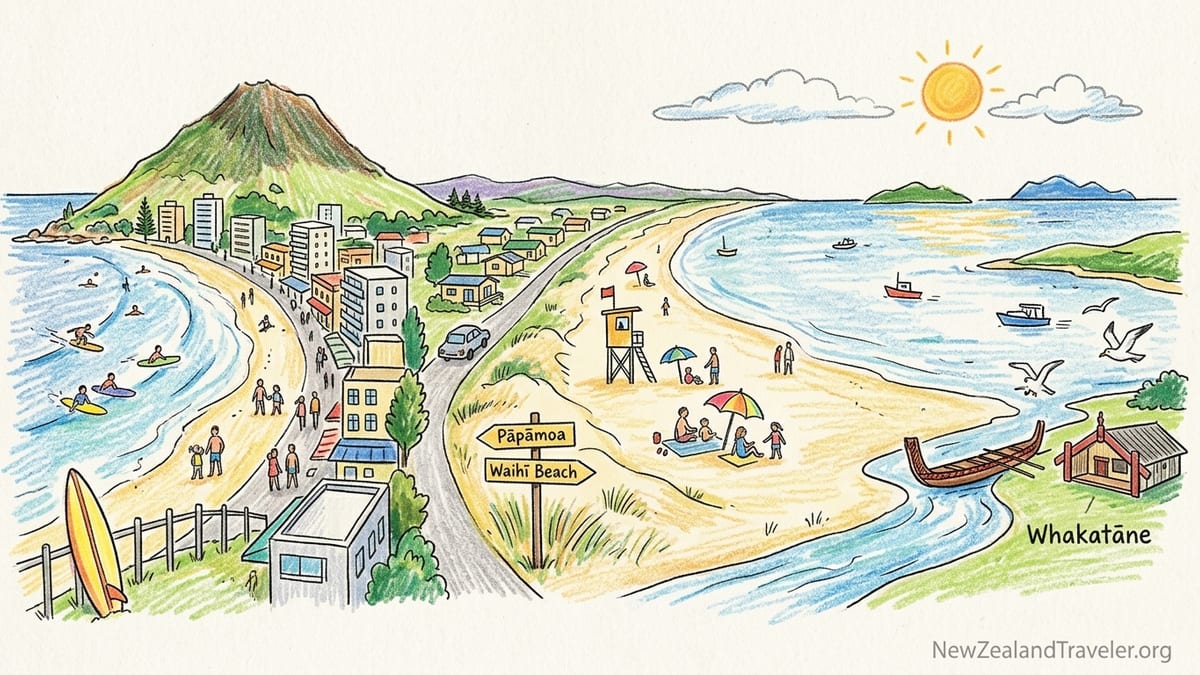
If you only glance at a map, the Bay of Plenty can look like one long, interchangeable stretch of sand. In reality, each centre has a distinct character and practical pros and cons. Mount Maunganui is the classic New Zealand beach-town experience with a busy surf beach, bars and cafes, and the iconic cone of Mauao at the end of the peninsula. Tauranga feels more like a small city, with supermarkets, shopping centres and a working port wrapped around a sheltered harbour. Pāpāmoa offers a softer, suburban version of the Mount’s beach scene. Waihī Beach anchors the western end of the bay and connects easily with the Coromandel. Further east, Whakatāne and Ōhope feel quieter and more regional, with strong Māori cultural connections and easy access to wildlife-rich islands and Ōhiwa Harbour.
For most travellers, it makes sense to choose one main base for three to four nights, then add one or two overnights elsewhere if you have a week or more. Mount Maunganui or Tauranga work well as a first base because of transport links and the range of accommodation. From there, you can make day trips to Pāpāmoa or Waihī Beach. If you are driving further east, Whakatāne and Ōhope work better as an overnight stay: Ōhope alone offers about 11 kilometres of north-facing sand plus access to Ōhiwa Harbour, which gives the eastern Bay a more low-key, nature-focused feel than the urbanised beaches further west.
When deciding, think in terms of three questions. First, how much built-up buzz do you actually enjoy around your accommodation. Second, do you want a surf-facing beach, a flat harbour, or the option of both. Third, will you be happiest walking everywhere from your motel, or are you comfortable using a car daily. The answers to those questions will often tell you, more clearly than any list of attractions, whether Mount Maunganui, Tauranga, Pāpāmoa, Waihī Beach, Whakatāne or Ōhope suits you best.
Mount Maunganui: classic beach holiday energy
If you imagine the archetypal New Zealand summer break, you are probably picturing something close to Mount Maunganui. The town sits on a narrow peninsula, with a long surf beach on one side and the calm waters of Pilot Bay on the other. Families can spend a morning bodyboarding or surfing on the ocean side, then cross the road in the afternoon for stand-up paddleboarding or a sheltered swim in the harbour. The volcanic cone of Mauao rises at the tip, with a loop walk around the base and steeper tracks to the summit for sunrise or sunset views across the Bay of Plenty.
Mount Maunganui shines if you like having holiday infrastructure at your doorstep. The strip along Maunganui Road and Marine Parade is lined with ice-cream shops, cafes, burger joints and brunch spots that are busy from Boxing Day through late January. In peak season you can expect to queue 15 to 20 minutes for a scoop at one of the popular gelato bars after dinner, or to wait for a table at a waterfront bar on a sunny evening. Lifeguard-patrolled swimming zones are clearly marked in front of the main surf club, and on summer weekends the sand in that zone can be carpeted with beach tents and umbrellas by late morning.
Accommodation here ranges from simple motels a couple of blocks back from the beach to high-rise holiday apartments with balconies facing the surf. A central one-bedroom apartment in December or January can easily run to several hundred New Zealand dollars per night, especially within walking distance of Mauao. There is also a holiday park near the base of the mountain which appeals to campervan travellers and families. Parking in the Mount is tight in peak season and often metered around the main streets, so staying within walking distance of the beach and dining precinct is worth paying for if you dislike circling for a car park.
Mount Maunganui deserves at least two to three nights if you enjoy a sociable, energetic beach town. It also works well as a hub for day trips inland to Rotorua or along the coast to quieter beaches. If you prefer tranquil evenings and minimal traffic, you may enjoy visiting the Mount for a day to walk Mauao and stroll the beach, then sleeping somewhere calmer.
Tauranga: harbour city convenience and rainy-day backups
Just across the harbour from Mount Maunganui, Tauranga is technically part of the same urban area, but it feels very different as a place to stay. The focus shifts from surf and sand to the sheltered harbour, marinas and suburban shopping centres. The city centre and nearby suburbs such as Bethlehem and Fraser Cove offer large supermarkets, department stores and chain restaurants that are useful if you are self-catering or travelling with children. On a wet day, you will be glad of Tauranga’s indoor activities, from cinemas and escape rooms to family-friendly eateries and shopping malls.
Tauranga is also the practical choice if you are driving the North Island and want an overnight stop with easy parking and services, without insisting on a beachfront address. Many motels sit on or near main arterial roads, with nightly rates often lower than equivalent beachfront apartments at the Mount. A typical mid-range motel room with kitchenette may cost noticeably less than a similar studio a few kilometres away on Marine Parade, especially outside the Christmas to mid-January peak. You are still only a 10 to 20 minute drive from the Mount’s surf beach or Pāpāmoa, but day-to-day life feels more like being in a small city than in a holiday village.
For travellers using public transport, Tauranga’s bus network and intercity coach stops can be more convenient than relying on the more compact Mount Maunganui area alone. Harbour activities such as scenic cruises, fishing charters and sailing trips usually depart from marina facilities on the Tauranga side or from Pilot Bay near the Mount, so staying anywhere in the wider Tauranga urban area keeps you within a short drive or taxi ride of departure points. If you plan to explore both inland attractions and the coast, Tauranga can serve as a practical base for three or four nights.
That said, Tauranga itself is not the place to come if your priority is waking up to crashing surf or sunset walks along a near-empty stretch of sand. Treat Tauranga as the service centre: ideal if you want city comforts, easy parking and wet-weather options, less ideal if you dream of wandering to the beach in bare feet from your motel. Many travellers find a split stay effective, with a couple of nights in Tauranga for errands, shopping and harbour outings, then a move to the Mount, Pāpāmoa or Ōhope for a more immersive beach experience.
Pāpāmoa: quieter beach suburbia
Driving southeast from Mount Maunganui, you gradually leave the apartment blocks behind and enter Pāpāmoa, a long, low-rise suburb that stretches for kilometres along the coast. The beach here feels familiar if you have been at the Mount: a wide, soft-sand surf beach with lifeguard patrols in summer, dunes and a backdrop of houses. What you lose in high-energy nightlife you gain in space and a more residential, family-oriented atmosphere. Outside of New Year’s week, you are more likely to share the sand with local dog walkers, runners and families than with large groups of out-of-town partygoers.
Pāpāmoa works especially well for travellers who want easy access to the Mount’s cafes and walks without paying top-tier apartment prices or putting up with its parking crunch. Holiday rentals include everything from modest three-bedroom family homes a few streets back from the beach to modern townhouses with small yards and barbecues. Many visitors shop at local supermarkets in Pāpāmoa’s town centres, stock up on groceries and spend their days walking over the dunes to swim, surf or build sandcastles. A beachfront restaurant and a scattering of cafes and takeaway shops mean you do not need to drive every time you want a meal, but the dining scene is quieter and more local than at the Mount.
Because Pāpāmoa is stretched out, location matters. If you want to walk to both the beach and a cluster of cafes, look for accommodation near the main commercial hubs rather than in the far-flung residential pockets where you will be driving for most errands. Public transport is available, but a car makes life significantly easier, especially if you want to head into Tauranga or out to Waihī Beach or Whakatāne for day trips. Noise levels tend to drop quickly at night away from any holiday parks or beachfront bars, making Pāpāmoa appealing for families with young children or travellers who prefer quiet evenings reading on the deck.
Pāpāmoa deserves an overnight stay if you are booking a holiday home or looking for a base of three nights or more. For short trips, it pairs naturally with the Mount: you can spend your days at Pāpāmoa’s less crowded beach and head to the Mount once or twice for a walk around Mauao and an ice cream on the main strip. As a pure day trip, Pāpāmoa on its own is less distinctive than Ōhope or Waihī Beach, but for longer, relaxed stays it offers a strong balance of beach access and suburban ease.
Waihī Beach: western gateway and Coromandel connector
At the western end of the Bay of Plenty, Waihī Beach feels a touch more old-fashioned than the Mount but more overtly holiday-oriented than Pāpāmoa. The main street has fish-and-chip shops, a small supermarket and cafes serving flat whites to a mix of bach owners and visiting families. The beach itself is an appealing sweep of sand backed by low dunes, with lifeguard patrols in the busier summer weeks. On a warm January afternoon you might see children boogie boarding in the whitewater, older kids learning to surf with a local school, and grandparents sitting under striped umbrellas with fish and chips for lunch.
Waihī Beach’s biggest advantage is its location. It sits within comfortable driving distance of both the Bay of Plenty and the southern Coromandel Peninsula, which makes it a convenient pivot point if you are driving between Auckland, the Coromandel and the Bay. Travellers sometimes base themselves here for three or four nights, taking a day trip south to Tauranga and the Mount one day, then a run up to towns such as Whangamatā or the Karangahake Gorge the next. This works especially well if you are more interested in relaxed beach time than in city-style dining or nightlife.
Accommodation options range from holiday parks and motels within a short walk of the sand to rental baches tucked into the streets behind the main road. Peak summer rates reflect the town’s popularity with repeat holidaymakers from Auckland and Waikato, but shoulder-season stays in March or November can be better value than the Mount, with quieter beaches and easier parking. With a full supermarket and a modest but capable range of takeaways and cafes, you can self-cater comfortably without needing to drive to a larger city.
Waihī Beach is worth at least a one or two night stay if you are looping between Auckland, the Coromandel and the Bay of Plenty. As a day trip from Tauranga or the Mount, it gives you a change of scene and slightly gentler pace, but the drive there and back can feel long if you do it several times. For travellers short on time who are already staying at the Mount or Pāpāmoa, Waihī Beach is more of a nice-to-have stop than an essential inclusion.
Whakatāne: culture, wildlife and an eastern hub
Continuing east, Whakatāne shifts the focus from big surf-town energy to regional charm and connections with the surrounding natural world. The town sits beside the Whakatāne River and a sheltered harbour, with views out towards offshore islands. The main street is compact, with local cafes, bakeries and independent shops rather than national chains. Many visitors use Whakatāne as a springboard for wildlife excursions, such as trips to see seabird colonies and marine life around nearby islands, or to join guided walks that highlight the area’s strong Māori heritage.
Because Whakatāne is a service centre for the eastern Bay of Plenty, it has practical advantages that Ōhope alone does not. You will find a wider selection of supermarkets, pharmacies and fuel stations, as well as motels that tend to be priced more moderately than equivalent beachfront stays. A typical central motel might offer simple studios and one-bedroom units with kitchenettes, off-street parking and easy walking access to cafes and the riverside walkway. For travellers on a road trip heading towards the East Cape or inland to the Urewera region, Whakatāne makes a logical overnight stop.
Culturally, Whakatāne offers more context than many coastal holiday towns. Local tours and visitor centres often weave in stories of early waka arrivals, pā sites on surrounding hills and the ongoing importance of the harbour and nearby Ōhiwa Harbour to local iwi. Even without booking a tour, you can get a sense of this history by walking along the riverfront, where interpretive panels and public art reference local stories and landmarks. This makes Whakatāne appealing if you are interested in more than just beach time and want to understand something of the Bay’s human landscape as well.
Whakatāne on its own is not a classic beach destination, but paired with Ōhope it becomes part of a compelling eastern Bay stay. Many travellers overnight in Ōhope for the beach access, then spend parts of a day or two in Whakatāne for supplies, cafes and any organised excursions. If you are short on time, Whakatāne can work as a half-day stop on the way along State Highway 2, but giving it at least one night lets you enjoy the riverfront walk and evening dining without rushing.
Ōhope and Ōhiwa Harbour: long beach, harbour calm and coastal walks
Only around 6 kilometres from Whakatāne, Ōhope feels like a different world. The town sits on a narrow spit between Ōhope Beach and Ōhiwa Harbour, which means you can walk from the surf to the sheltered harbour in minutes. The beach itself stretches for roughly 11 kilometres, from the harbour entrance in the east to the headlands near Whakatāne in the west. Much of it is broad, gently shelving sand with small to moderate surf that families and swimmers enjoy, especially on calm summer mornings and evenings. On clear days you can see offshore islands on the horizon while you walk, run or cycle along the shore.
Ōhiwa Harbour, tucked behind the sand spit, changes the character of the area compared with Mount Maunganui and Pāpāmoa. Instead of a built-up strip of bars and apartments, you get a sheltered estuary dotted with small boats and islands, with opportunities for kayaking, paddleboarding, fishing and birdwatching. Local holiday parks and campgrounds near the harbour often advertise the fact that they have the surf beach on one side of the road and the calm harbour on the other, which is particularly attractive for families with children at different confidence levels in the water. Low-tide mudflats and saltmarsh areas around the harbour support birdlife, and some conservation projects in the surrounding reserves have helped lift numbers of native species such as North Island brown kiwi over the past couple of decades.
Coastal walking is another reason Ōhope deserves at least a two or three night stay rather than being treated as a quick dip stop. A popular option is the track over the headland between Whakatāne and Ōhope, which weaves through coastal bush and offers views back along the length of Ōhope Beach and out towards the offshore islands. Shorter beach and harbour-side walks can fill in half days without any need to drive. Along the main beach reserve, picnic tables and pohutukawa trees provide shade, and in summer mobile coffee carts or nearby cafes offer an easy caffeine stop between swims.
Accommodation in Ōhope ranges from waterfront apartments at the western end of the beach to campgrounds near Ōhiwa Harbour at the eastern end. Prices vary by proximity to the water and by season, but in general you can expect to pay less than at a comparable apartment right on the Mount’s main beach, while still having a genuinely beachfront experience. Because Ōhope is smaller and more spread out, evenings are quieter. After dinner at a local restaurant or takeaway, many visitors simply walk the sand at sunset or sit outside their units listening to the surf. If you want an eastern Bay base that feels distinctly different from the busier western beaches, Ōhope and Ōhiwa Harbour are strong candidates for a three-night stay.
Putting it together: who should stay where and for how long
If you have a week in the Bay of Plenty and enjoy variety, a balanced itinerary might involve three nights around Mount Maunganui or Pāpāmoa, followed by three nights in Ōhope, with Tauranga, Waihī Beach and Whakatāne visited as needed for services, side trips or atmosphere. This gives you a taste of both the classic west-coast holiday scene and the more nature-forward eastern Bay. With less time, you may prefer to pick one base and use the others for day trips rather than packing and unpacking repeatedly.
For travellers who crave restaurants, cafes and people-watching, Mount Maunganui is the natural anchor. You can treat Tauranga as a daytime errand run or rainy-day backup, drive to Pāpāmoa for a quieter swim when the Mount is crowded, and save Ōhope and Waihī Beach for a future, more relaxed trip. Families who like a bit more breathing room might invert that approach, basing themselves in Pāpāmoa or Ōhope and driving into the Mount once or twice for the iconic walk up Mauao and a meal. Road trippers connecting Auckland, the Coromandel and the East Cape might use Waihī Beach and Whakatāne as single-night stops, with a longer pause at either the Mount or Ōhope depending on whether they lean towards buzz or calm.
When deciding whether a place is an overnight base or a day trip, test it against your own routines. If you picture yourself wandering to the same cafe each morning, going out for an evening stroll and using the beach multiple times a day without driving, then Mount Maunganui, Pāpāmoa, Waihī Beach and Ōhope all make sense for multi-night stays. Tauranga and Whakatāne are more utilitarian: excellent for stocking up, joining tours and experiencing everyday New Zealand regional life, but less compelling as pure seaside escapes unless you specifically want their city-like conveniences. Thinking in those terms will keep your Bay of Plenty trip focused on the kind of coastline you enjoy most, rather than on chasing a checklist.
The Takeaway
Viewed from a distance, the Bay of Plenty might look like just another line on the map where sand meets sea. On the ground, the differences between Mount Maunganui’s busy surf strip, Tauranga’s harbour city sprawl, Pāpāmoa’s quieter suburbia, Waihī Beach’s small-town holiday feel, Whakatāne’s cultural hub role and Ōhope’s long beach and harbour setting are obvious. Each can deliver a satisfying break, but only if it matches the pace, noise level and style of holiday you genuinely enjoy.
If your ideal holiday involves people-watching from a cafe, easy access to bars and the option of a sunrise hike up an iconic peak, Mount Maunganui is the right anchor, with Tauranga as its practical twin across the harbour. If you prefer sand dunes, backyard barbecues and easier parking, Pāpāmoa or Waihī Beach may suit you better. For travellers seeking wildlife, cultural context and softer, more contemplative coastal scenery, Whakatāne and especially Ōhope with its 11 kilometre beach and Ōhiwa Harbour backdrop offer a distinctly different eastern Bay experience.
In the end, you are unlikely to see every town and every headland on a single visit, and you do not need to. Choose one or two bases that fit your travel style, allow time to settle in rather than rushing between them, and treat the remaining places as options for future trips. The Bay of Plenty rewards repeat visitors, and understanding the character of each centre is the first step towards planning a stay that feels effortless rather than over-scheduled.
FAQ
Q1. Is Mount Maunganui or Ōhope better for a first Bay of Plenty trip
For a first visit, Mount Maunganui suits travellers who want energy, cafes and a famous landmark walk, while Ōhope suits those who prefer quieter beaches, harbour views and coastal walks.
Q2. How many nights should I spend in Tauranga versus the Mount
If you want more of a beach holiday, spend most nights at the Mount and treat Tauranga as a place for shops and rainy-day activities. One or two Tauranga nights are usually enough unless you are there for work or events.
Q3. Is Pāpāmoa suitable for families with young children
Yes. Pāpāmoa’s long beach, residential feel and access to supermarkets make it popular with families. Many visitors rent houses with fenced yards and walk to the patrolled sections of beach during summer.
Q4. Does Waihī Beach work as a base for exploring both the Coromandel and the Bay of Plenty
Waihī Beach is well placed for day trips south to Tauranga and north towards the southern Coromandel, so it works well as a base if you want a simple beach town and are comfortable driving an hour or more for some outings.
Q5. Do I need a car to enjoy these Bay of Plenty destinations
A car makes travel between Tauranga, Mount Maunganui, Pāpāmoa, Waihī Beach, Whakatāne and Ōhope much easier, especially for day trips. You can visit the Mount on buses from Tauranga, but flexibility is limited without your own vehicle.
Q6. Which destination is best if the weather turns bad
Tauranga is the most practical in poor weather because it has shopping centres, cinemas and a wider range of indoor dining. Mount Maunganui also offers cafes and some indoor activities, but the smaller beach towns are quieter when it rains.
Q7. Is Ōhope really different from Mount Maunganui for a beach stay
Yes. Ōhope combines a long, quieter beach with Ōhiwa Harbour, fewer high-rise buildings and a more low-key, nature-focused atmosphere, whereas the Mount has a denser strip of apartments, bars and shops beside the surf.
Q8. Can I visit Whakatāne and Ōhope as a day trip from Tauranga
You can, but it makes for a long day in the car. Many travellers prefer to stay at least one night near Whakatāne or Ōhope to enjoy the coastal walks, harbour and beach without rushing back the same evening.
Q9. Are there lifeguards on these beaches in summer
Mount Maunganui, Pāpāmoa, Waihī Beach and Ōhope all have surf lifesaving patrols on defined sections of beach during the main summer period. Always swim between the flags and check local signage.
Q10. When is the best time of year to visit the Bay of Plenty
Summer offers the warmest beach weather but also the biggest crowds and highest prices. Late spring and early autumn can bring pleasant temperatures, lighter traffic and better accommodation value.