


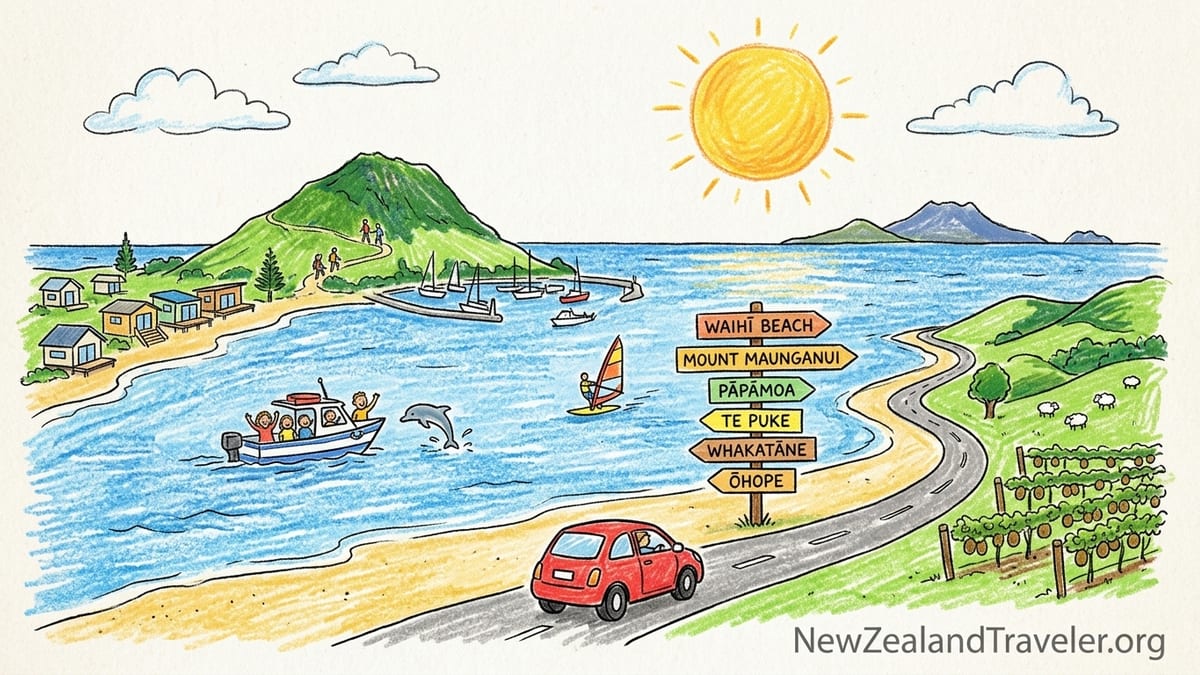
Golden sand beaches, relaxed surf towns and lush kiwifruit country make the Bay of Plenty one of New Zealand’s easiest and most rewarding coastal drives. This 4–5 day self-drive route links Waihī Beach, Tauranga and Mount Maunganui, Pāpāmoa, Te Puke and Maketū with Whakatāne and Ōhope, closely mirroring Tourism Bay of Plenty’s 5-day regional itinerary at around 300 kilometres total. It is compact enough to feel relaxed, but varied enough to deliver marine wildlife encounters, short walks, local food and classic Kiwi beach holiday vibes.
How Long To Spend and When To Go
A 4–5 day loop is ideal for the Bay of Plenty coast between Waihī Beach and Ōhope. That gives you one night each at Waihī Beach and Tauranga or Mount Maunganui, then one or two nights split between Pāpāmoa or Maketū and Whakatāne or Ōhope. Driving distances are short, often under 90 minutes between stops, which leaves time for beach walks, cafes and marine tours without feeling rushed.
Summer from December to February offers the warmest water and classic holiday energy, but it is also the busiest and most expensive time on this stretch of coast. Expect higher accommodation prices in popular areas such as Mount Maunganui and Ōhope, and book well ahead for Christmas and New Year. Shoulder seasons in November and March can be excellent, with long daylight hours, mild temperatures and slightly quieter beaches.
Weather matters if you are planning dolphin or wildlife cruises out of Tauranga or Whakatāne. Operators often cancel or reschedule in rough seas, particularly over winter fronts and spring winds. Building in at least one “buffer” half day near these ports gives you more flexibility to shift a marine tour from an afternoon to the following morning if conditions change. Always check the marine forecasts and keep an eye on your operator’s text or email updates.
Driving this route is straightforward but coastal roads can be busy during peak holiday weekends, especially around Tauranga. Speeds vary between 50 km/h in town centres and 100 km/h on highways, but traffic, roadworks and photo stops mean you should allow extra time. A compact car is fine for all segments and parking is usually free or low cost at beaches and motels, though paid parking applies around central Mount Maunganui in peak season.
Route Overview and Practical Driving Times
This road trip follows the Bay of Plenty shoreline from west to east. A typical 5 day flow is Waihī Beach to Tauranga or Mount Maunganui, then on to Pāpāmoa and Te Puke or Maketū, before finishing in Whakatāne and Ōhope. If you are driving in from Auckland, many travellers arrive via Paeroa and Waihī, then drop into Waihī Beach for the first night on the coast.
From Waihī Beach to Tauranga or Mount Maunganui, the drive is roughly 60 kilometres and usually takes around 50 to 60 minutes in light traffic. From there to Pāpāmoa and Te Puke, you are looking at 20 to 40 minutes depending on where you stop. Continuing from Pāpāmoa or Te Puke to Whakatāne is about 90 kilometres and typically 1.25 to 1.5 hours, with an additional 10 to 15 minutes over the hill to Ōhope Beach.
In practice, most people end up taking longer than the map suggests because the road is lined with small stops. There are cafes and berry farms around Te Puke, viewpoints around Matatā and picnic spots by the coast. If you plan to stop for short walks or photos, double the pure drive time: a 90 minute leg can easily become a relaxed three hour meander. This is especially true in summer when traffic can slow near popular beaches.
Fuel and supermarket stops are simple to work into your drive. Tauranga, Mount Maunganui and Whakatāne all have large supermarkets and petrol stations with standard opening hours, including late evenings. Smaller towns such as Waihī Beach and Ōhope have smaller groceries and dairies, which are perfect for stocking up on breakfast supplies, picnic foods and snacks for shorter coastal stretches.
Day 1: Waihī Beach and Karangahake Gorge
Waihī Beach, at the western edge of the Bay of Plenty, makes a gentle start for this coastal route. The beach itself stretches for several kilometres with soft sand and a low-key surf scene. On a fine afternoon you can swim, learn to surf with a local surf school or simply walk the shoreline from the main village area down towards Island View. Small cafes, a bakery and a handful of restaurants line Wilson Road, the main street behind the dunes.
If you are driving in from Auckland or the Coromandel, build in a stop at Karangahake Gorge before settling at Waihī Beach. The gorge, inland from Waihī, offers easy riverside walks such as the Windows Walk through old mining tunnels. You can reach Waihī Beach in about 15 to 20 minutes from Waihī township, making it easy to fit an inland walk and a seaside sunset into the same day if you arrive by midday.
For accommodation, you will find a mix of holiday parks, motels and self-contained rentals. A holiday park near the beach suits families and campervans, often offering powered sites, cabins and access to communal kitchens and barbecues. Couples might prefer a small motel or apartment within walking distance of the main beach access and eateries. Nightly rates vary but mid-range seaside motels in summer often sit in the mid to high NZD 200s, while powered sites can be significantly cheaper.
In the evening, stroll the sand at dusk and keep an eye on the sky. On clear days, sunsets can be spectacular as the light catches the clouds over the Coromandel ranges to the north. If the weather turns unsettled, Waihī township offers indoor distractions such as small museums or local pubs, making this a flexible first stop regardless of conditions.
Day 2: Tauranga and Mount Maunganui
From Waihī Beach, a direct drive to Tauranga or Mount Maunganui usually takes under an hour, but plan on 90 minutes with a coffee or scenic stop built in. Many travellers choose to base themselves at Mount Maunganui rather than central Tauranga, as “the Mount” sits right on a long surf beach with a walkable strip of cafes, bars and boutique shops. Tauranga city, a short drive across the harbour, provides galleries, restaurants and a working port atmosphere.
The headline experience here is walking around or up Mauao, the iconic volcanic cone at the end of the Mount Maunganui peninsula. The base track is a relatively gentle coastal path with harbour and ocean views, while the summit track is steeper but rewards you with sweeping views up and down the Bay of Plenty coastline. Allow 45 to 90 minutes depending on your fitness and how often you stop. Good shoes and a water bottle are useful even on cooler days.
Marine tours depart from the Tauranga harbour area during much of the year, offering half or full day trips to spot dolphins and other wildlife. Conditions can change quickly on the open ocean, especially from late autumn through spring. If possible, stay two nights in Tauranga or Mount Maunganui so that you can book a cruise on your first full day with another morning in reserve. That way, if wind or swell force a cancellation, you still have time to reschedule before you drive on.
Accommodation ranges from beachfront holiday parks and backpacker hostels to serviced apartments and hotels. Mount Maunganui’s beachside holiday park places you steps from the sand and close to the Mauao tracks, which is practical if you want sunrise walks. In Tauranga, inner harbour motels and apartments give you easy access to the art gallery, small eateries and harbour cruises. Parking is straightforward at most properties, though you may encounter paid street parking near the busiest Mount Maunganui beach blocks in high summer.
Day 3: Pāpāmoa, Te Puke and Maketū
Leaving Tauranga or Mount Maunganui, it is only a short hop along the coast to Pāpāmoa. Many travellers choose to break the day into at least two segments: a relaxed morning at Pāpāmoa Beach followed by an afternoon exploring kiwifruit country around Te Puke or the seaside settlement of Maketū. Driving from the Mount to Pāpāmoa might take 15 to 20 minutes, with another 15 minutes or so from Pāpāmoa into Te Puke on the inland highway.
Pāpāmoa Beach is long, wild-feeling and less crowded than the main Mount Maunganui strip. It is a good place for a quiet beach walk, surfing on mellow days and picnics in the dunes. If the weather cooperates, local operators in Pāpāmoa can arrange surf lessons or board rentals, and in summer there may be surf lifesaving patrols on popular sections of the beach. A few beachside holiday parks and motels sit back from the sand, while suburban shopping centres offer supermarkets and cafes a short drive inland.
Te Puke promotes itself as New Zealand’s kiwifruit capital, and you will notice the change as soon as you leave the coast for the rolling countryside. Roadside stalls sometimes sell seasonal fruit and honey, while organised tours and visitor centres at larger orchards can explain how kiwifruit is grown and exported. Some attractions allow visitors to ride among the vines on small trains or golf carts, which can be a welcome change of pace for families after a run of beach days.
For a more low-key coastal experience, continue south to Maketū, about 20 minutes from Te Puke. Maketū Beach is smaller and more rugged than Mount Maunganui or Pāpāmoa, with views over the estuary and sand bars. Simple fish and chip shops serve as an easy lunch stop, and basic holiday park and motel-style accommodations appear around the village and nearby Little Waihī. If you prefer to keep driving on the same day, you can also treat Pāpāmoa, Te Puke and Maketū as a string of stops on the road toward Whakatāne rather than a separate overnight, especially on a tighter 4 day schedule.
Day 4–5: Whakatāne and Ōhope Beach
From the Te Puke and Maketū area, the drive to Whakatāne runs for roughly 90 kilometres and generally takes around 1.25 to 1.5 hours. This section of State Highway 2 is mostly straightforward, with the option of scenic pauses near Matatā where the road briefly hugs the coastline. On arrival, Whakatāne feels smaller and more compact than Tauranga but has a strong local identity as a gateway to marine wildlife and the eastern Bay of Plenty.
Whakatāne’s riverfront and town centre are pleasant to stroll, with cafes, river walks and short tracks leading to viewpoints over the harbour and out towards Moutohorā Island. Historically, boat trips also ran from Whakatāne to the offshore volcanic island of Whakaari or White Island, but access has been restricted since the 2019 eruption and current options focus on harbour cruises and wildlife experiences closer to shore. As with Tauranga, allow a flexible half day here if you want to join any kind of boat tour that might be affected by sea conditions.
Ōhope Beach, about a 15 to 20 minute drive over the hill from Whakatāne, is repeatedly promoted as one of New Zealand’s most loved beaches. It runs for approximately 11 kilometres, combining surf breaks, family-friendly swimming sections and views across to volcanic islands offshore. There is a cluster of accommodation at central Ōhope, including motels, holiday apartments and a large beachfront holiday park that offers everything from tent sites and campervan hookups to cabins and more upmarket units.
Plan to spend at least one night in Ōhope, and two if your schedule allows. With a full day, you can walk sections of the beach, take short bush tracks in the hills behind town or simply relax at a holiday park pool. In good weather, kayaking and stand-up paddleboarding on the harbour side provide sheltered alternatives to the open surf beach. In poor weather, many accommodations provide covered barbecues, games rooms or nearby cafes to make hunkering down still feel like part of the holiday.
Building Weather Buffers and Marine Tour Flexibility
Because the Bay of Plenty trip is compact in distance, it is relatively easy to build small weather buffers around your key activities without derailing the overall plan. The most weather-sensitive elements are marine tours from Tauranga or Whakatāne, along with summit walks such as Mauao and open surf sessions on exposed beaches. If you structure the itinerary with two consecutive nights in either Tauranga or Whakatāne, you gain a flexible 24 to 36 hour window to move boat trips or long walks between mornings and afternoons.
For example, on a 5 day trip you might spend nights one and two in Tauranga or Mount Maunganui, booking a dolphin or harbour cruise on your first full day but keeping the second morning free. If the first date is cancelled due to wind, you can switch to the following morning and push your departure for Pāpāmoa and Te Puke into the afternoon. Similarly, staying two nights in Whakatāne and Ōhope means you can swap a planned afternoon harbour cruise for a morning beach walk and then sail the next day when conditions improve.
Rain does not necessarily ruin this itinerary. On a drizzly or windy day, shift focus away from exposed coastal walks and swims toward indoor or sheltered options. In Tauranga, the art gallery, cafes and hot pools provide warm alternatives. Around Te Puke, orchard tours and tastings still run in light rain, as most of the experience is either under cover or on slow vehicles. In Whakatāne and Ōhope, short bush tracks under forest canopy can remain enjoyable even when the beach feels less inviting.
Keep in mind that New Zealand’s weather can change quickly and forecasts improve significantly in accuracy within 24 to 48 hours. Rather than locking in every activity weeks in advance, pre-book only key elements such as peak-season accommodation and any non-refundable tours. For the rest, build a rough plan and be prepared to rearrange on the ground using the latest marine and local forecasts.
Onward Options: Rotorua or the East Cape
At the end of your Bay of Plenty coastal loop, you have two classic onward options: inland to Rotorua’s geothermal heartland or further east toward the remote East Cape. Each direction offers a different kind of New Zealand experience and both connect naturally from Whakatāne and Ōhope.
For Rotorua, the most direct route from Whakatāne usually runs inland past small lakes and forested hills, taking around 1.5 to 2 hours of driving time. Many visitors choose to stop at one of the clear green lakes on the way for a picnic or short walk. Rotorua then opens up a wide set of activities including geothermal parks, Māori cultural experiences, forest walks and lake cruises, making it a logical next base for two or three nights if you have more time.
If you prefer quieter roads and wild scenery, continue east from Whakatāne toward Ōpōtiki and the East Cape. The drive from Whakatāne to Ōpōtiki takes roughly an hour, after which State Highway 35 winds along the coast past small communities, rugged headlands and often empty beaches. Services thin out quickly compared with Tauranga and Whakatāne, so it is wise to top up fuel and supplies before committing to the longer stretches between towns. Accommodation here tends toward holiday parks, small motels and homestays rather than large hotels.
Deciding between Rotorua and the East Cape often comes down to your priorities. If you want more structured attractions, dining options and a wide choice of accommodation, Rotorua is the better fit. If you value slow travel, coastal drives and remote feeling settlements, the East Cape rewards the extra time behind the wheel. Either way, the Bay of Plenty coastal route between Waihī Beach and Ōhope acts as a natural bridge between North Island hubs and these contrasting regions.
The Takeaway
The Bay of Plenty coastal drive between Waihī Beach and Ōhope is at its best when you resist the temptation to turn it into a long marathon itinerary. In 4–5 days you can swim at different beaches, walk a volcanic summit, explore kiwifruit country and join at least one marine tour, all without spending more than a couple of hours a day in the car. The route aligns neatly with regional tourism suggestions that keep total distance to around 300 kilometres.
Using Waihī Beach, Tauranga or Mount Maunganui, Pāpāmoa and Te Puke or Maketū, and Whakatāne and Ōhope as short hops makes it easy to respond to weather and sea conditions. Building in two-night stays at either Tauranga or Whakatāne gives you room to shuffle marine tours or summit walks when forecasts change. Even if you hit a rainy patch, cafes, galleries, orchard tours and forest tracks ensure your days stay full.
From Ōhope, turning inland to Rotorua or east along State Highway 35 simply extends the coastal story rather than starting a new one. Wherever you continue, this compact Bay of Plenty loop offers an accessible slice of North Island coastal life that works as a stand-alone holiday or a relaxed section within a longer New Zealand itinerary.
FAQ
Q1. How many days do I really need for this Bay of Plenty coastal route?
Most travellers find 4 to 5 days enough to link Waihī Beach, Tauranga or Mount Maunganui, Pāpāmoa and Te Puke or Maketū, and Whakatāne and Ōhope without rushing.
Q2. Is it better to stay in Tauranga or Mount Maunganui?
Mount Maunganui suits visitors who want to walk to the beach, cafes and Mauao summit track, while Tauranga offers a more urban harbour setting with galleries and restaurants.
Q3. Do I need a four wheel drive vehicle for this road trip?
No, the entire route uses sealed highways and local roads, so a standard two wheel drive car is sufficient for all the towns and main attractions mentioned.
Q4. Are marine wildlife tours suitable for children?
Most dolphin and harbour cruises welcome families, but check minimum age and sea conditions, as younger children may find longer, rougher trips uncomfortable in strong winds or swell.
Q5. Can I freedom camp along this coast?
Freedom camping rules are strictly enforced in the Bay of Plenty and vary by district, so it is safer to plan on staying in official holiday parks and campgrounds with proper facilities.
Q6. What is the best season for swimming and beach time?
December to March usually offers the warmest air and sea temperatures, with January and February the peak for classic beach weather, though they are also the busiest and priciest months.
Q7. How far is it from Ōhope to Rotorua by car?
Driving from Ōhope or nearby Whakatāne to Rotorua typically takes about 1.5 to 2 hours, depending on your exact route and how often you stop at lakes or viewpoints.
Q8. Is this route manageable for nervous drivers or visitors used to driving on the right?
Yes, distances are short and roads are mostly straightforward, but first time left side drivers should take their time, avoid night driving and plan extra rest stops in busy holiday periods.
Q9. Do I need to book accommodation in advance?
In peak summer, advance bookings are highly recommended for Mount Maunganui, Pāpāmoa and Ōhope, while in shoulder seasons you often have more flexibility but should still book weekends.
Q10. Can I include this coastal route within a longer North Island itinerary?
Yes, many travellers connect it with Rotorua, the Coromandel Peninsula or East Cape, treating the Bay of Plenty section as a 4 to 5 day coastal chapter within a wider New Zealand trip.