


The ferry crossing between Wellington and Picton is one of New Zealand’s signature travel experiences and the essential sea link between the North and South Islands. Whether you are driving your own car, renting a campervan or simply walking aboard with a backpack, understanding how the Cook Strait ferries work will make your journey smoother and your wider road trip easier to plan.
Understanding the Cook Strait Crossing
The Wellington to Picton route is operated by two main companies: Interislander, part of Great Journeys of New Zealand, and Bluebridge Cook Strait Ferries. Both run large roll-on roll-off ships that carry passengers, cars, motorbikes, campervans and freight across Cook Strait and through the Marlborough Sounds. The crossing takes around three and a half hours in normal conditions, though this can stretch to four hours when swells are high or schedules are disrupted.
Most travellers see only the passenger lounges and outer decks, but this is a major freight and transport corridor. On a typical sailing you may be boarding behind logging trucks, refrigerated trailers or long-distance buses heading between Wellington and Christchurch. That mix is one reason you should always pre-book a vehicle space, especially in the busy summer months from December to February and around Easter school holidays.
Prices vary by operator, sailing time and vehicle type. As a rough guide in high season, a one-way ticket for an adult foot passenger is often in the range of the lower hundreds of New Zealand dollars, while adding a standard car can lift the total into the mid hundreds. Campervans and longer vehicles pay more because pricing is based on length. Night sailings often undercut daytime departures, while popular mid-morning and mid-afternoon crossings can cost more but align better with onward driving.
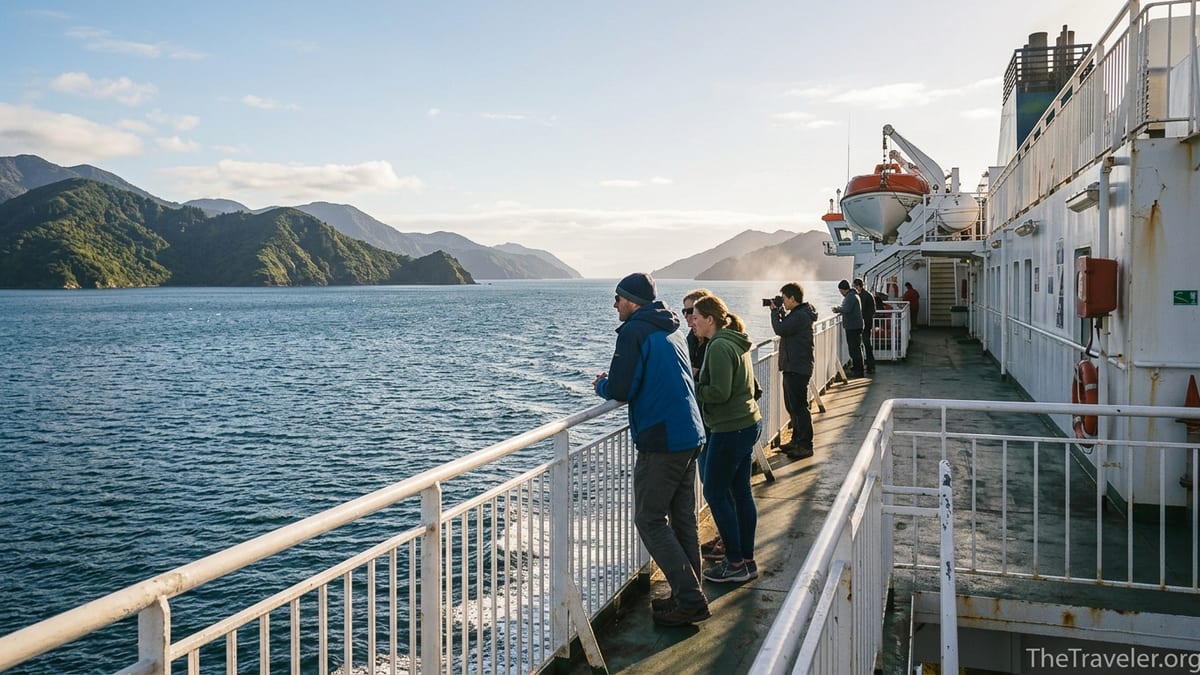
For many visitors, the Cook Strait crossing is not just transport but a scenic highlight. Leaving Wellington, you pass the city’s waterfront and hills before entering the open strait. The final hour into Picton winds through the forested inlets of Queen Charlotte Sound, with chances to spot dolphins or seabirds. In good weather it is worth heading to the outdoor decks for this section, but pack a windproof layer even in mid-summer.
Wellington and Picton Terminals: What to Expect
In Wellington, Interislander and vehicle traffic currently use terminals west of the city centre near Kaiwharawhara and Aotea Quay, while Bluebridge operates from a wharf close to the central business district on Waterloo Quay. Both are a short taxi or rideshare ride from downtown hotels. If you are a foot passenger on Interislander, a shuttle bus typically runs from Wellington Railway Station out to the passenger terminal at set times before each sailing, which is handy if you are arriving by long-distance train or local buses.
Facilities at the Wellington terminals are functional rather than glamorous but cover the basics: seating, toilets, free Wi-Fi and vending machines. Bluebridge’s city-side terminal is within walking distance of waterfront cafes and supermarkets, so many travellers pick up snacks there before boarding. Interislander’s terminal is more isolated on the port, so it is wise to arrive with any food or drinks you want for the sailing, although both companies offer meals and coffee on board.
In Picton, both operators’ terminals sit near the small town centre, with Interislander’s complex by the main port area and Bluebridge just a short distance away. It is an easy downhill walk into town from either terminal for foot passengers, and shuttle buses frequently connect with the ships for those with luggage or mobility issues. Many motels, hostels and holiday parks cluster within a kilometre of the waterfront, which makes it straightforward to stay overnight if you are catching an early morning or late evening ferry.
Terminal facilities in Picton are generally more relaxed than in Wellington, with children’s play areas, outdoor seating and views over the marina. This is where many travellers pick up or drop off rental cars and campervans. During summer, expect queues of hire vehicles returning keys before the morning departures and groups of backpackers collecting fresh rentals after the lunchtime arrivals.
Passenger vs Vehicle Bookings: Choosing How to Cross
When you book a Cook Strait ferry, the first decision is whether you travel as a foot passenger, take a vehicle, or combine the two by returning a rental at one terminal and collecting a new one across the strait. Both Interislander and Bluebridge allow you to book passenger-only tickets or add a specific vehicle type and length to your reservation. For example, you might book two adults plus a 4.5-metre hatchback, or four adults plus a 7-metre motorhome.
Travelling as a foot passenger is usually the most flexible and cost-effective option. Prices are lower, there is no need to worry about vehicle check-in queues, and you can often find space even at relatively short notice in shoulder seasons. This suits travellers who are happy to use buses, trains or domestic flights at each end. A common pattern is to drive a rental car around the North Island, drop it in Wellington, walk on to the ferry, then collect a new car or campervan in Picton for a loop of the South Island.
Taking a vehicle aboard is ideal if you are on a longer road trip with your own car, motorcycle or a single-hire campervan. For instance, a New Zealander driving their family SUV from Auckland to Queenstown may find it easier to stay in the same vehicle rather than shifting luggage twice. Similarly, some overseas visitors on a 30-day campervan rental prefer to keep their home-on-wheels continuous across both islands, especially if they have booked powered sites at holiday parks in advance.
Because space for vehicles is finite and demand is high around Christmas, New Year and long weekends, anyone crossing with a car, campervan or trailer should book weeks or even months ahead. Travellers sometimes report arriving in Wellington in late December to discover that the next available car space is two or three days away, while foot passenger spots remain available. Booking early is especially important if you are connecting to time-sensitive plans such as a guided hike, whale-watching tour in Kaikoura or a pre-booked train journey.
Campervans, Rental Cars and Company Restrictions
Interislander notes clearly that rental car rules differ by company, while rented campervans and caravans can usually travel on its ferries as normal provided the correct length and height are booked. Bluebridge takes a similar approach. The key point is that the ferry companies will carry most standard hire vehicles, but your rental agreement may not allow the vehicle itself to travel on board. Always check the fine print on your booking confirmation before you assume you can drive your hire car onto the ship.
Major car rental brands in New Zealand often follow one of two models. Some, including several large international chains, prefer “cross-hire”: you drop your car at their Wellington depot, walk on as a passenger, then pick up a new car at their Picton or Christchurch branch. Others, including a number of local and campervan specialists, allow or even expect you to keep the same vehicle across both islands and to book that specific registration on a named sailing. Because policies change frequently, it is safer to confirm in writing with your rental company rather than relying on anecdotal reports from other travellers.
For example, a couple renting a compact SUV from a global brand might be told to return it at Wellington Railway Station or an airport depot, take the ferry on foot, then collect an identical model at Picton. The company handles the logistics of shifting cars between islands and avoids the extra cost of a vehicle ferry ticket. By contrast, a family renting a 6.5-metre motorhome from a campervan specialist may be instructed to book the vehicle on Interislander or Bluebridge for specific dates, with the rental firm sometimes offering to arrange the ferry ticket as part of a package.
If your rental company requires cross-hire, plan extra time at each end of the crossing. In Wellington, allow at least an hour before foot passenger check-in to return the vehicle, complete paperwork and reach the terminal by taxi, shuttle or on foot. In Picton, build in a buffer to collect the new car or campervan, inspect it and load your luggage before driving on to your next stop such as Blenheim, Nelson or Kaikoura. This may mean accepting a late-morning or early-afternoon ferry rather than the very first sailing of the day.
Check-in, Luggage and Onboard Logistics
Check-in times differ slightly between companies and between foot passengers and vehicles, but a common pattern is that foot passengers must check in around 45 minutes before departure, while vehicles often need to be present at least 60 to 75 minutes before sailing. In peak season, both Interislander and Bluebridge recommend arriving even earlier to allow for queues at security gates and ticket counters. Turning up “just on time” with a car or campervan risks missing your sailing if port traffic is heavy.
For luggage, both operators treat foot passengers more like airline travellers. Bluebridge, for example, allows each passenger to check in two bags up to a set weight, with additional bags charged a modest fee per piece. Interislander uses a similar system, with large suitcases and backpacks checked into a luggage truck that is loaded separately and then reclaimed in the terminal at the other end. Smaller daypacks and handbags can usually be taken on board and kept with you in the lounges. Passengers travelling with vehicles simply leave their belongings in the car or campervan during the crossing.
Once on board, you cannot return to your vehicle during the voyage except in rare circumstances, so take a small bag with anything you might want for three to four hours: warm clothing layers, medications, valuables, a book, headphones and chargers. Both Interislander and Bluebridge ships offer cafes serving hot meals, snacks and coffee, along with licensed bars, children’s play areas, quiet corners and outdoor decks. Wi-Fi is available but can be patchy in parts of Cook Strait and the Marlborough Sounds, so do not rely on it for important work calls.
Boarding and disembarking as a driver involves following staff instructions carefully. You will be directed into specific lanes in the marshalling yard and then onto the vehicle decks by crew members in high-visibility clothing. Motorhomes and caravans are usually parked together in areas with extra headroom. At the end of the crossing, an announcement will call drivers back to their vehicles. It is a good idea to note your deck and row number when you park, as the larger ships can feel like multi-storey car parks when everyone heads back down at once.
Weather, Disruption and Building Flexibility Into Your Trip
Cook Strait has a reputation for quickly changing weather, and ferry services are occasionally delayed or cancelled when strong winds or large swells make conditions unsafe. Both Interislander and Bluebridge monitor forecasts closely and may adjust sailing times, substitute vessels or cancel individual crossings when necessary. In the past few years, travellers have reported days when several sailings on both companies were cancelled due to storms or mechanical issues, with waves forecast at seven or eight metres in the strait.
As a traveller, the most important step is to build flexibility into your itinerary rather than treating the ferry as a guaranteed, to-the-minute connection. If you must be in Christchurch or Queenstown by a certain date for a tour, ski package or flight, avoid scheduling your ferry for the same day as those commitments. Many New Zealand-based travellers now routinely allow at least one “buffer day” on either side of a Cook Strait crossing in winter and shoulder seasons, especially in July and August when storms are frequent.
If your sailing is cancelled, the ferry companies will generally move you to the next available crossing at no extra charge, but that may not be the same day, especially for vehicles when the decks are already fully booked. In this situation, you may need to arrange an extra night in Wellington or Picton. Both towns have a range of motels, backpacker hostels and hotels that are accustomed to last-minute ferry disruptions, although prices can rise when many people are stranded at once.
Travel insurance that covers missed connections and unexpected accommodation can be valuable on this route. For example, if a cancelled evening ferry from Wellington means you miss the next morning’s whale-watching tour in Kaikoura or a scenic train departure from Picton, a policy with interruption cover may reimburse some costs. Always keep receipts from additional nights’ lodging and meals. When severe weather is predicted, some travellers choose to reroute altogether by flying between Wellington and Nelson, Blenheim or Christchurch on short-notice fares, then collecting a car on arrival.
Fitting the Ferry Into a Wider New Zealand Road Trip
How you integrate the Cook Strait crossing into a broader itinerary depends on your time and priorities. One popular plan for a three-week trip is to collect a rental car in Auckland, spend 8 to 10 days exploring the North Island via Coromandel, Rotorua, Taupo and Tongariro, then drive to Wellington, drop the car, cross as foot passengers, and pick up a new rental in Picton to spend the remaining days exploring the South Island. This approach avoids paying a vehicle fare on the ferry and fits neatly with cross-hire rental policies.
Travellers on extended campervan journeys often do the opposite: they pick up a motorhome in Auckland or Christchurch and keep it for the entire four to six weeks, paying to take it on the ferry. A couple on a one-month holiday might, for example, loop from Christchurch through the West Coast and Nelson to Picton, sail to Wellington, then continue through Taranaki and the central plateau before finishing in Auckland. In this case, the extra cost of a campervan ticket is offset by the convenience of not unpacking and repacking between islands.
The timing of your crossing can also shape your plans. A morning sailing from Wellington allows you to reach Picton around lunchtime and then drive to Blenheim for wine tasting, Nelson for an overnight stop, or even down the coast to Kaikoura before dark in summer. An afternoon ferry means a relaxed morning in the capital, with arrival in Picton in time for dinner and a night in a waterfront motel. From the Picton side, an early sailing lets you reach Wellington by late morning, giving you a full afternoon to explore Te Papa museum, the cable car and Wellington’s dining scene.
Public transport connections add further options for foot passengers. Services like long-distance coaches, regional buses and occasionally trains are timed to meet major ferry arrivals and departures, especially between Picton, Nelson and Christchurch. Some guided tours also use the ferries as part of through-routes, with the guide and vehicle crossing with the group. If you prefer not to drive at all, it is possible to link local buses, ferries and intercity coaches to travel from Auckland to Queenstown using the Cook Strait crossing as just one step along the way.
What To Do When You Must Swap Rental Vehicles
If your rental company requires you to return a car in Wellington and collect another in Picton, or vice versa, the key is to treat the crossing as a changeover day and minimise stress by planning the handover steps. Start by confirming the exact depot locations and opening hours at both ends. Some companies have branches close to the ferry terminals, while others use airport or city locations and provide shuttle transfers back to the port.
On the northbound leg from Picton to Wellington, for example, you might drop your South Island rental at a depot near Picton’s town centre an hour before check-in, walk or ride a courtesy shuttle to the terminal, then board the ferry as a foot passenger. On arrival in Wellington, you would collect your bags from the luggage carousel, take the Interislander or Bluebridge shuttle or a taxi to the city depot, and pick up your new car for the North Island portion of your trip. Allow plenty of time in case the ferry is late docking or luggage takes longer than expected to be unloaded.
Pack with the swap in mind. Instead of spreading belongings throughout the car, concentrate items you will carry on board the ferry into a few suitcases or backpacks. Keep all important documents, medications and valuables in a single daypack that stays with you during the crossing. Many travellers find it easiest to treat each island as a separate “trip within a trip”, with one main piece of luggage for the South Island and another for the North, rather than constantly digging through rarely used items.
If you learn on short notice that your rental company does not permit the vehicle on the ferry, do not panic. In many cases you can still keep your sailing but switch to a foot passenger ticket and arrange a replacement car on the other side. This might mean accepting a different vehicle category or using a different rental brand in either Picton or Wellington. While this can be inconvenient, it is usually preferable to paying extra ferry charges yourself or risking breaching the rental agreement.
The Takeaway
The Wellington to Picton ferry route is both a practical necessity and a memorable part of any New Zealand journey. By understanding how passenger and vehicle bookings work, checking rental car and campervan rules ahead of time, and allowing extra space in your schedule for weather or mechanical disruptions, you can integrate the Cook Strait crossing smoothly into a wider road trip.
Choose whether to travel with a vehicle or on foot based on your budget, itinerary and tolerance for logistics. Travellers on shorter visits often benefit from cross-hiring rental cars on each island and crossing as foot passengers, while those on long campervan adventures may prefer to pay the higher vehicle fare for the convenience of keeping their rolling home intact.
Whatever option you choose, arrive at the terminals early, bring a small bag with essentials for the three to four hours on board, and treat the sailing not just as a transfer but as an opportunity to enjoy some of New Zealand’s most striking coastal scenery. On a clear day, with Wellington’s hills receding behind you and the forested slopes of the Marlborough Sounds ahead, you will understand why many locals still see the Cook Strait ferry as an experience worth planning a trip around in its own right.
FAQ
Q1. Do I need to book the Wellington to Picton ferry in advance?
Yes, advance booking is strongly recommended, especially if you are taking a car, campervan or motorhome, or travelling in peak periods like late December, January, Easter and school holidays. Foot passengers can sometimes book closer to departure, but even then it is safer to reserve ahead to secure your preferred sailing time.
Q2. How early should I arrive at the ferry terminal?
Foot passengers should generally arrive at least 45 minutes before departure, while vehicles are usually asked to check in 60 to 75 minutes before sailing. In busy summer periods, arriving 90 minutes early with a vehicle is wise to allow for queues at ticketing and security gates.
Q3. Can I stay in my car or campervan during the crossing?
No. For safety reasons, passengers are not allowed to remain on the vehicle decks while the ship is at sea. You must take a small bag with anything you will need and spend the crossing in the passenger lounges or on the outer decks.
Q4. What happens if my ferry is cancelled due to bad weather?
If a sailing is cancelled, the ferry operator will normally rebook you on the next available crossing. However, space for vehicles may be limited on later sailings, so you might need to stay an extra night in Wellington or Picton. Travel insurance that covers delays and missed connections can help with unexpected accommodation and rearranged plans.
Q5. Are rental cars and campervans allowed on the Cook Strait ferries?
Most private cars and campervans can travel on the ferries, but rental policies vary by company. Some rental car brands require you to return your vehicle at Wellington or Picton and pick up a new one on the other side, while many campervan companies allow their vehicles to be taken across. Always check your rental agreement before booking the ferry.
Q6. What should I do if my rental company makes me swap vehicles?
If you must swap vehicles, plan the day as a changeover: allow time to drop off the first car, reach the terminal as a foot passenger, and collect the new vehicle at the other end. Pack so your belongings are easy to move between cars and keep important items in a single carry-on bag for the crossing.
Q7. How much luggage can I bring as a foot passenger?
Ferry operators permit a limited number of checked bags per person, with weight limits similar to airline rules and fees for extra pieces. Large suitcases are tagged and stowed separately, while smaller bags and daypacks can be taken into the lounges. If you travel with a vehicle there are usually no formal luggage limits, as your belongings remain locked inside your car or campervan.
Q8. Is the crossing very rough, and will I get seasick?
Cook Strait can be choppy, especially in strong wind conditions, but many crossings are relatively smooth. If you are prone to motion sickness, consider taking medication before departure, choose a seat in the middle of the ship where movement is less noticeable, and avoid heavy meals and alcohol. In extreme weather, sailings may be delayed or cancelled rather than operating in unsafe conditions.
Q9. Can I cross with a bicycle or motorcycle?
Yes, both bicycles and motorcycles can be carried on Cook Strait ferries, usually for an additional but modest fee. Cyclists either walk their bikes on at special loading times or hand them to crew to be secured on deck, while motorcyclists ride onboard and park in designated areas. It is still sensible to book space for bikes and motorbikes in advance.
Q10. How long does the Wellington to Picton ferry take, and can I connect to other transport?
The crossing typically takes about three and a half hours, though timing can vary with weather and port traffic. At both ends, buses, taxis and sometimes trains connect with major sailings, making it straightforward to continue on to destinations like Nelson, Blenheim, Kaikoura or central Wellington after you arrive.