


Designing a realistic New Zealand itinerary is less about ticking off every famous place and more about choosing a logical route, accepting trade-offs, and understanding how much you can comfortably cover in the time you actually have. Tourism New Zealand itself now groups sample trips into broad duration bands like one week, two weeks, or three weeks rather than pretending visitors can see everything in a single loop, and that is the most useful mindset to borrow for your own planning.
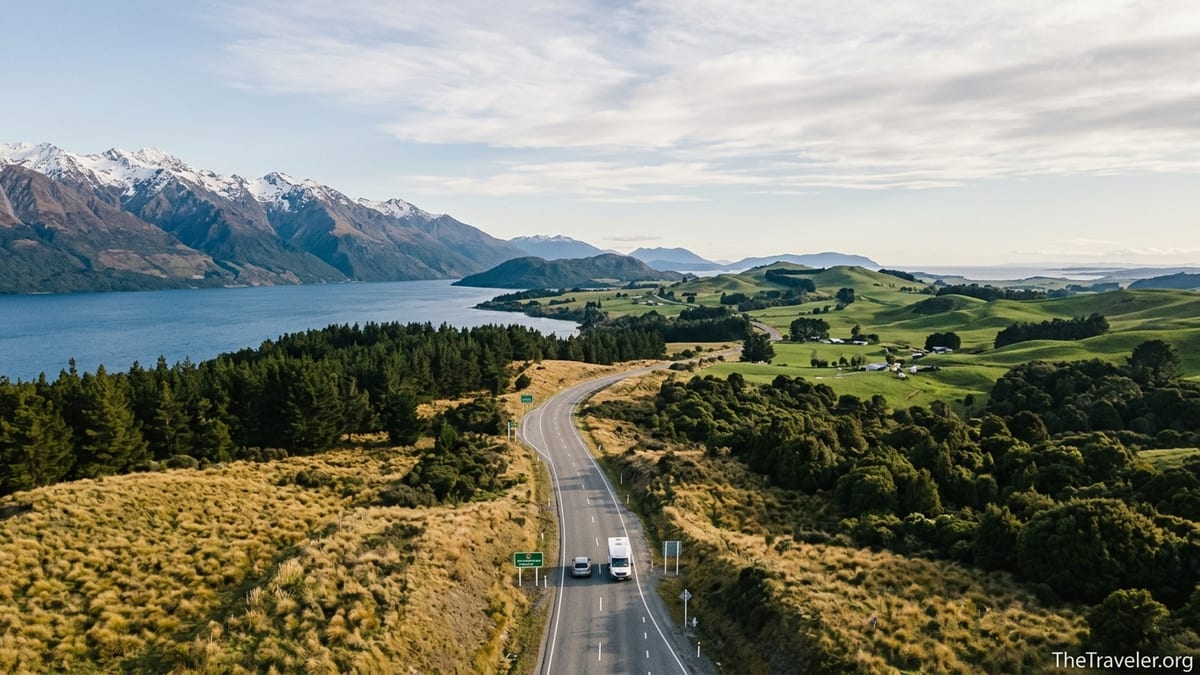
North Island, South Island or Both: Make the Big Decision First
The single most important choice is whether you focus on one island or try to split time between both. With only 7 to 10 days on the ground, most repeat visitors and local planners now recommend picking either the North Island or the South Island and exploring one region properly instead of rushing between them. Travelers often underestimate driving times, weather delays, and the mental fatigue of constantly checking in and out of accommodation, especially after a long-haul flight from North America or Europe.
Broadly speaking, the North Island combines the country’s biggest city and air hub Auckland, the cultural and geothermal spine between Rotorua and Taupō, coastal scenery like Northland and the Coromandel, and the capital city Wellington. The South Island offers the Southern Alps, the fiords of Fiordland, Queenstown and Wānaka for adventure activities, and a more dramatic feeling of space. If you only have a week, a concentrated loop such as Auckland to Rotorua and Taupō, then back via the Coromandel, will feel far more pleasant than sprinting down to Wellington and over the Cook Strait just to say you have “done” both islands.
Once you reach about 14 days in New Zealand, combining both islands becomes more realistic, especially if you are willing to use one or two domestic flights to avoid long backtracking drives. Three weeks is the tipping point where an Auckland to Queenstown one-way journey, with a mix of road trip sections and at least one scenic Cook Strait ferry crossing, can flow naturally without every day feeling like a transfer day. Anything longer than three weeks gives you the luxury to add second-tier but deeply rewarding regions like Northland, Taranaki, Nelson Tasman, or the Catlins.
The key is to start with your non-negotiables. If you are set on visiting Hobbiton and sailing Milford Sound, for example, you are already committing to both islands: Hobbiton is south of Auckland on the North Island, while Milford Sound boat trips typically depart from the South Island towns of Te Anau or Queenstown. In that scenario, your route needs to be built around connecting those anchors efficiently rather than drawing a loop that touches every bay and national park on the map.
Smart Arrival and Departure Airports to Reduce Backtracking
International visitors most commonly arrive in Auckland, New Zealand’s main hub, with frequent long-haul links to North America and Asia. Christchurch and Queenstown on the South Island, and Wellington on the lower North Island, also handle international flights but with fewer direct long-haul options. A realistic route starts by matching your arrival and departure airports to your goals, then filling in the middle. For example, if your dream is mostly glaciers, alpine scenery and fiords, it can make sense to land in Christchurch, road-trip the South Island, and depart from Queenstown without ever flying through Auckland.
Using a one-way “open-jaw” ticket is one of the simplest ways to reduce backtracking. A classic example is flying into Auckland, traveling south via Rotorua, Taupō and Wellington, crossing the Cook Strait to Picton, then continuing through the South Island to finish in Queenstown and fly out from there. Domestic flights between these main centers are frequent: government aviation data for 2026 lists high-capacity jet routes such as Auckland to Wellington, Auckland to Christchurch, Wellington to Queenstown and Auckland to Queenstown served multiple times per day, mainly by Air New Zealand and Jetstar. These flights often take about 1 to 1.5 hours, turning a full day of driving into a manageable morning hop.
If round-trip tickets into and out of Auckland are significantly cheaper, you can still trim backtracking by inserting a domestic flight at the end. One common strategy is to fly into Auckland, travel overland all the way to Queenstown, then fly directly from Queenstown back to Auckland for your international departure. This approach is especially useful in peak summer season from December to February, when rental car relocation fees for picking up in the North Island and dropping in the South can be higher.
On shorter trips confined to one island, using different airports on the same island can also help. On the North Island, arriving in Auckland and departing from Wellington allows an elegant north-to-south progression with minimal need to double back. On the South Island, flying into Christchurch and out of Queenstown works well for a route that includes the east coast, the Southern Alps and Fiordland without having to drive back to your starting point at the end.
How Long Do You Really Need: Pacing and Driving Days
New Zealand’s roads are scenic but slow. Two-lane highways, winding passes, frequent photo stops and single-lane bridges all mean that a 250-kilometre drive can routinely take four hours or more, even in good weather. This is why Tourism New Zealand’s official touring map and sample itineraries are now built around broad time bands like 7–10 days, 14–21 days and 3–4 weeks rather than ambitious every-town loops. A common rule of thumb among local trip planners is to design no more than one substantial driving day every second or third day, with shorter hops or local exploring in between.
For a one-week North Island trip, that might look like three bases: two or three nights in Auckland and nearby beaches, three nights around Rotorua and Taupō, and one or two nights in Waitomo or the Coromandel Peninsula. The longest drive in that plan, such as Rotorua to the Coromandel, is likely to take four to five hours with breaks. Trying to force Wellington and the Cook Strait ferry into this same week means several days of little but packing, driving and checking in, which quickly erodes the joy of the journey.
On the South Island, driving days are longer again but also some of the most memorable parts of the trip. The road between the West Coast glaciers and Wānaka, passing through the Haast Pass, or the section from Queenstown to Te Anau on the way to Milford Sound, is full of viewpoints and short walks. Realistically, you need to treat a day labeled “Queenstown to Franz Josef” or “Christchurch to Tekapo and Mount Cook Village” as a full travel day, despite the distance looking short on a map. Many trip reports from 2025 and 2026 show first-time visitors underestimating how often they will want to pull over for photos or a 30-minute waterfall walk.
Rental car costs also influence pacing. Recent traveler reports and 2026 pricing videos suggest that a compact hire car typically runs somewhere around 60 to 90 New Zealand dollars per day in high season, before the cost of fuel, insurance and ferry crossings for the vehicle. Given that you are paying for every calendar day the car is in your possession, it makes financial sense to cluster your long drives into fewer days and then park the car for multiple nights in key hubs such as Queenstown, Rotorua or Wellington, where you can join day tours or use local shuttle services instead of constantly moving hotels.
Cook Strait Crossing, Domestic Flights and When to Skip the Ferry
The Cook Strait between Wellington on the North Island and Picton on the South Island is both a practical transport link and a tourism experience in its own right. Two main companies, Interislander and Bluebridge, operate vehicle and passenger ferries year-round. Recent timetables show several sailings per day in each direction, with typical journey times of about three to three and a half hours, not including check-in time at the terminal. For many travelers, sailing out of Wellington Harbour past the city’s hillside suburbs and then winding through the Marlborough Sounds into Picton is one of the standout memories of the trip.
However, the ferry is not always the most efficient option, especially on short itineraries. You need to account for boarding times, potential delays in rough weather and the fact that the ferry ports are not located right next to the main tourist regions you may want to visit next. For example, after arriving in Picton you still need to drive at least two hours to reach Nelson or Blenheim, and significantly longer if your next overnight is on the West Coast or around Kaikōura. In shoulder seasons, some travelers now choose to drop their rental car in Wellington, take the ferry as foot passengers, and pick up a new vehicle in Picton or fly onward from Wellington to a South Island airport instead.
Domestic flights can be powerful tools to simplify a two-island itinerary. Routes such as Auckland to Queenstown, Wellington to Queenstown, and Auckland to Christchurch are operated by jets several times per day, and many trip planners use them to jump directly from the far north of one island to the deep south of the other in around 90 minutes. If you are planning only 10 to 12 days total and insist on both islands, a common pattern is to focus a few days on North Island highlights like Auckland, Hobbiton and Rotorua, then fly straight to Queenstown to spend the bulk of your time among the mountains instead of devoting two full days to overland travel and a ferry crossing.
Weather is another factor. The Cook Strait has a reputation for rough seas when southerly winds funnel through the gap, and while crossings are safe, some sensitive travelers prefer to avoid the possibility of seasickness during a tight schedule. Airlines are not immune to disruption either, particularly during winter fog or strong winds in Queenstown, but government transport reports for 2026 show on-time performance on core domestic jet routes broadly in line with other developed countries, making them a dependable component of most itineraries.
Natural Route Connections on Each Island
On the North Island, a logical southbound route begins in Auckland and flows through the central and eastern corridor. A common pattern for a 9 or 10 day trip is Auckland to the Coromandel Peninsula for beaches and coastal walks, then back through Matamata for a visit to the Hobbiton Movie Set, onward to Rotorua for geothermal activity and Māori cultural experiences, then south to Lake Taupō and finally to Wellington. Destinations like Northland and the Bay of Islands, beautiful as they are, sit in the opposite direction from this main corridor. Trying to include both the Bay of Islands and Wellington in a single short trip forces you to double back through Auckland and effectively burns most of a day on the highway.
If you prefer a west-coast slant, you could design a route from Auckland through the surf beaches near Raglan, across to Waitomo for glowworm caves, then to Rotorua and Taupō before heading to the art deco city of Napier and wine region of Hawke’s Bay. From there, you can either cut back inland toward Taupō and then down the Desert Road to Wellington, or fly from Napier to Wellington or Christchurch to connect with the South Island. The key is to link regions that naturally sit along the same transport spine instead of zig-zagging between distant peninsulas.
On the South Island, a natural loop connects Christchurch, Tekapo, Aoraki Mount Cook Village, the West Coast glaciers, Wānaka, Queenstown and back via the interior. Another variation follows the east coast from Christchurch through Kaikōura for whale watching, on to Blenheim and the Marlborough Sounds, then down the West Coast to the glaciers and inland to Queenstown. If your time is limited to 10–12 days, most route planners advise choosing either an east-and-interior focus (Christchurch, Tekapo, Mount Cook, Queenstown, Fiordland) or a coastal-and-alps focus (Christchurch, Kaikōura, Nelson Tasman, West Coast, Wānaka, Queenstown) rather than attempting both plus the deep south around Invercargill and the Catlins.
Transport infrastructure very gently nudges you into these patterns. Scenic rail routes like the TranzAlpine between Christchurch and the West Coast, and the Coastal Pacific between Picton and Christchurch, as well as domestic flights between Christchurch, Nelson, Queenstown and Dunedin, all align with these natural corridors. If you are considering long-distance buses, you will notice that many follow the same axes: Christchurch to Queenstown via Tekapo and Cromwell, or Nelson to the West Coast and down to Franz Josef and Fox Glacier. Your job as a route planner is usually to choose one or two of these spines and resist the temptation to branch off into every side valley.
Route Examples for Different Trip Lengths
For about 7 days on the North Island, a realistic example is to arrive in Auckland on day one, stay in the central city or a nearby beach suburb like Takapuna to recover from the flight, then head to Rotorua on day two. Spend two nights in Rotorua and one night in nearby Taupō, breaking up the drive with stops at geothermal parks or short walks such as the Huka Falls trail. On day five, you could either drive back toward the Coromandel Peninsula for two nights near Whitianga, or return slowly to Auckland via Hobbiton and the Waitomo glowworm caves before flying out on day seven or eight.
A 10-day South Island sample might start in Christchurch, with a night to adjust and pick up a rental car. From there, drive to Lake Tekapo and Aoraki Mount Cook Village for two nights to enjoy stargazing and alpine walks, then continue over the Lindis Pass to Wānaka for two nights. After that, move to Queenstown for three nights, using one day for a trip to Milford Sound or Doubtful Sound and another for local activities like a lake cruise or gondola view. Finish with a domestic flight from Queenstown back to Christchurch or Auckland for your international departure. This itinerary acknowledges that you simply will not reach the West Coast glaciers or Abel Tasman in 10 days, and that is acceptable.
With around 18 to 21 days and a desire to see both islands, a commonly recommended pattern is to arrive in Auckland, spend two or three nights including a visit to Hobbiton or a day trip to Waiheke Island, then move to Rotorua and Taupō for three nights. From there, drive to Wellington over one full day, stop for at least one or two nights in the capital, then cross the Cook Strait on the ferry to Picton. Spend two or three nights between Picton and Nelson, perhaps exploring Marlborough wine country or kayaking in the Marlborough Sounds, then continue down the West Coast through Punakaiki, Hokitika and the glaciers over four or five days. Finish with two nights in Wānaka and three in Queenstown, including a fiord cruise, before flying out from Queenstown.
For trips of a month or more, many travelers adopt a “slow two-island” strategy. They might spend two full weeks on the North Island, with several nights in Northland, two or three nights on the Coromandel, and a stretch in Taranaki or around New Plymouth for hiking and surf. After that, they cross to the South Island and devote a similar length of time to the Nelson Tasman region, the West Coast, Queenstown and Fiordland, potentially adding secondary regions like the Catlins or the Mackenzie Country around Twizel. Even on these longer trips, what you leave out is as important as what you include; for example, you might choose to skip Dunedin and Stewart Island entirely in order to have four slow days in Abel Tasman National Park instead of just one rushed afternoon.
What You Realistically Need to Leave Out
Many first-time itineraries try to include the Bay of Islands, Coromandel, Rotorua, Taupō, Tongariro, Wellington, Abel Tasman, West Coast glaciers, Queenstown, Fiordland and the Catlins in a two-week window. On paper, mapping services might claim that the drives are only five or six hours between each stop, making it seem possible. On the ground, continuous packing, unpacking, grocery stops, fuel stations and photo breaks mean that these 5–6 hour drives easily expand to all-day affairs. This leaves little daylight for walking tracks, cultural experiences or simply sitting with a coffee and taking in the view.
A practical approach is to designate one or two “sacrifice zones” based on your interests and the season. If you are visiting in winter and care more about alpine scenery than beaches, it is reasonable to skip the Coromandel and much of Northland, focusing instead on Rotorua, Tongariro National Park and then flying south to Queenstown. If you are traveling in early summer and have already seen glaciers elsewhere, you might decide to leave out Franz Josef and Fox Glacier in favor of more time walking in Abel Tasman National Park or wine tasting in Marlborough.
Some regions are best treated as self-contained add-ons when time allows. Stewart Island, accessible by ferry or short flight from the southern city of Invercargill, is a wonderful place for birdwatching and quiet coastal walks but is realistically an extra two or three days by the time you get there and back. The same is true of remote peninsulas like East Cape on the North Island or the remote valleys of inland Canterbury. They reward slow travel but should not be bolted onto an already tight North plus South itinerary that is struggling to include core highlights.
Resetting expectations at the planning stage pays off once you are on the road. Many recent trip reports mention that the most memorable days were the “nothing special” ones: an unplanned picnic beside Lake Wakatipu near Queenstown, a full afternoon in a Rotorua forest instead of rushing to another town, or an extra night in Wellington to explore its compact waterfront and national museum without time pressure. Building in this slack time almost always requires leaving some famous place off the list.
The Takeaway
New Zealand rewards travelers who think in terms of time bands, natural route connections and energy levels, rather than colored lines that cover every corner of the map. Begin by deciding whether your available days justify focusing on one island or comfortably splitting time between both, then match your arrival and departure airports to that choice. Aim for no more than one serious driving day every couple of days, and let domestic flights and the Cook Strait ferry do some of the heavy lifting instead of treating every journey as a road trip.
Most of all, be willing to say no. You do not have to see the Bay of Islands, Abel Tasman, Milford Sound and every glowworm cave on your first visit, and in practice you cannot do so without turning your trip into a sequence of rushed transfers. A well-paced route that flows naturally, with enough unscheduled time to linger in places you love, will feel richer and more memorable than an exhausting checklist. New Zealand’s landscapes are not going anywhere, and a realistic itinerary today often becomes the best excuse to come back tomorrow.
FAQ
Q1. Is it worth visiting both the North and South Islands on a 10-day trip?
For most travelers, 10 days is enough for one island or a quick sample of both if you add at least one domestic flight. Trying to drive and ferry between them usually creates too many long transfer days and not enough time on the ground in each place.
Q2. How far in advance should I book the Cook Strait ferry?
In peak season from December to March, it is wise to book several weeks ahead, especially if you are taking a vehicle. Outside those months, you often find space closer to departure, but booking in advance still gives you better choice of sailing times.
Q3. Are New Zealand driving times on maps realistic?
Online maps are a useful baseline, but New Zealand’s winding roads, photo stops and single-lane bridges mean you should add at least 20 to 30 percent to stated times. A drive listed as four hours can easily become five once you factor in fuel, food and viewpoint breaks.
Q4. Should I start my trip in Auckland or Christchurch?
Choose based on your priorities. If you are focusing on North Island highlights or want to visit Hobbiton and Rotorua, Auckland makes sense. If your main interest is South Island scenery such as Tekapo, Queenstown and Fiordland, starting in Christchurch or Queenstown can reduce backtracking.
Q5. Do I need a car, or can I rely on buses and tours?
A rental car provides the most flexibility and access to trailheads and small towns, but coach networks and day tours can work for travelers who are uncomfortable driving. In that case, plan around major hubs like Auckland, Rotorua, Wellington, Christchurch and Queenstown where organized excursions are plentiful.
Q6. How many domestic flights are reasonable on a two-week itinerary?
One or two well-placed flights are usually enough. For example, you might fly from Auckland to Queenstown or Christchurch to avoid two long days of driving, then do the rest of the trip overland so you still experience New Zealand’s famous scenic roads.
Q7. What is a realistic daily budget for a self-drive trip?
Budgets vary widely, but many mid-range travelers report spending roughly the cost of a modest hotel room, car hire, fuel, food and one paid activity every few days. Rental cars might run from about 60 to 90 New Zealand dollars per day in high season, and fuel and meals add significantly to that.
Q8. Is it better to cross the Cook Strait with my car or rent separate cars on each island?
Both approaches work. Taking your car is convenient if you have a lot of luggage or camping gear but adds ferry costs for the vehicle. Dropping one car in Wellington and picking up another in Picton or flying onward can save money and simplify logistics on shorter trips.
Q9. How much time should I spend in Queenstown?
Many visitors find that three nights is a good minimum, giving two full days for an alpine activity, a fiord cruise or day tour, and time to enjoy the town itself. If you want to mix adventure activities with hiking and side trips, four or five nights can feel pleasantly unhurried.
Q10. What are the biggest itinerary mistakes first-time visitors make?
Common pitfalls include trying to see the entire country in two weeks, underestimating driving times, booking one-night stays in too many places, and not allowing for bad weather in alpine regions. Building in buffer days and accepting that you will not see everything usually leads to a more enjoyable trip.