


Freedom camping is one of the great road trip traditions in New Zealand, but from June 2026 the rules are much tighter than many visitors realise. If you are hiring a campervan or planning a self-drive adventure, it is no longer safe to assume that you can pull over and sleep anywhere. This guide explains what freedom camping actually means under current New Zealand law, how the new green self-containment warrants work, and how to find legal places to stay without risking expensive fines.
What “freedom camping” really means in New Zealand law
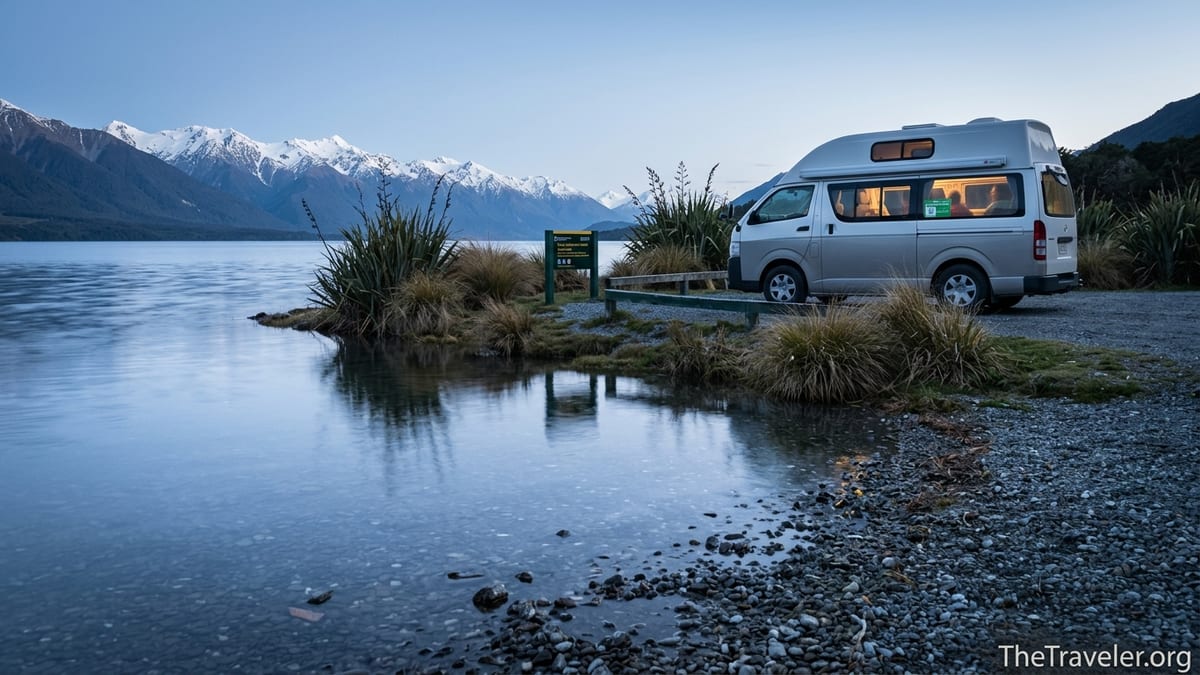
In everyday conversation, many travellers use “freedom camping” to mean any kind of free or cheap camping. Under New Zealand law it is much more specific. Freedom camping means sleeping in a tent, vehicle, or other temporary structure on public land that is not a formal campground, usually outside a serviced holiday park or commercial camping ground. It covers everything from parking a campervan overnight at a lakefront car park to pitching a tent beside a river on public land.
The key point is that freedom camping only happens on public land that is managed by a local council, the Department of Conservation (DOC), Waka Kotahi NZ Transport Agency, or certain other public bodies. If you are staying at a DOC campsite with a booking, or at a privately owned holiday park that charges nightly fees, you are not freedom camping even though you might be in the same van. This distinction matters because different enforcement rules, fines, and standards apply.
It is also important to understand that simply “sleeping in your vehicle” in a public place will usually be treated as freedom camping, even if you tell an enforcement officer you were just resting for a few hours. In practice, if you are using a public car park, roadside layby, or lakeside reserve as an overnight sleeping spot, you should assume the freedom camping rules and penalties apply, especially in popular regions such as Queenstown Lakes, Rotorua, or the Coromandel Peninsula.
Finally, freedom camping rules do not apply to genuinely homeless people, but this is a narrow exception and does not cover tourists or most long-term vehicle dwellers. Travellers are expected to use legal sites, respect restrictions, and move on when required by enforcement staff.
Where freedom camping is permitted in 2026
New Zealand’s default legal position is that freedom camping is allowed on most public land, unless it is expressly prohibited or restricted. In reality, a growing number of councils and DOC areas have detailed rules that carve out large zones where camping is either banned or tightly controlled. That means you cannot simply rely on the old advice that “if there is no sign, it is fine.” Signs are still important, but they are only part of the picture.
On council-managed land, each district or city adopts its own freedom camping bylaw. These bylaws divide parks, reserves, roadside laybys, and town car parks into zones. Some allow freedom camping only in certified self-contained vehicles, some only allow it in marked bays, some limit stays to one or two nights every 30 days, and some prohibit freedom camping entirely. For example, Christchurch City Council prohibits freedom camping in most of the central city but allows certified self-contained vehicles to stay in specific areas near New Brighton and Akaroa for limited periods.
On DOC land, the rules are set through freedom camping notices and site-specific regulations. Many popular conservation areas, such as parts of Fiordland or Tongariro National Park, only allow camping within formal DOC campsites or designated freedom camping areas. In practical terms this means that, even deep in the back country, you might need to stay at a marked DOC site rather than simply camping at the end of a road. DOC’s online maps and visitor centres are the best way to check which conservation car parks permit overnight stays in vehicles.
On NZ Transport Agency (NZTA) land, such as highway rest areas, the default position used to be more relaxed. Now, several councils treat at least some rest areas as local authority land for the purposes of their bylaws. As a traveller, you should not assume that sleeping at a roadside scenic lookout is automatically allowed. Always look for updated signs and, when in doubt, move on to a clearly identified campsite or holiday park rather than risk a fine.
Council land vs DOC land: two different rulebooks
Visitors often assume that there is a single national freedom camping rulebook. In reality there are at least two major systems to understand: local council bylaws for council and NZTA land, and DOC rules for conservation land. The Freedom Camping Act allows both councils and DOC to tailor their rules to protect the environment and manage visitor pressure, so what is allowed in one district may be illegal in the next.
On council land, bylaws tend to be tightly focused on busy coastal areas, town centres, suburban streets, and sensitive reserves. For instance, a beach reserve in the Bay of Plenty might be completely closed to freedom camping, while a nearby inland reserve beside a sports ground allows certified self-contained vehicles for one night. Councils publish maps that show green “allowed” zones, orange restricted areas, and red prohibited areas, and enforcement officers generally work from those maps when issuing tickets.
On DOC land, the thinking is slightly different. DOC manages around one third of New Zealand’s land area and wants to encourage low-impact access, so it operates hundreds of formal DOC campsites. Some road-end car parks and remote lakeshore spots are still open to freedom camping, but DOC will usually shift pressure toward its official campsites where toilets and basic facilities can manage the impact. For example, instead of allowing vans to sleep in random bays around Lake Pukaki, DOC directs visitors to formal campsites on the lake’s shore where parking and waste are controlled.
The practical takeaway for travellers is that you must always ask two questions: who manages this land, and what are their specific rules? A roadside spot that is legal under DOC rules might be illegal under the local council bylaw, or vice versa. Visitor centres, council offices, and official websites remain the most reliable sources, especially when local residents give conflicting advice.
Self-contained vehicles, green warrants and the end of the transition period
The biggest change affecting freedom campers in 2026 is the new national self-containment system. The Self-contained Motor Vehicles Legislation Act 2023 and subsequent regulations introduced tighter standards and a new green warrant card. The transition for private vehicles was extended, but it finished on 7 June 2026. From that date, almost all vehicles used for freedom camping in public places must meet the new standard and display a current green self-containment warrant.
Under the new rules, a certified self-contained vehicle must have a fixed, plumbed-in toilet that can be used inside with adequate headroom and privacy. Portable cassette toilets that are stored under a bed and set up outside usually do not meet the standard. The vehicle also needs sufficient fresh water storage, greywater collection, and a way to store or dispose of rubbish hygienically for at least three days. Certification is carried out by approved authorities, and the details are recorded in a national register.
A valid green warrant card must be displayed on the vehicle, typically on a side window near the front passenger seat, and the owner must keep a matching certificate inside the vehicle. Rental campervans from major brands such as Maui, Britz, Jucy, and Apollo will generally come with the green warrant already in place, and the rental agreement will state whether the vehicle is certified self-contained. Budget “sleeper vans” without their own toilet and water system usually cannot be certified and therefore cannot be used for freedom camping in most public areas.
During the long transition, many private vehicles carried blue self-containment warrants. Those blue warrants were gradually phased out for freedom camping purposes. As of mid 2026, any traveller relying on a blue sticker should check very carefully, as most councils and DOC now require the new green warrants except at sites that explicitly allow non self-contained vehicles. If your van does not have a green card, plan to stay at DOC campsites or holiday parks with toilets and showers rather than free roadside spots.
Local bylaws, prohibited areas and fines
Even with a fully certified self-contained vehicle, you cannot park just anywhere. Local bylaws and DOC notices decide where freedom camping is allowed, restricted, or banned. Councils use these powers for reasons such as protecting fragile dunes and wetlands, reducing pressure on suburban streets, and managing noise and rubbish in popular tourist towns. In 2026, it is common to see entire town centres, beachfronts, and lakefront promenades marked as prohibited zones.
Concrete examples help illustrate how this works. In Akaroa on Banks Peninsula, Christchurch City Council prohibits freedom camping on most council land in the township but allows a small number of marked bays where certified self-contained vehicles can stay for up to two nights in any thirty day period. In some parts of the Coromandel Peninsula, council bylaws completely ban freedom camping at busiest holiday beaches during peak season, pushing visitors toward nearby paid campgrounds instead. Similar patterns exist in Queenstown, Wanaka, and Taupo, where local residents have pushed back strongly against overcrowded laybys and lakeside reserves.
Fines for breaching the rules can be significant. Current national regulations allow infringement fees of around 200 to 400 New Zealand dollars for common offences such as camping in a prohibited area, staying longer than allowed, failing to display a self-containment warrant, or camping with an expired certificate. In more serious or repeated cases, councils can seek higher penalties through the courts and can even seize or impound offending vehicles. A 400 dollar ticket for one illegal night in a lakeside car park can quickly wipe out the savings from avoiding a 50 to 70 dollar holiday park fee.
Enforcement officers typically patrol popular areas in the evening and early morning. They may photograph vehicles, check registration plates against the self-containment register, and issue tickets even if you are asleep. Arguments that “there was no sign” or “we arrived late and were leaving early” rarely succeed as defences. The most practical approach is to research each district in advance, use official maps or apps in real time, and move if an officer advises that you are not in a legal spot.
Dump stations, waste rules and finding legal sites
New Zealand’s stricter self-containment rules are closely linked to waste management. A certified self-contained vehicle must have enough capacity for several days of water use, but that only works if travellers actually empty their tanks and toilets at legal dump stations. Using public toilets or storm drains to dispose of waste is illegal and strongly policed in popular regions such as Northland and Otago.
Public dump stations are widely available, especially along main touring routes. Many are located at council service areas, i-SITE visitor centres, fuel stations, and commercial holiday parks. Some are free, while others charge a small fee or require you to be a paying guest. For example, a holiday park in Rotorua might allow non-guests to use its dump station for 10 to 15 dollars, while a council-run facility beside a state highway rest area may be free but have shorter opening hours. Always plan your route so that you pass a dump station every few days, particularly if you are travelling with several people in a small camper.
To find legal sites, most travellers rely on a mix of official information and crowd-sourced apps. Council websites and DOC’s campsite listings remain the authoritative sources, especially because they are updated when bylaws change or sites are closed temporarily. Apps that show coloured pins for freedom camping spots, DOC campsites, and private campgrounds can be very useful for on-the-road planning, but you should always cross-check locations against current council maps or printed brochures picked up from local visitor centres.
When you arrive at a potential site, look carefully for entrance signs that specify who can stay, how many nights are allowed, and what kind of vehicle is required. A small rural reserve might have a sign reading “Freedom camping for certified self-contained vehicles only, maximum two nights” with icons for toilet and rubbish bins. Another reserve just a few kilometres away might be clearly marked “No freedom camping.” These signs override older guidebooks and blog posts, and enforcement officers will expect you to follow the wording on the ground rather than something you saw online months earlier.
Freedom camping vs DOC campsites vs holiday parks
One of the biggest misconceptions among visitors is that renting a campervan automatically gives them a “right” to park overnight almost anywhere. In reality, there are three distinct types of overnight stay to understand: freedom camping on public land, staying at DOC campsites, and staying at private holiday parks or commercial campgrounds. The price, facilities, and rules differ sharply between them.
Freedom camping sites are usually free or very low cost and may have no facilities beyond a simple car park or grass area. They are best suited to certified self-contained vehicles that can manage their own toilet, water, and rubbish. A classic example is a riverside reserve in a rural district that allows four or five vans to stay behind a simple bollard barrier, with a basic long-drop toilet and maybe a rubbish bin. In exchange for this low cost, you accept that space is limited, there might be road noise, and enforcement officers can move you on if the site becomes overcrowded or damaged.
DOC campsites sit in the middle. They are formal campgrounds on conservation land, usually with toilets, water supply, and basic cooking shelters. Prices vary but many standard DOC campsites cost in the region of 10 to 20 dollars per adult per night, with discounts available through DOC campsite passes. Examples include lakeside DOC camps near Te Anau, forest camps along the West Coast, or beachside sites in Northland. At these camps you might stay in a tent, a non self-contained van, or a large motorhome, as long as you pay the fee and follow the campground rules.
Holiday parks and private campgrounds are at the more comfortable end of the spectrum. They offer powered sites, hot showers, kitchens, laundries, and often playgrounds or hot tubs. A powered site for two adults in a popular summer destination such as Queenstown or Mount Maunganui might cost 60 to 90 dollars per night in peak season, while smaller rural parks may be significantly cheaper outside holidays. For many overseas visitors, mixing occasional freedom camping with regular nights in holiday parks is the most practical strategy, allowing them to recharge batteries, wash clothes, and enjoy hot showers while still taking advantage of some free or low-cost nights in between.
Practical planning tips for a 2026 campervan trip
For travellers arriving in New Zealand in late 2026 or beyond, the best strategy is to treat freedom camping as one tool in a broader mix of accommodation options rather than the default. Begin by choosing the right vehicle. If you want the flexibility to freedom camp in more places, rent or buy a fully certified self-contained campervan with a green warrant card and a fixed toilet. Accept that the daily rental price will be higher than a basic sleeper van, but remember that you may save money by being able to use a limited number of free council or DOC sites along the way.
Next, sketch a rough itinerary that includes a mix of freedom camping areas, DOC campsites, and holiday parks. For example, on a circuit from Auckland through the Coromandel and Bay of Plenty, you might stay two nights at a commercial holiday park in Coromandel Town, one night at a DOC campsite near Hot Water Beach, and then a permitted night of freedom camping at a small inland reserve in the Waikato before returning to Auckland. In the South Island, a loop from Christchurch to Queenstown and back might combine DOC camps at Lake Tekapo, holiday parks in Wanaka or Queenstown, and one or two legal freedom camping spots in quieter inland districts.
Finally, build some slack into your plans. Summer storms, fire danger, or local events such as music festivals can prompt councils to temporarily close or restrict freedom camping sites. When you pull into a town and find that your preferred riverside reserve is closed or full, you will be less stressed if you already know the location of the nearest DOC campsite or holiday park. Keeping a small contingency budget for these nights is much cheaper and more enjoyable than gambling on a questionable parking spot and waking up to a 400 dollar infringement notice.
The Takeaway
New Zealand remains one of the world’s best destinations for road trips in a campervan, but as of 2026 freedom camping is heavily regulated and more complex than it was a decade ago. The end of the transition period for green self-containment warrants means that only properly equipped vehicles can freedom camp legally at most public sites. Local bylaws and DOC notices now carve the country into a patchwork of allowed, restricted, and prohibited areas, and infringement fees for breaking the rules can quickly erase any savings from a free night.
If you approach your trip with realistic expectations, respect local communities, and use a blend of freedom camping areas, DOC campsites, and holiday parks, you can still enjoy remote beaches, mountain lakes, and quiet forests without putting pressure on fragile environments. Treat the legal framework as part of travelling responsibly rather than an obstacle, and you will find that New Zealand’s freedom camping culture is still alive, just more carefully managed than before.
FAQ
Q1. Can I freedom camp anywhere in New Zealand if my campervan has a green self-containment warrant?
Having a green self-containment warrant does not give you the right to park overnight wherever you like. It simply means your vehicle meets the national standard for managing toilet and waste. Local council bylaws and DOC rules still decide which specific areas allow freedom camping, which are restricted, and which are completely prohibited.
Q2. What is the main difference between freedom camping and staying at a DOC campsite?
Freedom camping happens on public land outside formal campgrounds and is usually free or very low cost, but often with minimal or no facilities. DOC campsites are official campgrounds on conservation land with toilets and basic infrastructure, and usually charge a per person fee. When you stay at a DOC campsite you are not treated as a freedom camper for legal purposes.
Q3. Do I need a self-contained vehicle to stay at all DOC campsites?
No. Many DOC campsites accept tents and non self-contained vehicles as long as you pay the fee and follow the campsite rules. The self-containment requirement mainly affects whether you can freedom camp outside formal campgrounds. However, some DOC vehicle-accessible sites may still require certified self-contained vehicles, so always check the individual campsite information.
Q4. Are blue self-containment stickers still valid for freedom camping after June 2026?
The long transition period that allowed some blue self-containment warrants to be used for freedom camping has ended. After June 2026, most councils and DOC sites require vehicles used for freedom camping to display a current green warrant that shows compliance with the new national standard. If you still have a blue sticker you should not rely on it without checking very carefully for any remaining limited exceptions.
Q5. How much are the fines for illegal freedom camping?
Typical infringement fees for common offences such as camping in a prohibited area, failing to display a self-containment warrant, or using an expired certificate are in the range of a few hundred New Zealand dollars. In serious or repeated cases, total penalties can be higher and authorities may seize or impound vehicles. These fines are regularly reviewed, so travellers should assume they will be significant enough to outweigh the cost of a legal campsite.
Q6. Can I sleep in a rental car or basic van without a toilet if I use public toilets nearby?
In most public places the answer is no. Using public toilets does not make a vehicle self-contained, and many districts now allow freedom camping only in certified self-contained vehicles with green warrants. You can still sleep in non self-contained vehicles at many DOC campsites and holiday parks, but roadside or lakeside freedom camping spots commonly exclude them.
Q7. How can I find legal freedom camping sites while travelling?
The most reliable approach is to combine official council and DOC maps with real-time information from visitor centres and reputable apps. Before entering a new district, check the council’s freedom camping map to see which areas are permitted, restricted, or prohibited. When you arrive at a potential site, read entrance signs carefully and move on if the rules are unclear or if the site is already full.
Q8. What facilities should I expect at a typical freedom camping site?
Facilities at freedom camping sites vary widely. Some are simple car parks with no toilets or water, intended only for fully self-contained vehicles. Others may provide a basic toilet, rubbish bins, or a picnic table. You should not expect hot showers, powered sites, or full kitchens at free locations. For those amenities you will usually need to stay at a DOC campsite with more infrastructure or at a private holiday park.
Q9. Are highway rest areas safe and legal places to sleep overnight?
Some highway rest areas allow overnight stays, but many are covered by local bylaws that restrict or prohibit freedom camping. Safety can also vary depending on traffic, isolation, and weather. Treat rest areas as short-term stops rather than guaranteed overnight spots, and always look for signs or guidance from the nearest visitor centre or council.
Q10. If I receive a freedom camping infringement notice, should I ignore it and leave the country?
Ignoring a freedom camping ticket is not advisable. Unpaid fines can be pursued through debt collection and may affect future dealings with New Zealand authorities. If you think a ticket was issued in error, follow the instructions on the notice to challenge it, provide evidence such as photos or site maps, and wait for the council or DOC to review your case.