


New Zealand looks small on the map, but once you start planning, it quickly becomes clear you cannot see it all in one holiday. Distances are longer than they appear, roads are scenic but slow, and almost every region claims a “must see” highlight. This guide focuses on the places that genuinely matter for most first-time visitors, explains what each destination is best for, and shows how to fit them together into a realistic road trip.
How to Choose Between Islands, Cities and Scenic Icons
The first decision for most travelers is how to divide limited time between the North and South Islands. If you have 7 to 10 days, many recent itineraries from New Zealand specialists now recommend concentrating on one island rather than rushing both. With 12 to 16 days you can usually sample both islands by flying one way and driving a loop on the other. Travelers on longer trips of three to four weeks can link several classic road routes into a full North and South Island journey without feeling rushed.
In practice, the South Island delivers the dramatic mountain-and-lake scenery that many visitors imagine when they picture New Zealand. Places like Queenstown, Aoraki/Mount Cook and Fiordland are built around alpine landscapes, glacier-fed lakes and winding passes, and they slot naturally into multi-day road trips. The North Island balances geothermal areas, Māori culture, easy beach breaks and the main international gateway cities, Auckland and Wellington. It suits travelers who want a mix of nature and culture, shorter driving days and slightly warmer weather overall.
This article focuses on the destinations that repeatedly appear in current, reputable itineraries and trip reports, rather than listing every possible stop. For each place you will find what it is genuinely best for, what makes it distinctive, how naturally it fits into a road trip, and whether it should sit near the top of a first-time visitor’s priority list. Along the way are concrete examples such as typical driving times, the feel of popular day tours, and how people are actually structuring their trips for 2025 and 2026.
Auckland and Northland: Gateways, Beaches and Bay of Islands
Most international flights land in Auckland, and many travelers now treat the city as either a short recovery stop or a soft introduction to New Zealand life rather than a major sightseeing base. One or two nights is usually enough for a stroll around the central harbor, a ferry ride across to Devonport or Waiheke Island, and a relaxed dinner in one of the waterfront precincts. For example, a common pattern is to arrive in the morning, check into a hotel near the Viaduct Basin, and spend the afternoon walking through the Britomart and Wynyard Quarter areas before an early night to reset from jet lag.
If you want beaches and subtropical scenery, the Bay of Islands and wider Northland region suit a three to five day detour. The drive from Auckland to Paihia typically takes about three hours in good conditions, and many visitors stop for coffee at a roadside town like Warkworth on the way. In the Bay of Islands, classic experiences include a half-day boat cruise among the islands, a short coastal walk with views over turquoise bays, and visits to historic sites that tell the story of early Māori and European encounters. Accommodation ranges from simple motels in Paihia to small lodges and beachfront holiday homes that are popular with families and small groups.
Northland fits naturally into a circular road trip that returns to Auckland along a different stretch of coast, often using the signposted Twin Coast Discovery Highway. Travelers with only 10 to 12 days overall sometimes skip this region in order to focus on the South Island, but for repeat visitors or those who love warm water and relaxed driving days, Northland and the Bay of Islands can easily absorb four or five nights at the start or end of a trip.
Rotorua and the Central North Island: Geothermal and Culture
Rotorua is the North Island destination that most rewards a specific stop rather than a quick pass-through. Within a compact area you can experience geothermal landscapes, lakeside walks, and structured introductions to Māori culture. Many itineraries now suggest spending two or three nights here, especially for families and travelers who prefer activities that are bookable and well organised. A typical day might start with a morning visit to a geothermal park with bubbling mud pools and geysers, followed by a soak in a spa complex with lake views, then an evening cultural experience with kapa haka performance and shared meal.
Getting to Rotorua is straightforward by rental car from Auckland in around three hours, often combined with a stop at a farm experience or at the well-known film set attraction near Matamata. The roads are sealed and relatively busy by New Zealand standards, although you should still expect winding sections and slower trucks. For travelers who do not want to drive immediately after a long-haul flight, an emerging pattern is to spend one night in Auckland, then collect a car the next morning and head straight to Rotorua for several days of exploring the central North Island.
Rotorua slots neatly into a broader North Island loop that might also include the Coromandel Peninsula for beaches or Taupō for lake and river activities. It is particularly worth prioritising for first-time visitors who want to understand Māori traditions beyond surface-level performances, since many local operators work closely with iwi and hapū and present stories connected to their own whakapapa. Even if your overall trip focuses more heavily on the South Island, two or three nights in Rotorua at the beginning can give your journey a cultural and geothermal dimension that you will not find later among the Southern Alps.
Wellington and the Cook Strait: Culture Hub and Island Connector
Wellington is both the capital city and the natural bridge between North and South Islands. For travelers who enjoy compact, walkable cities with strong food and coffee scenes, one or two nights here can be a highlight rather than just a transit stop. The central harborfront is easy to explore on foot, with public museums, restaurants and craft breweries all within a short distance. The national museum, located on the waterfront, is free to enter and offers well curated exhibitions on New Zealand’s natural history, social change and Māori perspectives.
From a practical standpoint, Wellington is also the departure point for ferries across Cook Strait to Picton in the South Island. Many self-drive itineraries build in a buffer night in Wellington before the crossing, since sailings can be delayed or cancelled by weather. A typical schedule might be to arrive in Wellington by mid-afternoon, drop the rental car at a central depot or secure car park, enjoy an evening in the Cuba Street and Courtney Place precincts, then take a morning ferry the next day. The three to three-and-a-half hour crossing offers views of both open water and the sheltered Marlborough Sounds.
Whether Wellington deserves a place on a first-time itinerary depends on your interests and total time. If you have fewer than 12 days and are primarily interested in mountains and fiords, you might reasonably fly directly between Auckland and a South Island hub such as Queenstown or Christchurch. If you enjoy galleries, live music, independent cinemas and the experience of a creative small capital city, Wellington is increasingly being treated as a destination in its own right, particularly by visitors who split their time more evenly between cities and wilderness.
Queenstown, Wanaka and Fiordland: Adventure Capital and Iconic Fiords
Queenstown is the South Island hub that anchors many first-time itineraries. Set on the shore of Lake Wakatipu and ringed by rugged peaks, it combines dramatic scenery with a very developed tourism infrastructure. Direct domestic flights connect it to Auckland and Wellington, and there are frequent shuttle transfers from the compact airport into town. Once there, visitors find a dense cluster of hotels, apartments, bars and tour operators, all within walking distance of the lakefront. It is common to spend three or four nights here, often without needing to use a car on days devoted to local activities.
The town is strongly associated with adventure tourism. Classic experiences include half- or full-day jet boat rides into narrow canyons, tandem bungy jumps or ziplines above the lake, and winter ski days at nearby resorts such as Coronet Peak and The Remarkables. Prices vary widely, but it is realistic to budget the equivalent of a few hundred New Zealand dollars per person for major activities such as bungy jumps or scenic flights. At the same time, Queenstown works well for lower-key travelers through lakeside walks, easy half-day hikes on the Ben Lomond track, and leisurely cruises on the historic steamship that crosses Lake Wakatipu to a working high country farm.
Queenstown also serves as a base for reaching Fiordland and Milford Sound, although the logistics require careful planning. The road journey to Milford Sound from Queenstown, including the stretch via Te Anau, takes roughly four hours each way in good weather, so many visitors opt for organised coach and cruise day trips or scenic flights. Others choose to overnight in Te Anau, reducing the travel time to the fiord, and to explore longer hiking tracks or lake cruises there. Milford Sound itself is usually experienced on a one-and-a-half to two-hour boat cruise beneath near-vertical granite walls and waterfalls, with a strong chance of rain or low cloud that adds to the atmosphere rather than spoiling it.
Nearby Wanaka, about a 60 to 70 minute drive from Queenstown over the Crown Range Road or via Cromwell, has grown into a softer alternative that many return visitors now prefer. It offers similar lake and mountain views with a calmer feel, a compact lakeside town and easier access to day walks in Mount Aspiring National Park. For first-timers with 10 to 14 days and a focus on the South Island, a realistic pattern is to fly into Queenstown, spend several nights there, take a trip into Fiordland, then drive on to Wanaka before continuing north or east.
Aoraki/Mount Cook, West Coast and Abel Tasman: Classic South Island Road Trip Arc
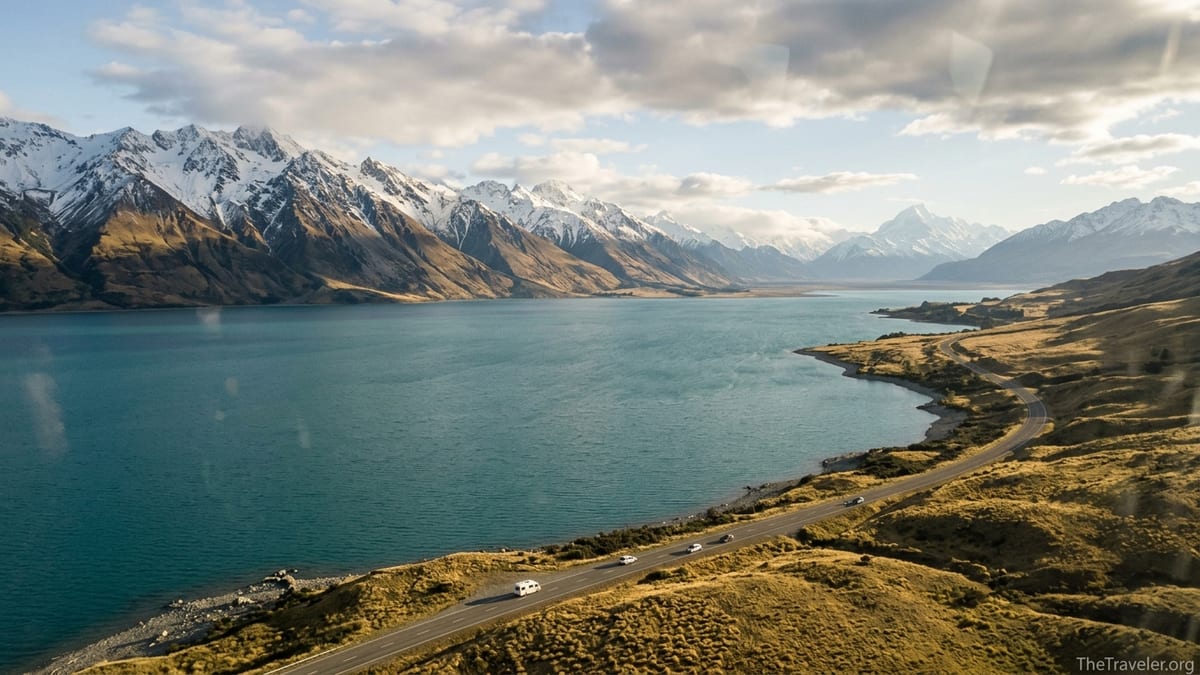
Aoraki/Mount Cook National Park represents the high alpine heart of New Zealand. Accessed by a sealed road along the shore of Lake Pukaki, it works best as an overnight stay or two-night stop within a longer South Island circuit. The tiny village at the road end is made up of lodges, motels and backpacker accommodation plus a visitor centre and a small number of eateries. Popular activities include short valley walks such as the Hooker Valley Track, which many visitors complete in around three hours, and scenic flights with glacier landings that depart from either Mount Cook Village or the larger town of Tekapo.
Driving between Queenstown or Wanaka and Aoraki/Mount Cook is one of the classic South Island road trip legs. Many recent trip reports describe the sense of progression as you leave the Otago lakes behind, climb over the Lindis Pass and then follow the turquoise water of Lake Pukaki toward the main divide. In settled weather it is realistic to complete the drive from Queenstown to Mount Cook Village in four to five hours without long detours, though most travelers add photo stops and a café pause in a small town such as Cromwell or Twizel. Because accommodation in the park is limited and in demand over summer, pre-booking is strongly recommended.
The West Coast of the South Island offers a different mood again. Between the Haast Pass and the small town of Westport, the road threads past rainforest, wild beaches and glacier valleys. Franz Josef and Fox Glacier have long been major stops, and while the retreat of the ice has changed some walking access in recent years, heli-hikes and scenic flights remain popular for those who want to step onto glacier ice. Hokitika and its nearby beach viewpoints often feature in current South Island loops as overnight stops that break the journey between the glaciers and larger centres such as Christchurch or Nelson.
At the northern tip of this arc, Abel Tasman National Park provides golden beaches and sheltered coastal waters in a compact, accessible package. The main gateway village of Marahau sits about an hour’s drive from Nelson. Typical experiences include half- or full-day sea kayak trips, water taxis that drop walkers at one bay and collect them from another, and relaxed beach time framed by forested headlands. Many travellers now allow two or three nights in the wider Nelson and Tasman region, combining Abel Tasman with local wineries and craft studios. On a first trip, this region is ideal for visitors who want at least a few classic beach days without committing to a much longer North Island coastal detour.
Coromandel, Bay of Plenty and Smaller Beach Towns: When Beach Time Matters Most
The Coromandel Peninsula and nearby Bay of Plenty towns provide some of the North Island’s most appealing beach landscapes, with forested hills dropping into coves and long, surf-friendly stretches of sand. Towns such as Whitianga, Whangamatā and Mount Maunganui are popular holiday bases for New Zealanders themselves, particularly around Christmas and January. For overseas visitors, these areas work best if you have at least three or four spare nights and are travelling in relatively settled summer weather between December and March.
Driving from Auckland to the Coromandel typically takes around two and a half to three hours depending on your exact destination and traffic, with the second half of the journey involving narrow, winding coastal roads. Many visitors break the trip with a stop in a small café town or at one of the simple roadside viewpoints. Once based on the peninsula, typical days might involve short coastal walks, time on the sand, and visits to hot pools and local art galleries. Some previously famous rock arch viewpoints have experienced access changes in recent years due to safety concerns and track damage, so it is worth checking the latest local advice through visitor centres when you arrive rather than relying on older guidebooks.
Because these beach regions sit somewhat off the most direct inland route between Auckland, Rotorua and Wellington, they are often the first to be trimmed when travelers compress a North Island itinerary. For a focused two-week trip that also includes the South Island, it is usually more efficient to gain your beach and warm-water time either in Northland at the very start or in Abel Tasman at the very end, rather than weaving east to the Coromandel in the middle. That said, repeat visitors and families on slower three- to four-week journeys often choose to spend a full week based in one beach town, using day trips to explore surrounding coves and estuaries.
Designing a Realistic New Zealand Road Trip
Putting the pieces together starts with a honest assessment of how much you like to drive. Many first-time visitors underestimate how tiring New Zealand roads can be. Even on state highways, single-carriageway sections, one-lane bridges and frequent curves keep average speeds low. A common rule of thumb used by local itinerary planners is to avoid more than four to five hours of actual driving time on any given day, and to build in at least two-night stays in most places. Reports from recent travelers on three-week trips often mention that their most memorable experiences came on days when the car barely moved.
For a 10- to 12-day South Island focused trip, a practical route might be to fly into Queenstown, spend three nights there with a day trip to Fiordland, then drive to Wanaka for two nights, Aoraki/Mount Cook for one or two nights, and finally either loop back to Queenstown or continue to Christchurch via Tekapo. This keeps daily drives to manageable lengths while still delivering alpine scenery, lakes, and at least one fiord or glacier experience. Those with more time can extend north up the West Coast to the glaciers and Hokitika, then cut back to Christchurch over Arthur’s Pass, turning the journey into a full loop.
If you prefer a mixed North and South Island journey of roughly two weeks, a different pattern is emerging in updated itineraries. One option is to spend a night or two in Auckland, three in Rotorua and the central North Island, fly south to Queenstown, then follow a shortened version of the South Island loop. Flying between islands saves a full day compared with driving and taking the ferry, and it reduces the risk of weather-related disruption. Travelers who strongly want the ferry experience and time in Wellington can reverse this by driving from Auckland to Rotorua and on to Wellington, taking the ferry to Picton, then heading down the South Island east coast by car or train.
Whatever your route, the key is to accept that you will not see everything and to choose anchor destinations that match your interests. If hiking and scenery are your highest priorities, you might allocate extra nights to Aoraki/Mount Cook, Wanaka and Fiordland and let some city time go. If culture, food and easy day trips appeal more, you might build the trip around Auckland, Wellington, Rotorua and Nelson with just a short alpine detour. Recent trip reports from visitors who tried to “do it all” in under two weeks are clear that constant motion is tiring and that meaningful experiences often come from lingering rather than ticking off extra stops.
The Takeaway
New Zealand rewards focus. With limited days, the best approach is not to chase a long list of place names, but to understand what each key destination offers and build a route that matches your style. Queenstown and Fiordland deliver dramatic peaks and fiords, Rotorua layers geothermal activity over Māori culture, Aoraki/Mount Cook and the West Coast give you glaciers and high-country roads, while Auckland, Wellington, the Bay of Islands, Coromandel and Abel Tasman supply cities, beaches and softer coastal scenery.
For a first trip, most travelers will be happiest choosing one or two cities as entry and exit points, then linking a handful of high-impact regions with realistic driving days and at least two nights in most stops. The examples in this guide reflect how people are actually travelling in 2025 and 2026: combining flights and road trips, accepting that weather on alpine passes and fiords is changeable, and leaving room in the schedule for a spontaneous extra hike, winery tasting or beach afternoon. New Zealand will still be there for a second visit. Planning with intention now simply increases the chances that your first one feels like the journey you hoped it would be.
FAQ
Q1. Is it better to focus on the North Island or South Island on a first trip?
Most travelers with 10 to 12 days lean toward the South Island for its dramatic mountains and fiords, then add a short North Island segment around Auckland and Rotorua if time allows.
Q2. How many days do I need for a South Island road trip that includes Queenstown and Fiordland?
A comfortable minimum is 10 to 12 days, which allows several nights in Queenstown, at least one night near Fiordland, and time to reach Aoraki/Mount Cook or the West Coast without constant long drives.
Q3. Do I need to rent a car, or can I rely on tours and buses?
A rental car or campervan gives the most flexibility, especially in the South Island, but it is possible to base yourself in hubs like Queenstown, Rotorua and Wellington and use day tours and intercity buses.
Q4. Is the ferry between Wellington and Picton worth doing, or should I fly between islands?
The ferry is scenic and enjoyable in calm weather but can be disrupted by strong winds. Many time-pressed visitors now choose to fly one way and use the ferry only if it naturally fits their route.
Q5. Are New Zealand roads difficult or dangerous for overseas drivers?
Most main routes are sealed and well maintained, but they are often narrow, winding and single carriageway, so you should allow extra time and avoid planning more than four to five hours’ driving in a day.
Q6. When is the best time of year to visit for hiking and mountain scenery?
Late spring through early autumn, roughly October to April, offers longer days and better access to alpine tracks, though weather in mountain areas is changeable year round.
Q7. Is Milford Sound better as a day trip from Queenstown or an overnight from Te Anau?
Staying in Te Anau shortens the drive and makes the day less tiring, while Queenstown offers more accommodation and dining. Many visitors now choose Te Anau if they have the flexibility to add a night.
Q8. Can I see glaciers without booking a helicopter flight?
Yes, there are valley walks at places like Franz Josef and Fox Glacier that bring you to viewpoints near the ice, but to actually stand on the glacier surface you will need a guided heli-hike or similar tour.
Q9. How far in advance should I book accommodation in popular spots like Mount Cook and Abel Tasman?
In peak periods such as December and January, it is wise to book key stops at least several months ahead, as small alpine villages and coastal towns have limited beds that sell out quickly.
Q10. Is it realistic to visit both the Bay of Islands and Abel Tasman on one trip?
It is possible on a three- to four-week itinerary, but for shorter holidays most visitors choose one main beach region and use their remaining time for mountains, cities and fiords instead.