


New Zealand is made for road trips. From winding coastal highways to alpine passes and deep fjord valleys, almost every classic Kiwi experience is reached by car. Yet many itineraries underestimate distances, ignore seasonal closures, or cram both islands into too few days. This guide steps back to a country-wide view so you can choose the right style of road trip, understand realistic driving times, and decide whether to focus on one island or both.
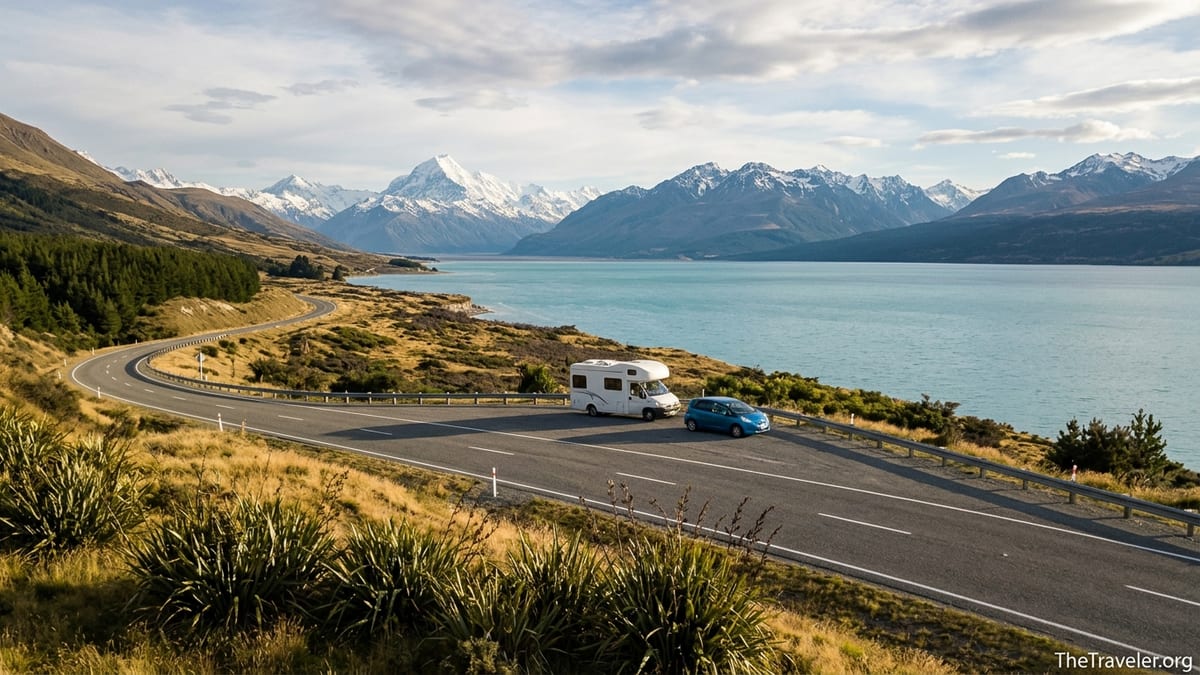
Choosing One Island or Both: How Much Can You Really Cover?
The first decision for any New Zealand road trip is whether to drive one island or both. On a map, the country looks compact. In reality, roads are mostly two-lane, often winding, and full of photo stops. A three-hour drive on a navigation app can easily stretch to five hours once you add viewpoints, coffee breaks and slow sections behind trucks or campervans. Many travellers who try to cover everything in 10 to 14 days end up spending most of their holiday inside the vehicle.
For trips of around a week, it is usually best to focus on one island and drive a loop or short one-way route. A seven-day North Island trip might focus on Auckland, the Coromandel Peninsula, Rotorua and Taupō, then back to Auckland. A seven-day South Island trip might look like Christchurch to Tekapo and Aoraki/Mount Cook, then Queenstown and Wanaka before looping back via Lake Tekapo or the coastal highway. With this approach, daily drives can stay in the two to four-hour range, leaving time to walk on beaches, soak in hot pools or take short hikes instead of sprinting between overnight stops.
With 14 to 21 days, combining both islands becomes realistic if you still limit one-way slogs. A classic three-week route might start in Auckland, loop through Northland or the central volcano region, then drop south via Wellington, cross the Cook Strait by ferry, and continue from Picton to Kaikōura, Christchurch and on through the Southern Alps. Even with three weeks, you will need to choose between extra time in Queenstown and Fiordland or adding the wild Catlins and Southern Scenic Route. The key is to decide what you care about most rather than trying to tick every box.
Beyond three weeks, you can start to add slower detours like the East Cape, the rugged West Coast glaciers, or a full lap of the South Island, including remote pockets such as the Catlins or the upper West Coast around Karamea. At that point, the bigger constraint becomes budget and energy rather than distance. Still, many long-term travellers find they enjoy themselves more by choosing clusters of two or three regions and spending several nights in each, instead of feeling compelled to constantly move on.
One-Way or Loop Trips: How Your Direction Shapes the Journey
New Zealand’s rental vehicle network is set up around a few hubs: Auckland, Christchurch and Queenstown for cars and campervans, with Wellington as a secondary pickup and drop-off point. This makes one-way road trips straightforward in theory but often more expensive in practice. Many rental companies charge a one-way fee that can add roughly a few hundred New Zealand dollars to the total, especially for popular routes like Auckland to Queenstown in peak summer. On the other hand, a loop itinerary that starts and finishes in the same city usually avoids those charges and can sometimes make flights cheaper.
On the North Island, common one-way routes run from Auckland to Wellington, often via Rotorua, Taupō and the Desert Road through Tongariro National Park, or via the east coast through the Bay of Plenty and Hawke’s Bay. Driving direct from Auckland to Wellington on the main highway takes about eight hours of wheel time if conditions are good, but most travellers split it with at least one overnight stop in somewhere like Rotorua, Taupō or Napier. Turning that into a loop back to Auckland adds more driving but can let you drop Rotorua or the Coromandel at the end rather than racing through everything at once.
On the South Island, one-way trips link Christchurch and Queenstown or run from Picton or Nelson down the West Coast to Queenstown or Te Anau. For example, Christchurch to Queenstown direct via Tekapo and Lindis Pass is roughly six hours of driving without stops, but many visitors turn it into an overnight in Tekapo or Twizel to enjoy the night skies and lakeside walks. A full West Coast traverse from Nelson or Picton through Punakaiki, Franz Josef and Fox Glacier to Wanaka and Queenstown spreads comfortably across three to five days, depending on how many hikes and glacier activities you add.
Loop trips suit travellers who want flexibility and value: for instance, a two-week Christchurch loop that runs Christchurch to Tekapo and Aoraki/Mount Cook, then to Queenstown, Te Anau and Milford Sound, back via the Southern Scenic Route through the Catlins and Dunedin, before returning to Christchurch along the east coast. That kind of circuit means no backtracking on airfares, but you will double back on some roads. A one-way route, by contrast, is usually better if your international flights already arrive at one end of the country and depart from the other, or if you especially want a sense of travelling in a single grand direction from north to south.
Car vs Campervan: Costs, Comfort and Overnight Flexibility
The choice between a regular car and a campervan shapes both your daily rhythm and your budget. In 2026, small rental cars can often be found from roughly 60 to 100 New Zealand dollars per day in shoulder season, while compact self-contained campervans typically start around 70 to 90 dollars per day at quieter times and climb steeply in summer. Larger family motorhomes with four to six berths can run from a couple of hundred dollars per day to several hundred in peak months. On top of this, many campervan hires add cleaning fees, insurance upgrades, outdoor furniture hire and child seat charges, which can push a two-week bill well beyond the headline daily rate.
For a couple staying in basic motels or mid-range hotels, a car often works out cheaper overall once you factor in fuel use, campsite or holiday park fees for campervans, and the convenience of easier parking in towns like Queenstown, Rotorua or Wellington. Cars also tend to be more fuel-efficient than large motorhomes, which matters when petrol prices hover in the three dollar or more per litre range and diesel sits in a similar band. Many diesel campervans also incur separate road user charges based on distance driven, which rental companies either build into the price or bill afterwards per 1,000 kilometres.
Campervans, however, offer a specific kind of freedom. In popular destinations such as the Coromandel, Northland or around the Queenstown and Wanaka lakes, being able to stay in well-equipped holiday parks or council-run campgrounds puts you closer to beaches and trails, with cooking facilities and hot showers on site. In places like Te Anau or Franz Josef, a campervan can mean waking up to mountain views without moving your luggage in and out each night. For families with children, having a familiar space where kids can nap or play while parked beside a lake is often worth the premium, especially on longer trips.
A practical middle ground is to rent a car for routes heavy on city stays and day trips, such as Auckland and Wellington with a detour to Rotorua, then pick up a campervan only for a South Island loop packed with national parks and long gaps between towns. Some travellers, particularly those arriving from long-haul flights, choose to spend the first few days in a city hotel to recover from jet lag and get used to local driving before switching to a larger vehicle. This makes the early adjustment to driving on the left, navigating roundabouts and understanding local road signs less stressful.
Realistic Driving Times, Scenic Stops and Road Conditions
New Zealand’s most famous drives are scenic for a reason: they twist alongside coasts and rivers and climb over mountain passes. The trade-off is slower average speeds and frequent temptation to pull over. On the North Island, the Auckland to Bay of Islands stretch can be driven in around three hours each way on the main highway, but if you detour to beaches around Whangārei Heads or to the Waipoua Forest to see giant kauri trees you will add substantial time. Similarly, the drive from Rotorua to Napier might be listed at about three hours, yet many drivers find it becomes a half-day journey once photo stops and cafe breaks are included.
On the South Island, expect key scenic legs to take most of a day. The drive from Greymouth to Franz Josef, for example, might appear as about two and a half hours on a map, but travellers regularly spend four to five hours including stops at Punakaiki’s pancake rocks, Hokitika Gorge and short coastal walks. The richly photographed West Coast run from Franz Josef and Fox Glacier to Wanaka via Haast Pass can be driven in roughly four and a half hours, but it is common to stop at places such as Lake Matheson near Fox Glacier, the Haast Pass waterfalls and viewpoints along Lake Hawea, turning it into a seven-hour touring day.
Mountain roads require special attention. The Desert Road in the central North Island, Lindis Pass between Tekapo and Wanaka, Arthur’s Pass linking Christchurch and the West Coast, and the Milford Road from Te Anau to Milford Sound can all experience winter snow, black ice and strong winds. Chains are sometimes required in winter, and while rental companies usually make them available, many visitors have never fitted them before. In poor conditions, local authorities may close sections temporarily or operate convoys, especially around the alpine passes and the Homer Tunnel on the Milford Road. It is important to check regional transport updates each morning before driving these routes in winter or early spring.
New Zealand’s one-lane bridges are another quirk for overseas drivers. Particularly common on rural highways and the West Coast, these bridges require one direction of traffic to give way to the other, with signs indicating priority. On popular touring roads, a queue of vehicles on both sides is normal; patient, single-file crossing is expected. Visitors used to multilane motorways should also be ready for long stretches without passing lanes, which means accepting that sometimes you will sit behind a truck or campervan at a conservative speed until a safe overtaking spot appears. This slower pace is built into how locals drive and is part of why apparent distances can feel longer than you might expect.
Fuel, Parking and Practical Costs on the Road
With fuel costs high by global standards, petrol or diesel is a major line item in any road-trip budget. A compact car that uses roughly five to seven litres per 100 kilometres will keep costs in check, while a fully loaded motorhome may use closer to twelve or more litres over the same distance. On a classic 2,000 kilometre loop that covers, for example, Auckland to Wellington and back via Rotorua and Napier, the difference between a small hatchback and a large motorhome can run into hundreds of dollars in fuel alone. For visitors used to cheaper petrol at home, seeing pump prices in the three to four dollar per litre range can be a shock and should be planned for in advance.
Pay-at-pump fuel stations are widespread around cities, but in remote parts of Northland, the East Cape, or between West Coast towns such as Haast and Fox Glacier, the interval between fuel stops can be more than 100 kilometres. On routes like Te Anau to Milford Sound there are no public petrol stations at the far end, so filling up in Te Anau is essential. Many locals set an informal rule of never letting the tank drop below half on back-country stretches. For electric vehicles, rapid charging infrastructure is improving along State Highway 1 and between major South Island centres, but long stretches of the West Coast, the East Cape, and rural inland regions still require careful planning around available chargers.
Parking is generally straightforward in small towns but can be tight in city centres and busy tourist hubs. Queenstown, central Auckland and Wellington’s waterfront all have multi-storey car parks and street parking with hourly fees that add up quickly over a week. Hotels in central areas sometimes charge for overnight parking, and large campervans may not fit easily into inner-city car parks. In popular spots like Lake Tekapo or central Rotorua, large motorhomes can be awkward to manoeuvre into small motel car parks or supermarket lots at peak times. Many campervan travellers choose to stay slightly outside the very centre and walk or use local shuttles to avoid stress.
Freedom camping rules, which allow self-contained campervans to stay overnight in certain public spaces, are tightly regulated and vary by council. Fines for parking or camping in restricted zones can be substantial. Most international visitors find it simpler to rely on a mix of holiday parks, Department of Conservation campsites and designated council camping areas, all of which are usually signposted and listed in local visitor information centres and travel apps. Budgeting for these nightly fees, which often include showers, kitchens and laundry facilities, gives a more accurate picture of the total cost of choosing a campervan over a car and motel combination.
Key Route Families: How the Classic New Zealand Drives Fit Together
When you zoom out to a national level, several “route families” appear again and again in tourism brochures and traveller itineraries. On the North Island, Auckland to Wellington is the backbone. The direct inland version runs through Hamilton, Rotorua, Taupō and the volcanic landscapes of Tongariro National Park, creating a string of geothermal parks, lakes and hiking options. Many travellers add side trips to Hobbiton near Matamata or to the Coromandel Peninsula for beaches like Cathedral Cove and Hot Water Beach at the beginning or end of the loop. Others swing east from Rotorua through Whakatāne and on to Hawke’s Bay wine country before rejoining the highway south to Wellington.
Northland is a separate, often underappreciated route family. Leaving Auckland, drivers head north via the Hibiscus Coast to Paihia and the Bay of Islands, with options to continue as far as Cape Reinga at the northern tip. Along the way, small beach towns like Tutukaka and Mangawhai offer surfing and coastal walks. A loop that travels up one coast and down the other, via Waipoua Forest and its giant kauri or the tranquil Hokianga Harbour, makes a rewarding five to seven-day add-on if you have a longer holiday and want warmer beaches and a more relaxed pace than the central North Island.
In the South Island, Christchurch to Queenstown is the most common inland spine. The scenic inland route passes Lake Tekapo and Lake Pukaki, with detours into Aoraki/Mount Cook National Park for alpine views and glacier walks. Continuing through the Mackenzie Basin and over the Lindis Pass, you drop into Wanaka and then over the Crown Range or via Cromwell into Queenstown. An alternative coastal approach runs Christchurch to Dunedin and on to Queenstown via the Southern Scenic Route, which hugs the Otago and Southland coasts past lighthouses, estuaries and forested bays in the Catlins.
The South Island West Coast is arguably the country’s most iconic multi-day drive. Starting from Nelson or Picton, you can follow the coastal highway past the limestone cliffs and blowholes at Punakaiki, through Greymouth and Hokitika, then on to the glacier towns of Franz Josef and Fox. From there, the road climbs through lush rainforest and over Haast Pass into the Southern Lakes region. Te Anau to Milford Sound is often treated as a separate day trip because of its specific conditions and the sheer number of lookouts, short walks and photo stops along the way. The sealed road passes lakes, beech forest, and avalanche-prone slopes before burrowing through the Homer Tunnel and emerging into the dramatic valley that leads down to Milford Sound, where most people join a boat cruise for a few hours on the water.
These route families interlock, which makes it easier to build a high-level roadmap followed by region-specific detail. For example, a three-week trip might begin with Northland, drop back through Auckland and Rotorua to Wellington, then cross by ferry to Picton. From there you could drive down the West Coast to Franz Josef, cut across to Queenstown and Te Anau, continue to Milford Sound, and finally fly out from Queenstown. Each segment aligns with recognised routes, and once you settle on the broad shape, you can turn to more detailed North Island or South Island articles that suggest specific overnight stops, walking tracks and local food experiences.
The Takeaway
Planning a New Zealand road trip works best when you think in broad strokes first: one island or both, one-way or loop, car or campervan, and which of the major route families you want to stitch together. Once those decisions are made, the details of where to spend extra nights and which side trips to choose naturally follow. The country’s compact appearance on a map hides slow, scenic roads, plentiful viewpoints and changeable mountain weather, all of which reward a gentler pace and realistic expectations about driving times.
If your time is short, one island with a well-chosen loop will almost always give a more satisfying experience than sprinting between Auckland and Queenstown. With two to three weeks, combining routes such as Auckland to Wellington, the South Island West Coast, and Christchurch to Queenstown with a side trip to Milford Sound offers a memorable cross-section of beaches, lakes, glaciers and fjords. Whatever you choose, build in spare time for bad weather days, unexpected roadworks, or the simple pleasure of staying an extra night somewhere that captures your imagination.
From here, the smartest next step is to dive into focused North and South Island road-trip guides that match the overall framework you have chosen. Those regional articles can help you decide which geothermal parks near Rotorua are worth the entry fee, where to find the quietest beaches in Northland, or which short hikes near Wanaka and Arthur’s Pass offer the biggest reward for the time. A thoughtful national plan, combined with on-the-ground flexibility and local advice, is what turns a New Zealand road trip from a checklist into a journey you will talk about for years.
FAQ
Q1. How many days do I need for a New Zealand road trip?
For a satisfying road trip, allow at least seven days for one island, around 14 days for a relaxed highlights route, and three weeks or more if you want to include both islands without rushing.
Q2. Is it better to self-drive or join bus tours in New Zealand?
Self-driving offers more flexibility and access to scenic stops, while bus tours reduce stress if you are nervous about mountain roads or driving on the left. Many travellers combine one escorted tour, such as to Milford Sound, with independent driving elsewhere.
Q3. Do I really need a campervan, or is a car enough?
A car plus motels is usually cheaper and easier in cities, while a campervan suits those who value waking up in nature and cooking on the road. Families and long-term travellers often find the campervan lifestyle worthwhile despite higher upfront costs.
Q4. What are typical daily driving distances in New Zealand?
Most visitors are happiest with two to four hours of driving on travel days, which often turns into four to six hours with stops. Longer single pushes are possible but can become tiring on narrow, winding roads.
Q5. Is it safe to drive in winter on alpine routes like Arthur’s Pass or the Milford Road?
It can be safe when roads are open and you drive cautiously, but snow, ice and high winds are common. Always check local road reports, carry chains if required and be willing to change plans if conditions deteriorate.
Q6. How expensive is fuel for a New Zealand road trip?
Fuel is relatively expensive, with petrol and diesel often costing several dollars per litre. Choosing a smaller, more efficient vehicle and avoiding unnecessary detours helps keep costs reasonable.
Q7. Can I rely on phone navigation and maps everywhere?
Phone navigation works well around cities and main highways, but coverage can be patchy on the West Coast, in parts of Northland and in remote inland regions. Download offline maps and keep an eye on old-fashioned road signs.
Q8. Are one-lane bridges difficult for overseas drivers?
One-lane bridges are straightforward if you slow down and follow the give-way signs. Take turns with oncoming traffic, avoid entering if another vehicle is already on the bridge, and be patient when it is busy.
Q9. Should I book accommodation and campsites in advance?
In peak summer and around popular spots like Queenstown, Rotorua and the Bay of Islands, booking ahead is strongly recommended. In shoulder seasons you can often be more spontaneous, but it is still wise to reserve at least a few key nights.
Q10. Is it worth driving both islands if I only have 10 days?
It is technically possible, but most travellers enjoy their trip more by focusing on a single island in 10 days. Trying to cover both usually means too many one-night stops and not enough time to enjoy the places you reach.