


Tourism New Zealand actively promotes campervans and motorhomes as one of the best ways to explore Aotearoa, and for good reason. Having your bed, kitchen and wheels in one place makes it easy to chase clear skies, stay close to hiking trails and wake up beside beaches or alpine lakes. Yet once you start searching for “campervan hire New Zealand”, the options and fine print can feel overwhelming. This guide explains, in practical terms, how to choose between small campervans, larger motorhomes and fully self-contained vehicles, and what you need to confirm before you book.
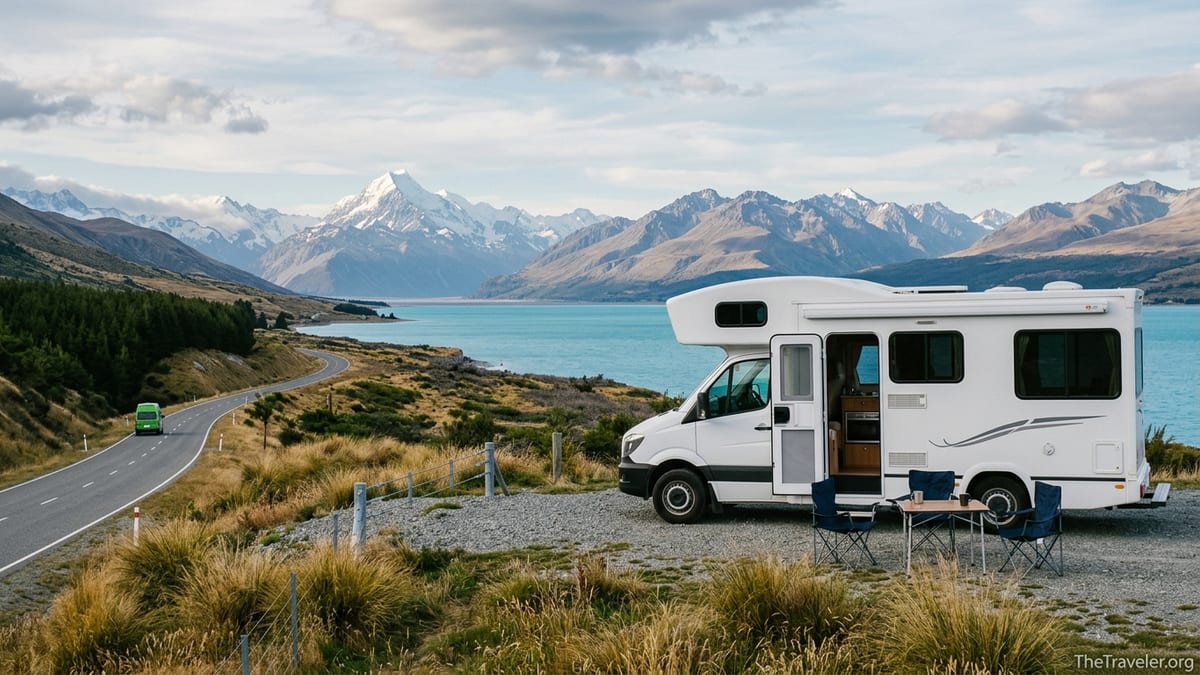
Campervan or Motorhome: What Is Best For Your Trip?
In New Zealand, rental companies use “campervan” and “motorhome” slightly differently. Budget brands like Jucy or Mad Campers usually call their smaller vans “campervans” and they are often based on compact Toyota Estima or Hiace style vehicles with a simple kitchenette and fold-out bed in the back. Premium brands such as Maui, Britz, Apollo, Wilderness or Pacific Horizon tend to use the word “motorhome” for larger coach-built vehicles with higher roofs, separate beds and a full bathroom. In daily use, locals will call everything a “campervan”, but the distinction matters when you are comparing inclusions, comfort and price.
Smaller campervans suit solo travellers and couples who want something easy to park in towns and supermarket car parks. A typical two-berth budget van from Jucy or Mighty might be just 4.7 to 5.0 metres long, similar to a large station wagon, so you can slot into most public parking spaces and feel confident driving through tight corners on the Coromandel or around Queenstown. Larger motorhomes from Maui, Britz, Apollo or Wilderness typically range from 6 to 7.2 metres long and are higher and wider, which brings hotel-like comfort but requires more care when manoeuvring in cities and on narrow rural roads.
Price is often the deciding factor. In shoulder seasons such as October or April, a basic two-berth campervan picked up in Auckland can sometimes be found for a few dozen New Zealand dollars per day on relocation specials, while a late-model four or six-berth motorhome from a premium brand can run to several hundred dollars per day in high summer. The best approach is to start by listing your priorities: if you want a fixed bed, indoor bathroom and space for children, look at motorhomes; if you are backpacking on a budget and spending most of your time outdoors, a compact van is usually enough.
Understanding Berth Sizes, Layouts and Comfort Levels
When you compare vehicles on booking sites, you will see them described as two-berth, three-berth, four-berth or six-berth. The “berth” number is the maximum number of sleeping spaces, not the number of seatbelts. For instance, Britz and Maui both offer two-berth motorhomes where the dining area converts to a large double bed. They also offer four-berth options with one double bed over the cab and another made from the rear lounge, and six-berth models with two fixed double beds plus a convertible dinette. Always check the seating plan to confirm how many people can legally travel in seatbelts, especially if you are bringing children and need anchor points for child seats.
Layout matters more than raw berth numbers. A couple renting a Wilderness Compact or Britz Venturer style two-berth motorhome gets a rear lounge that converts to a generous bed, a decent kitchen and a separate bathroom in a vehicle that is still easy to drive. A family of four in a six-berth may find the extra space handy on rainy days, but they will also pay more for ferry crossings and fuel. Travellers with mobility issues often prefer motorhomes with a fixed rear bed so they are not climbing ladders into over-cab bunks or assembling beds each night.
Real-world comfort can differ even within the same berth category. Some budget vans marketed as “two-berth” are essentially a mattress platform in the back with basic storage underneath and opening tailgate access to a rear kitchen. These are fine for short trips in summer but can feel cramped in cold or wet weather when you want to cook and sit indoors. At the other end of the scale, a premium two-berth motorhome from Wilderness or Pacific Horizon usually has insulated walls, better heating, thicker mattresses and double-glazed windows that make off-season trips in May or September much more pleasant.
Toilet, Shower and Self-Contained Vehicles: What You Must Know
New Zealand’s freedom camping rules have tightened in recent years and from June 2026 rental vehicles need to meet new standards to be certified self-contained. That certification is shown with a green warrant card in the window. To be classed as self-contained, a vehicle must, among other things, have a fixed toilet, freshwater and waste tanks of a minimum size and a way to store rubbish. Older “blue sticker” systems are being phased out and are no longer accepted as proof of self-containment for rental vehicles on most council or Department of Conservation land.
Many smaller campervans do not have a toilet or shower at all, which means they are not self-contained and generally cannot be used for freedom camping in places where a certified self-contained vehicle is required. They are still fine if you plan to stay in holiday parks or commercial campgrounds every night, where you can use shared bathrooms and kitchens. A popular pattern is to rent a non-self-contained budget van from Jucy, Mad Campers or Travellers Autobarn and stay mostly in powered sites at holiday parks near Rotorua, Wanaka or Paihia, using their facilities and treating the van mainly as a mobile bedroom.
Motorhomes almost always include a bathroom with a cassette toilet and shower. Premium two-berth and four-berth models from Maui, Britz, Apollo, Wilderness and others are usually certified self-contained to the new standard. This opens up more freedom camping options, though you still need to obey local bylaws and posted signs. If freedom camping is important to your trip, you must confirm, before booking, that your chosen vehicle currently has a valid green self-contained warrant and ask the rental company whether any areas on your planned route have additional restrictions or overnight parking bans.
Driving and Mechanical Choices: Transmission, Fuel and Road-User Charges
Most international visitors feel more relaxed in an automatic transmission, and in New Zealand you can easily find both small campervans and large motorhomes with automatic gearboxes. Brands like Jucy, Mighty and Britz often list whether a vehicle is automatic or manual in the model name. If you are not fully confident driving a manual on the left-hand side of the road, particularly on steep passes such as the Crown Range between Queenstown and Wanaka or the winding road into Milford Sound, it is worth paying a little more to guarantee an automatic vehicle.
Fuel type also matters. Many of the larger motorhomes from Maui, Apollo and Wilderness run on diesel, while smaller campervans are more likely to use petrol. Diesel at the pump is usually cheaper per litre than petrol, but in New Zealand diesel vehicles pay separate road-user charges. Some rental companies include this in the daily rate, but many, especially in the budget and mid-range categories, charge a road-user fee when you return the vehicle based on how many kilometres you have driven. This might add the equivalent of several dollars per 100 kilometres to the cost of a diesel vehicle, slightly reducing the fuel savings over petrol.
Before you book, check how the company handles road-user charges. A firm such as Freedom Campers, for example, calculates the fee on return based on kilometres travelled and the category of vehicle, and reserves the right to adjust the per-kilometre rate if the government changes the official charge schedule. In practice, this means that if you drive from Auckland to Queenstown and back, you could pay an additional set of road-user fees at drop-off. Understanding this up front makes it easier to compare the true cost of a diesel motorhome with a petrol campervan that has no extra charges.
Insurance, Bonds, One-Way Fees and Unlimited Kilometres
New Zealand campervan rentals nearly always come with unlimited kilometres, which is ideal if you plan to cover both islands in three or four weeks. Many companies, including larger players such as Britz, Maui, Apollo and regional operators, advertise unlimited kilometres on all or most vehicle types. This means you can detour to Cape Reinga, loop around the East Cape or add a side trip to the Catlins without worrying about distance-based rental fees. However, some relocation specials or very low promotional rates may have limits, so always read the inclusions carefully.
Insurance and bonds can be more confusing than distance allowances. A standard rental rate often includes basic insurance with a high excess, which can be several thousand New Zealand dollars. At pick-up, you will usually need to allow the company to place a bond or security hold on your credit card equal to that excess. For instance, a budget operator might require a bond in the low thousands for a campervan and more for a motorhome. You can usually pay a daily fee to reduce the excess and bond to a much smaller amount, sometimes almost to zero, which is attractive if you do not want a large hold on your card during your holiday.
When comparing companies, look past the daily rental price and add in the cost of any insurance upgrades you are likely to buy. Some firms market very low base rates but charge relatively high daily fees for excess reduction. Others bundle a moderate excess and reasonable bond into the standard rate, making the overall cost comparable. Check whether windscreen, tyre and overhead damage are covered, because rural gravel roads and overhanging branches are common in New Zealand, and some basic policies exclude these.
One-way hires are popular on routes such as Auckland to Christchurch or Christchurch to Queenstown. Major brands often have depots in all three cities and sometimes in regional centres like Nelson or Dunedin, so you can pick up in the North Island and drop off in the South Island. There is usually a one-way fee added to the booking, which might be modest in low season but higher in summer when fleets are under pressure. Occasionally, companies offer reverse relocation deals where they waive the one-way fee or heavily discount the rate if you move a vehicle in the direction they need.
What Is Included: Bedding, Kitchen Gear and Heating
Most mainstream New Zealand campervan and motorhome companies include the essentials so you can land at Auckland or Christchurch airport with just your suitcase. Bedding packs typically come with sheets, duvets or sleeping bags and pillows for each berth. Kitchen kits often include pots and pans, utensils, plates, mugs, basic knives and a kettle. For example, a mid-range motorhome from Britz or Apollo is usually delivered with linen, towels and kitchen equipment as standard, while some budget brands either include these or offer them as optional add-ons at a daily rate.
It is still worth checking the inventory list before you confirm your booking. If you plan to cook a lot, you might want to bring your own chef’s knife or a small spice kit, since rental packs tend to be basic. Families travelling with young children often add extras such as camp chairs, outdoor tables or portable barbecues. Agencies like Freedom Campers and others list these accessories on their booking pages, often with pricing per hire or per day, so you can decide what is worth paying for instead of buying cheaply in a supermarket on arrival.
Heating is another key comfort factor, especially outside the peak summer months of December to February. Many larger motorhomes include built-in diesel or gas heaters that can run off a separate fuel supply, which is particularly useful if you want to freedom camp at a Department of Conservation site with no power. Smaller vans may only have a portable electric heater that works when plugged into a powered campsite. If you are visiting in winter or shoulder seasons and plan to stay in alpine areas like Tekapo, Queenstown or Tongariro, confirm what type of heating your vehicle has so you do not end up shivering through the night.
Key Pick-Up Points: Auckland, Christchurch and Queenstown
Auckland is the main gateway for many international arrivals and has the widest choice of campervan and motorhome depots. Well-known brands such as Jucy, Britz, Maui, Apollo, Mighty, Wendekreisen, Travellers Autobarn and others have branches in the broader airport area, with free or low-cost shuttles from the terminals. Picking up in Auckland allows you to explore Northland, the Coromandel, Rotorua and Taupo before heading south. Before booking, check depot opening hours if your flight lands very early in the morning or late at night, and consider staying your first night near the airport to recover from jet lag before driving long distances.
Christchurch is the major hub for South Island road trips. Most of the same national brands have large depots here and treat Christchurch as their main base for vehicles that spend most of their time touring the South Island. If you are focusing on highlights like Aoraki Mount Cook, Lake Tekapo, the West Coast glaciers or the Otago region, starting in Christchurch can save you the time and cost of taking the vehicle across Cook Strait. Rental yards are usually located in industrial areas near the airport, so factor in time for the shuttle transfer and paperwork on pick-up day.
Queenstown has a smaller but growing selection of campervan and motorhome options and is a popular starting point for shorter itineraries that focus on Fiordland, Wanaka and Central Otago. Some big brands operate in Queenstown directly, while others service the town via nearby hubs. Because parking and traffic are more constrained in Queenstown than in Christchurch or Auckland, picking up a smaller campervan can make your first day or two less stressful. If you are flying into Queenstown and starting your hire immediately, be prepared for alpine driving conditions and quickly changing weather, particularly in winter.
Freedom Camping, Holiday Parks and Crossing Cook Strait
Freedom camping in New Zealand is only allowed in certain places and is tightly controlled by national rules and local council bylaws. Self-contained vehicles with the new green warrant, and a fixed toilet, have more options, but even then you must always check local signs. Many travellers combine a mix of Department of Conservation campsites, low-cost council sites and private holiday parks. For example, a common itinerary might use freedom camping or basic DOC sites around Lake Pukaki or the Catlins, then book a powered site at a holiday park in Queenstown or Franz Josef every few nights to recharge batteries, do laundry and restock.
If you plan to freedom camp, you must confirm that your rental vehicle is certified self-contained to current standards and ask the rental company whether they provide information on responsible camping locations. Many operators now include brochures or apps that highlight designated freedom camping sites and explain how to correctly dispose of toilet waste and grey water. Fines for breaching freedom camping rules can be significant, and enforcement officers in popular areas like Queenstown Lakes, Taupo and the Coromandel routinely check vehicles for valid self-containment warrants and adherence to time limits.
Taking a campervan across Cook Strait between Wellington and Picton is straightforward but needs planning. Large ferries run several times a day and carry motorhomes and campervans alongside cars and trucks. When you book your ferry, you will need to provide the vehicle length, which affects the fare. A six-berth motorhome from a brand like Maui or Apollo will usually cost more to ship than a compact two-berth van from Jucy or Wendekreisen because it takes up more deck space. In summer, sailings can sell out at popular times, so secure your crossing early once your hire dates are fixed.
Some rental companies allow you to take the same vehicle across Cook Strait, while others use a “swap” system where you drop off your campervan on one island and pick up a similar one on the other side. This can save the company ferry costs and sometimes results in lower overall rental prices. However, it also means you need to empty the vehicle, carry your luggage on board as a foot passenger and then repack a new van after the crossing. Before you reserve your ferry, ask your rental provider whether the vehicle can go on the ferry and whether any additional insurance conditions or restrictions apply.
How to Compare Companies and Read Reviews
New Zealand has a mix of large, multinational brands and smaller local operators. The biggest fleets are controlled by groups that operate Maui, Britz, Mighty and Apollo, while other well-regarded names include Wilderness, Wendekreisen, Pacific Horizon, Travellers Autobarn, Jucy, Mad Campers and various boutique firms. Comparison sites list nearly all providers side by side so you can filter by berth size, transmission, price range and pick-up location. This is a good starting point to understand market rates in your travel month and see how much extra you would pay to move from a basic van to a mid-range or premium motorhome.
Once you have a shortlist, read recent customer reviews that specifically mention vehicle condition, customer service and how the company handled any breakdowns or accidents. Experiences can vary widely even within the same brand, but patterns often emerge. Some travellers praise smaller local companies for personal service and well-maintained older vehicles, while others value the broad depot network and newer fleets of the major brands. Pay particular attention to comments about bond refunds, claims handling, responsiveness during mechanical issues and how clearly staff explained insurance options at pick-up.
If prices for the big brands feel high, do not assume that lesser-known operators are automatically a bad choice. Many run reliable, slightly older vehicles at lower rates, with honest descriptions and clear terms. The key is to avoid choosing purely on the lowest headline price. Make sure the photos and model descriptions match what you are expecting, ask the company to confirm in writing what is included and double-check that they are comfortable with your intended route, including gravel roads, alpine passes and any plans for freedom camping.
The Takeaway
Hiring a campervan or motorhome is one of the most flexible ways to explore New Zealand, but the details matter. Start by deciding whether a compact campervan or a larger motorhome better suits your style, group size and driving confidence. Think carefully about berth layout, bathroom facilities and heating so that wet or cold days do not catch you out. Understand how insurance, bonds, road-user charges and one-way fees add to the daily rate, and take a close look at what bedding and kitchen equipment are included.
If freedom camping or remote Department of Conservation sites are on your wish list, make sure your vehicle has a current green self-contained warrant and learn the local rules for every region you visit. For longer itineraries that include both islands, plan your Auckland, Christchurch or Queenstown pick-ups and Cook Strait crossing well in advance, especially in the busy summer season. With a little homework and clear questions for your rental company before you book, you can unlock the best of Aotearoa at your own pace, sleeping close to the landscapes that brought you here in the first place.
FAQ
Q1. Do I really need a self-contained campervan to travel New Zealand?
For trips where you stay mostly in holiday parks or commercial campgrounds, a non-self-contained campervan without a toilet is acceptable. If you want to freedom camp in many council or Department of Conservation areas, you will generally need a self-contained vehicle with a current green warrant and a fixed toilet.
Q2. Is it hard to drive a large motorhome on New Zealand roads?
It takes some adjustment, especially if you are not used to driving on the left or handling long vehicles. Most visitors cope well by choosing an automatic transmission, allowing extra time on winding roads, avoiding night driving and practising a few turns and parking manoeuvres near the depot before setting off.
Q3. Are unlimited kilometres really standard with campervan rentals?
Most mainstream New Zealand campervan and motorhome rentals offer unlimited kilometres, particularly on regular bookings of several days or more. Always read the terms, because some relocation deals, short specials or very low rates may have distance limits or extra charges beyond a set daily allowance.
Q4. How much extra should I budget for diesel road-user charges?
Diesel motorhomes often attract separate road-user charges that are calculated on the distance you drive. The exact rate depends on the vehicle and government schedules, but it can add a noticeable extra cost over a long trip. Ask your rental company for their current per-kilometre or per-100 kilometre rate so you can estimate the total.
Q5. Can I take any campervan on the Cook Strait ferry?
Most standard campervans and motorhomes are allowed on Cook Strait ferries, but you must provide the correct vehicle length and follow the rental company’s rules. A few specialist or oversized vehicles may have restrictions, and some companies prefer that you swap vehicles between islands instead of taking the same one across.
Q6. What is the difference between a two-berth and four-berth campervan in practice?
A two-berth vehicle is designed for two people to sleep, usually in a double bed converted from a lounge area. A four-berth may add an over-cab bed or a second convertible lounge, giving more sleeping options and space for families. However, four-berth models are often longer and higher, and can be more challenging to park.
Q7. Do rental campervans come with bedding and kitchen equipment?
Most reputable New Zealand campervan and motorhome companies include bedding and basic kitchen equipment as part of the hire or as clearly priced add-ons. Before booking, check what is supplied and decide whether you need extras such as outdoor chairs, a barbecue or additional blankets for winter travel.
Q8. Is it cheaper to hire a campervan or to rent a car and stay in motels?
The answer depends on season, group size and how you travel. For short trips in high summer, a rental car plus motels can be similar in price or sometimes cheaper than a motorhome. Over longer trips, especially for families or groups sharing one vehicle, a campervan can work out competitive while giving more flexibility.
Q9. How far in advance should I book a campervan for summer?
For peak months like late December, January and February, it is wise to book several months in advance, particularly for popular models and pick-up locations such as Auckland and Christchurch. Last-minute deals do appear, but they are less common in mid-summer and may not match your ideal dates or vehicle type.
Q10. Can I drive a New Zealand campervan with my regular foreign licence?
Most visitors can drive a campervan or motorhome on their full, valid home-country licence for up to 12 months, provided it is in English or accompanied by an approved translation or International Driving Permit. Age limits and licence requirements vary slightly between companies, so always check their conditions before you book.