


If you cannot comfortably fit both of New Zealand’s main islands into one trip, you are not alone. Distances are longer than they look on the map, weather can be unpredictable, and trying to "do it all" easily turns a holiday into a rush. The good news: you can have an unforgettable New Zealand adventure by focusing on just one island. The challenge is choosing between the volcanic, culture-rich North Island and the alpine, big-scenery South Island.
North Island vs South Island at a Glance
New Zealand’s two main islands feel like different countries stitched together. The North Island is warmer overall, more densely populated, and home to the largest cities, with Auckland and Wellington offering urban dining, museums, and nightlife. It is where you find Rotorua’s steaming geothermal valleys, the Bay of Islands’ sheltered bays and subtropical beaches, and the volcanic plateau of Tongariro National Park in the central spine.
The South Island is bigger in land area but has only about a quarter of the population, so the feel is wilder and emptier. The Southern Alps run almost the entire length, creating a wall of snow-capped peaks that feed glaciers, turquoise lakes, and dramatic fiords. Queenstown, Aoraki / Mount Cook National Park, Fiordland, and the rugged West Coast are the poster children of classic New Zealand scenery: towering mountains, deep valleys, and often rapidly changing weather.
For first-time visitors, most surveys of international holidaymakers show the South Island slightly ahead in popularity, especially for those drawn to dramatic scenery and road trips focused on landscapes rather than cities. At the same time, many repeat visitors and culture-focused travelers gravitate to the North Island, particularly for Māori experiences and easier winter travel in the north. In practice, the better island for you depends on what you most want to see in the limited days you have available.
A simple way to frame the decision is this: choose the North Island if geothermal landscapes, Māori culture, mild winters, and beach time appeal most. Choose the South Island if you dream about big mountains, glaciers, alpine hikes, and cinematic road-trip scenery, and you do not mind cooler weather or longer drives.
Scenery, Landscapes and Overall Vibe
The North Island’s landscapes are quieter in their drama but very varied over short distances. Drive three hours south from Auckland and you can go from urban skyline to Hobbiton’s rolling farmland, then to Rotorua’s geysers and mud pools. Another two hours brings you to the volcanic cones of Tongariro with views of Mount Tongariro, Mount Ngauruhoe and Mount Ruapehu on clear days. On the east coast, the Coromandel Peninsula and Bay of Plenty mix golden beaches with forested hills, while Northland and the Bay of Islands feel almost tropical in summer with pōhutukawa trees flowering red along the shore.
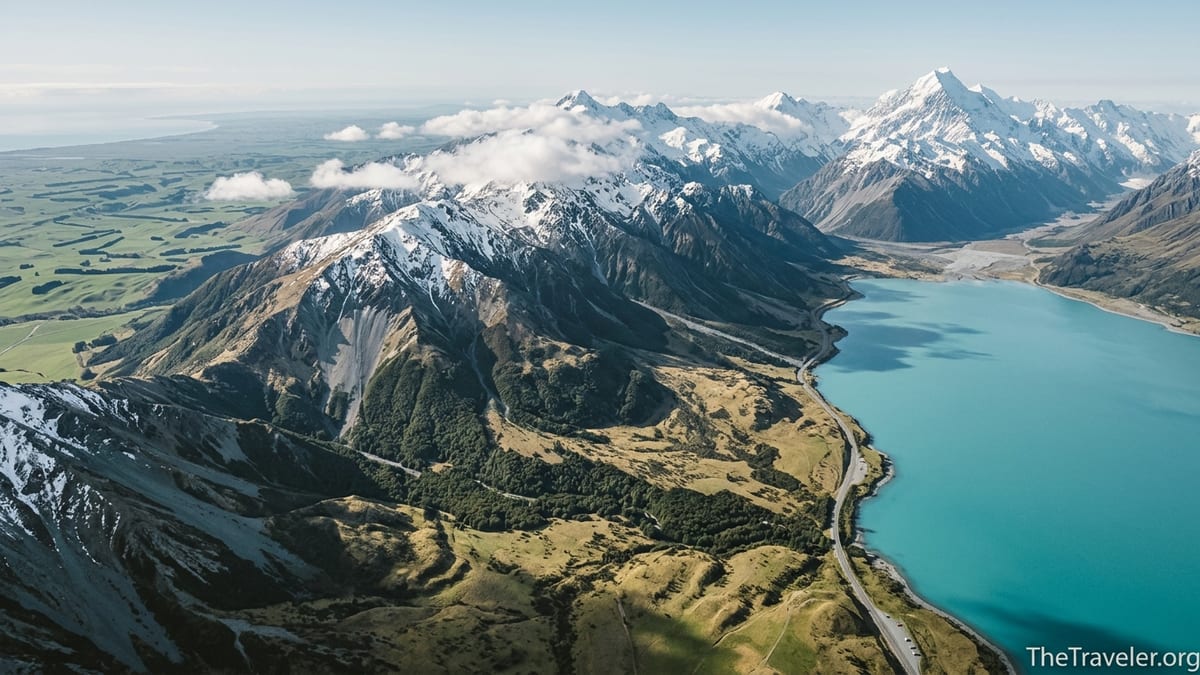
The South Island, by contrast, hits you with scale. Approaching Queenstown from the north, the highway winds between Lake Wakatipu and steep peaks, with the Remarkables range often capped in snow even outside mid-winter. In Fiordland, a day trip to Milford Sound means sheer cliffs rising straight from dark water, waterfalls that triple in volume after rain, and the possibility of dolphins or seals in the fiord. Around Aoraki / Mount Cook, the road alongside Lake Pukaki leads straight toward a skyline dominated by New Zealand’s highest peak, while short walks like the Hooker Valley Track bring you face to face with ice-filled valleys and floating icebergs in milky-blue glacial lakes.
If you are picturing a road trip where the views from the car window are almost as rewarding as the hikes, the South Island generally delivers more consistently dramatic scenery. The West Coast between Westport and Haast is a prime example, with rainforest, wild beaches, and roadside viewpoints of the Franz Josef and Fox glaciers a short detour from the highway. The North Island still offers scenic roads, such as the coastal route through the Bay of Islands or the Desert Road with its views of the volcanoes, but the landscapes tend to feel gentler and more lived-in, with more farmland and more frequent towns.
In terms of vibe, the North Island skews more multicultural and metropolitan, with easier access to galleries, music venues, and big-event calendars in Auckland and Wellington. The South Island feels more outdoorsy and small-town, where conversation naturally turns to snow conditions in winter or which hiking track you are planning next.
Driving Distances and Road-Trip Style
New Zealand looks compact on a map, but driving is slower than many visitors expect due to winding roads, frequent roadworks, and single-lane bridges in rural areas. On the North Island, you can often structure your trip around 2 to 3 hour hops. For example, Auckland to Rotorua is about 3 hours by car in light traffic, Rotorua to Tongariro National Park is around 2.5 hours, and Rotorua to the Coromandel or Bay of Plenty beaches usually falls in the 2 to 3 hour range. This makes the North Island practical if you like shorter driving days with more time left for activities.
On the South Island, the signature routes are longer and more remote, though not inherently difficult in good weather. Christchurch to Queenstown often takes around 6 to 7 hours with brief photo stops. Queenstown to Te Anau, your gateway to Fiordland, is about 2 hours, while Te Anau to Milford Sound is another 2 hours each way on a twisting alpine road where you will want extra time for viewpoints and short walks. The West Coast route from Franz Josef to Wanaka is roughly 4 to 5 hours, but heavy rain and slips can extend this.
The payoff for the extra driving on the South Island is that many of these drives are highlights in their own right. A realistic itinerary might have you drive from Queenstown to Aoraki / Mount Cook in about 3 hours, then spend the afternoon walking the Hooker Valley Track before a stargazing session in the nearby Aoraki Mackenzie International Dark Sky Reserve. On the North Island, an equivalent day might involve leaving Rotorua after breakfast, arriving in Tongariro National Park by lunch, and exploring short walks around Whakapapa Village with volcanic views before dinner.
If you are nervous about winter driving, the North Island is generally easier, especially if you keep to main highways north of Taupō. The Desert Road near Tongariro can close due to snow, but many North Island routes remain snow-free. On the South Island, alpine passes like the Lindis Pass, Crown Range Road and Arthur’s Pass can be icy from late autumn to early spring, so renting a car with snow chains and allowing wiggle room in your schedule becomes more important.
Climate, Seasons and When to Go
New Zealand overall has a temperate maritime climate, but conditions range from subtropical in Northland to cool and often alpine in the Southern Alps. The North Island is generally warmer, with the far north around the Bay of Islands enjoying mild, humid weather that feels almost like a Pacific island in midsummer. The South Island runs cooler, particularly in the south and higher inland regions, and snow regularly falls on ski fields and higher passes during winter.
In practice, this means that shoulder seasons like October and April can still feel beach-friendly in sheltered North Island spots while remaining quite cool in exposed South Island locations. For example, an April afternoon in the Bay of Islands might be comfortable in a light jacket with people still swimming on sunny days, while the same month in Queenstown often sees frosty mornings and visible snow on nearby peaks even if the lakeside is still walkable in a warm sweater.
Rainfall patterns also influence trip style. The West Coast of the South Island is one of New Zealand’s wettest regions due to moisture-laden westerly winds hitting the Southern Alps, so it is common to plan glacier or rainforest visits with at least one weather backup day. Fiordland is famously rainy but this is exactly what feeds its hundreds of waterfalls. By contrast, areas like Hawke’s Bay and Wairarapa on the lower North Island often enjoy drier, sunnier conditions, which is one reason they have become significant wine regions.
If your priority is avoiding winter cold, the North Island is often the safer bet, especially for families with younger children or travelers who dislike packing bulky layers. However, if you are traveling in summer and want cool nights, clear skies for stargazing near Aoraki / Mount Cook, or snow-capped peaks framing your lake views around Queenstown and Wānaka, the South Island’s climate works in your favor.
Māori Culture, Geothermal Wonders and Beaches
The North Island is the beating heart of contemporary Māori culture for many visitors. Rotorua, in particular, has been a center of Māori tourism for over a century. Today, you can visit Te Puia to see the Pōhutu Geyser erupting, walk through a geothermal valley of steam vents and mud pools, and then step into a carved meeting house for a cultural performance and introduction to the Māori language and arts. Evening experiences such as Mitai or Te Pā Tū often include a hāngī feast cooked in the ground, storytelling around a marae-style setting, and cultural performances, with prices commonly in the range of roughly NZD 110 to 200 per adult depending on inclusions.
Rotorua is not the only place to encounter Māori culture on the North Island. In Northland, the Waitangi Treaty Grounds near the Bay of Islands combines a museum, guided tours, and waka (canoe) displays to explain the country’s founding document and its ongoing significance. In Auckland, walking tours with local Māori guides bring volcanic cones and coastal paths to life through traditional stories about the landscape. These experiences are usually easy to combine with other attractions, making the North Island particularly rich for travelers who want culture and landscapes on the same itinerary.
Geothermal activity is strongly concentrated in the central North Island. Between Rotorua and Taupō you can visit public parks and paid sites with colored silica terraces, bubbling pools, and walkways crossing active ground. Some accommodations in Rotorua and Taupō offer private mineral hot tubs fed by natural springs; it is common to find motels where a 30 to 60 minute soak in a private tub costs an additional modest fee per room. There are also free or low-cost hot streams near Taupō where locals relax after work, though visitors should always check current access and safety advice.
Beaches exist on both islands, but if warm-water swimming and sheltered coves matter a lot, the North Island usually wins. The Bay of Islands, east coast of Northland, and Coromandel Peninsula offer calm bays with walking distance from small towns or holiday parks. In summer, families often spend entire afternoons picnicking under pōhutukawa trees while children paddle in the shallows. The South Island has gorgeous beaches too, especially in Abel Tasman National Park with its golden sand and kayak-friendly coastline, but water temperatures are cooler and the season for comfortable swimming is shorter.
Mountains, Glaciers, Hiking and Adventure
If your mental image of New Zealand is shaped by mountain backdrops and glacier-fed lakes, the South Island aligns most closely with that dream. Aoraki / Mount Cook National Park is the centerpiece, where short walks like the Hooker Valley Track and Tasman Glacier View Track give easy access to alpine vistas. Nearby, scenic flights and heli-hiking excursions onto the Tasman Glacier appeal to those comfortable with higher budgets. On the West Coast, Franz Josef and Fox glaciers allow for guided glacier walks and helicopter landings when weather permits.
Fiordland is another South Island heavy-hitter. Day trips from Te Anau to Milford Sound or overnight cruises into Doubtful Sound emphasize vertical rock walls, rainforest, and wildlife rather than glaciers. Serious hikers can commit to multi-day Great Walks such as the Milford Track, Routeburn Track or Kepler Track, which require advance bookings during the main season, while day hikers still have ample choices like the Lake Marian Track or Key Summit.
The North Island’s mountains are smaller in absolute height but have their own character. Tongariro National Park is New Zealand’s oldest national park and a UNESCO World Heritage site, protecting a volcanic plateau dotted with craters and lava flows. The Tongariro Alpine Crossing, often described as one of the world’s great day hikes, crosses between active volcanoes, passes near emerald-colored crater lakes, and descends through alpine meadows and forest. It is a serious 6 to 9 hour undertaking where shuttle transport, solid footwear, and careful attention to weather forecasts are essential, but it remains one of the most accessible big-feel day hikes in the country.
Adventure activities exist on both islands, but Queenstown brands itself as the self-styled "adventure capital". Within a compact radius you will find bungee jumping, jet boating on the Shotover and Kawarau rivers, ziplining, paragliding, and winter skiing at nearby resorts like Coronet Peak and The Remarkables. Prices for marquee activities such as a bungee jump commonly run into the low hundreds of New Zealand dollars per person, and many travelers cluster two or three activities into a single high-energy day. On the North Island, Taupō and Rotorua offer skydiving, white-water rafting, and mountain biking, often at slightly lower altitudes and with milder temperatures than their South Island counterparts.
Cities, Food, Wine and Everyday Experiences
The North Island hosts New Zealand’s main urban hubs. Auckland’s skyline, harbours and multicultural food scene give it the feel of a small, relaxed global city, from casual dumpling houses and food courts beneath apartment towers to fine-dining restaurants showcasing local seafood and wine. Wellington, the capital, is smaller but known for its compact, walkable downtown, strong coffee culture, craft beer bars, and the national museum Te Papa, which gives valuable context on natural history and Māori and Pacific cultures.
On the South Island, Christchurch is the largest city, blending historic gardens with contemporary architecture and street art following the earthquakes a decade ago. However, the urban experiences are more low-key overall, and many visitors spend more nights in smaller centers like Queenstown, Wānaka, or Nelson, where the focus is on lakefront walks, farmers’ markets, and outdoor bars that look straight onto mountain backdrops.
Wine and food experiences are strong on both islands but have different emphases. Hawke’s Bay and Wairarapa on the North Island are known for warmer-climate varieties such as syrah and full-bodied reds, while the South Island’s Marlborough is famous for sauvignon blanc and Central Otago for its pinot noir. Many cellar doors across both islands offer walk-in tastings, often with a tasting flight costing a moderate fee that may be waived with bottle purchases. It is easy to combine a winery lunch with other sightseeing, such as cycling the vineyard trails in Marlborough or exploring the Art Deco streets of Napier in Hawke’s Bay.
Day-to-day, food costs and supermarket prices are similar across the country, though remote areas like Fiordland and the West Coast often see higher menu prices due to transport costs and seasonal staffing. If you plan to self-cater in a campervan, both islands offer frequent supermarkets near major routes, but the North Island’s denser population means shorter gaps between substantial towns. On the South Island, it is common to stock up in Christchurch or Queenstown before heading into more remote regions like the West Coast or Fiordland where shopping and dining options are limited.
Who Should Choose Which Island?
For first-time visitors with around 7 to 10 days, the South Island is often the most satisfying single-island choice if dramatic scenery is your top priority. A typical loop might involve flying into Queenstown, exploring the town and nearby wineries, taking a day trip to Milford Sound or Doubtful Sound from Te Anau, and then driving to Aoraki / Mount Cook and on to Christchurch. This itinerary offers a dense concentration of what many imagine as "classic New Zealand": snow-capped peaks, mirror-like lakes, winding alpine roads, and abundant short hikes.
Families, particularly those with younger children or those visiting in winter, may find the North Island more straightforward. Shorter driving days, more indoor back-ups like Rotorua’s geothermal parks and cultural centers, and milder temperatures around the Bay of Islands or Coromandel take some pressure off parents. Many Māori cultural experiences in Rotorua are designed with families in mind, combining performances with hands-on elements like waka paddling demonstrations or weaving workshops. Theme-like attractions such as Hobbiton near Matamata also tend to be more accessible from North Island bases.
Hikers who want multi-day treks, high alpine scenery, and hut-to-hut experiences will often lean toward the South Island, where Great Walks like the Routeburn or Kepler and local favorites near Wānaka and Nelson Lakes are more abundant. However, hikers who prefer world-class day walks with relatively easy logistics may find the North Island’s Tongariro Alpine Crossing coupled with shorter walks in the Coromandel, Waitakere Ranges or along the East Coast equally attractive, especially if they are less interested in glaciers.
Couples seeking a mix of romance, food and wine, and beautiful landscapes can be happy on either island. On the North Island, combining Auckland’s dining, a stay at a Coromandel or Bay of Islands beach lodge, and a night or two in Rotorua with a private hot pool is a relaxed option. On the South Island, pairing Queenstown or Wānaka lakefront stays with a night under dark skies near Aoraki / Mount Cook and a day cycling through vineyards in Central Otago or Marlborough feels equally special.
The Takeaway
Choosing between New Zealand’s North and South Islands is less about which one is objectively better and more about what kind of trip you want in the time you have. If you have under 10 days and want towering peaks, iconic road trips, glaciers and fiords, prioritizing the South Island usually makes sense. Base yourself around Queenstown, Te Anau, and Aoraki / Mount Cook or the West Coast, and you will come home with memory cards full of big-sky landscapes.
If your interests lean toward Māori culture, geothermal wonders, beaches and warmer weather, or you are traveling with family members who would appreciate shorter drives and more indoor options, the North Island may be the wiser first choice. Rotorua, Tongariro, the Bay of Islands, and the cities of Auckland and Wellington together offer a good cross-section of modern Aotearoa New Zealand life, from cultural performances to café culture.
Either way, resist the temptation to zigzag between islands unless you have at least two to three weeks. It is almost always better to experience one island deeply than to skim both. Start by asking yourself whether you are more excited by hot springs and culture-rich evenings or alpine passes and glacier-fed lakes, then let that answer guide you to the island that fits your travel style best.
FAQ
Q1. Is the North Island or South Island better for a first-time visitor?
For most first-time visitors who want dramatic scenery and classic postcard views, the South Island edges ahead, especially with a loop that includes Queenstown, Fiordland and Aoraki / Mount Cook. However, if you are more interested in Māori culture, geothermal areas and slightly warmer weather, the North Island is an excellent first trip.
Q2. Which island is better if I only have 7 days?
With just a week, focusing on one island is best. For big landscapes and iconic roads, choose the South Island and fly in and out of Queenstown or Christchurch. For shorter drives, hot springs and culture, choose the North Island and center your trip on Auckland, Rotorua and Tongariro.
Q3. Where will I find the most Māori cultural experiences?
The North Island, especially Rotorua, Auckland and Northland, has the highest concentration of organized Māori cultural experiences, performances and historic sites, including geothermal villages and the Waitangi Treaty Grounds. The South Island does offer Māori-led tours in places like Kaikōura and Southland but they are more scattered.
Q4. Which island is better for beaches and swimming?
The North Island usually wins for beach holidays, thanks to warmer water and sheltered bays in regions like the Bay of Islands, Coromandel and Bay of Plenty. The South Island has beautiful beaches, particularly around Abel Tasman National Park, but the water is cooler and the reliable swimming season is shorter.
Q5. Where should hikers and trekkers go?
Serious hikers often prioritize the South Island for its Great Walks and alpine routes in Fiordland, Aoraki / Mount Cook, Wānaka and Nelson Lakes. The North Island still has excellent day hikes, including the Tongariro Alpine Crossing and coastal walks, so it can suit walkers who prefer shorter outings or who are less focused on glaciers and high alpine passes.
Q6. Is driving easier on the North Island or South Island?
Driving distances and conditions vary on both, but the North Island generally has shorter hops between major sights and fewer high alpine passes. The South Island’s signature drives are more dramatic yet can be longer and more exposed to snow and ice in winter, so they require more cautious planning, especially between Queenstown, Aoraki / Mount Cook and the West Coast.
Q7. Which island is better in winter?
For ski trips and snow-capped scenery, the South Island is ideal, particularly around Queenstown, Wānaka and Methven. For milder weather, easier driving and a mix of geothermal warmth and culture, the North Island is more comfortable, especially in regions north of Rotorua and around the Bay of Islands.
Q8. Where will I find better food and wine?
Quality is high across both islands. The North Island stands out for its big-city dining in Auckland and Wellington and wine regions like Hawke’s Bay and Wairarapa, while the South Island excels with vineyard-focused areas such as Marlborough and Central Otago paired with lake and mountain views. Your choice should follow your broader itinerary rather than food alone.
Q9. Is it worth trying to see both islands on a short trip?
If you have fewer than 12 to 14 days, seeing both islands usually means lots of time on the road or in airports and less time actually experiencing each place. Most travelers with a shorter holiday are happier choosing one island that matches their priorities and exploring it in more depth instead of rushing through two.
Q10. How should families decide between the islands?
Families who value shorter drives, easy backup plans for bad weather and attractions that work in any season often gravitate to the North Island, especially Auckland, Rotorua, the Bay of Islands and Tongariro. Families with older children who are keen on hiking, skiing or adventure activities like jet boating and bungee jumping may prefer a South Island trip based around Queenstown, Te Anau and Aoraki / Mount Cook.