


Driving the Kauri Coast into Waipoua Forest, the light suddenly softens and the air cools. Towering trunks rise out of the ferny gloom and the road narrows, winding between living pillars that have been here since before most human civilisations. At the heart of this forest stands Tāne Mahuta, the country’s most famous kauri and one of the defining experiences of Northland’s west coast. This guide explains how to visit responsibly and comfortably, and how to weave Waipoua and Tāne Mahuta into a wider Kauri Coast and Hokianga road trip.
Understanding Waipoua Forest and the Kauri Coast
Waipoua Forest sits on Northland’s remote west coast, roughly a three to four hour drive north of Auckland via State Highway 12. The highway itself threads straight through the forest, so every driver on the Kauri Coast route experiences at least a glimpse of this ancient ecosystem through the windscreen. For most travelers, though, Waipoua becomes more than a scenic drive when they pull into a layby, step onto a boardwalk, and look up into the crown of a kauri that has been alive for more than a thousand years.
The forest protects one of the largest remaining tracts of Northland temperate rainforest dominated by kauri. These trees define the wider Kauri Coast, a loose term used for the stretch from around Matakohe and Dargaville in the south to Hokianga Harbour in the north. Along this corridor you will find complementary stops such as the Kauri Museum at Matakohe, Trounson Kauri Park inland from Dargaville, and smaller remnant groves on side roads. Many visitors combine Waipoua with a swim at the Kai Iwi Lakes or a cafe stop in Dargaville or Ōmāpere, turning the journey into a full day rather than a simple transit.
Tourism New Zealand highlights Tāne Mahuta and the kauri forests as signature experiences of Northland’s west coast, and that status shows on the ground. Even in shoulder seasons, rental cars and small tour vans regularly nose into the forest car parks. Yet it remains relatively low-key compared with the Bay of Islands or Rotorua. Facilities are basic, mobile coverage can be patchy, and the emphasis is on walking quietly and respectfully through the bush rather than ticking off a long list of attractions.
Because of that combination of global profile and local simplicity, Waipoua rewards a bit of pre-planning. Knowing how far it is between stops, what you can realistically see in an hour versus a half-day, and what biosecurity steps are expected of every visitor will make your encounter with Tāne Mahuta feel more like a pilgrimage and less like a rushed roadside snapshot.
Meeting Tāne Mahuta: The Lord of the Forest
Tāne Mahuta is New Zealand’s largest known living kauri, and arguably its most famous tree. The exact dimensions vary depending on measurement method, but it is widely accepted as the giant of the species, with a trunk so broad that several adults cannot link hands around it. Age estimates often sit in the 1,200 to 2,000 year range, and it is common to hear guides compare its lifespan to the rise and fall of empires to help visitors grasp the timescale.
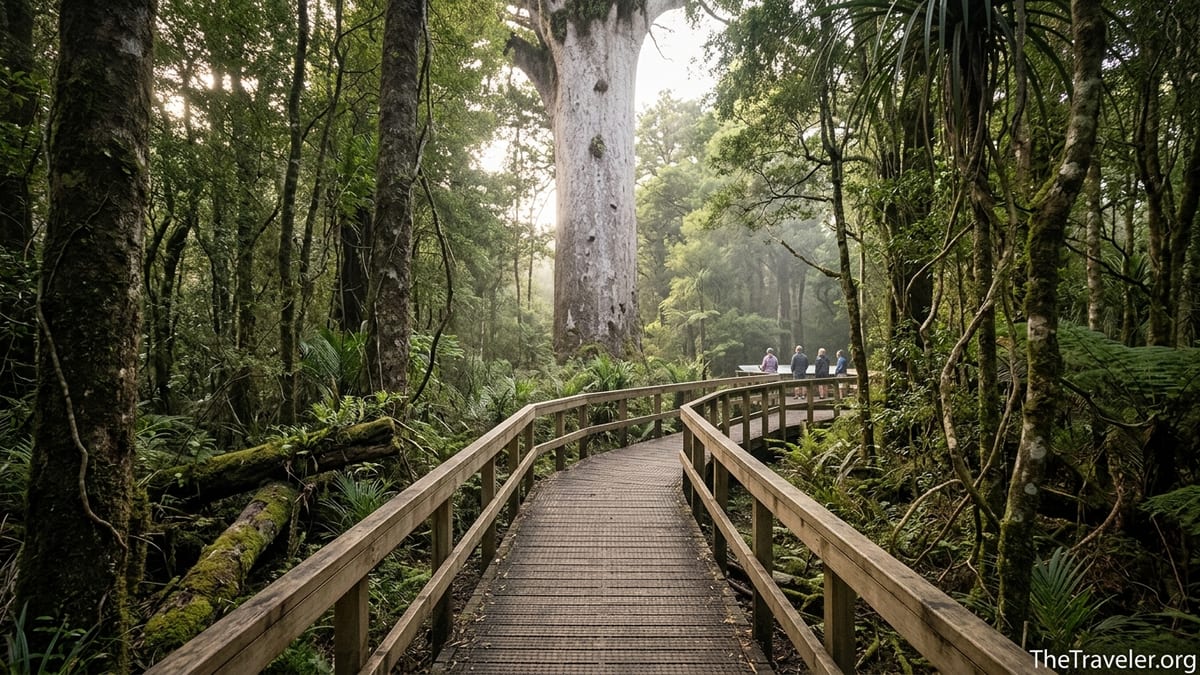
The access is far easier than its mythic status might suggest. The Tāne Mahuta car park is a signed layby directly on State Highway 12, around 20 minutes’ drive north of the small settlement of Waimamaku and about 45 minutes south of Ōmāpere on Hokianga Harbour. From the car park, an elevated boardwalk leads gently into the bush; the walk typically takes 5 to 10 minutes each way at a relaxed pace. There are steps, but most visitors who can manage a short walk find it accessible. You emerge onto a viewing platform with interpretive panels, usually sharing the space with a handful of other travelers quietly taking photographs or simply standing in silence.
The experience has both a practical and a ceremonial side. On the practical front, you will pass a modern kauri dieback cleaning station at the track entrance and again on your way out. These are not optional; rangers and signs frequently remind visitors to scrub the soles and sides of their shoes and then apply disinfectant. On the ceremonial side, many New Zealanders and local guides treat the visit as an audience with a revered ancestor. It is common to hear karakia, or Māori prayers, spoken softly on the platform. Independent travelers can participate respectfully by keeping voices low, avoiding eating or drinking near the tree, and taking a moment simply to look and listen rather than treating the stop as a quick photo opportunity.
Timed visits can add another layer. In the middle of the day, busier traffic and a bright overhead sun can flatten the atmosphere. Early morning or late afternoon often feel more intimate, with angled light filtering through the canopy and fewer people on the platform. Travelers staying overnight around Hokianga sometimes drive in after dinner on a clear summer evening, catching the last light on the trunk when the day-trip buses have long gone and the forest has settled into a softer hush.
Other Kauri Experiences: Walks and Viewpoints in Waipoua
Although Tāne Mahuta is the headline act, Waipoua Forest offers several other short walks that showcase different aspects of the kauri ecosystem. South of Tāne Mahuta, on the same highway, a larger roadside layby marks the start of the Te Matua Ngahere walk. This track leads through dense bush to another colossal kauri notable for its immense girth. The return walk usually takes 30 to 40 minutes, and while it involves some steps and uneven surfaces, it is well maintained. For many visitors, seeing both Tāne Mahuta and Te Matua Ngahere in one outing gives a more rounded sense of how varied individual kauri can be.
Further along, wayfinding signs point to shorter loop walks that wind past groves of younger kauri and other native trees. Some of these walks feature lookouts over the forest canopy or across valleys, particularly appealing in the late afternoon when the low sun picks out the layered ridges. Travelers with children often choose one of these 20 to 45 minute loops as a way to stretch legs mid-drive. For example, a common pattern is to leave Dargaville mid-morning, picnic at a roadside table, walk a loop track in the early afternoon, and then continue on to reach Ōmāpere or Ōpononi by late day.
Outside Waipoua proper, Trounson Kauri Park, about 40 minutes’ drive north of Dargaville on a side road, offers an easy 40 minute loop through dense kauri forest with night-time kiwi-spotting opportunities for those staying at nearby campgrounds. Closer to Whangārei on the east coast, AH Reed Memorial Park provides a canopy walk and short tracks beneath tall kauri that can serve as a gentle introduction before you reach the wilder west. Together, these sites help travelers appreciate that Waipoua is part of a network of remnant forests rather than an isolated attraction.
Track conditions and access can change, particularly as authorities respond to weather damage or to protect areas from kauri dieback, so it is worth checking visitor centres in Dargaville or Hokianga for the latest updates on which walks are open. In practice, this might mean that on a given weekend Te Matua Ngahere is restricted while Tāne Mahuta remains accessible, or that a side-loop is temporarily closed while the main track stays open. Having a flexible attitude and a backup plan, such as an extra stop at the Kai Iwi Lakes or a detour to the sand dunes at the Hokianga Heads, will keep your day enjoyable even if a particular trail is off limits.
Māori Significance and Local Guiding Experiences
For Māori, kauri are more than botanical giants. Tāne Mahuta carries the name of the god of forests and birds, a central figure in Māori cosmology who separated earth and sky to let light into the world. Local iwi (tribes) regard the tree as a tūpuna, or ancestor, and that relationship shapes how the forest is managed and how stories are told. Visitors who understand this cultural context often find their experience deepens from a scenic stop to something closer to a cross-cultural encounter.
Guided experiences such as evening or twilight tours into Waipoua, led by local Māori guides, bring this perspective to life. These tours typically depart from meeting points around Ōmāpere or Ōpononi and travel by minibus into the forest, combining visits to Tāne Mahuta and other significant trees with storytelling, waiata (songs), and explanations of traditional navigation and resource use. Practical elements are woven in: a guide may demonstrate correct use of the cleaning stations or point out signs of stress on certain kauri, linking ancestral narratives to contemporary conservation science.
Travelers who have joined these tours often describe moments such as standing in near-darkness while their guide sings to Tāne Mahuta, or hearing the names and stories of individual trees that they might otherwise have walked past without recognition. For visitors who do not have time or budget for a guided experience, it is still possible to connect respectfully by learning and using key Māori names, such as Tāne Mahuta for the tree and Waipoua for the forest, and by treating the visit with the same care you would bring to a church or historic memorial.
Engagement with local communities extends beyond the forest itself. Around Hokianga Harbour, small cafés, galleries, and marae-based cultural experiences give travelers ways to support local livelihoods connected to the land. Choosing locally owned accommodation in Ōmāpere, Ōpononi, or nearby settlements, asking staff about the best vantage points for sunset over the harbour, or visiting a community-run gallery in Rāwene all contribute to keeping the stories and guardianship of the kauri alive.
Biosecurity and Kauri Dieback: How to Visit Safely
Any modern guide to Waipoua must address kauri dieback, a soil-borne disease that can kill kauri by attacking their roots. The pathogen spreads through the movement of contaminated soil and water, which means that every visitor’s footwear, walking pole, and even pram wheels can either help protect or inadvertently harm the forest. Authorities have invested in upgraded cleaning stations at key track entrances, including the approach to Tāne Mahuta, but those stations only work if people actually use them correctly.
In practice, visiting safely means building a few extra minutes into every stop. When you arrive at a track, expect to spend time at the cleaning station brushing all visible soil and organic matter off your shoes, including the tread and edges, before stepping into a disinfectant tray or activating a spray system. On your return, you will be asked to repeat the process before you get back into your vehicle. It might feel routine, but it is one of the most direct contributions a casual visitor can make. Wearing sturdy, closed shoes with relatively simple tread patterns, rather than deeply lugged soles or open sandals, makes cleaning quicker and more effective.
Track closures are another visible aspect of the response. Some high-risk or badly eroded paths in kauri regions have been temporarily or permanently closed to reduce disease spread, and others have been upgraded with boardwalks and gravel surfaces. Around Waipoua, you may notice new sections of raised walkway or rerouted paths designed to keep feet away from kauri root zones. Respecting barriers and “track closed” signs is essential. Walking around a barrier or cutting across muddy shortcuts to get a slightly different angle for a photo actively undermines the protective work being done.
Simple everyday habits also help. Before leaving Auckland or another urban centre for Northland, cleaning hiking boots and poles at home reduces the amount of soil you bring into the region in the first place. Keeping a small brush or old dish-scrubbing brush in the car lets you do a quick clean before and after walks where no formal station is provided. If you are traveling with a dog, check current rules carefully; many kauri forest tracks either prohibit dogs entirely or strictly limit them, precisely because of the additional biosecurity risk from paws carrying soil.
The wider principle is that access to Waipoua and other kauri forests depends on visitor behaviour. A sustained pattern of poor compliance could lead authorities to close more tracks or further limit access to icons such as Tāne Mahuta. By treating each cleaning station as non-negotiable and talking about kauri dieback with fellow travelers or family members, visitors help normalise these precautions and keep the forest open for future generations.
Driving the Kauri Coast: Access, Conditions and Road Trip Itineraries
Waipoua Forest sits on State Highway 12, part of the well-known Twin Coast Discovery Highway that loops around Northland from Auckland via both the west and east coasts. Most travelers encounter the forest while driving between Auckland and Hokianga Harbour or continuing further north toward the Bay of Islands and Cape Rēinga. From central Auckland to the Tāne Mahuta car park is usually around three and a half to four hours of driving in good conditions, not including stops. From the forest north to Ōmāpere on Hokianga Harbour takes roughly another 45 minutes.
The road through Waipoua is sealed but narrow, winding and often shaded, with significant gradients and tight bends. Large tour coaches use it, but they do so slowly. Self-drive visitors in rental cars or campervans should be prepared for frequent corners, occasional logging trucks, and sections where the forest canopy creates sudden changes in light. In wet weather, fallen leaves and mossy patches can make the surface slippery, so conservative speeds and extra following distance are wise. There are limited overtaking lanes, and mobile coverage can be unreliable, so planning fuel and comfort stops around Dargaville, Ōmāpere, or Ōpononi is safer than assuming you can easily stop anywhere.
A common one-day itinerary from Auckland runs north through Dargaville in the morning, visits Waipoua at midday, then continues to stay the night at Ōmāpere or Ōpononi. Another variation combines the forest with the Kai Iwi Lakes for a lakeside swim or picnic before or after the kauri walks. Travelers on longer trips often weave Waipoua into a three to five day loop: Auckland to the Kauri Museum at Matakohe and Dargaville on day one, Waipoua and Hokianga on day two, then across to the Bay of Islands via Kaikohe on day three.
Season plays a role in driving conditions and crowd levels. In high summer, coastal settlements are busier, and parking at popular spots like Kai Iwi Lakes can be tight, but the forest itself often feels pleasantly cool and shaded. In winter and early spring, the road can be wetter and more exposed to slips or temporary closures after heavy rain. Checking road condition updates before you set off, particularly during stormy periods, avoids surprises such as delays where slips have partially blocked the highway.
Rental car companies generally permit travel through Waipoua on State Highway 12, but they may have restrictions on smaller unsealed side roads. If you plan to detour to more remote areas along the Kauri Coast or to lesser-known beaches, it is worth confirming coverage with your rental supplier. For most visitors, however, the main sealed highway and short, well-formed access roads to the forest car parks are entirely sufficient to experience the kauri heartland.
Quick Stop or Overnight Stay: How Long to Spend
Some visitors treat Tāne Mahuta as a quick stop on a longer driving day, spending 20 to 40 minutes from leaving the car to returning, perhaps adding a second short walk if time allows. This approach suits travelers who are primarily focused on reaching a northern destination such as the Bay of Islands the same day, or those who are more interested in the symbolic experience of seeing the famous tree than in immersing themselves in the wider west coast landscape.
However, there are strong reasons to plan at least one night on or near the Kauri Coast, particularly around Hokianga. Staying in Ōmāpere or Ōpononi, for example, allows you to see both the harbour and the forest in softer early morning or evening light. You can drive into Waipoua before the main flow of daytime visitors arrives, join an evening guided walk, and then enjoy sunset over the sand dunes from the harbourfront. With a full day, you can also fit in side trips such as the ferry across to Rāwene, a walk along the harbour’s edge, or a run out to the dune country at the Hokianga Heads.
Travelers with a particular interest in forests, photography or slower travel often stretch this to two nights. One practical pattern is to arrive in Hokianga in the late afternoon, watch the evening light, take a twilight forest tour that night, then spend the next day revisiting Waipoua independently and exploring the harbour or nearby beaches. Families with children may appreciate the chance to break up driving with a relaxed beach morning before or after the forest walks, rather than squeezing everything into a single long day in the car.
On the other hand, if you are visiting outside the main holiday periods and are comfortable with a full driving day, a well-paced day trip from Auckland that includes Waipoua, a short break at the Kai Iwi Lakes, and dinner in Dargaville or Ōmāpere before turning in may be sufficient. The key is to be realistic. The combination of windy roads, multiple scenic stops, and biosecurity routines at each walk entrance means that a day that looks short on a map can feel quite full in practice. Padding your schedule to allow for unhurried time at Tāne Mahuta and at least one other kauri site usually yields a more satisfying experience than trying to squeeze the forest between several other commitments.
The Takeaway
Waipoua Forest and Tāne Mahuta offer one of the most distinctive experiences on Northland’s west coast, blending ancient trees, living Māori culture and a dramatic coastal road into a single journey. The setting is spectacular but unpretentious: simple car parks cut into the roadside, understated boardwalks, and the hum of cicadas instead of loudspeakers. What elevates a visit from a tick-box stop to a memorable encounter is the time and care you are willing to give it.
Building Waipoua into a Kauri Coast itinerary is straightforward. State Highway 12 delivers you directly to the forest, and short, accessible walks place you beneath some of the largest trees on earth within minutes of locking your car. Choosing whether to pause briefly or stay longer around Hokianga depends on your schedule, but at minimum aim to see Tāne Mahuta and one additional kauri walk. If you can spare a night or two by the harbour, the combination of twilight forest, golden sand dunes and quiet west coast villages reveals a richer picture of this part of Aotearoa.
Whatever your timing, the forest now asks visitors for something in return: vigilance against kauri dieback and respect for cultural protocols that treat these giants as elders rather than mere scenery. Cleaning stations, track reroutes and occasional closures are not inconveniences so much as the price of continued access. By leaning into those routines and listening to the stories that local guides, signs and communities share, travelers help ensure that Tāne Mahuta and the wider Waipoua ecosystem remain standing, thriving and welcoming for centuries to come.
FAQ
Q1. How long does the walk to Tāne Mahuta take?
Most visitors take around 5 to 10 minutes each way on the boardwalk between the car park and the viewing platform, plus extra time for photos and quiet reflection.
Q2. Is Waipoua Forest suitable for young children and older travelers?
Yes, the main Tāne Mahuta walk is short and relatively gentle, though there are some steps. Other tracks vary in length and steepness, so choose options that match your group’s mobility.
Q3. Do I need a guided tour to visit Tāne Mahuta?
No, you can visit independently at any time the track is open. Guided tours add cultural context and storytelling, especially in the evening, but are optional.
Q4. What should I wear and bring for a visit to Waipoua?
Wear sturdy closed shoes that are easy to clean, comfortable walking clothes, and a light waterproof layer. Insect repellent, water, and a small brush for footwear are useful extras.
Q5. Are there toilets or cafes at the Tāne Mahuta car park?
Facilities are limited. Toilets are available at or near some car parks, but there are no cafes in the immediate forest. Plan food and coffee stops in towns like Dargaville or Ōmāpere.
Q6. Can I visit Waipoua Forest in bad weather?
Light rain can make the forest atmospheric, and tracks may remain open, but heavy rain or storms can lead to slippery surfaces or temporary closures. Check conditions before driving.
Q7. Why is cleaning my shoes so important in kauri forests?
Kauri dieback disease spreads through soil. Cleaning footwear and gear at hygiene stations helps prevent contaminated soil from moving between trees and different forest areas.
Q8. Are dogs allowed on the forest walks?
Many kauri forest tracks either prohibit dogs or severely restrict them because of the risk of spreading soil-borne disease on paws. Always check current rules before bringing a dog.
Q9. How does Waipoua fit into a Northland road trip?
Waipoua lies on State Highway 12 between Dargaville and Hokianga Harbour, forming part of the Twin Coast Discovery Highway loop that many travelers drive around Northland.
Q10. Is it better to visit Waipoua as a day trip or stay overnight nearby?
You can see Tāne Mahuta on a day drive, but staying a night around Hokianga allows for quieter early or late visits, guided tours, and more time to explore the west coast.