


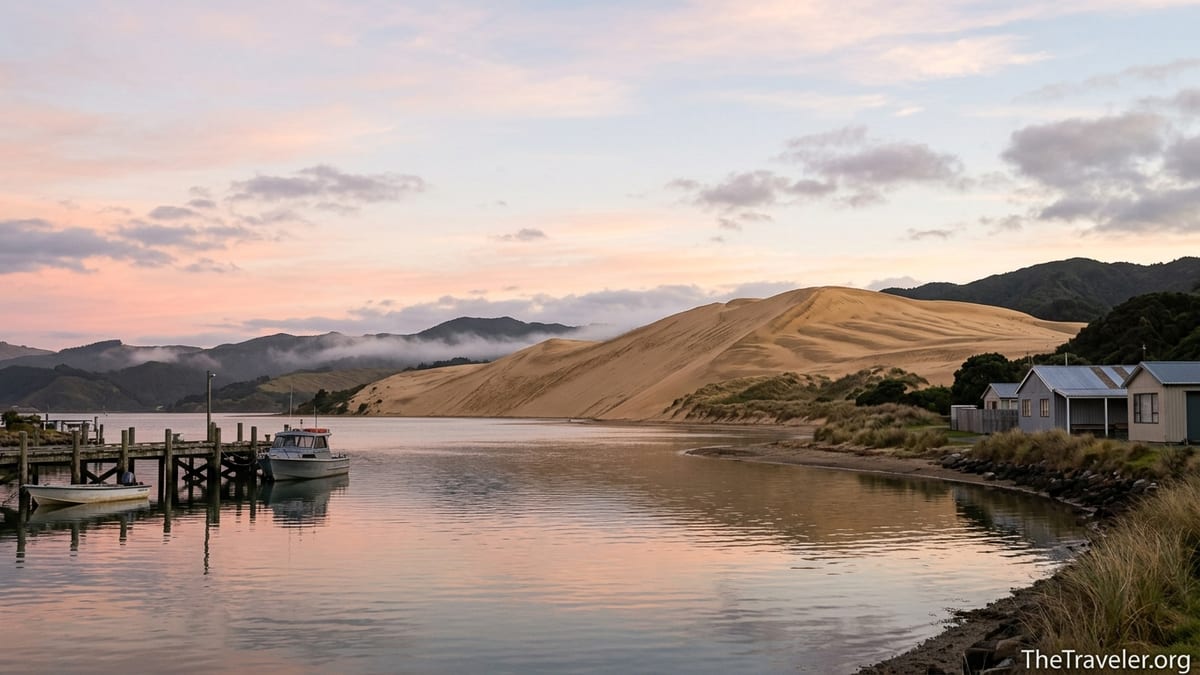
On Northland’s wild west coast, Hokianga Harbour feels like a different country to the polished resorts of the Bay of Islands. Golden sand dunes tower across the water from the twin settlements of Opononi and Omapere, dark kauri forest cloaks the hills, and stories of Māori arrival and settlement are woven into almost every headland. Many drivers on the Twin Coast Discovery route pass through in an hour. The real magic happens if you stay a night or two, slow down, and treat Hokianga as a base to explore the dunes, harbour and Waipoua Forest rather than a brief photo stop on the way to Cape Reinga.
Getting your bearings: Hokianga on the Twin Coast route
Hokianga Harbour lies on State Highway 12 on Northland’s Kauri Coast, about three hours and forty five minutes’ drive from Auckland and just under two hours from Whangārei, depending on traffic. Approaching from the south, the road winds through Waipoua Forest before emerging suddenly at Omapere, where a layby just above town gives a first wide view of the harbour mouth and the huge dunes opposite. From the east, SH12 crosses rolling farmland before dropping down to the shoreline at Opononi.
The harbour itself is a long drowned valley stretching roughly 30 kilometres inland. Opononi and Omapere sit near the entrance, facing the Tasman Sea, while Rawene and Kohukohu lie further up-harbour, connected by a vehicle ferry. The wider Hokianga region includes small Māori communities such as Waima and Waimamaku, with a strong sense of Te Ao Māori in marae, carvings and place names visible from the road.
For many drivers following the 800 kilometre Twin Coast Discovery Highway loop between Auckland and Cape Reinga, Hokianga is the first encounter with Northland’s west coast. Regional tourism maps commonly show an overnight break at Opononi or nearby as the start of the less-travelled side of the route, before continuing north via the ferry to Rawene and on toward Ahipara or Kaitaia. Treating Hokianga as a proper base rather than a refuelling stop gives you access to boat trips, forest walks and lesser-known beaches that most visitors never see.
A good rule of thumb is to allow at least one night in or around Opononi or Omapere, with two nights if you also want to add a twilight tour in Waipoua Forest and a day trip further up-harbour. Rental car companies generally allow driving on State Highway 12 and the Hokianga ferry, but if you plan to continue to Cape Reinga via Ninety Mile Beach, always check your rental agreement, as beach driving is often excluded.
Opononi & Omapere: twin villages at the harbour mouth
Opononi and Omapere function almost as a single settlement strung along SH12, with Omapere to the west and Opononi a few minutes’ drive east. Both are compact, easy to explore on foot and directly front the harbour, so even a short stroll offers changing perspectives on the dunes and the Tasman Sea swell just beyond the heads.
Opononi has the more obvious visitor cluster, with a small supermarket, takeaway, a couple of cafes, a pub and motels close to the main wharf. The seafront Opononi Hotel, for example, typically offers mid-range rooms with balcony views of the harbour and live music some evenings in summer. Nearby motels and holiday parks such as Opononi Beach Holiday Park provide cabin and powered-site options that suit campervans or families wanting kitchen facilities and a more casual feel.
Omapere, a few kilometres around the curve of the bay, feels quieter and more residential but still offers a choice of stays. A waterfront motel complex near the headland combines self-contained units with an on-site restaurant and bar, useful if you prefer to park up and walk. Many travellers also book locally run baches and holiday homes on major booking platforms, often gaining extras such as kayaks or direct beach access. These can work well for two or three nights if you are travelling with friends or family and want space to spread out.
Restaurants in the twin villages lean toward relaxed, with menus featuring fish and chips, burgers, local seafood and simple vegetarian dishes. Expect cafe lunches in the 20 to 30 New Zealand dollar range and main meals at pubs or hotel restaurants from around 28 to 45 dollars, depending on the dish. Breakfast can be as simple as grabbing coffee and a bacon sandwich from a dairy, or as leisurely as eggs benedict on a deck overlooking the harbour if you choose one of the sit down cafes in Opononi.
Riding the Hokianga dunes and exploring the harbour
The vast sandhills opposite Opononi are among Hokianga’s most striking features. Locals often call them the “monster dunes,” and from the main road they really do look more like low mountains than simple sandhills. Because there is no public road on the dune side, the only practical way to visit is by boat across the harbour from Opononi’s wharf.
Several local operators run small boats from the wharf to the dunes, most prominently Hokianga Express Charters. This family-run outfit typically runs on a regular schedule in peak season, with additional sailings by demand. Return fares are usually in the region of 35 to 50 New Zealand dollars per adult for a combined harbour cruise and dune drop off, with discounted rates for children. Boards for sandboarding are normally provided at no extra cost, though bringing your own boogie board or old bodyboard can be useful in busy periods.
The standard experience involves a ten to fifteen minute ride across the harbour, often with commentary about local history and landmarks. Once you land on the sand, you are free to climb and slide as you wish for an hour or two. The climbs can be physically demanding, especially in midday heat, so packing water, sun protection and a light long sleeved shirt is essential. Most visitors go barefoot on the sand, but in peak summer the surface can become very hot, so light sandals or reef shoes can be helpful.
For a more relaxed harbour encounter, some charters offer scenic-only cruises, sunset trips or fishing excursions targeting species such as snapper and kahawai. Keen photographers might choose a late afternoon crossing, when low angled light picks out the ripples on the dunes and the harbour often falls glassy calm. If you are travelling in winter, check directly with operators or local i-SITE visitor centres in advance, as departures may be reduced to a few sailings per day or on request only.
Views, short walks and coastal scenery around the heads
Even without setting foot on a boat, Hokianga’s headlands and roadside lookouts offer some of the most memorable views on the west coast. Just north of Omapere, a signed side road climbs to the historic signal station site high on the headland. From the end of Signal Station Road, a short walk leads to a panoramic viewpoint where you can see straight out to the Tasman Sea, down into the harbour entrance and across to the dunes. Locals often recommend timing a visit for late afternoon or sunset, when the dunes glow deep gold and the surf line at the harbour mouth turns silver.
From Omapere beach itself, it is possible to walk around the rocks toward the headland at lower tides, revealing small coves and rock pools. Conditions change with swell and weather, and there is no formal lifeguard presence here, so always keep an eye on the sea state and avoid pushing around exposed corners if the tide is rising. Families with younger children often choose the gentler shallows right in front of Omapere’s accommodation strip, where the harbour waters are usually calmer.
In Opononi, a promenade-style footpath runs beside the water, linking the wharf with small beaches and grassy picnic areas. It is an easy flat walk suitable for most abilities, and in settled weather you can watch local boats pottering across the harbour and kids jumping from the wharf. Anglers frequently fish from the wharf and nearby rocks on a rising tide, with modest success for species such as kahawai. A simple travel tip is to pick up fish and chips in Opononi and eat them on the waterfront wall while the sun drops behind the dunes.
Further afield, drivers with a half day spare can continue south on SH12 toward Waimamaku and the coastal settlement of Kawerua, or take the vehicle ferry from Rawene to Kohukohu and follow side roads to beaches like Mitimiti. These side trips involve extra driving and, in places, gravel roads, but reward you with even quieter stretches of coast, ancient cemeteries and dramatic views back toward Hokianga Heads.
Māori history, Opo the dolphin and Waipoua Forest access
Hokianga is one of the most historically significant harbours in Aotearoa New Zealand. Tradition holds that the great Polynesian navigator Kupe made landfall here and eventually returned to his homeland from this harbour, leaving descendants who established hapū and iwi throughout the region. Many contemporary tourism experiences emphasise this whakapapa, and visitors quickly notice the number of carved pou, marae and traditional place names that anchor Hokianga in its Māori identity.
In more recent history, Opononi became famous in the 1950s thanks to Opo, a wild bottlenose dolphin that began interacting with swimmers and children near the wharf. For a couple of summers, Opo drew crowds from across the country before dying under disputed circumstances. Today, a memorial and sculpture in Opononi and references in local artwork keep the story alive, and older residents still share personal memories of swimming with the friendly dolphin.
Waipoua Forest lies directly south of Hokianga on SH12 and is one of the most accessible places to see remaining stands of giant kauri trees. The most famous, Tāne Mahuta, is the country’s largest known living kauri and stands a few minutes walk from a roadside car park roughly thirty minutes drive from Omapere. Boardwalks and viewing platforms keep visitors off the soil to protect the trees from kauri dieback disease, and at busy times in summer there can be a short wait for a parking space, so visiting early or later in the day can help.
For a deeper experience, consider joining a guided night or twilight tour such as those offered by Māori owned operator Footprints Waipoua. Tours often depart from accommodation in Omapere or Opononi, shuttling guests into the forest at dusk. Along the way, guides share stories, waiata and explanations of the forest’s spiritual significance, while keeping groups on designated paths to protect sensitive areas. Prices vary by season, but you can expect to pay in the region of 100 to 160 New Zealand dollars per adult for a multi hour experience that includes transport, guiding and interpretation.
Why Hokianga deserves more than a quick stop
On a busy Northland itinerary, it can be tempting to save nights for the high profile Bay of Islands and treat Hokianga as a short photo stop at the Omapere lookout. Yet travellers who do so miss out on the slower, more introspective side of the region. Hokianga offers atmosphere rather than attractions: mist lifting off the harbour in the morning, the low roar of Tasman surf just beyond the heads, the way local kids greet each other by name outside the Four Square.
Compared with Paihia or Russell, which can feel dense with tour sales desks, boat schedules and waterfront bars in peak season, Opononi and Omapere operate on local time. You are more likely to see farmers in gumboots at the cafe than queues of coach passengers, and many businesses are owner operated rather than part of national chains. That slower pace means fewer restaurant choices and shorter opening hours, but also more space to breathe and to connect with people who live in the harbour communities year round.
Hokianga also gives you direct access to both sea and forest in a compact area. Within a 40 minute drive you can be standing beneath a thousand year old kauri, riding a boat to the dunes, or sitting on a modest wharf watching the tide turn. The harbour’s role in early Māori navigation and settlement also lends weight to time spent here. Joining a guided walk or simply reading interpretive panels around Opononi gives context for later visits to more famous sites such as Waitangi in the Bay of Islands.
For many road trippers, the most persuasive argument for staying is practical. Breaking the drive between Auckland and Cape Reinga into manageable sections, with a night in Hokianga and another further north around Ahipara or Kaitāia, makes for safer and more enjoyable travel than attempting to push through in a single long day. Choosing Hokianga as that first overnight stop on the west coast sets the tone for a journey that values small communities and landscapes as much as headline destinations.
Connecting Hokianga with the Bay of Islands, Kauri Coast and Cape Reinga
Hokianga fits naturally into several Northland itineraries. One of the most common loops for international visitors begins in Auckland, follows SH1 north, then diverts onto SH12 at Brynderwyn to pass through Matakohe and the Kauri Museum before reaching Dargaville, Waipoua Forest and finally Opononi or Omapere for the night. From there, drivers can take the vehicle ferry from Rawene to Kohukohu, explore the upper harbour and continue via Broadwood and Ahipara to reach Kaitaia and eventually Cape Reinga.
Another option is to start on the east coast with a stay in Paihia or Russell in the Bay of Islands, then cut across to Hokianga for a contrasting second night. The drive from Paihia to Opononi via Kaikohe and SH12 typically takes about two hours in light traffic. This combination works well if you want to balance dolphin cruises or sailing trips in the Bay of Islands with quieter harbour views and forest time at Waipoua, without adding too much driving in a short holiday.
Travellers heading for Cape Reinga can continue from Hokianga to Ahipara or Kaitaia in around two and a half to three hours, depending on route choice. Many join a full day coach tour from Kaitaia or Ahipara to reach the cape and Te Paki sand dunes without needing to drive on Ninety Mile Beach themselves. Coach tours generally cost in the region of 120 to 180 New Zealand dollars per adult and include stops at the lighthouse, sandboarding and beach sections that are not recommended for conventional rental cars.
If you have more time, you can shape a broader Kauri Coast circuit. From Opononi, drive south again through Waipoua and then on to Kai Iwi Lakes near Dargaville for freshwater swimming, before looping back toward Whangārei and returning to Auckland down the east coast. This approach lets you connect Hokianga’s harbour and forest with coastal views around Waipū, Mangawhai or even the Hibiscus Coast near Auckland, showcasing both sides of Northland without backtracking too much.
Practical tips: seasons, services and staying comfortable
Weather in Hokianga is strongly influenced by the Tasman Sea. Summers are typically warm, with daytime temperatures commonly in the low to mid twenties Celsius, while winters are mild but often wet, with frequent showers rolling in from the west. Pack a light waterproof jacket and layers even in warmer months, especially if you plan to take a boat across the harbour or join an evening forest tour where temperatures drop after dark.
Services in Opononi and Omapere are modest. There is usually one small supermarket, a service station and a handful of cafes and takeaways. Opening hours can shorten outside the main summer season and during public holidays, so it is sensible to keep your fuel topped up when passing through larger towns such as Dargaville, Whangārei, Kerikeri or Kaitaia. Mobile coverage is generally available in the main settlements but can be patchy in forested sections of SH12, so downloading offline maps before leaving a major centre is a good precaution.
Accommodation price points fluctuate with demand. In peak summer school holidays, simple motel rooms in Opononi or Omapere can reach 220 to 300 New Zealand dollars per night, while shoulder seasons often see rates drop closer to 140 to 200 dollars. Holiday parks and campgrounds tend to offer powered sites for 25 to 45 dollars per person and basic cabins from around 90 dollars. Booking ahead is strongly recommended from late December through February and during long weekends, as options are limited and popular with domestic travellers.
Driving conditions on SH12 require a little patience. The road is sealed but narrow and winding in places, especially through Waipoua Forest and the Mangamuka Ranges. Allow extra time for slower vehicles and be prepared for wet surfaces and occasional fallen branches in winter or after storms. Pull into designated laybys for photos rather than stopping in the traffic lane, and respect speed advisory signs on tighter bends. If you are unused to rural New Zealand roads, planning shorter driving days and building in time for rest stops will make the journey safer and more enjoyable.
FAQ
Q1. How long should I stay in Hokianga Harbour?
Most travellers find one or two nights in Opononi or Omapere ideal, giving enough time for a dune boat trip, a visit to Waipoua Forest and some relaxed harbour time without rushing.
Q2. Is Hokianga Harbour suitable for families with children?
Yes, the area works well for families. The dune boat trips, gentle harbour beaches and easy walks offer plenty of low key activities, though parents should supervise children closely around water and on the steep dunes.
Q3. Do I need a car to explore Opononi, Omapere and Waipoua Forest?
A car makes visiting Waipoua Forest and nearby viewpoints much easier. Within Opononi and Omapere you can walk between many accommodation, dining and waterfront areas, but public transport is limited.
Q4. Are there budget accommodation options in Hokianga?
Yes. Holiday parks with cabins and powered sites, simple motels and shared holiday homes provide more affordable choices, especially outside peak summer and school holidays.
Q5. Can I swim in Hokianga Harbour?
Many locals and visitors swim from the beaches at Opononi and Omapere in settled conditions. Always check tides, avoid strong currents near the harbour entrance and be aware that there are usually no lifeguards on duty.
Q6. How does Hokianga compare with the Bay of Islands?
The Bay of Islands is busier and more developed, with a wide range of tours and nightlife. Hokianga feels quieter, more local and more closely tied to forest and dune landscapes than to open sea cruising.
Q7. When is the best time of year to visit Hokianga Harbour?
Late spring to early autumn offers the best mix of warm temperatures and longer daylight for dune trips and forest walks, though winter visits can still be rewarding for misty harbour views and quieter roads.
Q8. How do I get from Hokianga to Cape Reinga without driving on the beach?
From Opononi or Omapere you can drive via Rawene, Ahipara or Kaitaia and then join a coach tour that includes Ninety Mile Beach and Te Paki dunes, avoiding beach driving in your rental car.
Q9. Are guided tours necessary in Waipoua Forest?
You can visit roadside walks independently, but guided tours add cultural context, stories and night time access, while also helping ensure visitors follow track and hygiene protocols that protect kauri trees.
Q10. Is it easy to find food and fuel in Hokianga?
There is a small supermarket, fuel and several cafes and takeaways in Opononi and Omapere, but options are limited. It is wise to keep your tank topped up in larger towns and to check seasonal opening hours.