


Perched above the Bay of Islands with sweeping views across the water, the Waitangi Treaty Grounds are both New Zealand’s most important historic site and one of its most rewarding visitor experiences. This is where the Treaty of Waitangi was first signed in February 1840, and today the grounds combine powerful storytelling, contemporary museums, Māori cultural performances and peaceful coastal walks. This guide focuses on how to visit: what your ticket includes, how long to allow, what not to miss, and how to get here easily from Paihia or Russell.
Why Waitangi Matters: A Brief, Traveler-Friendly History
To understand why people travel from all over Aotearoa New Zealand and abroad to Waitangi, it helps to know the basics of what happened here. In 1840, representatives of the British Crown and many Māori rangatira (chiefs) gathered at Waitangi to debate and sign an agreement that would shape the future of the country. Known in te reo Māori as Te Tiriti o Waitangi and in English as the Treaty of Waitangi, the document set out a new relationship between Māori and the Crown, with promises of protection, recognition of chiefly authority and rights of British subjects.
The first signing took place on 6 February 1840 in a marquee set up on the lawn below what is now called the Treaty House. Copies were then taken around the country, and by the end of that year more than 500 Māori leaders had signed one of several versions. The exact meanings and the differences between the Māori and English texts remain at the heart of ongoing discussion and negotiation in New Zealand life, which is why the place where it began carries such weight.
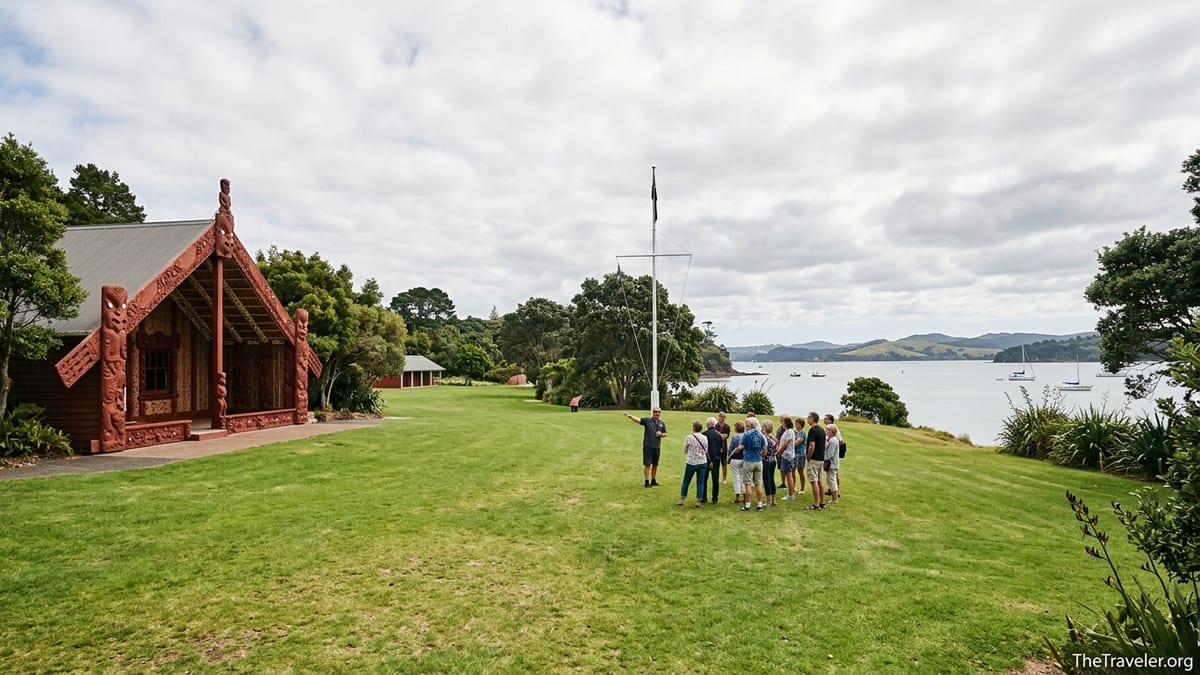
For travelers, visiting Waitangi is less about reading a single plaque and more about walking through a living landscape of stories. The Treaty House, the carved meeting house Te Whare Rūnanga, the flagstaff, and the waka taua (war canoe) all sit within park-like grounds above the sea. Two modern museums add depth and multiple perspectives, making this a site where you can connect historic events with contemporary New Zealand society in a very tangible way.
Because Waitangi is both a national symbol and a community space, it also hosts major events. On 6 February each year, the grounds become the focus of Waitangi Day commemorations, with dawn ceremonies, speeches and performances. On that day the buildings close and access works differently, so most independent travelers plan regular visits on other dates when the museums, café and guided tours operate as normal.
What Your Ticket Includes: Prices, Passes and Value
Admission to the Waitangi Treaty Grounds is sold as a comprehensive experience rather than separate museum or tour tickets. A standard day admission currently includes access to the entire historic site, a 50 minute guided tour, a 30 minute Māori cultural performance, and entry to both on-site museums. Admission is valid for two consecutive days, which means you can explore intensively on the first day and return the next morning to revisit exhibits, walk more of the coastal tracks or simply sit with a coffee overlooking the bay.
As of the current pricing period from 1 October 2025 to 30 September 2026, international adult tickets are listed at around 74 New Zealand dollars, with a reduced youth price for ages 13 to 17 and free entry for children aged 12 and under when accompanied by a paying adult. New Zealand residents pay roughly half the international adult rate with valid ID, reflecting the site’s role as a place of national learning and reflection. Prices are scheduled to rise modestly from October 2026, so it is worth checking the latest figures when you book, but you can confidently budget for this to be one of the higher-cost yet higher-value experiences in the Bay of Islands.
Because the two-day validity and included tour and show are standard, there is no complex menu of add-ons to decipher. For many visitors staying in Paihia, a common pattern is to spend an afternoon at the museums and grounds, then return the following morning for a second guided tour or to catch a different cultural performance time. If you are traveling with children, the no-charge policy for under 12s makes this an especially worthwhile educational stop compared with activities that charge per person for boat trips or adventure tourism.
Separate from daytime admission, the site also offers an evening hāngī and concert experience during the warmer months, typically from October to April. This is booked as a distinct product at a significantly higher price point than daytime entry and includes a full hāngī meal alongside a longer performance. Many travelers who opt for the evening package still purchase day admission to enjoy the museums and grounds in detail, so consider it an addition rather than a substitute if your budget allows.
Guided Tours, Museums and The Best Way To Explore
The included 50 minute guided tour is the backbone of most visits. Knowledgeable guides lead small groups around key sites such as the Treaty House, the carved meeting house and the flagstaff, weaving together historical accounts, Māori perspectives and anecdotes that you simply will not pick up by wandering alone. Tours generally run on the hour through the late morning and afternoon; it is wise to confirm current times on arrival and work your museum visits around a tour slot rather than the other way around.
Inside Te Kōngahu Museum of Waitangi, opened in 2016, the permanent exhibition “Ko Waitangi Tēnei: This is Waitangi” uses more than 500 images, immersive audiovisual experiences and interactive displays to walk you chronologically through the decades before, during and after the signing. One memorable section recreates the canvas marquee where discussions took place in early February 1840, allowing you to stand under the projected images and listen to the voices of historical figures debating the treaty. Expect to spend at least 60 to 90 minutes here if you engage with the exhibits, more if you like to read in detail.
The second major museum, Te Rau Aroha, focuses on the stories of Māori who have served in New Zealand’s armed forces and the impact of war on communities. Even if military history is not a primary interest, the personal stories, photographs and taonga (treasured objects) provide a powerful perspective on citizenship, sacrifice and the evolving relationship between Māori and the state. Many visitors find this museum unexpectedly moving and devote another 45 to 60 minutes here, especially if they take time in the quiet contemplation spaces.
A practical way to structure your time is to start with a guided tour soon after arriving, then explore Te Kōngahu while the narrative is fresh in your mind. Follow this with the cultural performance (or vice versa, depending on the schedule) and finish with Te Rau Aroha and a walk down to the waka shelter. If you are using your two-day pass, you might dedicate day one to the museums and performance, and day two to the walks, shoreline and any exhibits you skimmed the first time.
Māori Cultural Performances, Waka and Respectful Engagement
The Māori cultural performance is a highlight of the Waitangi experience and is staged in and around Te Whare Rūnanga, the intricately carved meeting house on the upper grounds. Your visit typically begins with a pōwhiri, or formal welcome, on the marae ātea (the open space in front of the meeting house). From there, the performance moves indoors, where a kapa haka group presents waiata (songs), poi, storytelling and a haka, bringing traditional and contemporary Māori culture to life in a way that is both informative and emotionally powerful.
Performance schedules vary slightly through the year, with more sessions during the peak summer period. In the current season a daytime visitor can usually choose from late-morning and afternoon times, and operators recommend arriving around 15 minutes early so staff can seat the group and explain etiquette such as when to remove hats or stand. Photography is generally allowed during parts of the show, but there may be moments when the performers ask visitors to pause cameras out of respect, so it is wise to follow on-the-day guidance rather than assuming.
Down on the lower grounds near the water, you will find one of the world’s largest ceremonial waka taua. Launched on special occasions, this immense canoe requires scores of paddlers and becomes a spectacular sight during Waitangi Day events. On regular days it rests on a purpose-built shelter where you can walk alongside its carved hull, appreciate the scale of the craftsmanship and imagine how waka like this once moved swiftly through the Bay of Islands. Guides frequently incorporate the waka into their tours, explaining its design, symbolism and the protocols that surround it.
As with all Māori cultural experiences, a respectful attitude goes a long way. Simple gestures such as listening attentively, following instructions given before the pōwhiri, and asking questions thoughtfully after performances show appreciation rather than consumption. If you are traveling with children, it can be helpful to explain beforehand that the meeting house is a place of significance, not just a backdrop for photos, and that some areas may be off limits for climbing or casual sitting.
Key Historic Sites Around the Grounds
Beyond the museums and performance, a visit to Waitangi is also about moving through a landscape where individual sites each contribute part of the story. The Treaty House itself was once the residence of James Busby, the British Resident. Here, the 1835 Declaration of Independence of the United Tribes of New Zealand was drafted, and the text of the Treaty of Waitangi received its finishing touches before being presented to Māori leaders in February 1840. Today the house has been carefully restored, with some rooms furnished to evoke its 19th century appearance and interpretive panels that explain the debates and personalities associated with it.
In front of the house stands the flagstaff, marking the spot where New Zealand’s first national flag was chosen in 1834, several years before the treaty itself. The choice of flag reflected the desire of northern chiefs to have a recognised national symbol for trading ships, and for many visitors it becomes a concrete reminder that political negotiations here did not begin or end in 1840. Your guide is likely to pause here to discuss how relationships between Māori and the Crown evolved, sometimes cooperatively and sometimes through conflict in the decades that followed.
Te Whare Rūnanga, the carved meeting house completed in the 1940s, is another focal point. It stands as a symbol of the unity of Māori tribes, incorporating carving styles from around the country and serving as the main setting for official welcomes and cultural performances. When the house is not in use for ceremonies or shows, you may be able to step inside and examine the carvings more closely. The building holds particular significance during Waitangi Day commemorations and official visits.
Paths from the main grounds lead to more contemplative spaces. Coastal tracks wind down towards the water, past native bush and viewpoints over the Bay of Islands. It is possible to follow a loop that takes you past the waka shelter, along the shoreline and back up through forested paths, making the site feel more like a coastal park than an urban museum. If you have mobility considerations, staff at the visitor centre can advise which routes are suitable and where ramps or gentler gradients are available.
How Much Time To Allow and Sample Itineraries
Because admission is valid for two consecutive days, you can tailor your visit to your energy levels and interests. At an absolute minimum, you should allow three hours to join a guided tour, attend one cultural performance and walk quickly through at least one of the museums. This is the sort of schedule many cruise passengers follow on half-day shore excursions from ships anchored in the Bay of Islands.
A more comfortable visit for independent travelers is four to six hours. This gives you space to do a guided tour, linger in both museums, attend a performance, stroll down to the waka and flagstaff, and take a break at the on-site café without rushing. Many visitors staying in Paihia or Russell choose to arrive late morning, watch a midday performance, have lunch, then spend the afternoon in the museums before walking back along the waterfront.
If you are especially interested in New Zealand history, politics or Māori culture, or if you simply prefer a slower pace, you can easily spend most of a full day here and return briefly the following morning. One realistic pattern is to dedicate day one to orientation: do the guided tour and one museum, then focus on Te Rau Aroha, the waka and coastal walks on day two. The grounds can be an atmospheric place in changeable weather too; light rain or cloud often softens the views and makes the carved timber and greenery appear richer in photographs.
Families, in particular, benefit from the flexibility of the two-day pass. Children can engage with interactive elements of the museums in shorter bursts rather than attempting to take in everything in one long session. Returning the next day to “show” younger family members their favourite exhibit or to walk a different track along the water helps reinforce what they have learned without feeling like schoolwork.
Access From Paihia and Russell: Getting There and Practicalities
Most visitors base themselves in Paihia, the main hub of the Bay of Islands, where accommodation ranges from backpacker hostels and motels to boutique hotels facing the harbour. From central Paihia it is a short and often scenic trip to the Waitangi Treaty Grounds. Walking takes roughly 25 minutes one way, following a flat waterfront path and crossing the bridge over the Waitangi River. This is a pleasant option on a fine day and allows you to appreciate the views back towards the township and out to Russell.
If you prefer not to walk, local shuttle services, taxis and some tour operators run regular transfers between Paihia and the Treaty Grounds. Driving takes about five minutes, and there is on-site parking near the visitor centre. For travelers on coach tours, Waitangi is often one of several stops in a broader Northland or Bay of Islands itinerary, with commentary provided en route. If you are arriving by cruise ship tender into Paihia, check your ship’s shore excursion options, as many lines offer pre-arranged guided visits that coordinate tour and show times with tender schedules.
Reaching Waitangi from Russell involves a short ferry crossing plus a road or shuttle link. Passenger ferries run frequently between Russell and Paihia, with the crossing itself taking around 15 minutes and offering some of the best views of both settlements and the outer islands. Once in Paihia you can pick up a shuttle, taxi or rental car to cover the remaining distance to the Treaty Grounds. Travelers with their own vehicle can also use the vehicle ferry between Okiato and Opua and then drive through to Waitangi, a route that suits those continuing on to explore other parts of Northland.
The Treaty Grounds are generally open daily except for Christmas Day and Waitangi Day itself on 6 February, when standard visitor operations pause for national commemorations. Opening hours typically cover the daylight period from morning into late afternoon. There is a café on site serving coffee, snacks and light meals, and a gift store that stocks books, Māori arts, carvings and thoughtfully chosen souvenirs. Given the coastal setting, it is wise to bring a light jacket even in summer, along with comfortable walking shoes, sun protection and a reusable water bottle.
The Takeaway
The Waitangi Treaty Grounds reward visitors who come not only to “tick off” a historic site but to listen, reflect and spend time in a landscape where the story of modern New Zealand continues to unfold. From the moment you step into the entrance foyer and see contemporary design alongside traditional carving, it is clear this is not a static monument. The guided tours, museums, cultural performances and waka shelter each offer different angles on the same intertwined narrative of land, language, authority and identity.
For travelers based in Paihia or Russell, the practicalities are straightforward. A relatively short transfer delivers you to expansive grounds with big-sky coastal views, well-maintained paths and clear signage. Once there, your two-day pass lets you decide whether to treat Waitangi as a half-day highlight or as the anchor for nearly a full day of exploration, with time to pause at the café or linger in a favourite gallery.
Whether you are visiting Aotearoa for the first time or are a New Zealander returning to understand your own history more deeply, Waitangi remains a compelling place to start. You will leave with memorable images of carved meeting houses and soaring flagstaffs, but more importantly with questions, insights and stories that stay with you long after you have crossed back over the bridge to Paihia or sailed across the bay to Russell.
FAQ
Q1. How much does it cost to visit the Waitangi Treaty Grounds?
The standard admission for international adults is currently around 74 New Zealand dollars, with discounted rates for youth and New Zealand residents and free entry for children 12 and under traveling with a paying adult. Prices are reviewed periodically, so it is sensible to check the most up to date rates when planning your trip.
Q2. How long should I allow for a visit?
Allow at least three hours to join a guided tour, see one cultural performance and explore one museum. Four to six hours is more comfortable and lets you enjoy both museums, stroll to the waka shelter, take photos and stop at the café. Because tickets are valid for two consecutive days, many travelers split their time over two shorter visits.
Q3. What does my admission ticket include?
A standard ticket includes access to the entire historic site, a 50 minute guided tour, a 30 minute Māori cultural performance, and entry to both on-site museums. It also allows you to return the next day, giving flexibility to explore at your own pace without needing separate tickets for each component.
Q4. Do I need to book in advance?
Advance booking is recommended, especially in the busy summer months and on days when cruise ships are in the Bay of Islands, but same day tickets are often available. Booking ahead helps you secure your preferred time for guided tours and cultural performances and allows staff to manage group sizes more effectively.
Q5. How do I get to the Treaty Grounds from Paihia?
From central Paihia you can walk along the waterfront to the Treaty Grounds in around 25 minutes, crossing the bridge over the Waitangi River. Alternatively, taxis, shuttles and tour buses make the trip in about five minutes, and there is parking available if you are driving your own car or campervan.
Q6. Can I visit from Russell without a car?
Yes. Passenger ferries link Russell and Paihia throughout the day, with the crossing taking about 15 minutes. From the Paihia wharf you can either walk to the Treaty Grounds if you are comfortable with a half hour stroll or connect with a local shuttle or taxi for a short ride to the entrance.
Q7. Are the grounds suitable for children?
The Waitangi Treaty Grounds are very family friendly. Children 12 and under enter free with a paying adult, there are interactive elements in the museums, and open lawns and coastal paths provide space to move. Some content deals with serious historical themes, so many parents choose to talk with children beforehand about what they will see.
Q8. Is the site accessible for visitors with limited mobility?
Many key areas, including the museums, visitor centre and performance space, are on level or ramped access. Some of the outdoor paths are gently sloping rather than flat, and a few coastal tracks are steeper or uneven. It is a good idea to speak with staff at the entrance, who can suggest routes and viewing points that best match your mobility needs.
Q9. What should I wear and bring?
Wear comfortable walking shoes and dress in layers, as coastal weather can shift between sunshine, wind and light showers in a single day. A light jacket, sunhat, sunscreen and reusable water bottle are practical essentials. Because parts of the experience take place outdoors and near the water, a compact umbrella or raincoat is useful in unsettled conditions.
Q10. Is the Waitangi Treaty Grounds worth a visit if I am short on time?
Yes. Even with only three hours you can gain a meaningful introduction to New Zealand’s founding document and Māori culture through a guided tour, one museum and the cultural performance. Travelers who make space for Waitangi in a tight Bay of Islands itinerary often describe it as the most thought provoking and rewarding stop of their trip.