

The journey from Auckland to the Bay of Islands is one of New Zealand’s classic routes, linking the country’s largest city with subtropical beaches, waterfalls and some of its most important historic sites. Whether you drive yourself, take an InterCity coach or join an organised tour, the choices you make between Auckland and Paihia will shape how relaxed, rushed or rewarding your Bay of Islands experience feels.
Understanding the Auckland to Bay of Islands Route
The main route from Auckland to Paihia runs north on State Highway 1 for roughly 220 to 230 kilometres, depending on whether you start in the central city or from the airport. In light traffic, the point-to-point drive is typically around three to three and a half hours without stops, which matches most current self-drive estimates. In reality, roadworks, holiday traffic and natural pauses for food, fuel and viewpoints mean most independent travellers should plan on at least four to five hours door to door.
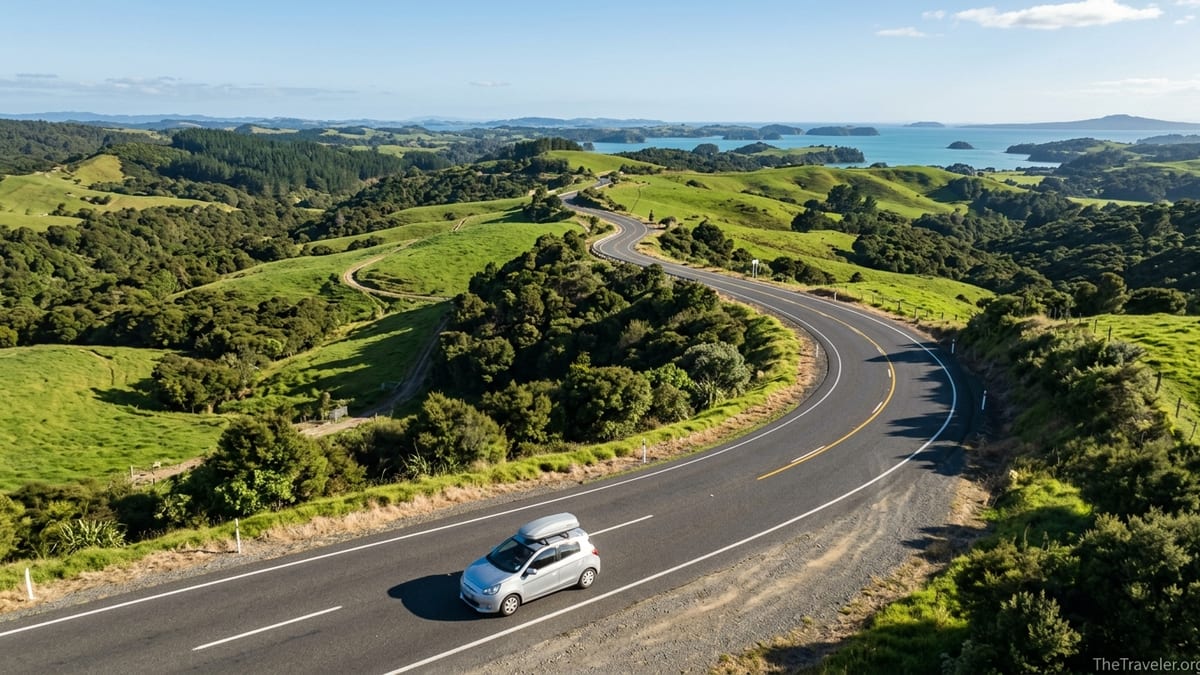
Once you clear Auckland’s motorway system and the Northern Gateway Toll Road, the highway alternates between fast dual carriageway and more winding single-lane sections. North of Warkworth, the road becomes hillier and slower, but it is also where the scenery improves, with rolling farmland, forested ridges and glimpses toward the coast. This combination of changing road conditions and frequent reasons to stop is why trying to “sprint” the journey in exactly three hours rarely feels relaxing, especially after a long flight.
Paihia is the main visitor hub in the Bay of Islands and sits across the water from historic Russell and close to the Waitangi Treaty Grounds. It is the usual end point for Auckland to Bay of Islands transfers, though some coach services and rental cars also continue north to Kerikeri or further into Northland. For planning purposes, assume similar driving times between Auckland and Kerikeri as to Paihia, with an extra 20 to 30 minutes depending on your exact route.
There are no passenger trains running from Auckland into Northland today, so travellers are choosing between self-drive, long-distance coach or organised tours. That simplicity makes planning easier, but it also means thinking carefully about your budget, comfort level with New Zealand roads and how much time you realistically want to spend behind the wheel versus on the water once you arrive.
Self-drive: Flexibility, Timings and Classic Stops
Self-driving between Auckland and the Bay of Islands remains the most flexible option, especially for couples and families. With a standard rental car from a major operator such as Avis, Budget, Hertz or Omega, daily rates can often fall in the range of 60 to 120 New Zealand dollars in shoulder seasons, with higher prices and stricter minimums in peak summer. That typically proves competitive or cheaper than buying three or four separate coach tickets, and it gives you control over departure time and route.
In practical terms, most independent travellers leaving Auckland city centre around 8 am will reach Paihia by about midday if they keep stops short. A realistic pattern is a quick coffee near Warkworth or at the large service centre around Kaiwaka, then a longer break in Whangārei. Whangārei Falls is a popular off-highway pause that adds about an hour, including parking, the short walk to the viewing platforms and a restroom break. Factoring this in, a four-and-a-half-hour total journey feels much more believable for those who want at least one worthwhile stop.
Beyond Whangārei, there are further options for detours and breaks. Some drivers divert to the Tutukaka Coast for a coastal lunch or beach stroll, which turns the day into a more meandering road trip, while others prefer the straight run via Kawakawa and Opua. Kawakawa itself is well known for its Hundertwasser-designed public toilets and small cafes by the main street, and it works as a characterful fifteen to thirty minute leg-stretch before the final 20 to 25 minutes into Paihia.
Driving also lets you easily call into supermarkets in Whangārei or Kerikeri to stock up before reaching your accommodation. For visitors staying in self-catering apartments in Paihia or renting a holiday home, this can mean significant savings over eating every meal out. The main trade-off is driver fatigue. After a long-haul arrival into Auckland, many visitors overestimate their alertness and underestimate local road conditions. For late-arriving flights, it is usually wiser to overnight in Auckland and drive north the following morning rather than trying to tackle three to four hours of unfamiliar roads at the end of an international journey.
Coach Travel: InterCity, Comfort and Expectations
Coach travel between Auckland and the Bay of Islands is dominated by InterCity, which runs multiple daily services from the central Auckland terminal to Paihia and Kerikeri. Typical one-way travel times listed by the operator sit around four hours and fifteen minutes to four and a half hours, reflecting scheduled stops in Whangārei and other towns along the way. Fares vary by season and how far in advance you book, but it is common to see standard adult tickets in the region of 40 to 60 New Zealand dollars one way, with occasional lower “web saver” specials.
Modern long-distance coaches usually offer reserved seating, onboard toilets and free Wi-Fi, and luggage allowances are generous enough for standard suitcases plus a daypack. From a practical standpoint, this can remove both the stress of driving and the need to pay city-centre parking fees in Auckland for those starting their Northland journey from downtown hotels. Travellers can walk or take a short taxi or rideshare to the coach terminal, load their bags and relax for the duration of the ride.
What bus travel does not provide is the same degree of spontaneity. While the Whangārei stop gives you a chance to buy snacks or stretch your legs, you will not be swinging off to Whangārei Falls or detouring along the coast without switching to local buses or taxis. The day becomes about efficiency rather than exploration. For many backpackers and solo travellers focused primarily on reaching Paihia to join a Bay of Islands cruise or dolphin tour, this compromise is entirely acceptable, particularly when budgets are tight.
There are also sightseeing-style coach tours operated under brands associated with experienced companies, which blend point-to-point transport with commentary and prebooked excursions. For example, a full-day sightseeing coach from Auckland might include the coach ride north, entry to the Waitangi Treaty Grounds and a ferry crossing to Russell, then return you to Auckland in the evening. These tend to be priced closer to 220 to 280 New Zealand dollars per person and are worth considering for those who prefer having logistics fully handled and a guide narrating the history along the way.
Organised Tours and Auckland-based Day Trips
For visitors short on time or reluctant to drive, organised Bay of Islands day tours from Auckland bundle transport and activities into a single package. Many follow a similar pattern: a pre-dawn pickup from central hotels, a coach journey of about three hours each way, a midday cruise from Paihia or Russell to the Hole in the Rock or around the inner islands, and a return to Auckland in the later evening. Because operators must keep to cruise departure times and daylight hours, these tours tend to be tightly scheduled, typically lasting 12 to 13 hours in total.
In practice, this means your Bay of Islands “experience” on a day trip might amount to a few hours on the water and perhaps a short walk or coffee break in Paihia or Russell, bookended by six or more hours on a bus. For some travellers, especially those with only two or three nights in Auckland and an ambition to see as much as possible, that trade-off is acceptable. It is a straightforward way to tick off the famous Hole in the Rock cruise or the Waitangi Treaty Grounds without changing hotels.
However, many people underestimate how draining the day can feel. Pickups often start around 6.30 or 7 am and returns to Auckland can be after 7 pm, depending on traffic and season. Parents with younger children, older travellers and anyone prone to motion sickness may find the combination of twisting roads and long stints of sitting uncomfortable. As a result, Auckland-based day trips work best as a backup choice when extending your itinerary to stay in the Bay of Islands itself is genuinely not possible.
Smaller-group and private tours offer another style of experience, usually at a higher price point. A private driver-guide taking a couple or small family north for the day might charge several hundred dollars per person, but the benefit is a flexible schedule, custom stops and a vehicle tailored to your group. With an early departure, it is feasible to include Whangārei Falls, a cafe stop in Kawakawa, a three-hour cruise from Paihia and a brief wander in Russell before returning to Auckland in the evening. Even so, the underlying constraint of three hours each way on the road remains.
Is a Bay of Islands Day Trip From Auckland Too Rushed?
Whether a day trip feels too rushed comes down to expectations and travel style. If your goal is simply to say you have seen the Bay of Islands, perhaps photograph the Hole in the Rock and step briefly onto a beach, a long day from Auckland can accomplish that. You will glimpse the subtropical coastline, hear a little of the region’s history and return to your Auckland base without having to repack your suitcase.
On the other hand, if you imagine lingering in Paihia’s cafes, walking the coastal track to Opua, exploring the Waitangi Treaty Grounds at your own pace and taking an unhurried late-afternoon swim, a same-day return journey from Auckland will almost certainly feel rushed. You will spend more time on the motorway than at the water’s edge, and you may find yourself watching the clock instead of the scenery throughout your cruise or guided tour.
Seasonal factors matter as well. In peak summer, traffic north of Auckland can be heavy on weekends and during school holidays, lengthening travel times and sometimes compressing the schedule in the Bay of Islands. If a day trip operator needs to return guests to Auckland by a fixed time, that pressure can translate into shorter breaks or reduced free time ashore if the morning run north is slow. Conversely, in winter there may be fewer departures and more variable weather at sea, increasing the risk of cancellations or choppy conditions.
As a rule of thumb, if you are visiting New Zealand for two or three weeks or more, building at least one overnight in the Bay of Islands is a far better use of your time than packing the region into a single massive day. Day trips are most defensible for business travellers or conference delegates who have limited spare time in Auckland but want a taste of Northland without rearranging their schedule.
When to Stay One Night, Two Nights or Longer
Deciding how long to stay in the Bay of Islands is as important as choosing how to get there. For many visitors using Auckland as their main hub, one night in Paihia or Russell is a good minimum. This allows a comfortable drive or coach ride north on day one, a relaxed afternoon exploring the waterfront, maybe a short evening cruise or dinner on the harbour, then a full morning the next day for a signature activity such as a Hole in the Rock cruise or a visit to the Waitangi Treaty Grounds before returning south.
Two nights opens up a more balanced experience. With this amount of time, you can arrive from Auckland without rushing, enjoy one major activity each day and still build in downtime on the beach. For example, on a two-night stay you might drive or coach up on day one and wander Paihia or take the passenger ferry to Russell for sunset. On day two, you could dedicate the morning to the Waitangi Treaty Grounds and the afternoon to kayaking or a sailing trip. On day three, you would travel back to Auckland or continue onward to Cape Reinga.
Stays of three nights or more are worthwhile for travellers using the Bay of Islands as a base for broader Northland exploration. With a rental car, you can day trip to Kerikeri’s wineries and historic missions, drive to the giant kauri trees of the Waipoua Forest or make a long but memorable excursion to Cape Reinga and Ninety Mile Beach with a specialist tour operator. This length of stay works particularly well for repeat visitors to New Zealand who want to slow down and enjoy the “winterless north” climate at a more local pace.
Pricing often nudges travellers toward slightly longer stays. Accommodation in Paihia and Russell covers everything from holiday parks and backpacker hostels to mid-range motels and boutique waterfront lodges. Outside of peak festival dates and school holidays, you may find that adding a second night increases the total cost only marginally compared with committing to an expensive one-day tour from Auckland. When comparing, consider not just nightly rates but also the value of extra time not spent on the road.
Rental Car Logistics and One-way Considerations
For those planning an Auckland to Bay of Islands road trip as part of a broader North Island itinerary, rental logistics matter. Most international brands and local companies maintain depots in central Auckland, at the airport and in a few Northland towns such as Paihia or Kerikeri. One-way rentals within the North Island are usually possible, but they often carry minimum rental periods of around three days and may attract additional drop fees, especially if you pick up in a major centre like Auckland and drop off in a smaller one.
As an example, a traveller might collect a compact car at Auckland Airport, drive to Paihia for two nights, then continue by road to Rotorua or Wellington. In this scenario, the car remains in use for the full journey and works well as a flexible base for luggage and day trips. By contrast, picking up a car in Auckland solely to drive to Paihia, then dropping it there and immediately taking an InterCity coach back south, is less common and may incur higher per-day and one-way costs. It is worth comparing a simple round-trip rental to a more complex one-way booking before committing.
Fuel prices in New Zealand change frequently, but visitors should budget for a full tank each way for most standard petrol cars between Auckland and Paihia, with precise costs depending on engine size and whether you detour significantly. Filling up in larger centres such as Auckland, Warkworth or Whangārei often proves slightly cheaper than relying solely on smaller rural stations. Many travellers choose to top up in Whangārei on the way north and south as a convenient midpoint.
Finally, be realistic about driving conditions. While the Auckland to Bay of Islands route is sealed and generally in good condition, it still involves narrow sections, occasional slow vehicles and changing weather. Overseas visitors should familiarise themselves with New Zealand’s left-hand driving, give themselves time to adjust to local signage and factor regular breaks into their schedule. If you are nervous about driving but still value some flexibility, consider pairing an Auckland to Paihia coach with a smaller local rental for a day or two around the Bay of Islands only.
Putting It Together: Example Point-to-point Itineraries
To help translate these options into real-world plans, consider a typical three-day, two-night self-drive itinerary. On day one, you leave central Auckland around 9 am, stop in Warkworth for a coffee, then detour slightly to Whangārei Falls for a short walk and photos. After a simple lunch in Whangārei’s town centre, you continue via Kawakawa, pausing to see the famous Hundertwasser toilets and grab an ice cream, before rolling into Paihia around 3 pm. That evening, you stroll the waterfront and enjoy dinner at a casual restaurant overlooking the bay.
Day two is spent fully in the Bay of Islands. You might join a mid-morning cruise from Paihia that visits the Hole in the Rock and includes an island stop where you can swim, walk to a viewpoint and relax on the beach. Returning mid-afternoon, you have time for an early evening ferry ride to Russell, where you can wander the historic streets and enjoy a drink with harbour views before heading back to Paihia. On day three, you visit the Waitangi Treaty Grounds when they open, then depart by late morning to drive back to Auckland, arriving by early evening with generous stops along the way.
A coach-based alternative compresses the journey slightly. You could take an InterCity coach from Auckland to Paihia in the morning, arriving early afternoon, then walk to your accommodation. After an evening at leisure, you might dedicate the next day entirely to the Waitangi Treaty Grounds and a shorter cruise or sailing outing. On the third day, you would catch an afternoon coach back to Auckland. While you lose the ability to make spontaneous stops en route, you also avoid fuel and parking costs and the stress of unfamiliar driving.
For travellers absolutely constrained to a single day, a structured Auckland round-trip tour offers clarity. You are collected in the city early, ride the coach north with commentary, take a prebooked cruise or guided visit in the Bay of Islands and return that evening. You do not need to worry about directions, parking or multiple tickets. The price you pay is a very long day and less control over timing, but for some it is still preferable to not visiting the Bay of Islands at all.
The Takeaway
The corridor between Auckland and the Bay of Islands is straightforward on a map yet nuanced in practice. Self-drive delivers freedom to pause at waterfalls, quirky small towns and scenic lookouts, but it also demands confidence on New Zealand roads and a realistic approach to fatigue and timing. Long-distance coaches like InterCity provide a stress-free, affordable way to reach Paihia, particularly for solo travellers and those content to focus their exploration on the bay itself rather than the journey.
Organised tours, from budget-friendly sightseeing coaches to private driver-guides, fill the gap for visitors who want logistics and key activities bundled together, sometimes in a single day from Auckland. Whether that long day feels exhilarating or exhausting will depend on your expectations. For anyone with the flexibility, even one or two nights based in Paihia or Russell turns the Bay of Islands from a rushed excursion into a highlight of a New Zealand trip.
When choosing between self-drive, coach and tours, start with time and energy rather than distance alone. A “three-hour” journey on paper quickly becomes four to five once you add worthwhile stops and traffic. If your schedule allows, slow the pace, spend at least one night by the water and let the journey between Auckland and the Bay of Islands be part of the experience rather than just a transfer.
FAQ
Q1. How long does it really take to drive from Auckland to Paihia?
In light traffic and without stops, many drivers cover the distance in about three to three and a half hours, but most travellers should plan on four to five hours with breaks.
Q2. Is it safe for first-time visitors to self-drive this route?
Yes, the road is sealed and generally in good condition, but overseas visitors need to adjust to left-hand driving, variable speeds and occasional winding sections, so unhurried planning and regular rest stops are important.
Q3. How much does a coach ticket from Auckland to the Bay of Islands cost?
InterCity coach fares typically range from around 40 to 60 New Zealand dollars one way, with lower prices sometimes available when booking well in advance or on less busy departures.
Q4. Is a Bay of Islands day trip from Auckland worth it?
It can be worthwhile if you have very limited time and want a taste of the region, but expect a 12 to 13 hour day with more time on the coach than by the water.
Q5. Should I stay in Paihia or Russell?
Paihia is the main transport hub with more accommodation and tour options, while Russell offers a quieter, historic village feel; the passenger ferry makes it easy to visit both during a stay.
Q6. Are one-way car rentals between Auckland and Paihia possible?
Yes, many rental companies allow one-way hires within the North Island, but they may require a minimum rental period and can include additional drop fees, so check terms before booking.
Q7. Do I need a car once I am in the Bay of Islands?
You can see a lot without a car by staying near the Paihia waterfront, using ferries to Russell and joining organised cruises, though a car helps for exploring wider Northland.
Q8. When is traffic heaviest between Auckland and the Bay of Islands?
Traffic tends to be busiest on summer weekends, public holidays and during school breaks, when travel times can lengthen and it is especially important to allow extra time.
Q9. How many nights should I plan in the Bay of Islands?
One night is a workable minimum, two nights allow a more relaxed balance of activities and downtime, and three or more nights suit travellers wanting to explore wider Northland.
Q10. Can I visit the Waitangi Treaty Grounds on a day trip from Auckland?
Some long day tours include the Waitangi Treaty Grounds, but your time there will be limited; staying at least one night in the Bay of Islands gives a far richer experience of the site.