


Standing at Cape Reinga, watching the Tasman Sea and Pacific Ocean collide, is one of the defining experiences of a New Zealand trip. Many travellers staying in Paihia in the Bay of Islands want to fold this iconic Far North adventure into a single long day, combining Cape Reinga, Te Paki sand dunes and Ninety Mile Beach. The big question is whether to book a full-day coach tour or attempt the journey independently by car. Both options are possible, but they deliver very different days on the road.
Understanding the Route from Paihia to the Far North
The first thing to appreciate is the sheer distance involved. From Paihia to Cape Reinga by the main inland route via Kawakawa, Kawakawa and Awanui is roughly three hours of driving each way in normal conditions, not counting stops. That means close to six hours behind the wheel if you attempt a return trip in one day. Many coach itineraries from Paihia end up being around 10 to 11 hours door to door, which gives a good indication of how much ground is covered over the course of the day.
The inland road is sealed and suitable for standard rental cars, but it is not a fast motorway drive. Expect winding sections, slow vehicles and limited overtaking opportunities, especially between the Bay of Islands and Kaitaia. Once you pass Awanui and head up the Aupouri Peninsula, services thin out. There are no major towns north of Pukenui, and fuel, food and toilets become infrequent. Day tour coaches manage this by timing rest breaks in places such as Kaitaia or Houhora, while self-drivers need to plan their stops carefully.
By contrast, many guided tours add variety by returning via the coast or incorporating a run along Te Oneroa a Töhē / Ninety Mile Beach. A typical Paihia-based coach tour might head north on State Highway 1, stop at the Puketi or another kauri forest early in the day, visit Cape Reinga around late morning or midday, then call at the Te Paki sand dunes and drive a long stretch of Ninety Mile Beach before looping back toward the Bay of Islands in the late afternoon.
If you only have a short stay in the Bay of Islands, it is technically possible to drive from Paihia to Cape Reinga and back in a day. However, the route length, variable traffic and lack of services north of Kaitaia make it a demanding undertaking, especially for visitors unused to New Zealand’s often narrow and winding rural highways.
What the Cape Reinga & Ninety Mile Beach Coach Tours Include
Full-day coach tours from Paihia are designed to pack the Far North highlights into a single, well-managed itinerary. Operators based in the Bay of Islands offer daily departures in high season, with coaches typically leaving Paihia around 7 am and returning around early evening. Companies such as Fullers Bay of Islands and smaller local providers run purpose-built coaches with high clearance that can safely travel along Ninety Mile Beach and through the Te Paki Stream bed to reach the sand dunes.
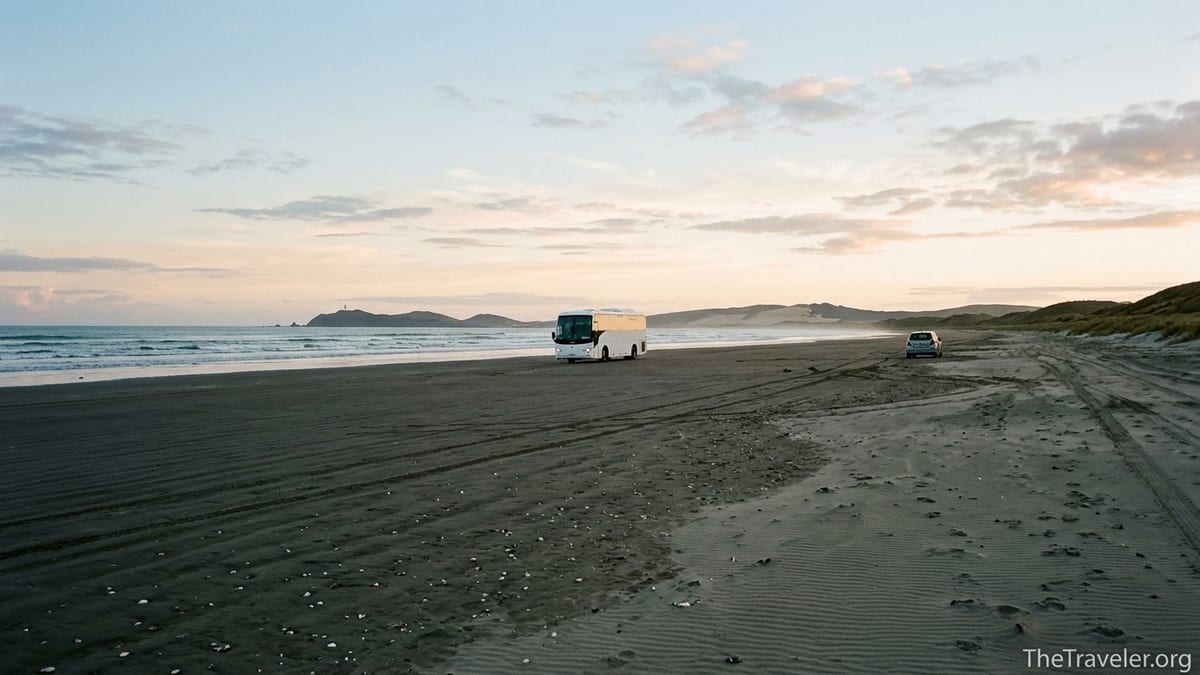
Most coach tours combine several key experiences in one day. Travellers usually get a guided walk to the Cape Reinga lighthouse and lookout, enough time to appreciate the swirling meeting point of the Tasman Sea and Pacific Ocean, and an explanation from the driver-guide of the site’s importance in Māori tradition as Te Rerenga Wairua, the leaping place of spirits. Many tours also include a stop at Te Paki for sandboarding, with bodyboards provided, and a drive along a long section of Ninety Mile Beach itself, treating the sand as a legal highway when conditions allow.
Onboard commentary is a major part of the appeal. Drivers tend to be locals who know the region’s stories, from early Polynesian voyagers and missionaries to modern-day farming communities and surfing spots along the west coast. Some tours make short detours into places like the Puketi Kauri Forest, Mangonui for fish and chips, or small rural settlements, building in regular bathroom and snack stops. Inclusions vary by operator, but it is common to have at least a basic lunch or prepaid meal stop, which simplifies the day for travellers who do not want to think about logistics.
These tours are also structured around the tides. Operators check tidal charts to decide whether the beach drive is feasible, and if a high tide or rough weather rules out the sand highway, they switch to the inland road. As a guest, you may find your schedule adjusted, but you will not need to make safety judgments about water levels, quicksand risk in Te Paki Stream, or soft sand conditions on the beach.
Self-Driving from the Bay of Islands: Freedom with Trade-Offs
For independent travellers with a rental car, driving from the Bay of Islands to Cape Reinga offers maximum flexibility. You can leave Paihia early, perhaps around 6 am, and arrive at Cape Reinga ahead of the main tour buses, enjoying a quieter lighthouse walk and more serene atmosphere. You can linger at viewpoints, take detours to east coast beaches or Doubtless Bay, and choose your own lunch spot in places like Mangonui or Houhora rather than following a fixed schedule.
However, self-driving also comes with significant trade-offs. Most standard rental contracts in New Zealand specifically exclude driving on Ninety Mile Beach and through the Te Paki Stream, and there is usually no roadside assistance if you get stuck in sand. That means an independent driver who follows the rules will be limited to sealed or well-graded gravel roads, visiting Cape Reinga via the inland highway and then reaching Te Paki via the access road and car park. You can still walk out onto the beach at Ninety Mile Beach’s southern end near Ahipara or view it from lookouts, but the signature experience of driving a bus down the surf line is usually off-limits.
The day is also substantially more tiring for the person behind the wheel. A realistic self-drive itinerary from Paihia might involve leaving before sunrise, stopping in Kaitaia or Awanui for fuel and supplies, driving up to Cape Reinga with a 45 to 60 minute visit, continuing to Te Paki for an hour or so of sand dune exploration, and then heading back down the peninsula. With breaks, photographs, and a possible stop for fish and chips in Mangonui or another coastal town, it is easy for the day to stretch to 12 hours. That is a long day to drive on unfamiliar rural roads, especially after previous days of travel.
Travel fatigue matters. Visitors arriving from long-haul flights in Auckland sometimes head straight to Paihia, then attempt a self-drive Cape Reinga day trip the following morning. After several days of time zone adjustment and lots of time behind the wheel, concentration can slip. New Zealand roads can be demanding, and driver fatigue has been a recurring concern for local authorities in tourist regions. If you are the only driver in your party, you will finish this day trip tired, which may affect your enjoyment of the scenery and your energy for the rest of your itinerary.
Sandboarding, Tides, and Weather: Why Conditions Matter
Te Paki sand dunes and the tides on Ninety Mile Beach play a major role in shaping the day, whether you join a tour or drive yourself. The dunes near Te Paki Stream can reach impressive heights, and most coach tours provide bodyboards and basic guidance for sandboarding. The climb up the soft sand is physically demanding, and even fit travellers often find that two or three runs are enough. During peak summer, the sand can become extremely hot in direct sun, so guides usually recommend carrying water, wearing closed shoes or thick socks and applying sunscreen.
Conditions at Te Paki can change quickly. Heavy rain can raise water levels in the stream, altering the route buses take through the bed, and strong winds can make the summit of the dunes unpleasant with blowing sand. Professional tour drivers are used to assessing whether it is comfortable and safe to linger, and they can adjust sandboarding time accordingly. Self-drivers can park at the Te Paki car park and walk a short distance to the dunes, but they must judge for themselves whether the wind and visibility make it wise to climb high.
On Ninety Mile Beach, tide timing is critical. Even large tour coaches only drive the beach on a falling or low tide and will switch to the inland road if swells or recent storms have shifted sand or left debris on the shore. The beach is officially designated as a public highway, but that does not make it forgiving. There are stories of private vehicles becoming trapped in incoming tides or sinking axle-deep in soft patches. Many rental companies explicitly ban their cars from the beach for this reason. By booking a guided tour, you hand those decisions to professionals who know the beach well and have vehicles built for the environment.
Weather at Cape Reinga itself is also changeable. Even when Paihia is warm and settled, the far north headland can be windy with fast-moving squalls. Visibility can drop, and the famous view of the two seas meeting is not guaranteed. Coach tours usually proceed in most conditions but will alter the order of stops to match the weather where possible. Independent travellers should bring layers, waterproof jackets and sturdy footwear, and accept that driving so far for a potentially moody, dramatic Cape Reinga is part of the experience.
Cultural Significance and Guided Interpretation
Cape Reinga is far more than a scenic lookout. For Māori, it is Te Rerenga Wairua, the place where spirits of the dead depart the land, travelling along the roots of a lone pōhutukawa tree on the cliffs and descending into the underworld. The meeting of the Tasman Sea and Pacific Ocean is often explained in cultural narratives as the coming together of masculine and feminine waters. Standing at the lighthouse, many visitors find that the stories shared by guides add a depth that a simple photo stop cannot provide.
On coach tours, driver-guides typically explain this spiritual context in accessible language as the coach approaches the Cape, then expand on it during the walk from the car park down to the lighthouse. Some tours also weave in stories associated with sites along the way, such as pa sites, early mission stations near Kaitaia and Kauri forests that hold deep cultural and ecological significance. For many travellers, especially those visiting New Zealand briefly, hearing these explanations live is one of the main reasons to choose a guided experience over driving alone.
Independent travellers can absolutely learn about this significance on their own. The Department of Conservation displays at the Cape Reinga car park outline aspects of the site’s meaning, and guidebooks and visitor information centres in Paihia and Kaitaia often provide background before you set out. However, without the real-time narrative, it is easy for a self-drive trip to become a sequence of scenic photo stops. If your priority is understanding the cultural landscape as well as seeing it, a coach tour offers a concentrated dose of interpretation.
Some visitors also appreciate having local hosts who can answer questions about etiquette and behaviour at spiritually significant locations. Simple practices such as treating the area with quiet respect, not eating near certain vantage points and giving space to whānau or groups performing their own karakia or reflection are easier to observe when a guide has gently set expectations.
Meals, Comfort, and How Tiring Each Option Feels
Meals and comfort are often overlooked when comparing coach tours and self-driving, yet they shape the experience of such a long day. Full-day tours from Paihia generally include either a simple packed lunch or a stop at a pre-arranged venue, such as a café in Houhora or a fish and chip shop in Mangonui, where orders are handled in bulk for the group. This keeps the day moving and reduces the chance of long delays at busy counters. Snacks, water and coffee stops are usually built into the schedule, and the ability to nap or simply watch the scenery from a comfortable seat is a major advantage.
Coach interiors vary by operator, but most long-distance sightseeing buses have large windows, air conditioning and seats comparable to long-haul coaches elsewhere. Some travellers report that the day feels long but not draining, particularly since the most intense physical exertion tends to be limited to sandboarding and the walk down to the lighthouse and back. The trade-off is that your timetable is fixed; if you feel like lingering over a long lunch in Mangonui or making an unscheduled beach stop, you will be constrained by the group schedule.
For self-drivers, meal planning is another decision to manage. You might pick up fresh supplies in Kerikeri or Kaitaia and pack a picnic to eat at one of the picnic tables near the Cape Reinga car park or at Tapotupotu Bay, a nearby beach accessible via a side road. Alternatively, you can time your route to have lunch at the historic Mangonui waterfront or a small café in Awanui or Pukenui. This flexibility is attractive but requires more effort, especially if you need to factor in dietary preferences or travelling with children.
In terms of fatigue, the difference is stark. On a tour, energy ebbs and flows, but there are long stretches where you are simply a passenger. On a self-drive, the driver must be alert for the full duration, navigating unfamiliar intersections, adjusting to local speed limits and reacting to changing weather and light conditions. If you already have multiple long driving days built into your wider New Zealand itinerary, delegating this one to a professional driver can be a valuable form of self-care.
When to Base Yourself in Kaitaia or Doubtless Bay Instead
For some travellers, especially those with flexible itineraries or a strong interest in exploring the Far North more deeply, it makes sense to base yourself farther north than Paihia. Kaitaia, Ahipara and the Doubtless Bay area, including Mangonui and Coopers Beach, all sit significantly closer to Cape Reinga and Ninety Mile Beach. From Kaitaia, for example, the drive to Cape Reinga by road is typically around 90 minutes each way, compared with roughly three hours from Paihia. This cuts the daily driving time almost in half.
Tourism services reflect this advantage. In addition to the Paihia departures, there are daily guided Cape Reinga and Ninety Mile Beach tours that leave from Kaitaia and sometimes Ahipara or Awanui. These trips follow a similar pattern to the Bay of Islands tours, combining Cape Reinga, Te Paki sandboarding and the beach highway, but the overall day can be a little shorter thanks to the reduced distance. Staying a night or two in Kaitaia or nearby coastal settlements means you can enjoy a more relaxed start and finish, or even add separate days for surfing at Ahipara or beach walks along the southern end of Ninety Mile Beach.
Doubtless Bay is another appealing base. Mangonui, Coopers Beach and Cable Bay sit on the east coast, about an hour’s drive from Kaitaia and roughly two hours south of Cape Reinga. Many travellers structure their trip so that they spend a couple of nights in the Bay of Islands, then move north to Doubtless Bay for two or three nights, using that as a launching point for a Cape Reinga day trip either by tour or self-drive. This approach breaks up the driving, allows time for local walks and swimming, and turns the Far North into a multi-day highlight rather than a rushed tick-box excursion.
Choosing a more northerly base makes particular sense if you are travelling with children, older relatives or anyone who tires easily on long days. It is also a smart strategy if your New Zealand schedule has multiple other long road legs, such as Auckland to Rotorua or drives on the South Island. Instead of cramming Cape Reinga into a single very long return day from Paihia, you spread the effort over a series of shorter drives and give yourself time to recover between them.
Coach Tour or Self-Drive: Which Option Suits You Best?
Deciding between a coach tour and self-driving comes down to your priorities, budget and travel style. If your main goal is to experience as much as possible in one day with minimal logistical stress, a full-day coach tour from Paihia is usually the better choice. You will likely visit Cape Reinga, walk to the lighthouse, hear cultural stories, go sandboarding at Te Paki and travel a section of Ninety Mile Beach, all without having to think about tide times, fuel stops or navigating gravel access roads. For many first-time visitors to New Zealand or those short on time, this all-in-one approach offers strong value.
On the other hand, if you dislike fixed schedules, prefer quieter moments and are confident driving long distances on rural roads, self-driving can be rewarding. You gain the freedom to beat the crowds to the Cape, linger at favourite spots, and decide whether to divert to less-visited bays on either coast. Self-driving may also work out cheaper if you are travelling as a group of four or more and you already have a rental car. The trade-offs are the increased fatigue for the driver, missing out on the Ninety Mile Beach driving component and the need to plan around limited services in the Far North.
A hybrid strategy is also possible. Some travellers base themselves in Paihia for Bay of Islands cruises and local walks, then move on to Kaitaia or Doubtless Bay and join a shorter Cape Reinga and Ninety Mile Beach tour from there. Others might self-drive all the way to Cape Reinga from a northern base but still book a half-day sandboarding or beach excursion with a local operator for added safety and expertise. Thinking of the Far North as a region rather than a single day trip from Paihia opens up more relaxed and varied itineraries.
Whichever option you choose, it is wise to build in some buffer. Avoid scheduling a long Cape Reinga day immediately after an international flight or back-to-back with other major driving days. Check seasonal daylight hours, especially if you are travelling in winter, and remember that rural roads can become slippery in heavy rain. With realistic expectations and a bit of planning, both guided tours and self-drive adventures can deliver the magic of watching the two seas meet at the northern tip of the country.
The Takeaway
For most visitors staying in Paihia with only one day to spare, a full-day coach tour to Cape Reinga and Ninety Mile Beach is the simplest and most efficient way to experience the Far North. It delivers the headline sights, manages the complexities of tides and weather, and lets someone else handle the long hours of driving, all while providing cultural context and local stories.
Self-driving from the Bay of Islands suits confident drivers who value flexibility and are prepared for a very long day on the road. You gain control over timing and detours, but you give up the ease of a guided itinerary and, in most cases, the chance to drive on Ninety Mile Beach itself. The driver bears the brunt of the fatigue, and careful planning is needed for fuel, food and contingencies.
If your schedule allows, basing yourself farther north in Kaitaia or Doubtless Bay can transform the experience. It shortens the daily driving time, allows you to tap into local tours that still combine Cape Reinga, Te Paki sand dunes and Ninety Mile Beach, and turns the Far North into a more relaxed multi-day highlight. Whatever route you choose, giving this unique region enough time and respect will reward you with some of the most memorable landscapes and stories in New Zealand.
FAQ
Q1. Can I drive my rental car on Ninety Mile Beach?
Most rental car contracts in New Zealand specifically prohibit driving on Ninety Mile Beach or through Te Paki Stream, and doing so can void your insurance. It is usually safer and more compliant to experience the beach as a passenger on a guided tour.
Q2. How long is a typical Cape Reinga and Ninety Mile Beach tour from Paihia?
Most full-day coach tours from Paihia run for about 10 to 11 hours, leaving in the early morning and returning in the early evening, with multiple stops for sightseeing, sandboarding, meals and bathroom breaks.
Q3. Is a day trip from Paihia to Cape Reinga and back too tiring to self-drive?
For many travellers, driving roughly six hours in one day on rural roads, plus sightseeing and sand dune climbing, feels very tiring, especially if they are still adjusting to time zones or have other long drives planned.
Q4. Do coach tours run to Cape Reinga every day?
There are daily guided tours to Cape Reinga and Ninety Mile Beach from both Paihia and Kaitaia in most seasons, although exact schedules can vary slightly with demand and time of year.
Q5. What happens if the tide is too high for driving on Ninety Mile Beach?
If tides or surf conditions make the beach unsafe, tour operators switch to the inland highway route. You will still visit Cape Reinga and usually Te Paki sand dunes, but the beach driving component may be shortened or skipped.
Q6. Is sandboarding at Te Paki safe for children?
Many families take children sandboarding at Te Paki using bodyboards provided by tour operators, but parents should supervise closely, choose smaller dunes for younger kids and ensure everyone understands how to brake and steer safely.
Q7. When is it better to stay in Kaitaia or Doubtless Bay instead of Paihia?
Staying in Kaitaia or Doubtless Bay makes sense if you want shorter driving times to Cape Reinga, have several days to explore the Far North or are travelling with people who might find an 11-hour day tour from Paihia too long.
Q8. Can I visit Cape Reinga and do a Bay of Islands cruise on the same day?
Realistically, no. A full-day Cape Reinga and Ninety Mile Beach trip from Paihia uses almost all available daylight, so Bay of Islands cruises and other local activities are better planned on separate days.
Q9. What should I wear for a Cape Reinga and Ninety Mile Beach trip?
Wear layered clothing, a windproof outer layer, closed shoes suitable for walking on sand, a hat and sunscreen. The Far North can be windy and cooler than Paihia, even on sunny days.
Q10. Is Cape Reinga suitable for travellers with limited mobility?
The path from the car park to the lighthouse is sealed but slopes downhill and back up again, which can be challenging. Some travellers with limited mobility choose to enjoy the views from higher up near the car park instead of walking all the way down.