


Northland is New Zealand’s subtropical tail, a long peninsula that stretches from just north of Auckland all the way to Cape Reinga. For first-time visitors, it can be hard to judge distances, choose a base, and decide how to balance Bay of Islands cruises, Māori heritage sites, diving at the Poor Knights, and the wild Far North without constantly backtracking to Auckland. This guide focuses on Northland and the Bay of Islands, explaining the key hubs, the character of the east and west coasts, and how to link highlights like Paihia, Russell, Kerikeri, Whangārei, Tutukākā, Hokianga, Waipoua Forest, Doubtless Bay, Ninety Mile Beach and Cape Reinga into a coherent trip.
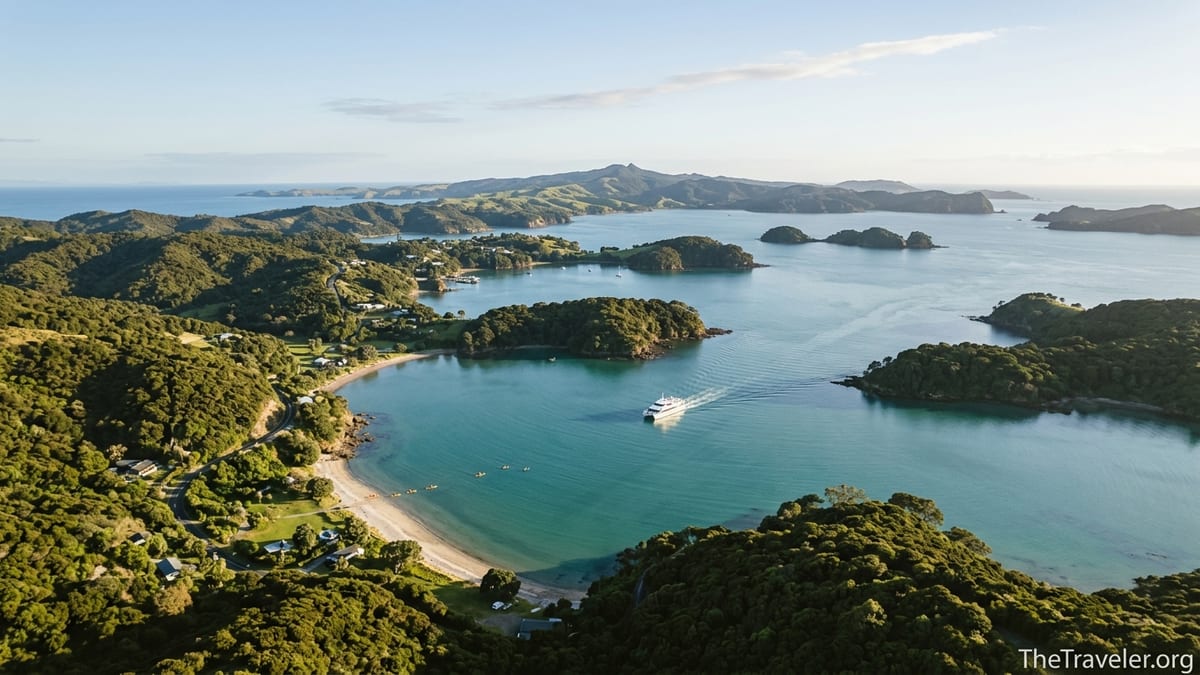
Understanding Northland: A Region of Two Coastlines
Northland is often described as a region of two very different coastlines. The east coast, from Whangārei through the Bay of Islands and up to Doubtless Bay, is all about sheltered harbours, island-dotted bays, and relatively polished beach towns. Places like Paihia, Russell, Kerikeri and Tutukākā offer cafés, tour desks, marinas and a good range of motels and apartments. The water is generally calmer here, which is why classic activities such as Hole in the Rock cruises from Paihia and dive trips to the Poor Knights Islands from Tutukākā operate most of the year.
By contrast, the west coast looks straight out into the Tasman Sea and feels more remote and soulful. Around Hokianga Harbour and south through the Waipoua Forest, you find surf beaches, huge sand dunes, and small settlements like Ōmāpere and Opononi that feel more like end-of-the-road communities than resort towns. Farther north, Ninety Mile Beach runs for almost 90 kilometres along the Aupōuri Peninsula and is officially classified as a public highway, yet is mostly used by locals and guided tour coaches rather than everyday traffic.
For planning, it helps to remember that Northland is larger than it looks on a map. From Auckland to Cape Reinga is roughly 420 kilometres by the usual inland route, which means at least six hours of actual driving without lengthy stops. Many visitors underestimate this and try to rush a loop that includes both coasts and the Far North in only two or three days, then end up spending more time behind the wheel than on beaches or walking tracks.
The key advantage is that you do not need to return to Auckland after seeing each section. Once you leave the city, you can follow the main Twin Coast Discovery Highway in a broad loop, linking Whangārei and Tutukākā on the east with Hokianga and Waipoua on the west, then continuing north to Doubtless Bay, Kaitaia, Ninety Mile Beach and Cape Reinga before circling back down through either coast or cutting inland toward Auckland.
Key Bases: Where to Stay and Why They Work
For a first visit that combines the Bay of Islands, coastal scenery and at least one trip into the Far North, most travellers choose two or three main bases. Paihia is the most practical hub for the Bay of Islands. It has the widest choice of midrange hotels, motels and hostels, a compact waterfront where multiple cruise companies depart, and easy bus connections to Cape Reinga day tours and Ninety Mile Beach. For example, a standard Hole in the Rock cruise from Paihia typically runs for about four and a half hours and costs in the region of 150 New Zealand dollars per adult, depending on the operator and time of year.
Across the water, Russell works better as a quieter, more atmospheric base. It has a historic village feel, wooden villas and a waterfront lined with restaurants, but fewer budget options and no large supermarkets. Travellers who want to self-cater often base themselves in Paihia or Kerikeri and visit Russell as a half-day trip on the passenger ferry. Kerikeri, inland from the Bay of Islands, is the largest town in the immediate area and makes a comfortable base if you want farmers’ markets, supermarkets and wineries, along with easy access to Rainbow Falls and the Stone Store precinct.
Farther south, Whangārei is Northland’s only real city and a useful stop if you are driving up from Auckland late in the day. It has chain hotels, large supermarkets and services, and is about half an hour’s drive from the Tutukākā Coast. Many divers and snorkellers choose to stay either in Tutukākā itself or in nearby Ngunguru and drive to the marina in the morning for Poor Knights Islands trips, which typically cost between 130 and 200 New Zealand dollars per person for a full-day snorkelling or dive charter.
On the west coast, Ōmāpere and Opononi on Hokianga Harbour are well placed for visiting Waipoua Forest and its famous kauri trees, as well as for sunset walks along the harbour and optional sandboarding on the giant dunes across the water. In the Far North, Mangōnui and nearby Coopers Beach in Doubtless Bay make easy-going bases for a few days of swimming and exploring Karikari Peninsula. Kaitaia is the main service town and the starting point for many Ninety Mile Beach and Cape Reinga coach tours, but most holidaymakers prefer to sleep in Doubtless Bay or back in the Bay of Islands and only use Kaitaia for tour departures and petrol.
Driving Times and How to Link the Coasts
Driving times in Northland are shaped by winding roads, small towns and frequent viewpoints. From central Auckland to Whangārei usually takes around two and a half hours in normal traffic. From Whangārei to Paihia you should allow roughly one and a half hours without detours; add at least another 30 minutes if you weave out to one of the beaches on the Tutukākā Coast on the way. This means that a realistic first-day plan for many visitors is simply Auckland to Whangārei Falls for a leg stretch, then on to Paihia in time for dinner.
Linking the two coasts is straightforward if you think in loops rather than out-and-back routes. A popular three to five day circuit starts in Auckland, goes to Whangārei and the Tutukākā Coast, continues to Paihia and Waitangi, then cuts across to Hokianga via Kaikohe and Opononi, visits Waipoua Forest, and finally drops back to Auckland via Dargaville and the Kauri Museum at Matakohe. Distances between these points are usually in the 80 to 150 kilometre range, but road conditions and sightseeing stops mean that a 120 kilometre leg often takes two and a half to three hours.
For the Far North, an efficient pattern is to treat the Bay of Islands and Doubtless Bay as twin bases. From Paihia to Mangōnui in Doubtless Bay, using the east coast route via Kerikeri, it is roughly a two-hour drive, depending on traffic and stops at roadside viewpoints or orchards. Mangōnui to Kaitaia is about 45 minutes, and from Kaitaia to Cape Reinga allow a further two and a half hours each way by coach if you include time on Ninety Mile Beach and at the Te Paki sand dunes.
If you are self-driving, you can go up to Cape Reinga via the sealed inland road and return through Doubtless Bay, or vice versa. Rental car contracts almost always forbid driving on Ninety Mile Beach, even though it is legally a highway, because of soft sand, tides and the risk of saltwater damage. That means many independent travellers still join a full-day 4WD bus tour from Paihia, Kerikeri or Kaitaia that includes beach driving, sandboarding and time at the lighthouse, while keeping their own car safely parked at their accommodation.
Bay of Islands, Paihia, Russell, Waitangi and Kerikeri
The Bay of Islands is the main reason many travellers head to Northland at all. Centered on a sheltered bay with more than 100 islands, it offers sheltered swimming, sailing and historical sites. In Paihia, the waterfront is lined with booking kiosks selling island-hopping cruises, Hole in the Rock trips out to Motukōkako, sailing charters and dolphin watching excursions. Prices vary by operator and season, but as a rule of thumb, a half-day cruise sits in the mid-hundreds of dollars for two adults, while full-day sailing or island stopover trips cost more but include lunch and beach time.
Waitangi, just north of Paihia, is one of the most important historic places in Aotearoa New Zealand. At Waitangi Treaty Grounds you can walk through the museum, see the carved meeting house and giant ceremonial waka, and join guided tours and cultural performances that explain the signing of the Treaty of Waitangi between many Māori chiefs and the British Crown in 1840. Entry passes are not cheap by regional standards, but they are valid for return visits within a set timeframe, so visitors who base in Paihia often go back a second day to explore at a slower pace.
Russell lies across the water from Paihia, reached by a short passenger ferry or a slightly longer drive using the vehicle ferry from Ōpua. Once known as a lawless whaling port, it is now a genteel village with galleries, historic churches and waterfront restaurants. A typical visitor experience might be a mid-morning ferry from Paihia, a walk up to Flagstaff Hill for views across the bay, lunch at a café on the waterfront, and a swim at Long Beach before catching an afternoon ferry back.
Kerikeri, inland from the bay, mixes orchards, craft shops and one of the country’s oldest European settlements. Travellers often spend a morning walking the easy track from the Stone Store and Kemp House upriver to Rainbow Falls and then reward themselves with lunch at a vineyard or café. Because Kerikeri has practical services like supermarkets and petrol stations, it is a convenient base for families and longer stays, especially if you plan to day-trip to Doubtless Bay, Matauri Bay or back into the Bay of Islands.
Whangārei, Tutukākā and the Poor Knights Islands
Whangārei is more than just a city you drive through on the way north. The riverside Town Basin has cafés, a marina and art galleries, while just outside town the track to Whangārei Falls offers a short, family-friendly loop with classic photo opportunities. For many visitors, though, Whangārei’s main appeal is its position as the gateway to the Tutukākā Coast and the Poor Knights Islands Marine Reserve.
Tutukākā is a small harbour town about 30 minutes east of Whangārei. From here, day boats head out to the Poor Knights Islands, a protected marine reserve recognised by divers for clear water, arches and abundant fish life. A typical full-day snorkelling or sightseeing trip includes up to an hour’s cruise each way, two stops for snorkelling or swimming, the use of wetsuits and gear, a light lunch and hot drinks. Prices in 2026 generally sit around 130 to 195 New Zealand dollars per adult depending on whether you are snorkelling or doing multiple scuba dives with rental equipment.
Even if you are not a diver, the Poor Knights are worth considering for their sea caves, cliffs and marine life. Many first-time visitors who are confident swimmers but not certified divers opt for a “perfect day” style trip that combines snorkelling, kayaking and paddleboarding from the boat. Families often stay in accommodation at Tutukākā or nearby Matapōuri so they can enjoy local beaches like Matapōuri Bay and Whale Bay on the days they are not out at sea.
From a planning point of view, fitting Tutukākā into a wider Northland itinerary is easiest if you treat it as a one or two-night stop between Auckland and the Bay of Islands. For example, you might drive from Auckland to Whangārei on day one, continue to Tutukākā for a two-night stay, do a Poor Knights trip on day two, then drive up to Paihia on day three via the scenic coastal route, arriving in time for an afternoon swim or a sunset walk along the beach.
West Coast, Hokianga and Waipoua Forest
Northland’s west coast offers a different mood from the sheltered east. Hokianga Harbour is framed by golden sand dunes and low-key villages like Ōmāpere and Opononi. The pace is slow here, with classic activities including evening walks along the harbour, fish and chips eaten on a picnic table by the water, and optional boat transfers across to the dunes for sandboarding. Local operators provide boards and guidance, and trips typically last two to three hours, making them a popular choice for families.
Just south of Hokianga lies Waipoua Forest, home to some of the most significant remaining kauri trees in the country. Short boardwalks lead to giants such as Tāne Mahuta and Te Matua Ngahere. Because kauri are vulnerable to a soil-borne disease, walkways are carefully managed and visitors are asked to clean their footwear at hygiene stations at the start and end of each track. It is worth planning at least half a day for Waipoua so you can stop at several viewpoints along the winding forest road and take your time on the walks.
Many travellers fold Hokianga and Waipoua into a loop rather than treating them as a destination on their own. One common pattern is to drive from Auckland to Paihia, spend two or three nights in the Bay of Islands, then cross to Hokianga via Kaikohe, spend a night in Ōmāpere or Opononi, explore Waipoua the following morning, and then continue south past Dargaville and the Kauri Museum to reach Auckland by evening. This route lets you experience both coasts without repeating the same stretch of highway multiple times.
For those heading farther north, Hokianga is also a possible staging point for the Far North, though you will need to allow time to cross back to the east or northbound routes. Travellers who prefer to limit one-night stays may choose to base themselves in the Bay of Islands or Doubtless Bay and visit Waipoua as a long day trip, but that can mean over five hours of driving in a single day, which is tiring on winding inland roads.
Doubtless Bay, Ninety Mile Beach and Cape Reinga
Beyond the Bay of Islands, the Aupōuri Peninsula and the Far North feel more remote. Doubtless Bay curves in a wide arc from Taipā and Coopers Beach to the historic village of Mangōnui, known among New Zealanders for its harbourfront fish and chip shop. The mood here is laid-back and residential rather than resort-like. Many holiday homes and motels sit right above the sand, and it is easy to spend a couple of days doing little more than swimming, reading and taking short drives to nearby beaches such as Cable Bay or out onto the Karikari Peninsula.
Kaitaia, inland from Doubtless Bay, is the main hub for the Far North and the launching point for many Cape Reinga and Ninety Mile Beach coach tours. A typical full-day tour includes an early morning pick-up, a drive north on the sealed highway to Te Rerenga Wairua, time at the Cape Reinga lighthouse and the meeting of the Tasman Sea and Pacific Ocean, followed by a beach drive along sections of Ninety Mile Beach, sandboarding on the Te Paki dunes, and a stop at a small kauri workshop or café on the way back. Prices usually fall somewhere in the low to mid-hundreds of dollars per adult, with family and child discounts common.
Independent travellers can also drive themselves to Cape Reinga on sealed roads, stopping at viewpoints on the way, but should still avoid taking rental vehicles onto Ninety Mile Beach unless their contract explicitly allows it, which is rare. The beach surface can change quickly with tides and weather, and vehicles that get stuck may be damaged by incoming waves or require expensive recovery. A practical compromise is to stay two or three nights in Doubtless Bay, drive up to the Cape for a day trip using the inland road, and join a separate sandboarding or beach excursion with a local operator that provides suitable vehicles.
When connecting the Far North with the rest of Northland, you can either loop back to the Bay of Islands using the east coast road via Kerikeri or return down the spine of the peninsula and peel off west toward Hokianga and Waipoua. The first option suits travellers flying in or out of Kerikeri, while the second works well for those finishing their trip in Auckland and wanting to experience both coasts on the way back.
Combining Māori Heritage, Coastal Scenery, Cruises and Diving
The appeal of Northland for many visitors lies in its mix of cultural history and ocean experiences. A balanced first-time itinerary might include a half-day or full-day visit to Waitangi Treaty Grounds, a Bay of Islands cruise, a Poor Knights snorkelling or dive trip, a night or two in the Far North around Doubtless Bay, and a journey to Cape Reinga, all linked by scenic drives along at least one of the region’s coasts. Because there is so much water-based activity, keeping a flexible day or two in your schedule helps you rebook if wind or swell affects boat departures.
In practical terms, many travellers allow around five to seven days for Northland alone. A five-day version might look like this: drive from Auckland to Tutukākā on day one, take a Poor Knights trip on day two, drive to Paihia and visit Waitangi on day three, join a Cape Reinga and Ninety Mile Beach coach tour from Paihia on day four, and return to Auckland on day five via Waipoua Forest. A seven to ten day version can add extra nights in Doubtless Bay, an overnight stay in Hokianga, and additional time in Kerikeri or Russell.
Māori heritage is not confined to Waitangi. Cape Reinga, known as Te Rerenga Wairua, is a place of deep spiritual significance, where tradition holds that the spirits of the deceased leave Aotearoa for the ancestral homeland of Hawaiki. Guided tours and interpretation panels explain aspects of this story, and visitors are asked to treat the headland respectfully, staying on formed paths and avoiding eating or drinking in certain areas. In small communities around Hokianga and the Bay of Islands, you may also see carved marae and local artwork that reflect the strong Māori presence in the region.
Coastal scenery and water-based tours are available in many forms and price ranges. Backpackers on a tight budget sometimes choose a simple ferry trip between Paihia and Russell, combined with a coastal walk, instead of a full cruise. Families might select a shorter dolphin and islands cruise that includes time on a beach but returns by mid-afternoon for naps and playground time. Divers often plan their trip around the Poor Knights Islands, adjusting their Northland schedule to match suitable weather windows and operator availability, and may extend their stay on the Tutukākā Coast to squeeze in an extra day of diving or a skills course.
The Takeaway
For first-time visitors, the key to Northland is to respect its size and variety. Trying to visit every bay, forest and headland in two days will leave you mostly remembering the inside of your car. Instead, pick two or three main bases such as Tutukākā, Paihia or Kerikeri, and Doubtless Bay or Hokianga, and arrange your driving so that you move steadily north and then back south without unnecessary backtracking.
By understanding the difference between the polished, island-rich east coast and the wilder, more contemplative west, you can match locations to your interests, whether that means diving at the Poor Knights, walking under ancient kauri, or watching the Tasman Sea meet the Pacific at Cape Reinga. With five to ten days and a loose loop that connects Auckland, the Bay of Islands, the Poor Knights, Hokianga, Waipoua Forest, Doubtless Bay and the Far North, you can experience the essence of Northland in a way that feels unhurried and deeply memorable.
FAQ
Q1. How many days do I need in Northland for a first visit?
Most first-time visitors should aim for at least five days to include the Bay of Islands, one coast-to-coast drive and a trip to Cape Reinga. With seven to ten days you can add the Poor Knights Islands, Doubtless Bay and an overnight in Hokianga without feeling rushed.
Q2. Is it better to stay in Paihia, Russell or Kerikeri?
Paihia suits most first-time visitors because it has the widest range of accommodation and cruise departures. Russell is quieter and more atmospheric but has fewer budget options, while Kerikeri works well if you want supermarkets, markets and wineries along with easy access to the Bay of Islands and day trips north.
Q3. Do I need a car to explore Northland?
You can reach the Bay of Islands by bus from Auckland and join local tours from Paihia, but having a car makes it much easier to link Whangārei, Tutukākā, Hokianga, Waipoua Forest, Doubtless Bay and Cape Reinga on your own schedule. For flexible coastal and Far North exploration, a rental car is strongly recommended.
Q4. Can I drive on Ninety Mile Beach in a rental car?
Most rental car contracts specifically forbid driving on Ninety Mile Beach because of soft sand, tides and the risk of damage. The safer and usually required option is to join a guided 4WD coach tour from Kaitaia, Paihia or Kerikeri, where the operator provides suitable vehicles and local knowledge.
Q5. What is the difference between Northland’s east and west coasts?
The east coast is more sheltered and developed, with island-studded bays, marinas and towns like Paihia, Russell, Kerikeri and Tutukākā. The west coast is wilder and less built-up, defined by Hokianga Harbour, Waipoua Forest and long surf beaches such as Ninety Mile Beach.
Q6. How expensive are cruises and dive trips in the Bay of Islands and Tutukākā?
As a general guide, half-day Bay of Islands cruises often cost in the ballpark of 150 New Zealand dollars per adult, while full-day Poor Knights snorkelling or dive charters from Tutukākā usually range from about 130 to 200 dollars per adult depending on inclusions and equipment hire.
Q7. When is the best time of year to visit Northland?
Northland has a mild, often subtropical climate, with warmest conditions from late spring to early autumn. December to March offers the best beach and boating weather but is also the busiest and most expensive period. Late spring and early autumn can provide a good compromise between warmth, availability and price.
Q8. Is Northland suitable for families with children?
Yes. Many Northland attractions, such as Bay of Islands cruises, beach days in Doubtless Bay, short walks to waterfalls, Hokianga sandboarding and farm stays, work very well for families. It is wise to plan shorter driving days and allow time for playgrounds, ice cream stops and swims.
Q9. How can I experience Māori culture in Northland?
The most accessible introduction is at Waitangi Treaty Grounds, where museums, guided tours and performances explain key aspects of Māori and national history. You will also encounter marae, carvings and local stories in communities around Hokianga, the Bay of Islands and the Far North, especially if you choose locally owned tours and accommodations.
Q10. Do I need to book accommodation and tours in advance?
Between December and March, advance bookings are strongly advised for popular areas such as Paihia, Russell, Tutukākā and Doubtless Bay, as well as for Bay of Islands cruises, Poor Knights trips and Cape Reinga coach tours. Outside peak periods you can often be more spontaneous, but it is still sensible to reserve at least your first few nights and any must-do activities.