


The Hole in the Rock cruise to Motukōkako off Cape Brett is one of the signature experiences of New Zealand’s Bay of Islands. It is also a longer, more expensive outing than many shorter bay cruises, which means it pays to understand exactly what you are booking. This guide breaks down how the 4.5 hour cruise works from Paihia and Russell, what to expect on board, how the Otehei Bay island stop fits in, and how it compares with shorter Bay of Islands trips so you can decide whether the longer journey is worth it for you.
What the Hole in the Rock Cruise Actually Is
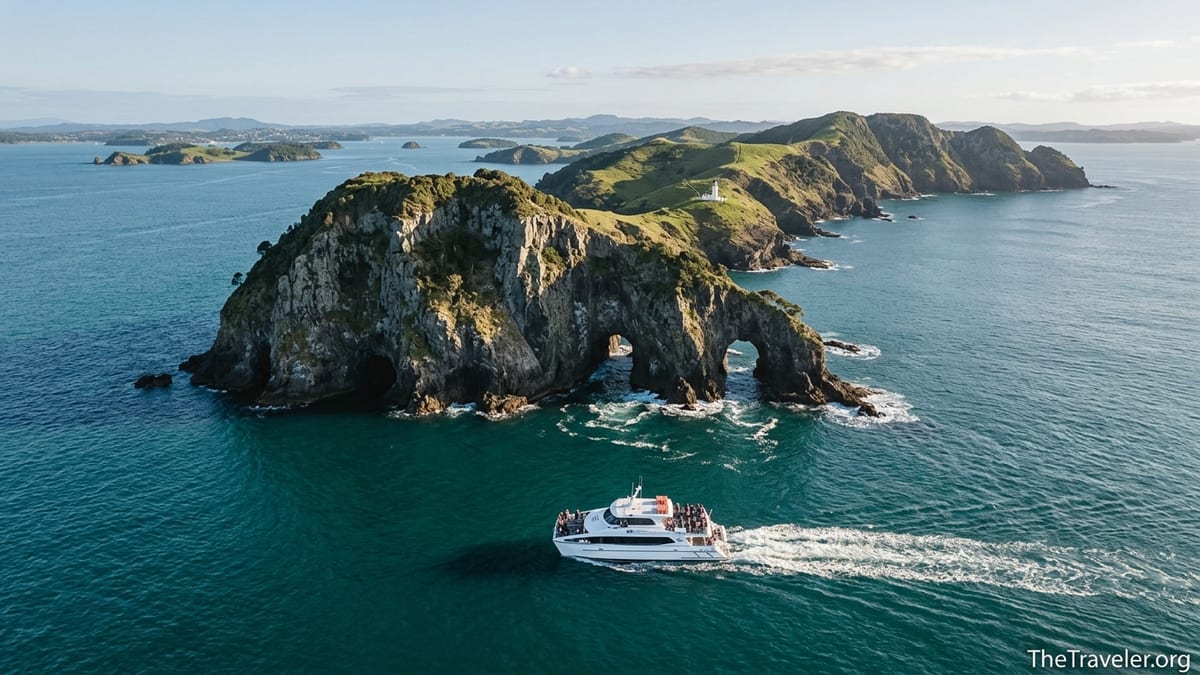
When operators in Paihia and Russell advertise a "Hole in the Rock" cruise, they are talking about a half day trip out across the Bay of Islands to Motukōkako, an offshore island at the end of the Cape Brett Peninsula with a tall sea arch eroded right through its base. Modern catamarans are just low enough to slip under the arch on calm days, and that short passage is the adrenaline moment most people imagine when they book. In reality, the cruise is about the whole journey: crossing open water, rounding Cape Brett, and spending time on Urupukapuka Island on the way back.
As of 2026, a major operator in the region runs this as a 4.5 hour cruise marketed under names such as "Discover the Bay" or "Hole in the Rock Dolphin Cruise." It departs daily from both Paihia and Russell, usually twice a day in the main tourist season and once a day in winter. Typical departure times are around 8:30 or 10:00 in the morning from Paihia, with Russell departures 10 minutes later, and an afternoon sailing in the warmer months. Duration is advertised clearly as 4 hours 30 minutes, which includes cruising time and an island stop at Otehei Bay on Urupukapuka Island.
On board you can expect a modern, stable catamaran designed for open coastal waters, with indoor seating, outdoor viewing decks, a licensed bar or café counter, and toilets. Commentary from the crew covers local history, Māori stories, marine wildlife and the geology of Motukōkako. The atmosphere is usually relaxed rather than scripted: guests move between the open bow, upper deck and indoor cabin depending on wind and sun.
For planning purposes, treat this as a half day commitment door to door. If your tour leaves Paihia at 10:00, for example, you will normally not be back at the wharf much before 2:30 in the afternoon. Cruise-ship passengers tendering into Paihia should check their ship’s all-aboard time carefully and aim for the earliest departure of the day.
Departures from Paihia and Russell
Paihia is the main jumping off point for Hole in the Rock cruises. The wharf sits right in the middle of town, a short walk from most motels and beachfront apartments. For a 10:00 sailing you are usually asked to check in at the operator’s ticket office by around 9:30, which allows time for issuing boarding passes and a safety briefing. If you are driving into Paihia for the cruise, allow extra time to find parking near the waterfront, especially in January and February when the town is at its busiest.
Russell departures use the town’s small wharf on the waterfront, reached either by staying in Russell overnight or taking the passenger ferry across from Paihia. The same 4.5 hour cruise will typically call briefly at Russell after leaving Paihia, so guests can board from either town on the same vessel. If you are staying in Russell, this is extremely convenient: you step aboard within a few minutes’ walk of the historic Duke of Marlborough hotel and the seafront cafés, cruise for half a day, then return to Russell in time for an early dinner.
Tickets are priced in New Zealand dollars, with recent sample fares for the longer Hole in the Rock cruise around the mid 100s NZD for adults, roughly half that for children, and a family pass priced to be slightly cheaper than booking four separate seats. Exact prices change with seasons and occasional promotions, but this gives a realistic ballpark. You generally do not pay extra to board in Russell rather than Paihia, although you might need to factor in the cost of the separate passenger or car ferry if you are staying on the opposite side of the bay.
In peak season, morning departures are popular with independent travelers and families who want to be back for afternoon activities, while afternoon trips tend to suit people driving up from Whangārei or Auckland that morning. Locals often recommend booking at least a few days ahead in December and January, especially if you are a group of four or more or you want a specific time slot. Walk up bookings are more realistic in winter, but even then it is wise to reserve once you know your travel dates, as strong winds can concentrate demand onto fewer sailings.
The Cape Brett Route and Motukōkako
From Paihia the boat threads its way through the inner islands, passing green hills and small sandy coves before turning east toward the open Pacific. This part of the trip usually takes around an hour, depending on sea conditions and whether dolphins appear early along the route. You pass by or near islands such as Motuarohia (Roberton Island) and Moturua, both classic Bay of Islands landscapes with sheltered bays, bush covered ridges and holiday homes tucked discreetly above the water.
As the catamaran rounds the Cape Brett Peninsula the landscape becomes more dramatic. The low rolling hills give way to steeper cliffs and a long headland that stretches out toward Motukōkako. One of the visual highlights is the historic Cape Brett lighthouse, perched on a grassy slope high above the sea. Many skippers slow down here long enough for everyone to get photos and to explain the history of the light station and the walking track that now runs along the ridge from Oke Bay to Cape Brett.
Motukōkako itself is smaller than many people expect but much more imposing. The island is steep sided, with sheer basalt cliffs that drop straight into deep water. The sea arch, the Hole in the Rock, has been cut through the base of the island by waves over thousands of years and is tall enough for a catamaran to pass beneath on calm days. The rock walls are streaked with mineral colors and home to nesting seabirds, and on bright days the water around the base glows an intense blue green in the sunlight.
Every skipper has a slightly different way of approaching the island. Generally the boat will circle slowly to give everyone multiple views of the arch from different angles, sometimes idling near smaller caves and blowholes on the seaward side of the island. On trips where the swell is too high to risk a passage, you will still get this close viewing and photos of the hole itself, as well as a sense of the open ocean beyond Cape Brett where the deep blue water begins.
Otehei Bay and the Urupukapuka Island Stop
A key feature of the 4.5 hour Hole in the Rock cruise is the stop at Otehei Bay on Urupukapuka Island on the way back from Cape Brett. Urupukapuka is the largest island in the Bay of Islands and Otehei Bay has a sheltered white sand beach, a jetty, a café and bar, and access to a network of walking tracks. The typical stop here is around 90 minutes. That is long enough to swim, have lunch, or walk up to a viewpoint and back before reboarding the vessel for the short hop home.
In practical terms, this island stop is what makes the cruise feel like a day out rather than just a boat ride. Families often spread towels on the grass above the beach while children paddle in the shallows. Couples wander up to one of the low headlands for a 360 degree view across the bay. Many travelers time their day so they can order a simple lunch and a local beer or a soft drink from the café. Prices are similar to casual cafés in Auckland or Paihia, so budget accordingly if you plan to eat there rather than bring your own picnic.
The walking tracks are well signposted and you do not need hiking boots to enjoy them. A realistic choice for the time available is to follow the marked trail up to a nearby ridge, take in the views over Urupukapuka and the inner islands, then loop back down in around 45 to 60 minutes at a leisurely pace. If you prefer to stay near the water, the beach in Otehei Bay shelves gently, and on calm summer days the water is often warm enough for comfortable swimming. There are outdoor showers and toilets near the shore, which makes it easy to rinse off before getting back on the boat.
Outside peak season the atmosphere on Urupukapuka can be very peaceful, with only guests from your boat and a few campers or day trippers on the island. In January school holidays, there may be several vessels calling in and a lively buzz around the café, but the hills and headlands absorb people quickly, so it rarely feels crowded once you leave the immediate bay.
Wildlife, Sea Conditions and Passing Through the Hole
Most marketing for the Hole in the Rock cruise mentions dolphins prominently, and with good reason. The Bay of Islands is home to common and bottlenose dolphins, and operators licensed under New Zealand’s marine mammal regulations are experienced at finding and viewing pods responsibly. On a typical summer day your chances of seeing dolphins somewhere along the route are decent, though never guaranteed. Crews keep in touch by radio and alter their track slightly if another vessel has sighted a pod nearby.
Whales are less common but occasionally seen, usually in cooler months when migrating species pass along the coast. Passengers on recent seasons’ trips have reported sightings of orca and, more rarely, larger baleen whales. These encounters are opportunistic. No operator in the Bay of Islands can honestly sell a cruise as a reliable whale watching trip in the same way that specialist operators in Kaikōura or the Hauraki Gulf can. If you do see a whale, consider it a bonus rather than the main purpose of the outing.
Sea conditions play a crucial role in what your day looks like. Much of the route runs in relatively sheltered water among the islands, but the stretch around Cape Brett and Motukōkako is exposed to swell rolling in from the Pacific. On light wind days the water can be almost glassy and even very nervous sailors feel comfortable. On days with a 1 to 2 metre swell and a fresh breeze it can feel lively, with the catamaran pitching and rolling as it rounds the cape. The crew will usually warn passengers before they get to the open section and recommend that those prone to motion sickness sit toward the stern or inside where the motion is less pronounced.
Whether the boat actually passes through the Hole in the Rock is 100 percent dependent on sea and swell conditions at the island and the skipper’s judgment on the day. Even if the forecast looked calm when you booked, an unexpected change in swell direction or a building wind can make the passage unsafe or uncomfortable. In that case the skipper will stay outside the arch, usually edging as close as they safely can for viewing and photos. Cruise descriptions make this clear in their small print, and you should mentally plan on viewing the hole from the outside with a passage through as a welcome bonus if it happens.
How the 4.5 Hour Cruise Compares to Shorter Bay Trips
Travelers often weigh the flagship Hole in the Rock cruise against shorter Bay of Islands trips that cost less and require less time. Typical alternatives include three hour cruises that focus on the inner bay and nearby islands, 75 to 90 minute mini tours that simply loop around a handful of islands with commentary, and ferry trips out to Urupukapuka Island for independent hiking with no visit to Cape Brett at all.
In price terms, a three hour scenic cruise that stays within the inner bay and may or may not include a brief island landing often comes in cheaper than the full 4.5 hour Hole in the Rock trip. A recent example is a three hour cruise from Paihia with island stopovers advertised from under 100 NZD per adult. Very short mini tours of around 75 minutes can be significantly less again, making them attractive to cruise ship passengers with only a few hours in port or to travelers on tight budgets.
The trade off is reach and drama. Shorter cruises generally do not venture all the way out to Cape Brett or Motukōkako. Instead they weave among the closer islands, which are undeniably pretty but do not have the same sense of open ocean or the cliffs and lighthouse that define the Cape Brett route. Dolphins can be seen anywhere in the bay, so your chance of an encounter is not only tied to the longer cruise, but the combination of deep water and more time on the water does increase the odds somewhat.
Many travelers with feedback on recent seasons note that if your primary goal is to relax on a beach and walk on an island, catching a ferry to Otehei Bay or booking a shorter cruise with a generous island stop can be enough. However, if you want the full sense of going "out to sea" and of seeing the Hole in the Rock and Cape Brett from close up, the 4.5 hour trip is the one that consistently delivers that experience when weather allows. As a rough rule, choose the longer cruise if this might be your one and only visit to the Bay of Islands, and choose a shorter trip or island ferry if you are already planning several days in the region and can mix and match experiences.
Booking Strategies and Setting Expectations
Because sea conditions control so many aspects of the Hole in the Rock experience, setting realistic expectations when you book is vital. Start by deciding which day of your Bay of Islands stay you are prepared to commit to the cruise. The longer outing takes half a day, so avoid stacking it on the same morning as a long drive from Auckland or an afternoon appointment that cannot move. Once you have chosen the date, look for a morning departure if you are sensitive to choppy seas. Winds in coastal New Zealand often increase through the afternoon, and while this is not a rule, morning sailings do more often enjoy calmer seas.
When you book, read the operator’s wording on what happens if sea conditions prevent going through the Hole in the Rock. Policies vary slightly. Some will offer partial refunds or credits only if the trip cannot reach Motukōkako at all, while others emphasize from the outset that passage through the hole itself is never guaranteed and is not a basis for refunds. This difference rarely matters in practice, but understanding it in advance avoids disappointment at the wharf.
Consider your own group’s needs. Families with small children often find the 4.5 hour timing works well if they bring snacks, sun hats, lightweight layers and something for kids to do during the quieter stretches of cruising. Couples on tight itineraries sometimes prefer to combine the cruise with a late lunch in Russell or an afternoon visit to the Waitangi Treaty Grounds, which are a short taxi or bike ride from Paihia. If anyone in your group is prone to motion sickness, consult a pharmacist in advance about suitable tablets and take them before boarding, not after you start to feel unwell.
Remember that Bay of Islands operators are used to cruise ship schedules and peak summer crowds. It is common practice for staff at the wharf to check return times against visiting ship timetables, and they will usually advise cruise passengers to choose earlier departures or shorter tours. If you mention that you are on a ship schedule when booking, the staff can point you toward the safest option for your available window.
The Takeaway
The 4.5 hour Hole in the Rock cruise from Paihia and Russell is best thought of as a compact coastal expedition. You leave the shelter of the inner Bay of Islands, follow the spine of Cape Brett out toward the Pacific, circle a steep volcanic island with a natural arch right through its base, then spend an hour and a half on a laid back island beach before returning to town. Along the way there is a decent chance of seeing dolphins and seabirds, a smaller chance of spotting whales, and a near certainty of seeing the Bay’s islands from a variety of angles.
Compared with shorter Bay of Islands cruises, you pay more and commit more time, but in return you see a more varied cross section of the region: inner coves, offshore cliffs, open ocean and an island where you can actually set foot ashore. Passing directly through the Hole in the Rock is never guaranteed and depends entirely on conditions, so the real value lies in the overall journey rather than that single moment. If you arrive expecting a half day on the water, a scenic run along Cape Brett, an island stop at Otehei Bay and the possibility, not promise, of gliding under the arch, you are very likely to step off the boat satisfied that you made good use of your time in the Bay of Islands.
FAQ
Q1. How long does the Hole in the Rock cruise take from Paihia or Russell?
The main Hole in the Rock cruise that includes Cape Brett and an Otehei Bay stop is usually advertised as 4.5 hours from departure to return, regardless of whether you board in Paihia or Russell.
Q2. How much does the 4.5 hour Hole in the Rock cruise typically cost?
Recent prices for the longer Hole in the Rock cruise have been in the mid 100s New Zealand dollars per adult, with children around half that and discounts for family passes. Exact fares vary by season and operator.
Q3. Are dolphins guaranteed on the Hole in the Rock cruise?
No operator can guarantee dolphins, but the Bay of Islands is a good habitat and licensed crews are skilled at finding pods. On many trips guests do see dolphins somewhere along the route, though it should be considered a bonus rather than a promise.
Q4. How likely is it that the boat will actually pass through the Hole in the Rock?
On genuinely calm days with low swell, skippers often take the boat right through the arch. However, this depends entirely on conditions at Motukōkako and the captain’s safety assessment on the day, so you should always book with the understanding that you may only view the hole from outside.
Q5. What happens if sea conditions are too rough to reach Motukōkako?
If conditions are unsafe around Cape Brett, the captain may alter the route, spend more time in the sheltered inner bay, or cancel and reschedule the trip. Policies on refunds or credits vary, so check your operator’s terms when you book.
Q6. Is the cruise suitable for children and older travelers?
Yes, the 4.5 hour cruise is commonly booked by families and older travelers. The vessels have indoor seating, toilets and easy access to viewing areas. Those with limited mobility should mention this when booking so staff can assist with boarding and advise on sea conditions.
Q7. Can I get off at Otehei Bay and return on a later boat?
Some operators allow passengers to disembark at Otehei Bay and return on a later scheduled ferry or cruise, subject to space and timetable. If you want extra time on Urupukapuka Island, ask specifically about this option when you book your Hole in the Rock ticket.
Q8. How does this cruise compare to taking a simple ferry to Urupukapuka Island?
The Hole in the Rock cruise includes the long run to Cape Brett and Motukōkako as well as the island stop, while the ferry focuses on getting you directly to Urupukapuka. If you mainly want beach time and hiking, the ferry can be enough; if you want the offshore cliffs and the Hole in the Rock itself, the longer cruise is the better fit.
Q9. What should I wear and bring on board?
Dress in layers with a windproof outer layer, closed shoes or sturdy sandals, sunglasses and a hat. Bring sunscreen, a reusable water bottle, snacks, a camera or phone, and motion sickness remedies if you are prone to seasickness.
Q10. When is the best time of year to do the Hole in the Rock cruise?
Summer and early autumn offer the warmest weather and best swimming at Otehei Bay, while spring and autumn can bring clearer air and slightly fewer crowds. Cruises operate year round, but sea conditions vary more in winter, so be prepared for cooler, choppier days if you sail then.