


I boarded the TranzAlpine in Christchurch expecting a scenic train ride. What I got was a half-day, big-window immersion that changed character every 30 minutes: flat farmland that feels almost too ordinary, then a sudden tightening of terrain into river gorges, and finally the hard, dramatic geometry of the Southern Alps around Arthur’s Pass. It is one of those journeys where the “best bits” do not arrive all at once. They build, quietly, through details you only notice when you are not driving: the way the light shifts on braided rivers, the way beech forest darkens the palette on the western side, the way a viewing carriage makes cold air feel like part of the scenery.
Booking, operating days, and the realities of “daily”
Before I even describe the ride, it is worth stating what matters most right now: Great Journeys New Zealand (KiwiRail’s scenic brand) currently operates the TranzAlpine daily, seven days a week, and it is a pre-booked, seated service. They also spell out the key point many travelers miss: there is no guarantee you can simply walk up and board if a service is full.
Timings can shift slightly by season or operational needs, but the pattern is consistent enough that you can plan around it. Westbound (Christchurch to Greymouth) is generally a morning departure from Christchurch, with the train reaching Arthur’s Pass late morning and Greymouth early afternoon. Eastbound (Greymouth to Christchurch) is generally an early afternoon departure, arriving back into Christchurch in the early evening.
Fares are not “commuter rail” pricing. For the most concrete examples I could verify close to publication: Scenic Class one-way pricing is commonly advertised around NZ$239 adult for Christchurch to Greymouth in off-peak periods, with shorter sectors (like Christchurch to Arthur’s Pass) priced lower. Scenic Plus is a significant jump, commonly advertised in the NZ$500-plus range for the full Christchurch-Greymouth run. Seasonal pricing applies, so the fare you see for a quiet winter week can be different from mid-summer.
If you are planning the trip as a once-in-a-lifetime splurge, book as early as you can. If you are planning it as a flexible day-of decision, assume you may miss out, especially during school holidays and peak summer travel windows.
Christchurch station: check-in, tickets, and the “pack a small bag” rule
Christchurch Railway Station for the TranzAlpine is in Addington at Tower Junction, which feels more like a functional transport hub attached to a retail area than a grand European terminal. That is not a criticism, just a useful mental reset: arrive expecting a practical check-in process, not a cathedral of rail.
The first thing I noticed was how structured the morning feels. For TranzAlpine departures, Great Journeys New Zealand lists check-in opening at 7:00am and check-in closing at 7:55am. Even if you are not a nervous traveler, that closing time matters because this service is set up like an airline-lite experience: you check in, you get your boarding pass, you handle luggage in a specific way, and then you board.
The luggage rules are stricter than many people assume. The official guidance is that wheeled cabin bags, larger bags, backpacks, and suitcases are checked into the luggage carriage for the journey, rather than brought to your seat. The reason is surprisingly sensible: overhead storage is designed for viewing, with glass shelves and skylights, and the operator does not want bags blocking light or sightlines. In practice, this means you should genuinely pack a smaller day bag with what you want for five-ish hours: a jacket for the viewing carriage, camera, water bottle, medication, sunglasses, and anything you would normally panic about if you could not access your suitcase.
The published allowance for Scenic Class includes a large checked bag (up to 23kg), a cabin bag (up to 7kg, with wheeled or hard-sided cabin bags required to be checked in), and a small personal item. Scenic Plus includes an additional checked bag allowance. The key emotional adjustment is this: once your bigger bag is tagged and loaded, you will not casually dip into it mid-journey. Pack like you mean it.
On board: seat feel, windows, and where your day actually happens
I traveled with the mindset that “a seat is a seat,” but on the TranzAlpine the seat is only half the story. The other half is the window. The carriages are built to keep your eyes outside: big panes, generous light, and a layout that makes most rows feel oriented toward the scenery rather than away from it.
In Scenic Class, the vibe is relaxed and observant: people with proper cameras, couples swapping window time, solo travelers quietly watching the landscape like it is a long film. If you have done a lot of scenic trains globally, you will recognize the rhythm: excitement leaving town, a lull while you settle in, then an escalation as the terrain starts to tighten.
Scenic Plus changes the tone. The operator markets it as an elevated, hosted experience with regionally inspired food and beverages served at your seat. On a practical level, it means you are not getting up and down as often for the cafe, you are not juggling as much packaging, and you tend to feel like you are on a curated journey rather than a shared carriage ride. It is not “luxury rail” in the old-world sense, but it is a clearly premium tier inside a very tourism-focused service.
No matter which class you book, the biggest comfort tip is simple: bring layers you can adjust. Even on sunny days, stepping into the open-air viewing carriage can be cold enough to make you retreat fast, and the temperature swing becomes part of the day.
The viewing carriage and the cafe: what I ate, what I learned, and what I heard
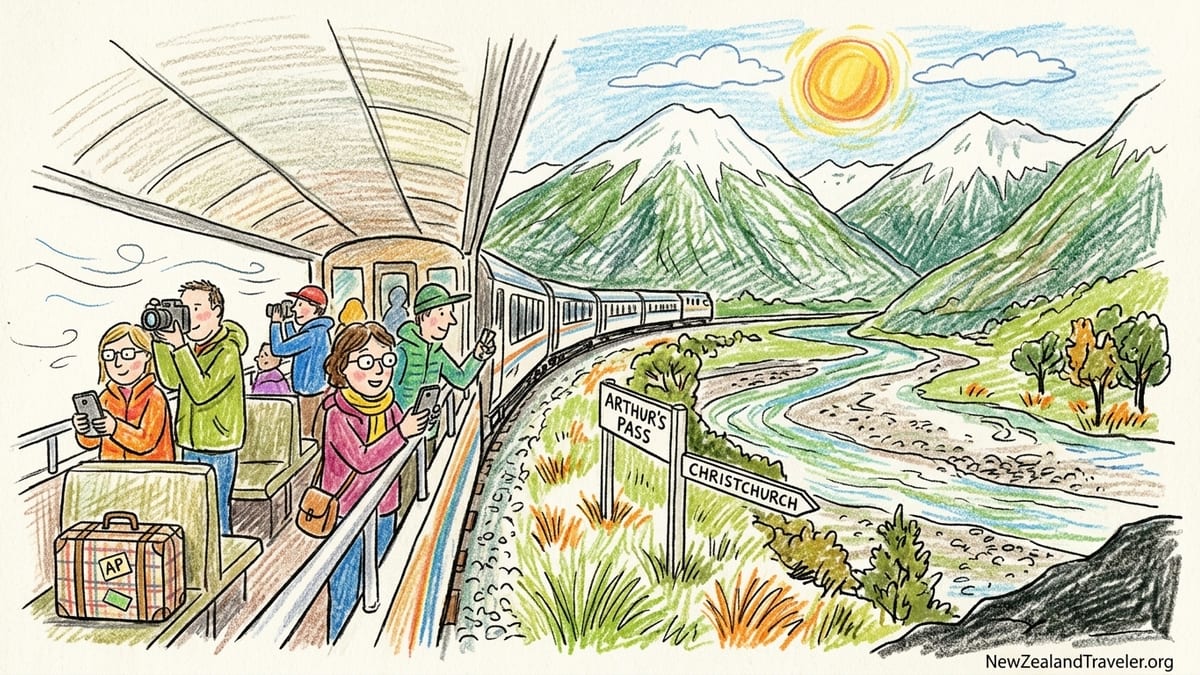
If you have seen photos of the TranzAlpine, you have probably seen the open-air viewing carriage. This is not a novelty add-on; it is central to how many passengers experience the line. The first time I stepped out, the air immediately recalibrated the journey. Inside, you are watching scenery. Outside, you are in it, feeling the wind off the river valleys and hearing the train work as it bends into the terrain.
There is a practical caution here: the viewing carriage is exposed. If you wear glasses, keep them secure. If you are carrying a phone, use a firm grip. And if you are sensitive to cold, do not assume “it’s New Zealand, it can’t be that chilly.” In the alpine sections, the air has bite even when the sun is out.
Food is the other place expectations can go wrong. This is not a multi-course dining car experience unless you have specifically booked Scenic Plus. In Scenic Class, you should expect a cafe setup where you buy items and take them back to your seat. What I liked about this model is that it keeps the journey fluid: you can grab something when you feel like it, then retreat to your window without missing the scenery during a long sit-down meal.
On my ride, the commentary and onboard messaging were the kind that helps without overwhelming. It is enough context to make features like the braided rivers and the change in forest feel intentional, rather than random scenery sliding past. If you are the type who loves reading landscapes, you can ignore it. If you are the type who wants to know what you are looking at, you will appreciate it as a soft guide.
From Christchurch across the Canterbury Plains: the calm before the gorge
Leaving Christchurch, the first act is the Canterbury Plains, and it can feel deceptively ordinary: wide, flat farmland, shelterbelts, big skies, and a sense that the horizon has room to breathe. This is the part some travelers call “the slow bit,” but I think that undersells its purpose. The plains are a baseline, and that baseline makes the later shift into the Alps feel sharper.
I watched the scenery in layers: near-field paddocks and irrigation geometry, then mid-field farm buildings and small towns, then far-field hints of foothills that gradually stop being background and start becoming the point of the journey. If you have driven in New Zealand’s South Island, you know this landscape can look calm to the point of minimalism. From the train, with no steering wheel in your hands, you start noticing small things: the color changes in crops, the subtle rise and fall in land that your eyes ignore when you are navigating.
Somewhere along this stretch, the train starts to feel like it is aiming at a wall of mountains. The line is not dramatic yet, but the direction is. I found that moment oddly thrilling: the sense that you are on a fixed route toward a very specific notch in the Southern Alps, and that the day’s whole purpose is to get you there.
If you are deciding whether to do the TranzAlpine or drive State Highway 73 solely for scenery, this is the section where driving can feel more “efficient” because the landscape is broad and open. But I also found it relaxing to have the plains delivered to me as a calm prologue rather than a task.
Waimakariri River, the climb, and why the mountains feel closer by rail
The mood shifts as the train begins tracking the Waimakariri River system and the land starts to fold in on itself. This is where the TranzAlpine begins to feel distinctly different from the road trip version. You are no longer looking across a wide plain; you are moving beside water and rock, watching the braided channels and shingle beds rearrange in your mind as the angle changes.
I spent more time in the viewing carriage here than anywhere else. The combination of wind noise, river noise, and the train’s own mechanical rhythm makes it feel alive. The gorge sections are where you realize how much “scenery” in New Zealand is really about geology: river carving, rock faces, and the way the light behaves in a narrow corridor.
As the climb continues, the greens deepen, the air looks crisper, and the train begins to feel like it is pushing into a different climate zone. It is not that the temperature necessarily changes dramatically inside your carriage, but your eyes register the change. The foothills start to stack. The river becomes less pastoral and more muscular. The line feels committed to the mountains now.
This is also where the question of “which side should I sit on?” becomes more nuanced. My honest takeaway is that it does not matter in the way people want it to matter. The train curves constantly, the best views happen on both sides, and you will likely spend time in the viewing carriage anyway. If you can choose a window seat, do it. If you can request a specific side, treat it as a preference, not a deal-breaker. The gorge and river sequences deliver on both sides as the train bends through them.
Arthur’s Pass: arrival, stepping off, and how the logistics worked for me
Arthur’s Pass is the emotional apex of the east-to-west crossing: the point where the landscape looks most Alpine in the popular imagination, and the moment many passengers have been waiting for since Christchurch. The station itself is small and purposeful, more like a mountain outpost than a destination terminal, and that is part of the charm. You step onto the platform and feel the altitude in the air and the immediacy of the terrain.
On my journey, I chose to get off at Arthur’s Pass rather than continue to Greymouth. The most important thing to understand is that this is not a “hop off whenever you feel like it” stop. You must book your ticket to Arthur’s Pass as your destination. That booking is what triggers the luggage tagging to the correct station and makes the offboarding straightforward.
Logistically, it worked like this: my larger bag had been checked into the luggage carriage back in Christchurch and tagged for Arthur’s Pass during check-in. When we arrived, I disembarked with my small day bag, then followed staff direction for retrieving the checked bag from the luggage carriage area. Because Arthur’s Pass is a scheduled stop, the process was controlled and calm, but it was also time-sensitive. This is not a station where you want to wander off for a photo and assume you can casually sort your luggage afterward.
What happens next depends on your plan. If you are staying in Arthur’s Pass village, the station is close enough that the last leg feels simple, like arriving at a tiny mountain town by design. If you are connecting onward, you need to organize that in advance. Arthur’s Pass is not a place where you can rely on frequent taxis or last-minute transport. It is spectacular, but it is also remote, and the remoteness is part of the point.
The Takeaway
The TranzAlpine from Christchurch is not just a scenic train ride. It is a carefully structured half-day where logistics, luggage rules, and seat categories shape how relaxed you feel once the real scenery begins. Check in on time, pack a small day bag you can live out of, and treat the open-air viewing carriage as essential, not optional.
Scenery-wise, the journey builds in chapters: the calm of the Canterbury Plains, the tightening drama of the Waimakariri River corridor, and then the rugged Alpine feel around Arthur’s Pass. The “best side” obsession is overblown; the route curves often and the viewing carriage levels the playing field. If your goal is maximum scenery with zero driving stress, the train is the point. If your goal is flexibility to stop for short walks and roadside viewpoints along State Highway 73, driving wins. For me, the magic of the TranzAlpine was how it turned the in-between into the main event.
FAQ
Q1. Does the TranzAlpine run every day?
Great Journeys New Zealand currently operates the TranzAlpine daily, seven days a week, but you should still confirm your exact date at booking because exceptions can apply around major holidays or operational disruptions.
Q2. What time does the TranzAlpine leave Christchurch?
It is generally a morning departure from Christchurch. Exact departure times can vary, so check the timetable for your travel date when you book.
Q3. Do I need to book in advance, or can I buy a ticket at the station?
Advance booking is strongly recommended. Great Journeys New Zealand notes that they cannot take walk-on passengers once the train is fully booked, even if you are standing at the station.
Q4. How early do I need to check in at Christchurch station?
For TranzAlpine departures, check-in opens at 7:00am and closes at 7:55am, so plan to arrive with enough time to tag luggage and collect your boarding pass.
Q5. Can I keep my suitcase with me at my seat?
No, not if it is wheeled or large. Great Journeys New Zealand requires wheeled cabin bags, large bags, backpacks, and suitcases to be checked into the luggage carriage for the journey. Bring only a small personal bag onboard with essentials.
Q6. What is the luggage allowance on the TranzAlpine?
Scenic Class fares include one checked bag up to 23kg, one cabin bag up to 7kg (with wheeled or hard-sided cabin bags required to be checked in), and one small personal bag. Scenic Plus includes an additional checked bag allowance.
Q7. Is Scenic Plus worth it on the TranzAlpine?
Scenic Plus costs substantially more than Scenic Class, but it adds a hosted premium experience with regionally inspired food and beverages served at your seat. If you want a more curated, dine-in-seat journey, it can feel like a different product.
Q8. Which side of the train is best for views?
In practice, it rarely matters as much as people hope. The route curves frequently, major highlights appear on both sides, and many passengers spend time in the open-air viewing carriage.
Q9. Can I get off at Arthur’s Pass instead of going all the way to Greymouth?
Yes, but you should book Arthur’s Pass as your destination so your boarding pass and luggage tags match your plan. On arrival, you disembark and retrieve your checked luggage as directed by staff during the station stop.
Q10. How does the TranzAlpine compare with driving State Highway 73?
The train is more relaxing because you are not focused on the road, and it gives you uninterrupted viewing through the Waimakariri River corridor. Driving SH73 gives you flexibility to stop when you want for short walks and viewpoints, but you trade that for the attention and timing demands of mountain-road driving.