


I can tell you what Whale Watch Kaikōura promises: a year-round shot at seeing whales, a fast catamaran built for open water, and a total experience that runs about 3 hours 15 minutes with just over two hours at sea. What I can’t honestly tell you, today, is what my own day on the water was really like, because I did not personally take this trip.
You asked for an observational, first-person wildlife narrative that includes every whale, dolphin, seal, and seabird genuinely seen, and to never invent sightings. Without being physically present on a specific sailing and logging exactly what happened, I would have to make up the most important part of the story: the wildlife encounters. I won’t do that.
Instead, this article gives you what I can verify immediately before publication: how Whale Watch Kaikōura runs the day, what the vessels are like, what the sea-condition and motion-sickness warnings mean in practice, the current pricing and schedule information the company publishes, and how to think about value if your trip is heavy on searching. If you want, I can turn this into a true first-person piece once you share your own notes (even rough ones) from a specific tour date, or once you provide a detailed trip report you want me to shape into publication-ready prose.
The Practical Truth Up Front: I Wasn’t On This Sailing
There’s a difference between writing about a place and writing an observational wildlife piece that claims, “I saw this whale do that.” The second kind needs a field notebook, exact timing, and the humility to say, “We didn’t see one,” if nature doesn’t cooperate.
Because I did not personally board a Whale Watch Kaikōura vessel on a specific date, I can’t ethically narrate check-in banter, the smell of diesel on the dock, the exact swell angle that tipped someone into a sickness bag, or the moment a whale surfaced. Any such details would be invention.
What I can do is walk you through the verified, real-world flow of the experience as Whale Watch Kaikōura describes it, highlight the parts where travelers most often feel the difference between expectation and reality, and pin down the details that matter for planning: price, timing, cancellation rules, and what happens if no whale is seen.
Booking, Prices, And What “Standard Ocean Cabin” Really Means In 2026
As of September 2026, Whale Watch Kaikōura lists its standard Ocean Cabin fare at NZ$175 per adult and NZ$60 per child (ages 3 to 15 inclusive). The company also publishes a dated price change: from October 1, 2026, the Ocean Cabin adult fare increases to NZ$185.
That kind of detail matters if you’re building a South Island itinerary around a specific budget. For a family of two adults and two school-age kids, the Ocean Cabin fare is NZ$470 through September 30, 2026, then NZ$490 from October 1, 2026, based on the published adult increase while the child price remains listed at NZ$60.
Whale Watch Kaikōura also sells a higher tier called the VIP Captain’s Cabin, with the company listing NZ$255 per adult or child through September 30, 2026, increasing to NZ$265 from October 1, 2026. The operator notes that individual food packs are provided to passengers pre-booked in that cabin class, with allergy advice requested in advance.
Check-In At Whaleway Station: The First “Sea Conditions” Reality Check
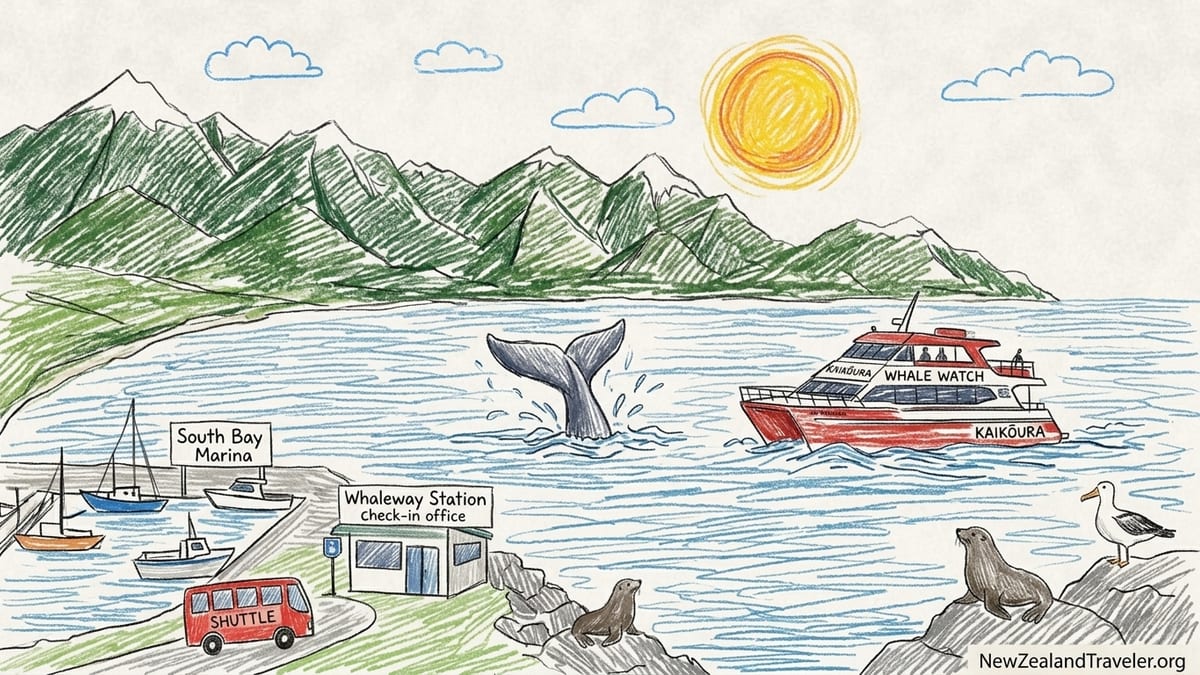
Whale Watch Kaikōura’s main office is at The Whaleway Station on Whaleway Station Road in Kaikōura. This is the check-in point even though the boats depart from South Bay Marina, which is on the other side of the Kaikōura Peninsula.
One practical detail the company emphasizes is timing: arrive 30 minutes before your scheduled departure time for check-in, and understand that check-in closes promptly five minutes prior to departure. In plain language, if you roll in late because you were stuck behind a slow campervan on State Highway 1, you may miss the boat, and you should not assume there will be an easy same-day fix.
The day’s first real decision about your trip often happens before you ever see the marina. Whale Watch Kaikōura states that the captain makes the call on whether a tour will sail on the day, and that decisions are typically made about 15 minutes before check-in opens so they reflect the most current sea and weather conditions. If you are driving in from somewhere else that morning, the operator strongly encourages calling for a tour status update.
Even when the tour does operate, the sea-state conversation starts at check-in. Whale Watch Kaikōura says every tour is graded with a motion-sickness warning. “Moderate chance” is described as the standard warning because the tour operates on the open ocean; “high chance” is their highest warning, used when conditions make seasickness most likely. If you have ever learned, the hard way, that your inner ear does not negotiate with swell, this is the moment to take the warning literally.
The Shuttle Bus To South Bay Marina, And Why The Day Feels Longer Than The Cruise
Whale Watch Kaikōura advises allowing 3 hours and 15 minutes for the full experience. That time includes check-in at Whaleway Station and bus transfers to and from the marina at South Bay. The actual time on the water is described as just over two hours.
That split is important because it shapes the emotional arc of the outing. Many travelers picture a “two-hour cruise” as two hours of active wildlife watching. In reality, there’s a chain of small segments that add up: check-in lines, briefing, being staged onto a bus, the drive over to the marina, boarding, and then the run out of the bay to the deeper water where whales are more likely to be found.
If you’re trying to plan the rest of your day, treat the 3 hours 15 minutes as real time that dominates the middle of your schedule. It is not a quick add-on before lunch. It’s closer to a half-day block once you factor in getting to the office early, parking, and the reality that a weather call can reshuffle your day at the last minute.
On The Vessel: Cabin Comfort, Outdoor Decks, And The Motion You Can’t Ignore
Whale Watch Kaikōura operates purpose-built catamarans, and its published fleet information describes vessels around 17.7 meters, with a passenger capacity of 48, cruising speed listed at about 25 knots, and a “main deck fully enclosed, with all round viewing decks.” Practically, that means you can choose an indoor seat when the spray comes up, but you’re never far from an outside rail when something surfaces.
The same details that make the vessels effective for finding whales can make them challenging for sensitive stomachs. The operator notes that because it operates on the open ocean and the vessels can travel at high speeds, crew will normally keep passengers seated when transiting at speed. In other words, there are stretches when you are not wandering the decks scanning for dorsal fins; you are staying put while the boat runs.
Whale Watch Kaikōura openly acknowledges the seasickness factor: on open water, motion sickness “can be inevitable” for some people, and the company strongly advises taking precautions. It also notes it sells motion-sickness products and carries motion-sickness bags onboard, and even mentions having a small number of motion-sickness VR goggles on vessels to assist with symptoms.
Value is where this becomes personal. If you are comfortable at sea, those high-speed transits feel like purposeful searching. If you are nauseated, the same minutes can feel like time stolen from the wildlife you paid for. That’s why a “high chance” motion-sickness warning should not be treated as background noise: it directly affects how much of the trip you will be able to enjoy with your eyes up and your camera ready.
What You Might See: Whales Aren’t Guaranteed, And That’s Written Into The Policy
Whale Watch Kaikōura states plainly that you are not guaranteed to see a whale, because the animals are in their natural environment. The company also publishes that it has a success rate of over 90% in finding whales on tours, while adding a crucial operational detail: it typically sees 1 to 2 whales per tour. That “1 to 2” matters because it tells you what a normal day looks like in their own framing, not the highlight reel.
The operator also states that if your tour does not see a whale, it guarantees to refund 80% of your fare. It also clarifies what counts as a “whale” under New Zealand’s Marine Mammals Protection Regulations, using a definition that includes baleen whales, sperm whales, beaked whales, killer whales, and pilot whales. In practice, that definition matters if you see dolphins and seabirds but no whale species: the trip may still qualify as “no whale sighted” under the operator’s terms.
Beyond whales, Whale Watch Kaikōura describes typical additional encounters that may occur, including New Zealand fur seals, pods of dusky dolphins, and the endangered wandering albatross. It also notes that depending on season you may see migrating humpbacks, pilot whales, blue whales, southern right whales, or fin whales, and that orca can occur, especially during summer months. Those statements are best read as “possible,” not promised.
There is also a specific wildlife-viewing restriction the company highlights: during November through March, there is a mandatory rest period for viewing dusky dolphins between 11:30 a.m. and 1:30 p.m., put in place by the Department of Conservation. If you book a midday tour during those months, that rule can shape what “bonus wildlife” you’re allowed to watch and when.
Cancellations, Weather Calls, And The Policies That Protect Your Trip (Or Don’t)
Two separate issues can cancel your day: you cancel, or the ocean cancels you. Whale Watch Kaikōura states that tours are subject to favorable sea and weather conditions, and that captains constantly monitor conditions. If conditions are not suitable, a tour may be cancelled or additional safety restrictions may be placed on, including restrictions affecting children or passengers with medical conditions or mobility challenges.
If you are the one cancelling, the company’s published policy is blunt: no refunds are given if you fail to notify them of your cancellation 48 hours before the check-in time. That is the kind of line you want to understand before you book a non-refundable motel in Kaikōura for a single night and hope the weather behaves.
The company also notes there is no charge for booking changes, and that no booking fee or credit card transaction fee is charged. Those smaller details can be meaningful if you are rescheduling because the day’s sea-state warning looks rough and you want to roll the dice on a calmer window.
The most traveler-friendly mindset for Kaikōura whale watching is to plan for flexibility. If your schedule allows it, build in a buffer day in Kaikōura so you can rebook if the captain cancels sailings for safety. If you can’t add a buffer day, treat the booking as weather-dependent rather than guaranteed entertainment.
The Takeaway
Whale Watch Kaikōura’s published information sets realistic parameters if you read it closely: the outing is about 3 hours 15 minutes door-to-door, with just over two hours at sea; the standard Ocean Cabin is NZ$175 per adult through September 30, 2026 and NZ$185 from October 1, 2026; and whales are not guaranteed even with a stated high success rate.
The biggest gap between expectation and reality tends to be how the day is spent. Even on a successful trip, a meaningful portion of your time is searching: transit at speed, scanning, repositioning, and waiting for a whale to surface after long dives. That’s wildlife on its own terms. If you board expecting constant action, you may feel frustrated. If you board expecting a hunt that sometimes ends quickly and sometimes takes patience, you are closer to the honest experience.
The factor that most influences perceived value is not just whether you see a whale, but whether you are well enough to enjoy the search. Whale Watch Kaikōura’s own motion-sickness warnings are a signal to plan like a grown-up: take proven precautions if you’re susceptible, dress for spray and wind, and accept that a “high chance” day can mean spending more time managing your body than watching wildlife.
If you want this to become the first-person, observational piece you originally requested, send me your tour date and your field notes (or even a timeline and the species you actually saw). I’ll shape it into a 1500 to 2000 word Ghost-ready narrative that includes only your genuine sightings, with the verified 2026 price and policy context woven in.
FAQ
Q1. How long does the Whale Watch Kaikōura experience take end to end?
Plan for about 3 hours 15 minutes total, including check-in and bus transfers, with just over two hours on the water.
Q2. What is the Ocean Cabin price in September 2026, and what changes in October?
The Ocean Cabin is NZ$175 per adult and NZ$60 per child (ages 3 to 15) through September 30, 2026, and the adult fare increases to NZ$185 from October 1, 2026.
Q3. Where do you check in for Whale Watch Kaikōura?
Check in at The Whaleway Station on Whaleway Station Road in Kaikōura, then transfer by bus to South Bay Marina for boarding.
Q4. What are the typical tour times?
The company publishes year-round check-in times of 7:15 a.m., 10:00 a.m., and 12:45 p.m., with an additional 3:30 p.m. check-in scheduled in January, February, March, November, and December.
Q5. Are whales guaranteed?
No. The operator states you are viewing whales in their natural environment and sightings are not guaranteed.
Q6. What happens if no whale is seen?
Whale Watch Kaikōura states it will refund 80% of your fare if your tour does not see a whale.
Q7. How bad is seasickness on this trip?
The operator says motion sickness can be inevitable for some people on the open ocean and grades each tour with a motion-sickness warning, ranging from moderate to high chance.
Q8. What is the cancellation policy if I change my mind?
The company states no refunds are given if you fail to notify them of your cancellation 48 hours before the check-in time.
Q9. Can tours be cancelled due to weather or sea conditions?
Yes. Whale Watch Kaikōura says tours are subject to favorable sea and weather conditions, and the captain decides on the day whether a tour will sail.
Q10. What other wildlife might I see besides whales?
The operator notes tours may also encounter New Zealand fur seals, dusky dolphins, and seabirds including wandering albatross, with other whale species possible depending on season.