


I arrived at Hanmer Springs Thermal Pools & Spa with that very specific travel-writer skepticism: I love a good soak, but I hate paying premium admission just to discover I’m mostly renting a crowded hot tub and a lukewarm coffee line. The promise here is big, a sprawling, year-round complex with 23 outdoor pools and activity areas, including sulphur pools, aqua-therapy zones, hydroslides, and dedicated kids’ spaces. The price is also unavoidably “destination attraction”: in September 2026, a date-specific Online Saver single entry is NZ$40 for adults and NZ$23 for children, while a flexible single entry is NZ$43 and NZ$25. Towel and locker hire cost extra. So I went in looking for practical value: what you actually use, what you’ll pay beyond the ticket, what works smoothly, what feels like a bottleneck, and how long a normal traveler honestly wants to stay once the novelty of hot water wears off.
Entry price reality check: what my ticket did and didn’t cover
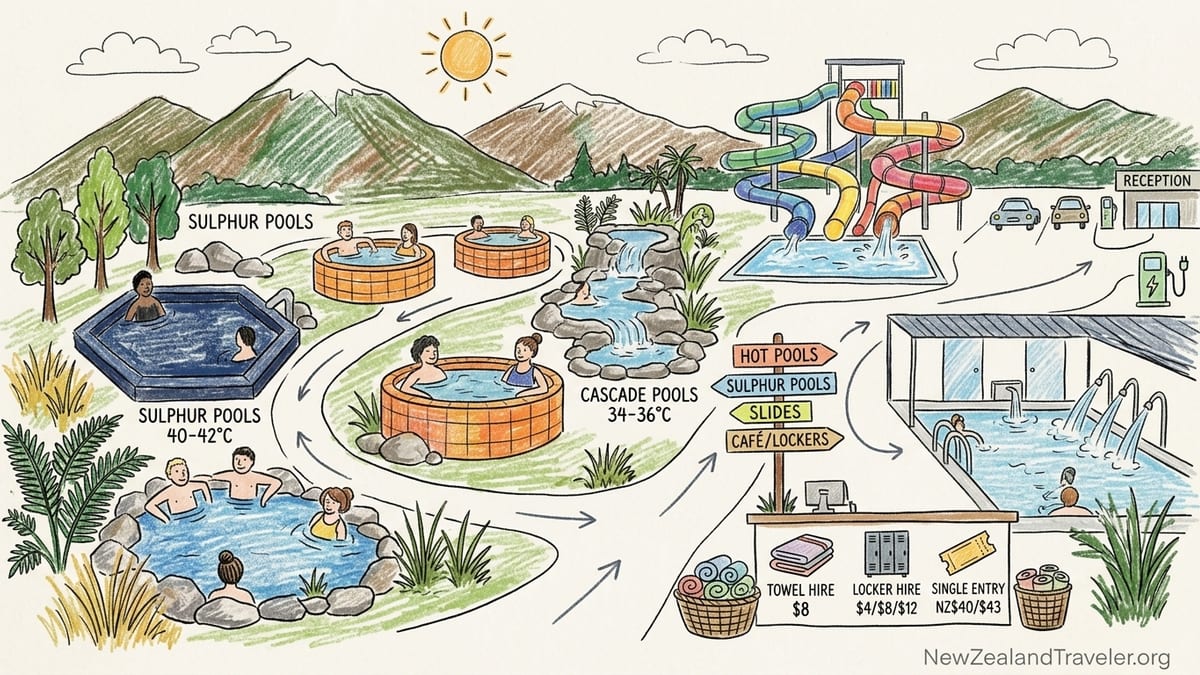
At the time of writing (late September 2026), Hanmer Springs Thermal Pools & Spa sells two headline single-entry options. The Online Saver single entry is NZ$40 per adult (16+) and NZ$23 per child (ages 5 to 15), and it has a key catch: you must book for a specific date and purchase by 10pm the day before your visit. If you want flexibility, the Flexi Pass single entry is NZ$43 adult and NZ$25 child and can be used any day within 12 months of purchase.
In practical terms, that NZ$3 adult difference sounds minor until you’re booking for a couple, a family, or you’re traveling with anyone who might change plans due to weather, road conditions, or energy levels. If your trip is tightly scheduled, the Online Saver feels like straightforward value. If you’re in Canterbury for a week and “Hanmer is a maybe,” the Flexi Pass can reduce the stress of locking in a date.
What the entry does include is meaningful: access to the pools and hydroslides, and it’s easy to underestimate how much variety you get. This is not a single thermal pool with a view. It’s a circuit. You can move between hotter and cooler pools, soak in sulphur water, spend time in aqua-therapy areas, and switch to more active zones like slides and family pools without paying an extra per-feature fee at the gate.
What it does not include: basics you might assume are bundled at this price point. Towel hire is NZ$8, robe hire is NZ$10, and locker hire is time-based: NZ$4 for 2 hours, NZ$8 for 4 hours, or NZ$12 for the whole day. If you show up without a towel and decide you want a locker for more than a quick dip, your “NZ$40 day” quickly looks like NZ$52. That’s not a complaint, it’s the actual math travelers should plan for.
Arrival, parking, and the first 15 minutes inside
The good news is that getting there and getting in is designed to be easy. There is free on-site parking directly in front of the entrance, and there is additional free parking nearby at 14A Amuri Avenue. If you’re being dropped off, there’s a short 5-minute waiting zone at reception for pickups and drop-offs, which is the kind of small operational detail that matters when you’re traveling with kids, older relatives, or heavy day bags.
Another practical win: dedicated accessible parks are right by reception. And for EV drivers, chargers are available in a separate administration car park (with app-based use). I mention this because Hanmer Springs is exactly the kind of place people drive to for a day trip or a stopover, and charging access changes whether you can comfortably spend the extra hours you want in the village after your soak.
Once inside, the “first 15 minutes” is where a hot pools complex either feels like a holiday treat or a logistical chore. Here, the experience is very much a paid facility: you’re moving through reception, into changing areas, deciding whether to rent a locker, and sorting your towel situation. My practical takeaway is simple: if you can, arrive already wearing your swimwear under your clothes. It shortens the changing-room time and reduces the feeling of queuing for a bench or hook during busy periods.
I also found it worth committing to a realistic plan before I even got wet: do I want slides first (while I’m fresh and dry-haired), or do I want the hot pools first (while I’m calm and less likely to talk myself into climbing a tall slide tower)? This place is large enough that bouncing back and forth without a plan wastes time and warmth.
Changing rooms, lockers, and the towel question (the real add-on cost)
Changing rooms are where value can collapse, because nothing kills “spa day” energy faster than feeling rushed, cramped, or unsure where to put your stuff. I’m not going to claim every moment is serene, because crowds vary wildly, but the facility is set up as a major attraction: you’re not improvising with a tiny changing shed. The flow is built for volume.
The locker pricing is where I had to make a decision based on how long I realistically expected to stay. If you think you’ll be in and out in under two hours, NZ$4 for 2 hours is a tidy add-on. But Hanmer Springs is almost engineered to keep you longer than two hours: you’ll want to try different zones, you’ll likely take breaks, and you’ll probably end up at the café. That makes the 4-hour locker (NZ$8) the sweet spot for most visitors who are actually going to use the variety they paid for.
Towel hire at NZ$8 is the other “do I pack or rent?” moment. If you’re road-tripping and your towel is already in the car, bring it. If you’re coming straight from a hotel without spare space, towel hire is painless, but it’s not cheap enough to feel like a throw-in. And if you’re traveling as a family, towel hire is the kind of line item that quietly turns the outing from “one paid activity” into a budget category.
My honest value read: the entry ticket is fairly priced only if you treat the extras strategically. Bring a towel. Decide your locker duration upfront. And if you’re staying in Hanmer Springs overnight, consider whether leaving towels at your accommodation and returning for a second session makes more sense than hauling damp gear around all day.
Pool temperatures and the “what did I actually use?” circuit
Hanmer Springs’ biggest strength is that it isn’t one perfect pool, it’s an entire temperature and mood menu. The listed pool ranges give you an idea of what your body will tolerate for long sessions and what will feel like a quick, intense soak. The AquaTherapy pools sit in the 37 to 42°C range, the Cascade Pools range about 34 to 36°C, Rock Pools are around 38 to 40°C, Hexagonal Pools are about 40 to 42°C, and the Sulphur Pools are positioned as the hottest soaks with no chlorine added.
In real use, I treated the complex like a loop. I started with something mid-range so my body could settle into the heat rather than going straight to the hottest water. Then I moved hotter in steps. This matters because “too hot too soon” is the classic hot-pools mistake. You end up overheating, sitting on the edge, and mentally calculating how much you paid to feel uncomfortable.
What I used most was the variety rather than any single pool. I’d soak for 10 to 20 minutes, move, soak again, then take a short walk to reset. It’s not just about temperature, it’s about changing scenery, finding a quieter corner, and avoiding the sensation of sitting in a human soup of the same voices for an hour.
If you’re a practical-value traveler, here’s the key point: the best “return on entry price” comes from moving through multiple zones. If you pick one pool and camp there, you might love it, but you’ll also be the person who could have achieved the same satisfaction in a smaller facility for less money.
Sulphur pools, aqua-therapy, and whether the “spa vibe” feels real
The sulphur pools are the most distinctive part of the experience. They have a different feel on the skin and a different smell, and the fact that they’re described as having no chlorine added is part of their appeal. For me, they were not the pool I stayed in the longest, but they were absolutely the pool I would miss if I skipped Hanmer Springs and went somewhere more basic.
The aqua-therapy area is where I saw the most practical wellness value. Instead of pure soaking, you’re using water jets and features that feel designed for shoulders, backs, and legs after travel days. If you’re coming off long drives, a hiking day, or a ski-field visit, this is the zone that can feel like it’s doing something tangible rather than just feeling pleasant.
Does the complex feel like a “spa” in the strict sense? Not exactly, because a spa implies quiet by default. This is a hybrid: part relaxation facility, part family activity park. There are quiet corners and calmer pools, but you will also hear kids squealing and slide splash-downs depending on where you are. The value is in being able to choose your vibe by walking 60 seconds in another direction.
If you want a truly hushed, adult-only soak, Hanmer Springs can still work, but only if you actively avoid peak family times and choose the calmer zones. If you show up expecting monastic silence at 1pm on a weekend, the mismatch is on you.
Hydroslides, kids’ zones, crowds, café breaks, and my honest “how long was enough?”
The hydroslides are included with entry, and they run daily from 10am to 6:30pm, while the pools are open 10am to 7pm. That schedule matters because the slides effectively have an earlier “last call.” If slides are your priority, you need to time your visit so you’re not arriving late afternoon and discovering the clock is against you.
I did use the slides, and my experience was simple: they’re fun, they’re physical, and they change the entire tone of the visit. The moment you climb a slide tower, you’ve shifted from “spa day” to “active attraction.” For groups, that’s actually helpful because it prevents the visit from becoming just sitting around. For couples chasing a romantic soak, slides can be either a playful highlight or a complete detour you skip.
Children’s areas and family activity spaces are a major part of why crowds feel variable. In family zones, energy is high and noise is part of the package. In quieter soak areas, people tend to be more respectful. If you want a calmer visit, plan your circuit intentionally and treat the complex like multiple venues in one, not one shared pool space.
The café is open daily 10am to 6pm, which makes it easy to build in a reset. Practically, this is where I decided whether I was staying longer. After a couple of hours, I wanted a warm drink, something salty, and a break from being wet. That break can extend your day substantially because once you’ve eaten, you often feel ready for “one more soak.” Without the café break, I think my personal limit would have been shorter.
So how long did I realistically want to stay? I wanted about three to four hours of real use, not an all-day marathon. That included time to change, do a purposeful circuit of different pools, spend some time in the sulphur pool area, test the slides, and take a café break. Beyond four hours, I started to feel the diminishing returns of hot water: you’re warm, relaxed, slightly pruny, and you’ve already “seen” what you came for.
The Takeaway: single entry vs return-entry vs multi-day for my trip
If you’re doing Hanmer Springs as a single stop on a wider South Island itinerary, the Online Saver single entry (date-specific) is the best value if you can commit to your date by 10pm the day before. For my style of visit, a single entry made sense because I wanted one substantial session, then to get on with the rest of the trip. The facility is big enough to justify the ticket, but it’s still, at its core, hot pools. I didn’t personally need consecutive days of soaking to feel satisfied.
A return-entry option becomes attractive if you’re staying in the village overnight and you like the idea of splitting your soak into two chapters: a daytime session, a break to explore or nap, then another soak later the same day. This is especially useful if you don’t want to stay wet for hours on end. I can see this suiting families (kids burn energy, then reset) and anyone who likes soaking in shorter blocks.
A multi-day pass is the one I’d reserve for travelers who are truly using Hanmer Springs as a base, not a stop. If you’re in the village for two nights, a two-day pass can make the price-per-visit feel more rational, especially if you’re the type who wants a quick soak in the morning and a longer soak in the evening. But if your schedule is packed with drives, hikes, wineries, or ski time, a multi-day pass risks becoming “money you paid to feel guilty.”
One important honesty note: I am not claiming a personal summer-vs-winter comparison from separate visits. The complex is year-round and the idea of a winter soak is famously appealing, but if you’re choosing based on weather alone, pick the day that makes sense for your itinerary and your body. The practical comfort factor is less about the season and more about timing your arrival to avoid the busiest windows and planning for towel and locker logistics so you can relax once you’re inside.
FAQ
Q1. What are the opening hours for Hanmer Springs Thermal Pools & Spa in September 2026?
Pools are open daily 10am to 7pm, and hydroslides run daily 10am to 6:30pm.
Q2. How much is adult entry right now, and what’s the difference between Online Saver and Flexi?
Online Saver single entry (date-specific) is NZ$40 adult, while the Flexi single entry is NZ$43 adult and can be used any day within 12 months.
Q3. How much is child entry in September 2026?
Online Saver child entry (ages 5 to 15) is NZ$23, and Flexi child entry is NZ$25. Children under 5 are free.
Q4. Are towels included with entry?
No. Towel hire is an extra cost, priced at NZ$8.
Q5. How much are lockers, and how long do they last?
Locker hire is NZ$4 for 2 hours, NZ$8 for 4 hours, or NZ$12 for the whole day.
Q6. Is there free parking on-site?
Yes. There is free on-site parking in front of the entrance, plus additional free parking nearby.
Q7. What temperatures are the pools, roughly?
Different zones range from about 34°C up to 42°C, including aqua-therapy pools, cascade pools, rock pools, hexagonal pools, and the hottest sulphur pools.
Q8. Are sulphur pools included, and do they contain chlorine?
They are included with entry, and the sulphur pools are described as having no chlorine added.
Q9. Are hydroslides included with entry, and are there age limits?
Yes, hydroslides are included with entry. Hydroslides are for ages 5+.
Q10. How long should I plan to stay to feel like I got good value?
A realistic plan for most visitors is around 3 to 4 hours to change, try multiple pool zones, take a break, and still leave feeling refreshed rather than overheated.