


The first thing you learn about stargazing in Lake Tekapo, New Zealand is that the sky does not care about your plans. I arrived in Takapō (Tekapo) with the usual checklist: warm layers, a charged phone, and that quietly ambitious hope that I would step off the bus and immediately see the Milky Way like a postcard. Instead, I got something far more Tekapo-authentic: a windy lakefront, fast-moving cloud, and the kind of forecast that makes you refresh weather apps the way other travelers refresh flight status.
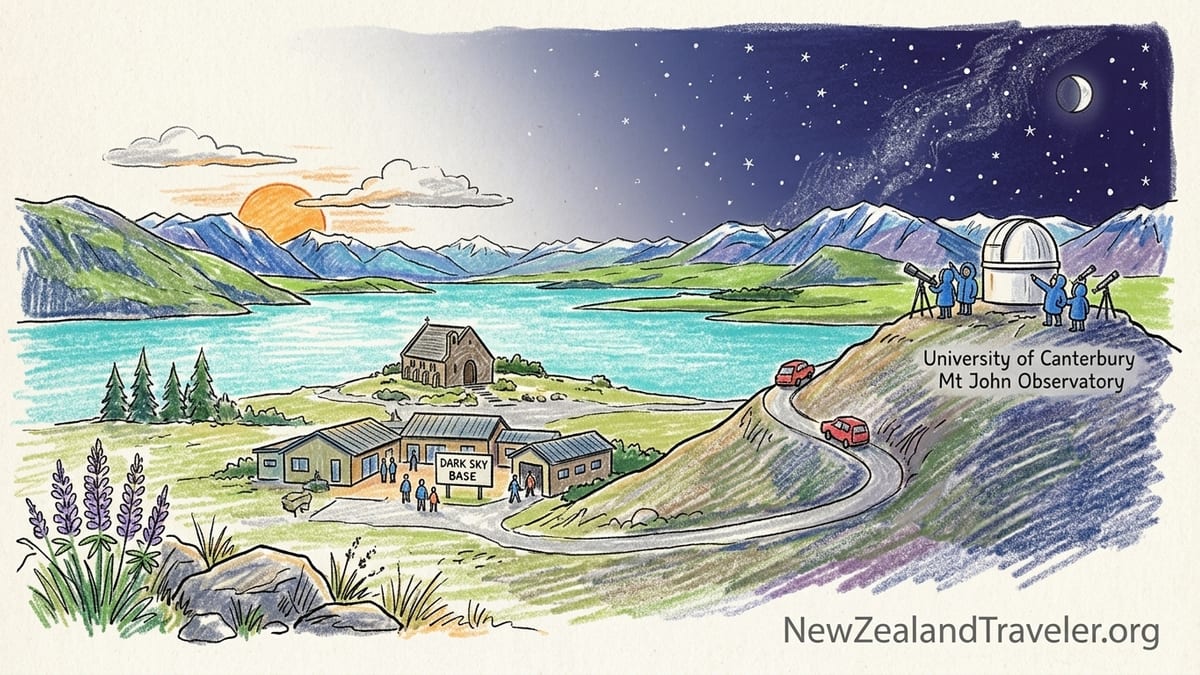
Arriving in Takapō: The Dark Sky Feeling Starts Before Nightfall
Tekapo has a particular kind of calm. In daylight, Lake Tekapo looks almost unreal, a pale turquoise that seems lit from underneath, with the Church of the Good Shepherd sitting quietly nearby like it has been waiting for your camera. But the story that matters here is what happens after dinner, when the town’s lights dim and you realize you are in a place that takes darkness seriously.
I planned my evening around Dark Sky Project, the best-known operator in town, based at 1 Motuariki Lane on the lakefront. That location matters because it sets the tone: you are not meeting at an anonymous car park. You are stepping into a purpose-built astronomy hub with a customer service counter, indoor experiences, a gift shop, and the sense that you are about to do something that has been rehearsed thousands of times, yet still depends on weather that refuses to be rehearsed.
I also quickly learned that Tekapo stargazing is not just about “seeing stars.” It is about managing uncertainty. Cloud can roll in off the Southern Alps. Wind can be strong enough to make standing still feel like work. And the most important decision you make might be when to book: early in your stay, not at the end, so you have another night to try if the sky does not cooperate.
Check-In Reality: Times, Rules, and the Quiet Countdown to Departure
On my stargazing night, I treated check-in like catching a flight. Dark Sky Project’s terms require guests to check in at their customer service counter at 1 Motuariki Lane before departure. For the Summit Experience and the Crater Experience, the stated check-in requirement is 20 minutes prior to scheduled departure. For their indoor Dark Sky Experience and Virtual Stargazing Experience, the stated check-in requirement is 10 minutes prior.
In practice, that meant arriving with time to spare, using the bathroom, and not rushing myself into a night where the main activity is standing still in the cold. There is also a strict late policy: close to departure, guests who have not checked in can be treated as no-shows and their tickets released, and missing check-in does not create a refund situation. It is not harsh, but it is firm, and it is a reminder that these tours run on a tight schedule to catch the best darkness.
Another reality check is their light discipline. The rules around light pollution are not just etiquette, they are part of the product. White lights, bright phone screens, and flash photography are not compatible with what everyone came for. I watched people instinctively reach for phones, then quickly tilt them down or dim them, the way you do in a theater.
And then there is the unspoken ritual of any Tekapo night: everyone becomes an amateur meteorologist. You can feel the group energy shift when a guide mentions cloud bands and timing, because suddenly the night is a story with suspense.
What I Wore, What I Regretted, and Why Tekapo Cold Feels Different
I dressed like I was going to stand outside in winter, even though Tekapo can look deceptively mild earlier in the evening. I wore a base layer, a warm mid-layer, long pants, thick socks, and closed shoes I trusted on gravel. I added gloves and a beanie because the biggest discomfort in stargazing is not your core, it is your fingers and ears once you stop moving.
For Dark Sky Project’s Summit Experience, the operator specifically includes the use of an extreme cold weather jacket as part of the tour. That jacket makes a real difference because Mount John is higher and more exposed than the lakefront. The Summit Experience page also notes you need a moderate level of fitness: there is a short walk of about 100 meters on a gravel incline plus steps in the dark. That might sound small, but it changes what footwear feels sensible. This is not a place for slippery soles or fashion boots.
Wind was the biggest variable on my night. Even when the temperature itself felt manageable, gusts had a way of cutting through layers. It is also the wind that makes the darkness feel more remote. When you are standing under a sky you can barely measure, and the air keeps moving, you understand why guides are strict about keeping the group together.
The one thing I regretted was not bringing a spare layer for my neck. A scarf or neck gaiter is the small item that suddenly feels like a luxury when you are trying to hold still, listen to a guide, and keep your attention on the sky rather than your own shivering.
The Drive Up: Transport, Timing, and the Mount John Factor
The Summit Experience is built around a simple promise: you start at Dark Sky Project Base in town and they transport you to the summit of Mount John. The published itinerary describes a comfortable 15-minute bus journey from base to the Mount John summit, and then transport back to where you started. That transport element is not just convenience, it is part of why the Summit Experience can feel “worth it” even before you see a single star. You are paying to be brought to a controlled, professional setting where the darkness is protected and the storytelling is structured.
On my night, the bus ride itself felt like an extended exhale. Lake Tekapo was behind us, and the view opened into a darker countryside that looked less like a destination and more like an absence of everything that usually competes for your attention. The chatter on the bus was mostly hopeful and a little nervous. People were already asking what we might see, and the phrasing mattered: “might.”
Mount John also changes your relationship to light. The Summit Experience takes place at the University of Canterbury Mt John Observatory site, which is a working research observatory. You feel that in the atmosphere. This is not a casual “look up anywhere” moment. It is organized, with domes nearby and a clear sense that you are a visitor in a place where science is the priority.
It is also important to remember that even with a tour, you are still not buying certainty. Dark Sky Project explicitly states it cannot guarantee clear skies or the visibility of specific celestial objects on its outdoor experiences. That statement became my mental anchor as cloud moved in and out like it was testing the group’s patience.
Under the Mackenzie Dark Sky: What I Actually Saw When the Cloud Finally Broke
My night did not start with a perfect reveal. It started with cloud that came in waves. The guide handled it the way good guides do: by making the waiting part of the experience instead of treating it like a failure. We started with naked-eye orientation whenever there were gaps, using a handheld laser to trace shapes quickly before the next cloud band slid over. Those first glimpses were short, but they were enough to recalibrate my eyes to true darkness.
When the sky opened wider, what struck me first was not a single famous object, but the sheer density of stars. In cities, we use “starry” casually. Here, starry is a physical feeling. The sky looked textured. Even without naming constellations, you could sense patterns everywhere, the way your brain tries to connect points into something familiar.
On my clearest stretch of the night, the Milky Way became visible as a pale, cloudy river rather than a crisp band. It was not the high-contrast, long-exposure look you see in astrophotography. It was subtler and more honest, like something you notice more the longer you stare. I remember realizing that the real thrill was not “seeing it once,” but watching it strengthen as my eyes adjusted and my attention stopped hopping.
Through the telescope portion of the experience, I saw a handful of targets that were realistic for a mixed-sky night: a bright planet that showed a clean, unmistakable disk, and at least one star cluster that looked like a concentrated spill of light against black. I am being careful with specifics because visibility depends on season, timing, and cloud, and my experience was shaped by the gaps we were given. What I can say confidently is that the jump from naked-eye viewing to telescope viewing was emotionally immediate. The telescope made the night feel less like “I’m outdoors in the dark” and more like “I’m actually observing.”
There was also a moment that felt uniquely southern: the guide oriented us to constellations that do not dominate northern skies, and the storytelling blended cultural context with practical sky navigation. Even as cloud returned, those references stuck. I left feeling like I could step outside later in my trip and identify at least a few anchors without needing someone else to translate the sky.
Crater vs Summit vs Indoors: Picking the Right Experience When Weather Is a Character
Tekapo has enough stargazing options that the hardest part can be choosing what you are buying. Dark Sky Project’s three core categories are clear: the Summit Experience at Mount John (1 hour 45 minutes), the Crater Experience at Cowan’s Private Observatory (75 minutes), and indoor options that keep your plans from collapsing when the sky does.
The Summit Experience is priced at NZ$219 for adults and NZ$169 for children, with pricing stated as valid to September 30, 2026. It includes transport from their base, guiding, and the loan of an extreme cold weather jacket, and it uses naked-eye viewing plus powerful telescopes, including a 16-inch telescope inside a private observatory dome. Minimum age is stated as 10 years and above.
The Crater Experience is priced at NZ$129 for adults and NZ$95 for children ages 5 to 17, with a family pass also offered, and pricing stated as valid to September 30, 2026. It is hosted at Cowan’s Private Observatory and is designed around purpose-built observation craters that help shelter you from wind and light pollution. Stargazing is described as using naked-eye viewing and 14-inch telescopes, plus an observatory dome. Minimum age is stated as 5 years and above. It is also shorter, which can matter if you are traveling with kids or if you are trying to fit stargazing into a tight itinerary.
Then there is the all-weather reality: Dark Sky Project offers indoor alternatives. Their Dark Sky Experience is a separate indoor product priced at NZ$59 for adults and NZ$39 for children, with pricing stated as valid to September 30, 2026, running about 45 to 60 minutes. Their Virtual Stargazing Experience is specifically described as a premium indoor journey for weather-impacted guests, using real-time astronomical data to simulate the exact night sky you would have seen, and it is priced at NZ$89 for adults and NZ$45 for children with pricing stated as valid to September 30, 2026.
What I appreciated about this structure is that it acknowledges what every Tekapo traveler learns: you might arrive for darkness and end up negotiating with cloud. Having an indoor option that still teaches you what would have been visible can turn a “wasted night” into something that at least improves your chances of enjoying your own independent stargazing later.
The Takeaway: Was It Worth Paying When I Could Have Just Looked Up?
Tekapo is one of those rare places where stepping outside independently can genuinely be spectacular. If you have a clear night, you can often see an extraordinary sky from surprisingly close to town, especially if you move away from brighter pockets and give your eyes time to adjust. That fact is important because it keeps tour expectations honest: you are not paying solely for darkness. You are paying for access, equipment, guidance, and a curated experience that compresses a lot of learning into a short window.
For me, the value was in three things: being transported to a controlled observation site, having a guide who could quickly orient the group during short breaks in cloud, and getting telescope time that delivered a feeling my naked-eye view could not. The telescope portion justified itself in the same way a wildlife safari justifies itself even if you could drive a public road: you could get lucky alone, but a trained guide and specialized gear dramatically increase what you notice and understand.
That said, I would not recommend booking a Tekapo stargazing tour for your final night in town, because weather uncertainty is too real. I would book early in your stay, treat it as a learning experience as much as a viewing experience, and plan at least one independent night as well, even if it is just ten minutes outside your accommodation with a hot drink and a willingness to wait for your eyes to adapt.
The most genuine Tekapo stargazing souvenir is not a photo. It is the moment you stop checking the forecast and start watching the sky move, accepting that a perfect night is not guaranteed, but a meaningful one is still possible.
FAQ
Q1. What is the Dark Sky Project Summit Experience and how long is it?
It is a guided stargazing tour at the University of Canterbury Mt John Observatory site that lasts 1 hour 45 minutes and includes transport, guiding, and an extreme cold weather jacket loan.
Q2. How much does the Summit Experience cost right now?
Dark Sky Project lists the Summit Experience at NZ$219 for adults and NZ$169 for children, with pricing stated as valid to September 30, 2026.
Q3. What is the Crater Experience and how long is it?
It is a 75-minute guided stargazing experience at Cowan’s Private Observatory using purpose-built observation craters for shelter from wind and light, plus telescope viewing.
Q4. How much does the Crater Experience cost right now?
Dark Sky Project lists the Crater Experience at NZ$129 for adults and NZ$95 for children ages 5 to 17, with pricing stated as valid to September 30, 2026.
Q5. What time should I check in for Dark Sky Project tours?
Their terms state check-in is 20 minutes before departure for Summit and Crater, and 10 minutes before departure for the Dark Sky Experience and Virtual Stargazing Experience.
Q6. What happens if the weather is bad and the sky is cloudy?
Dark Sky Project states it cannot guarantee clear skies or specific objects. If stargazing is not possible, options may include rescheduling, a voucher, or a refund, and they may offer an indoor alternative for weather-impacted guests.
Q7. Is there an indoor option if I still want astronomy even in bad weather?
Yes. Dark Sky Project sells the Dark Sky Experience (an indoor multimedia tour) and also offers a Virtual Stargazing Experience as an indoor alternative when outdoor tours cannot operate due to weather.
Q8. What does the Dark Sky Experience cost and how long is it?
Dark Sky Project lists it at NZ$59 for adults and NZ$39 for children, with a stated duration of about 45 to 60 minutes and pricing valid to September 30, 2026.
Q9. What does the Virtual Stargazing Experience cost?
Dark Sky Project lists it at NZ$89 for adults and NZ$45 for children, with pricing stated as valid to September 30, 2026.
Q10. Is a Tekapo stargazing tour worth it compared with stargazing on your own?
If you get a clear night, independent viewing can be excellent. Tours add value through transport to controlled sites, trained guides, and telescope access, but the experience is still weather-dependent.