

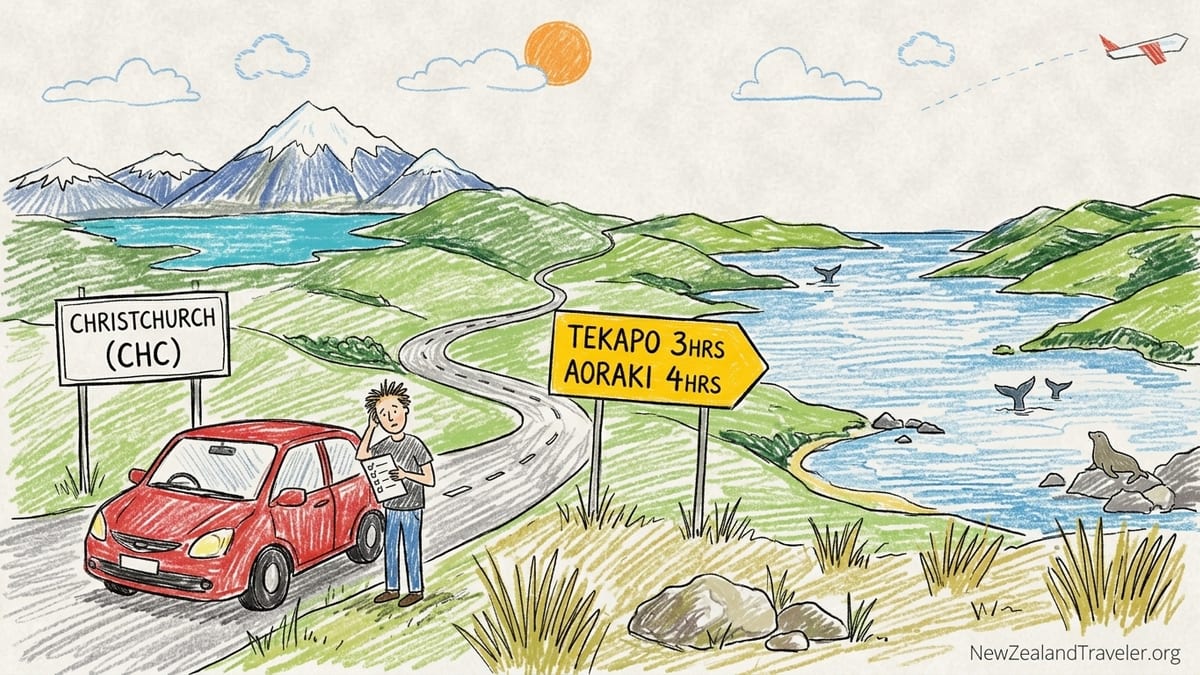
I wanted a Canterbury road trip that felt like driving, not chasing. So instead of forcing a single, exhausting loop, I linked the region in clusters: a Banks Peninsula day out to Akaroa, a separate coastal run north to Kaikōura, and then a southbound shift into the Mackenzie Country for Lake Tekapo and Aoraki/Mount Cook. Christchurch became my hub and reset button. That one decision kept the days human-sized, cut down on constant repacking, and let weather dictate my hikes without derailing the whole itinerary.
Picking Up the Car in Christchurch: The Unromantic Start That Sets the Tone
I collected my rental car at Christchurch Airport (CHC), which is the kind of simple detail that matters more than you think when you are jet-lagged and trying to remember to drive on the left. Most major rental desks are located right inside the terminal in International Arrivals, so I did not need a shuttle just to get keys in hand. I still gave myself extra time for the handover because the airport can feel busy and disorienting after a long flight, and because rental desks often have queues in peak periods.
Before I rolled out of the airport area, I treated the first hour like a systems check. I synced my phone, set offline maps as backup, tested wipers and headlights, and confirmed I had the New Zealand emergency number saved. I also asked the staff member to point out the fuel type on the vehicle and showed them the existing scrapes on the rental report. That two-minute walk-around saved me from stress later when I returned the car.
Fuel planning started immediately. Around Christchurch, fuel prices can jump around in ways that make you feel like you are imagining it, and recent local chatter has put 91 octane close to the mid-$3 NZD per litre range at times. Rather than chase the cheapest pump, I focused on convenience: I topped up before long highway stretches, kept the tank above half when heading into more remote areas, and avoided leaving refuelling until late evening when some smaller-town stations can feel limited.
My other early rule was pacing. Canterbury distances look tame on a map, but driving takes real concentration: open-road speeds, oncoming trucks, changing weather, and narrow sections where you cannot simply drift wide. I built in time for breaks even on “short” drives because fatigue arrives fast once you add wind, rain glare, or a line of slow vehicles that you cannot safely pass.
Cluster One: Christchurch to Akaroa (Banks Peninsula) as a Clean First Hit
Akaroa was my easiest win, and I treated it like a warm-up lap before bigger road days. The drive from Christchurch to Akaroa is typically around 1.5 hours, and the distance is commonly cited in the 80 to mid-80 km range depending on where you start in the city. On paper that sounds like nothing, but Banks Peninsula is not a “set cruise control and forget it” kind of road once you leave the flatter approaches behind.
What I remember most is how the road changes character near the peninsula: you move from easy, wide driving into hillier, curvier sections where your speed naturally drops. There are climbs, tight bends, and moments where you are watching for slower vehicles while also keeping your eyes on the scenery. I found overtaking opportunities limited once you get into the more winding parts, so the most sensible approach was simply to accept a slower pace and enjoy it.
In Akaroa itself, I kept my car parked and walked as much as possible. The town feels compact, and the payoff of leaving the car alone is that you actually absorb the harbour atmosphere instead of constantly scanning for a better spot. Parking can still be competitive when it is busy, so arriving earlier in the day made everything smoother. I also liked having the car ready to go for a short hop viewpoint or a quick grocery run without turning the whole afternoon into a driving mission.
Overnight strategy here was simple: I did not move accommodation for Akaroa. If you only have limited time, Akaroa works brilliantly as a long day trip from Christchurch, which means no repacking and no checking in and out for a single night. In my experience, one-night stays are where road trips start to feel like chores, especially when you are juggling wet jackets, charging cables, and grocery bags.
Cluster Two: Christchurch to Kaikōura on SH1, With Roadworks Reality
Kaikōura was a very different drive day, even though it is not outrageously far. Many local tourism materials commonly describe Kaikōura as roughly a two-and-a-half-hour drive from Christchurch in good conditions, and that feels about right as a planning baseline. What changes the experience is not the distance but the unpredictability: roadworks, weather events, and the fact that SH1 is the spine of the South Island’s east coast transport network.
When I planned my run north, I checked official state highway travel updates rather than relying on a static map screenshot. In 2026, parts of the wider SH1 corridor around Kaikōura have had disruptions and recovery work noted by transport authorities, and that can translate into stops, temporary traffic management, and the kind of delays that do not show up until you are already committed to the drive. I built in buffer time and avoided stacking “must-do” activities too tightly on arrival day.
Driving notes: the surface is generally sealed and straightforward, but it is not always fast. You can get stuck behind slower traffic, especially if you hit roadworks or heavy vehicles. Overtaking is not something to force. I only passed when the road markings and sightlines made it clearly safe, and when I could complete the move quickly without pressuring oncoming traffic. If you are used to multi-lane highways, this is where New Zealand driving asks you to reset your instincts and be patient.
Kaikōura itself rewarded staying put. This was one of the places where two nights felt obviously better than one. With only one night, you arrive, do a quick dinner, and then you are already thinking about packing and the next morning’s drive. With two nights, I had a full day to match activities to conditions, which matters on the coast where weather can flip fast. If you are self-driving, that extra night also breaks the mental load of having to be “road-ready” every single day.
Reset in Christchurch: Why I Did Not Force Akaroa and Kaikōura Into One Sprint
It is tempting to link Akaroa and Kaikōura in one continuous run because they are both “near” Christchurch, but the shape of the roads and the human factor made me resist that urge. I used Christchurch as my reset base between the peninsula and the coast. That meant I could wash clothes, properly reorganize my luggage, and start the next drive with a rested brain instead of a vague feeling that I was always behind.
This is also where I kept the itinerary honest. A road trip article can make everything sound seamlessly connected, but in practice you pay for rushed sequencing with fatigue. Long driving days in Canterbury are not only about hours behind the wheel; they are about the constant micro-decisions: speed changes, oncoming traffic, wind gusts, narrow bridges, and whether you are comfortable passing that campervan before the next bend. I would rather do two calmer drive days than one heroic day that leaves me too tired to enjoy where I arrive.
Christchurch was also the best place for errands you do not want to solve in a tiny town at 7:30 p.m. I used the city for a proper supermarket run, a phone cable replacement, and a fuel top-up before heading inland. Those boring details are what keep the Mackenzie portion of this trip smooth, because once you are south of Christchurch and settling into the rural rhythm, you want to spend time on viewpoints and short walks, not on logistics.
If your timeline is tight, this “reset” might feel like lost time. For me, it was the opposite: it protected the rest of the trip from cascading stress. It also meant I could keep each cluster clean and distinct: Akaroa as a peninsula day, Kaikōura as a coastal stay, then a southbound pivot for Tekapo and Aoraki, which drive and feel like an entirely different New Zealand.
South to Lake Tekapo: The Three-Hour Baseline, Then Add Your Stops
The drive from Christchurch to Lake Tekapo is often described officially and locally as about three hours, and that estimate felt like a realistic baseline for planning. I treated it like a proper travel day, not something to squeeze between breakfast and a late lunch reservation. The road out of Christchurch quickly opens into the Canterbury Plains, and the driving becomes more relaxed, but monotony can be its own fatigue, especially if you are fighting a headwind or rain bands.
The Mackenzie Country approach is where the trip starts to feel cinematic, and that is also where weather can become the boss. On a bright day, the colour of the lakes looks almost unreal, but in poor conditions you might be dealing with low visibility and glare off wet pavement. I kept my speed conservative and pulled over only where it was safe and clearly designated, because shoulders can be narrow and some viewpoints can attract sudden stops from other drivers.
Tekapo is a place that rewards staying two nights if you want it to feel like more than a photo stop. One night can work if you are simply breaking up the drive to Aoraki/Mount Cook, but I found that a single overnight created too much repacking pressure. Two nights let me do the lakeside moments slowly: sunset, a relaxed dinner, a morning walk, and then a day trip toward Aoraki without having to check out in a hurry.
Fuel and supplies were part of my Tekapo routine. I topped up in town rather than assume I would “do it later,” because the next leg toward Aoraki is more remote and the day can stretch if you stop often for photos. Even if the distances are not huge, having a comfortable buffer in the tank and a few snacks in the car made me feel much less dependent on timing.
Tekapo to Aoraki/Mount Cook: Short on the Map, Big on the Windshield
The drive from Lake Tekapo to Aoraki/Mount Cook Village is commonly given as about 105 km and roughly 1 hour 15 minutes without stops. In reality, it is almost impossible to drive it straight through because the scenery keeps pulling you over. Lake Pukaki viewpoints, the long straight stretches with mountain silhouettes, and the shifting cloud lines all work like magnets.
This is also where road conditions and wind become real considerations. The route is generally sealed and well-travelled, but strong gusts can nudge the car, especially if you are in a larger vehicle or passing trucks. I kept both hands on the wheel in exposed sections and gave heavy vehicles extra space. It is not scary driving, but it is attentive driving, and that matters because Aoraki days often include hikes that demand energy and focus.
Parking is now part of the Aoraki/Mount Cook experience in a very literal way. The Department of Conservation has moved forward with paid car parking at Aoraki/Mount Cook as part of a wider approach at high-demand sites, and White Horse Hill is one of the places where you can expect charges. The rates have been publicised as $2.50 per hour up to a $25 day cap, with the practical detail that if you arrive one day and leave the next, you may pay for two days. That small line item can change your itinerary if you are planning a sunrise walk or an overnight stay.
This is where my strongest recommendation is to consider two nights in the Aoraki area if hiking is your priority, even if you keep Tekapo as a base for other parts of the Mackenzie. With one night, you can feel squeezed between check-in, weather windows, and the parking clock. With two nights, you get flexibility: you can move a big walk to the clearer day, and you can spread out the effort so you are not driving long distances after a tiring track day.
The Takeaway: A Canterbury Itinerary That Feels Like Travel, Not a Timer
If you want to link Akaroa, Kaikōura, Tekapo, and Aoraki without racing, the secret is refusing the urge to “connect everything” in one tidy loop. Christchurch is not just a gateway, it is the hinge that makes this itinerary humane. I drove this as clusters: Christchurch to Akaroa and back, Christchurch to Kaikōura and back, then Christchurch south to Tekapo, and onward to Aoraki as its own alpine chapter. Each cluster has its own road rhythm, and each deserves its own energy.
Long driving days were the real limiter, not distance alone. SH1 delays, weather, and the concentration required on New Zealand two-lane highways made me treat drive times as optimistic baselines rather than promises. When I did that, the trip stopped feeling like a schedule and started feeling like a series of good decisions: fuel before the long leg, two-night stays where they reduced stress, and early starts only when they bought me calm roads and better parking.
My clearest lodging lesson was this: one-night stays sound efficient but often create constant packing and mental clutter. Two nights in Kaikōura and two nights in the Tekapo or Aoraki orbit made everything easier. I still moved around, but I moved with purpose. That is what kept the road trip grounded and enjoyable, even when the weather did not cooperate.
Finally, I kept Arthur’s Pass as a separate westbound ambition, not a “just because” add-on. The village is roughly 140 km from Christchurch on SH73, and that is a completely different drive day with its own mountain conditions and fatigue profile. Canterbury rewards the traveller who respects geography and energy. When you do, linking these four destinations feels natural, not forced.
FAQ
Q1. What is the most sensible sequence to link Akaroa, Kaikōura, Tekapo, and Aoraki without rushing?
Base in Christchurch for the Akaroa and Kaikōura clusters first, then drive south to Lake Tekapo, then continue to Aoraki/Mount Cook as the alpine finish.
Q2. How long should I plan for Christchurch to Lake Tekapo by car?
Use about three hours as a planning baseline, then add time for stops, weather, and slower traffic through towns or roadworks.
Q3. Is Akaroa better as a day trip or an overnight?
Akaroa works extremely well as a day trip from Christchurch. An overnight is nice, but one-night stays can add packing hassle without adding much time on the ground.
Q4. How long is the drive from Christchurch to Kaikōura, realistically?
Plan roughly two-and-a-half hours in good conditions, but always allow buffer time because SH1 can have delays from maintenance, incidents, or weather-related recovery work.
Q5. What is the drive like from Tekapo to Aoraki/Mount Cook Village?
Expect about 105 km and around 1 hour 15 minutes without stops, plus frequent scenic pullovers and the possibility of strong winds near Lake Pukaki.
Q6. Do I need two nights in Tekapo or can I just stop briefly?
You can stop briefly, but two nights makes Tekapo feel like a destination rather than a checkbox and reduces the pressure to pack and move every day.
Q7. Are there paid car parks at Aoraki/Mount Cook?
Yes. DOC has implemented paid parking at Aoraki/Mount Cook, including White Horse Hill, with pricing published as $2.50 per hour up to a $25 day cap.
Q8. What is the biggest driving mistake people make on these routes?
Overplanning a single “mega-day” and assuming drive times are guaranteed. Fatigue and overtaking pressure build quickly on two-lane highways.
Q9. How should I handle overtaking on Canterbury highways?
Only overtake when markings and visibility clearly allow it and you can complete the pass quickly. If the road is winding or busy, accept the slower pace.
Q10. Should I add Arthur’s Pass to this itinerary?
Only if you give it its own westbound day trip or separate leg. Arthur’s Pass Village is around 140 km from Christchurch, and it is a different mountain-driving commitment.