


I landed in Christchurch expecting a tidy city break: a few flat white mornings, an easy day trip or two, and a gentle drift back to the airport. Canterbury corrected me within 24 hours. The region looks compact on a map, but once I started driving and watching the weather change by the hour, it became clear that Christchurch is only the front door. Beyond the CBD, the trip pivots fast: volcanic Banks Peninsula roads tighten into hairpins, the marine edge north at Kaikōura turns wind and swell into real scheduling factors, Hanmer Springs feels like a mountain village you earn by driving into it, and the Mackenzie Basin spreads out until distances stop feeling like numbers and start feeling like daylight.
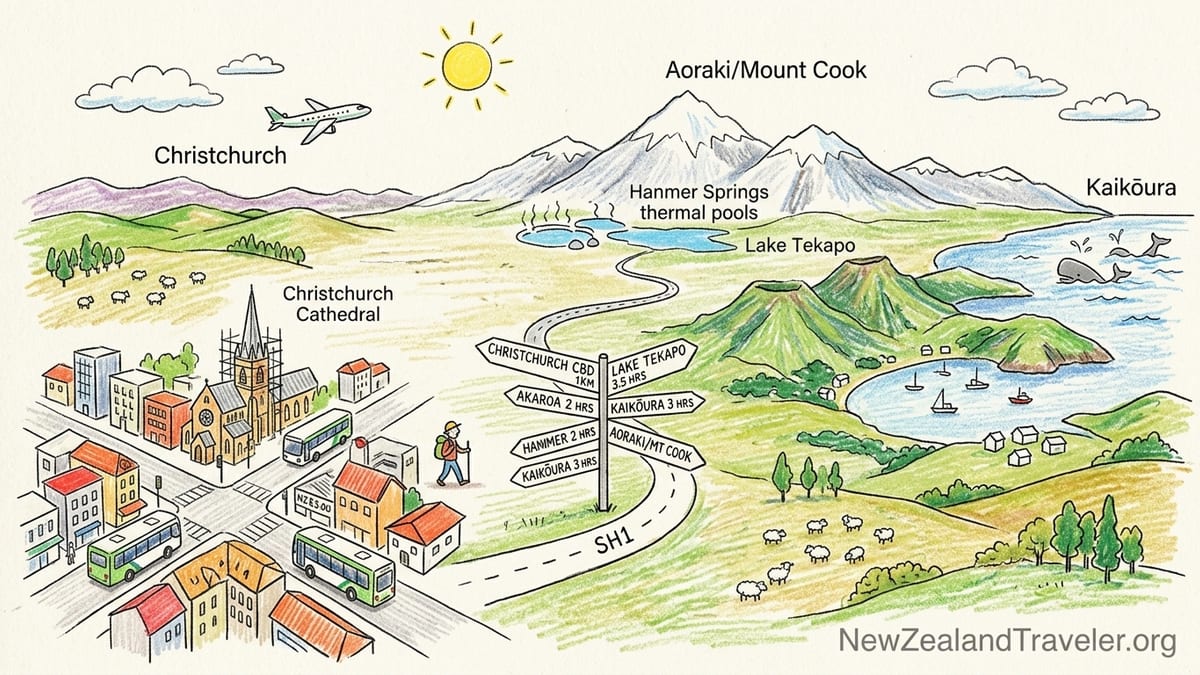
Arriving in Christchurch: The Compact Core That Made Me Overconfident
I flew into Christchurch Airport and went straight into “city mode” which is exactly how I got fooled by Canterbury’s scale. The airport to central city transfer was straightforward on Metro buses, and it felt like the kind of place where everything would stay easy once I got oriented. Metro’s current standard fare for a bus ride is NZ$3.00 using a Metrocard or contactless payment, with a standard cash fare listed at NZ$4.00. That first ride into town set the tone: clean, practical, and deceptively calm.
I based myself in a central pocket that let me walk most evenings without thinking about transport. I stayed around the CBD edge and moved through nearby neighbourhoods that each felt like their own micro trip: the Riverside Market area for quick meals, the inner-city grid for morning coffee, and the leafy streets you reach when you walk a little farther than you planned. Christchurch is compact enough that you can string together a day on foot and still feel like you “covered it.” That’s the trap.
The real surprise was how quickly the city disappears once you commit to the region. In Christchurch, a 20 minute bus ride feels like a normal errand. In Canterbury, a 2 hour drive can be just the beginning of the day. On my first evening I caught myself sketching an itinerary that stacked Akaroa, Kaikōura, Hanmer Springs, Lake Tekapo, and Aoraki/Mount Cook like they were neighbourhoods. They are not. They are full travel days with weather, road conditions, and fatigue.
If you take anything from my planning misstep, let it be this: Christchurch is the easiest part of the logistics. You can land, settle, and feel capable quickly. But once you leave the city grid, Canterbury starts asking you to plan like you are going somewhere remote, even when the destination is popular.
From City Streets to a Volcanic Peninsula: Akaroa and Banks Peninsula Reality Check
I left Christchurch and pointed the trip toward Banks Peninsula because I wanted the feeling of a coastal reset without committing to a huge transfer. The drive over to Akaroa is where my “Canterbury is easy” confidence started to wobble. The roads narrow as you get deeper into the peninsula, and the day becomes more about corners, changing light, and wind exposure than about kilometres. It was the first time I felt like I had truly left the city, even though I hadn’t gone all that far in pure distance.
I also tested the simplest, most concrete alternative to driving: Akaroa French Connection’s premium scenic coach service. Their current published schedule shows a departure from Christchurch at 9:00am with an arrival in Akaroa at 11:00am, then departing Akaroa at 4:00pm and returning to Christchurch around 5:45pm. The published adult return fare is NZ$80 on their premium service. They also note that, since 22 June 2026, the Main Wharf in Akaroa has been under reconstruction and their collection point is at the Old Post Office at 80 Rue Lavaud until further notice. Those details mattered on the ground because “meet at the wharf” is exactly the kind of instruction you might assume still applies.
That coach timing is both generous and limiting. It gives you a clean day structure, but it also compresses what you can do once you arrive. I underestimated how much I wanted to slow down in Akaroa and just stay put, especially in shoulder season conditions when the wind can make the harbour feel sharper than the sunshine suggests. If I had known how much I’d enjoy the peninsula’s switchback scenery and the sense of being in a sheltered harbour town, I would have built in an overnight instead of treating it like a postcard stop.
My personal lesson from Banks Peninsula was that it changes the rhythm of a Canterbury trip immediately. Even before you touch alpine terrain, you are already dealing with winding roads, small-town timing, and the reality that the “fast way” is not always the nicest way. Akaroa was my first hint that the region rewards fewer bases and longer stays more than it rewards rapid-fire day trips.
North to Kaikōura: Where the Coast and the Wind Rewrite Your Plans
Kaikōura was the point where I stopped pretending I could schedule Canterbury like a city break. The drive north from Christchurch puts you on the spine of State Highway 1, and in 2026 that corridor has been particularly sensitive to weather and repair work. NZTA has documented significant disruption south of Kaikōura, including a severe flooding event and road damage that led to closures earlier in July 2026. NZTA’s updates around that event made one thing clear: you can have a plan, but you need to verify it close to departure, not a week before.
Even after reopening, the Kaikōura section can come with stop-go traffic management, temporary speed restrictions, and delays depending on what’s being repaired and what weather is doing. I felt the difference immediately: a drive that looks straightforward on a map becomes mentally tiring when you are moving in and out of work zones. The coast here is dramatic and exposed, and the same geography that makes it beautiful is the reason it can be fragile.
I also looked hard at rail as an alternative because Kaikōura is one of those rare places where a scenic train is not a novelty but a genuinely practical connector. Great Journeys New Zealand publishes the Coastal Pacific timetable on their official site and describes the service as running northbound in the morning and returning southbound in the afternoon. A third-party rail timetable aggregator also lists Coastal Pacific services with Christchurch departures at 7:00am and an arrival into Kaikōura around 9:50am, with a southbound Kaikōura departure around 4:15pm if you are coming down from Picton. Whether you use the official timetable page or confirm by phone, the key point is that this route exists and is time-specific. It can be a brilliant way to reduce driving stress on a day when you still want coastal scenery, but you have to structure your day around the schedule.
Kaikōura itself forced me to respect wind. Whale watching here is world-famous, but it is not guaranteed, and I treated that too casually at first. I didn’t lock my whole stay to a single morning because cancellations can and do happen in windy conditions. Once I was there, I understood why locals and repeat visitors build flexibility into their bookings. Even when the town looks calm from the street, the marine environment can say no.
Hanmer Springs: Thermal Pools, Alpine Air, and a Night I Should Have Added
Hanmer Springs was the most satisfying “change of scene” I had in Canterbury because it felt like a true pivot away from the coast and into a mountain village atmosphere. You can drive it, of course, but I also researched the simplest dedicated shuttle option: Hanmer Connection advertises a daily service linking Christchurch and Hanmer Springs, with pickups and the Hanmer stop located outside the thermal pools at the bus stop on the corner of Amuri Avenue and Jack Pass Road. For travellers who do not want a rental car for every day of a Christchurch base, that kind of fixed shuttle becomes very real planning infrastructure.
Once in Hanmer, the Thermal Pools and Spa are the centre of gravity, and I appreciated having current entry pricing to plan around rather than shrugging and hoping it would be reasonable. Hanmer Springs Thermal Pools and Spa currently lists an Online Saver Pass adult single entry at NZ$40 when booked online for a specific date, with a Flexi Pass adult single entry at NZ$43. That difference sounds small, but it is exactly the kind of detail that makes a last-minute “let’s go tomorrow” decision either feel smart or feel mildly irritating. Their pricing also notes child pricing and mini-group bundles, which matters if you are travelling as a family or a pair who want to split costs intelligently.
The temperature contrast was the point for me. Christchurch can be bright and breezy, and then you arrive in Hanmer where the air feels cleaner and cooler, but you are sinking into mineral water that sits in the low to low-mid 30s Celsius up to hotter pools around the low 40s Celsius depending on the pool. I found myself staying longer than planned because it is one of the few experiences that genuinely resets your body after long drives.
Here is the honest mistake I made: I treated Hanmer Springs as a one-night add-on. If I could redo my itinerary, this is the destination that needed another night. The pools are only part of it. The village pace, the way evenings cool quickly, and the simple pleasure of not driving for a full day made me want to stay put. In an overpacked itinerary, I would remove one of the long out-and-back transfers and trade it for a second night in Hanmer. It is where I felt the most benefit from slowing down.
Across the Plains Into the Mackenzie: Lake Tekapo as the First True Alpine Shift
Leaving Christchurch for the Mackenzie Basin felt like watching the colour palette drain and then intensify again. The drive starts with the Canterbury Plains, open and agricultural, and then the landscape stretches, dries, and opens into something that feels closer to a high-country film set than a casual day trip. This was the first point where I truly felt the region’s scale in my bones: long straight sections, big sky, and the sensation that you are driving into a different climate zone.
Lake Tekapo was my transition base because it is both iconic and practical. You can arrive, get oriented, and immediately see why this basin is treated as its own destination rather than a stop between cities. Even without chasing any specific “stats,” you feel the air change. The wind seems to have more room to build. The sun feels sharper when it breaks through. Then, once it drops, the temperature falls fast enough that you notice it while you are still outside locking the car.
What surprised me most was how the day’s planning had to become more conservative. In Christchurch, I could comfortably schedule dinner at a specific time and assume I would arrive. In the Mackenzie, I started thinking in buffers: what if the wind picks up, what if the road forecast changes, what if I stop for viewpoints longer than expected. This is where you stop treating a transfer as “dead time” and start treating it as part of the experience that consumes energy.
If you are building a Christchurch and Canterbury itinerary, Tekapo is also where I recommend you stop trying to do everything “on the way.” Choose a base, commit to it, and let the basin be the trip for a minute. I underestimated how restorative it would feel to stay still in such a wide landscape after stacking city walking, peninsula bends, and coastal weather.
Aoraki/Mount Cook: The Weather Edge, DOC Alerts, and the Track That Taught Me Patience
Aoraki/Mount Cook was the emotional high point of my Canterbury loop, and also the place where I had to pay the most attention to official alerts. DOC has been actively communicating about visitor safety and track management in Aoraki/Mount Cook National Park, including updates connected to work on the Hooker Valley Track and its infrastructure. I treated those communications like required reading, because this landscape is not forgiving if you arrive assuming yesterday’s conditions still apply today.
Right before my visit, I checked for track and weather warnings and found a specific operational detail that changed how I approached the Hooker Valley Track: a published alert stating that a maximum of 20 people at a time would be allowed to cross the first suspension bridge in the summer season, enforced with pause gates and staff presence. That is a small logistical note with big practical consequences. It means you should expect a bottleneck, start earlier than you think you need to, and bring a mindset that you might wait even if the weather looks perfect.
I also watched the road and mountain weather warnings closely, because alpine driving in shoulder season can go from “clear” to “problematic” quickly. A live alert feed I checked included Road Snowfall Warnings for key routes, including Lindis Pass on SH8 and Porters Pass on SH73 with predicted accumulations around the summits during specific time windows. Even if you are not crossing those passes on your exact route, they are a reminder that the system can change while you are on the road, and that you should be prepared to adjust timing.
This is where I made my second major itinerary correction: I tried to treat Aoraki/Mount Cook as a quick, photogenic pop-in. I should have given it more space. If I had to cut something from an overpacked Canterbury circuit, I would cut one destination that requires a full repositioning drive, not this one. Mount Cook is not a “stop.” It is an environment. The difference between arriving late afternoon and arriving with a full day of clear weather is the difference between ticking a box and feeling like you were actually there.
The Takeaway: Canterbury Isn’t Hard, It’s Just Bigger Than You Think
My strongest memory of Canterbury is not a single viewpoint or meal. It is the speed of the transitions. In one trip I went from Christchurch’s compact urban core, where a NZ$3 bus fare and a short walk can solve your day, to Banks Peninsula’s volcanic bends, then up to Kaikōura where wind can cancel marine tours, then into Hanmer Springs where a thermal soak can steal half your afternoon, and finally into Tekapo and Aoraki where weather warnings start to matter more than your schedule.
The region rewarded me every time I slowed down, and it punished me every time I tried to stack too much into a single day. The destination that deserved another night was Hanmer Springs, because it is not just the pools, it is the way it breaks up the driving fatigue and gives you a real rest day. The place I would remove from an overpacked itinerary is whichever extra out-and-back you are tempted to add after Kaikōura. The coast is spectacular, but it is also where road conditions and stop-go delays can steal your margin.
If you are planning your own Christchurch and Canterbury loop, build it like this: choose fewer bases, give each base room for weather variability, and treat transfers as part of your energy budget. Check NZTA journey updates close to departure, watch DOC alerts for Aoraki/Mount Cook, and give yourself at least one “no driving” afternoon somewhere between the coast and the mountains. Canterbury will still surprise you. The difference is that you will have enough time to enjoy being surprised.
FAQ
Q1. How much does it cost to ride Christchurch Metro buses right now?
Using a Metrocard or contactless payment, the standard fare is NZ$3.00 per ride, with a standard cash fare listed at NZ$4.00.
Q2. What is the simplest bus option from Christchurch to Akaroa without driving?
Akaroa French Connection runs a daily scenic service with a published 9:00am departure from Christchurch and 11:00am arrival in Akaroa, returning at 4:00pm and reaching Christchurch around 5:45pm.
Q3. How much is the Akaroa French Connection fare?
Their premium scenic service lists an adult return fare of NZ$80.
Q4. Where do you get picked up in Akaroa right now if the wharf is under construction?
Akaroa French Connection states the collection point is the Old Post Office at 80 Rue Lavaud until further notice due to Main Wharf reconstruction.
Q5. Is the Coastal Pacific scenic train operating and where can I confirm times?
Great Journeys New Zealand publishes the Coastal Pacific timetable on its official site and also provides an automated phone service for latest arrival and departure times.
Q6. What is the most important road-planning lesson for Kaikōura?
Check NZTA travel bulletins close to departure, because SH1 south of Kaikōura has had significant flood-related closures and ongoing repair periods in 2026.
Q7. What does Hanmer Springs Thermal Pools entry cost?
Hanmer Springs Thermal Pools and Spa lists an Online Saver Pass adult single entry at NZ$40 (booked online for a specific date) and a Flexi Pass adult single entry at NZ$43.
Q8. What transport detail matters most if I’m taking a shuttle to Hanmer Springs?
Hanmer Connection advertises a daily service and notes the Hanmer Springs stop is outside the Thermal Pools at the bus stop at Amuri Avenue and Jack Pass Road.
Q9. Are there current restrictions on the Hooker Valley Track suspension bridge?
An alert feed based on DOC information states a maximum of 20 people at a time will be allowed to cross the first suspension bridge, with pause gates and enforcement staff in place.
Q10. What is the single biggest itinerary mistake to avoid in Canterbury?
Trying to stack too many far-apart destinations into consecutive days without buffer time for wind, roadworks, and alpine weather shifts.