


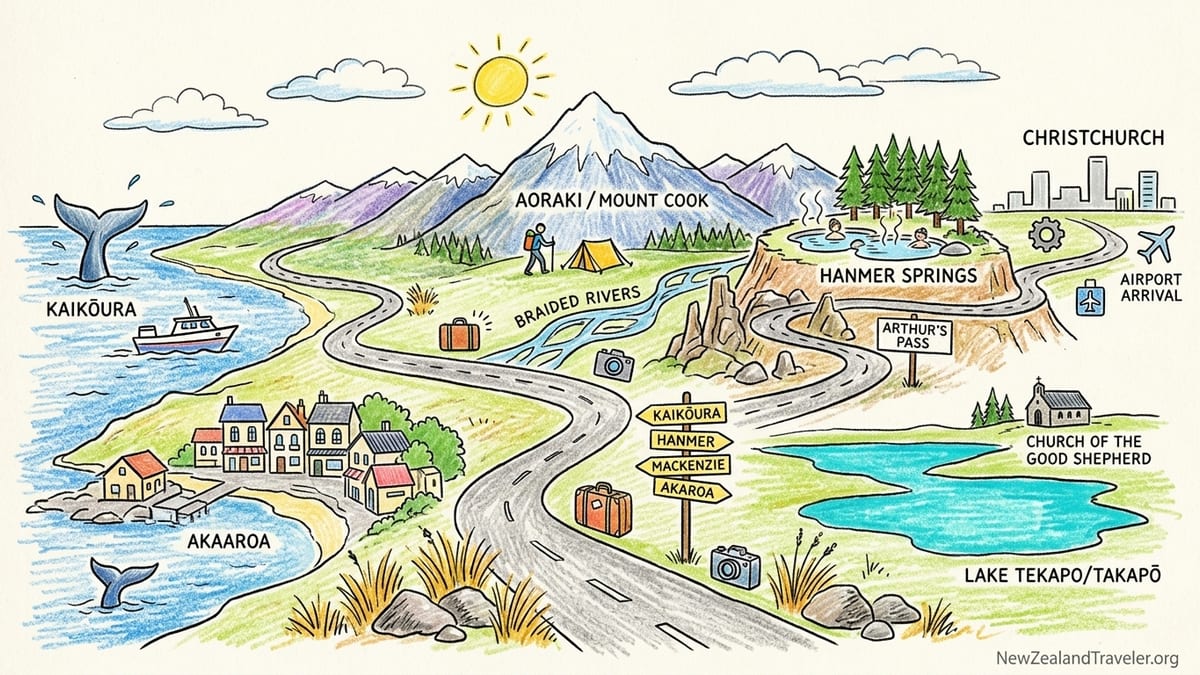
I went to Canterbury thinking I would “do” Christchurch in a day, tick Akaroa for dolphins, then rush south to the lakes. Instead, Canterbury quietly took over my South Island route. Not because it has one single headline attraction, but because the region is split into distinct travel personalities: a city you actually want to linger in, a wildlife coast that runs on ocean mood swings, hot springs that reset your body, and an alpine highway where the weather changes the story every hour. Canterbury tourism material tends to divide the region into areas like Kaikōura, Hurunui and Hanmer Springs, Mid Canterbury, South Canterbury, and Mackenzie, and that framework matters on the ground. It forces the right question: which version of Canterbury are you here for, and how much time can you give it without turning your holiday into a relay race?
How I’d Choose Canterbury Now (And Why You Can’t “See It All”)
On paper, the distances look manageable. Christchurch to Kaikōura is often quoted as an easy drive, Christchurch to Tekapo looks like a straight shot, and Arthur’s Pass sits temptingly in between as a dramatic “scenic detour.” In real travel time, Canterbury’s variety is what slows you down: coastal weather can cancel boats, alpine roads ask you to stop every few minutes for viewpoints, and the best moments tend to happen at the edges of the day, not at noon.
The way the region is commonly presented in distinct areas is actually helpful for trip design. Kaikōura is its own marine wildlife world; Hurunui and Hanmer Springs is about hot pools, forests, and family-friendly downtime; the Mackenzie basin is built for big-sky photography and lake-and-mountain itineraries; Mid and South Canterbury are the connective tissue of plains, braided rivers, and small towns that become meaningful if you’re road-tripping rather than flying city-to-city.
If I were allocating time today, I’d plan Canterbury as a set of “bases” rather than a checklist. Christchurch is a base for the city and Banks Peninsula day trips. Kaikōura is a base for whale watching and coastal walking, but you need schedule slack for wind. Hanmer Springs is a base for recovery and families. Tekapo and Aoraki/Mount Cook are a base pair for the Mackenzie, where sunrise and stargazing do the heavy lifting. Arthur’s Pass is the pivot: it can be a day trip, a one-night stop, or a full hiking reset, but only if you respect the mountain weather.
Christchurch: The Unexpected Anchor (Arrival, Rhythm, And When It Clicked)
I arrived in Christchurch expecting a transit city and found something more useful: a place to recalibrate after a long flight and to build a smarter loop through the rest of the region. The practical advantage is obvious: the airport is the South Island gateway, the rental car pick-up is straightforward, and the city gives you supermarkets, gear shops, and restaurant choice before you start paying small-town prices.
Logistically, I’d stay in or near the central city if you’re doing a “Christchurch first” itinerary, because it keeps your mornings efficient. One of my best Christchurch decisions was to treat the first evening like a soft landing: check in, walk a compact loop, then commit to an early night. The next day felt like I’d stolen time back from jet lag.
Food-wise, Christchurch is where I stop pretending I can do road trip dinners every night. I plan one proper sit-down meal here because it’s easy to find something that suits different travelers: couples can go date-night, families can keep it casual, solo travelers can grab something quick without it feeling like a compromise. The city is also where I stock the car with the mundane items that make alpine days better: a cheap insulated bottle, a rain jacket if I forgot one, and an emergency stash of snacks that won’t melt.
The moment Christchurch became memorable was not a single attraction, but the realization that it made the rest of Canterbury easier. The city gave me a weather window plan: if the coast looked windy, I’d push inland; if the mountains looked socked in, I’d go for Banks Peninsula or city time. That flexibility is the difference between a route that feels “tight” and a route that feels like you’re choosing your day, not reacting to it.
Akaroa and Banks Peninsula: A Day Trip That Became a Route-Changer
Akaroa is close enough to Christchurch to be “just a day trip,” but it didn’t behave like one. The drive out onto Banks Peninsula is the kind of road where you keep losing time in the best way: pullouts, little bays, sudden views over water, and that feeling that you’ve stepped into a slower, saltier Canterbury. If I were planning today, I’d still day-trip it from Christchurch, but I’d start early and give myself permission to stay late if the light turns golden.
For wildlife logistics, Akaroa is where I’d send travelers who want a marine experience without committing to the full Kaikōura schedule gamble. Operators here focus on Akaroa Harbour experiences, and the town’s scale makes it easy to arrive, park, and walk down to meet a boat without the “industrial tourism” vibe that can happen in bigger hubs. If you don’t want to drive, it’s also the kind of place where a packaged day trip with transport can make sense because the road demands attention and the viewpoints tempt you into long stops.
Food in Akaroa feels like a reward for making the effort. I remember the relief of eating something warm near the waterfront after being out on the water, when the breeze finds every gap in your jacket. That is the Banks Peninsula pattern: the sun can look friendly, then the wind turns the temperature into a different story. Pack layers even if Christchurch felt mild.
The exact moment Akaroa changed my route was when I realized I didn’t want to leave immediately after the “main activity.” I wanted a slow walk through town, extra time to watch the harbor, and the option to linger for dinner before driving back. That’s my Akaroa rule now: don’t schedule it on a day when you also plan to drive long-distance afterward. For couples, it’s romantic without trying too hard. For families, it’s manageable because the town is compact. For photographers, it rewards patience, especially when cloud breaks create shifting light over the hills.
Kaikōura: Wildlife Dreams, Weather Reality, And Why I’d Build in Slack
Kaikōura looks like a simple “drive up, see whales, drive away” stop until you spend a night. Staying changes the feel completely. You stop measuring it as an activity and start experiencing it as a coastline with its own tempo. Official travel guidance often describes it as easily accessible from Christchurch by road, and that’s true, but the bigger truth is that Kaikōura demands flexibility because the ocean is in charge.
If whale watching is your priority, treat it like a first-morning mission. The pricing is significant enough that I plan around it, and I also plan emotionally for the possibility of cancellation. Even travelers on the ground regularly report weather disruptions, and the town’s wind can whip up fast. When it works, it’s one of the strongest wildlife experiences in the region. When it doesn’t, Kaikōura is still worth it if you’ve built in alternatives like coastal walks, viewpoints, and food.
Food is part of the Kaikōura story. I remember the satisfaction of something simple and salty after the sea air, and the way the whole town seems to understand that people arrive hungry and slightly sunburned or slightly chilled, sometimes both. It’s also a good place to lean into a “two-night” mindset so you’re not forcing a perfect ocean day into a single time slot.
The moment that stayed with me in Kaikōura was the contrast: dark sea, bright sky breaks, mountains looming behind town, and the feeling that you’re at the meeting point of ecosystems. For today’s time allocation, I’d give Kaikōura two nights if whales or marine wildlife are a top goal, one night if you’re simply curious, and I’d skip it only if your route is already overloaded and you can’t handle the schedule uncertainty. Best for wildlife lovers, road trippers, and photographers who can work with changing conditions. Less ideal for travelers who hate the idea of “maybe” plans.
Hurunui and Hanmer Springs: The Reset Button (For Bodies, Families, And Couples)
Hanmer Springs is what I now plan as the deliberate pause in a Canterbury loop. It’s close enough to be reachable without drama, and different enough from both the coast and the alpine highway that it feels like a new chapter. The arrival is part of it: you come off the road and the village feels designed for recovery, with a walkable center and a clear purpose.
The thermal pools are the obvious draw. Current published pricing lists adult entry at NZ$40, which makes it one of the more straightforward splurges to budget for, especially if you’ve been doing long drives and big walks. The complex is built for mixed travel styles: families with kids who want slides and play areas, couples who want to slow down, and road trippers who need their legs to forgive them.
Weather matters here too, but in a friendlier way. If it’s crisp or cold, Hanmer feels like you timed it perfectly. If it’s warm, it becomes more of a pool day than a soak day, and you may want to add a forest walk or a short hike so you don’t feel like you came all this way just to sit in water.
The moment I remember most clearly was stepping from cool air into the warmth and realizing how much tension I’d been carrying from driving and hiking. That is why I’d allocate at least one night, preferably two, if relaxation is a priority. Hanmer is best for families, couples, and anyone who wants a recovery stop between Kaikōura and the Mackenzie. It’s also a smart option when mountain weather looks unstable and you need a Plan B that still feels like a holiday.
Arthur’s Pass: The Alpine Pivot Where The Weather Writes the Itinerary
Arthur’s Pass is the stop that can make your route feel like a story rather than a line on a map. The drive across State Highway 73 has a gradual build from plains into drama, and the landscape shift is so pronounced that it feels like you’ve crossed into a different island. If you’re road-tripping, it’s the kind of day that makes you grateful you didn’t just fly over it.
For hiking logistics, this is one of the rare places where I rely heavily on Department of Conservation track descriptions because the timing is precise and the terrain is real. The Devils Punchbowl Walking Track is signposted off the highway near Arthur’s Pass Village and climbs steeply through mountain beech forest to a viewing platform near the base of the falls. That steepness matters for families with small kids and for anyone who is tired from driving. The Arthur’s Pass Walking Track also has a very different feel, with a short option from the Punchbowl car park to a lookout and picnic table that gives you village-and-peak context without committing to a big climb.
Accommodation here is not about luxury, it’s about location. I treat Arthur’s Pass either as a day trip from Christchurch if I’m short on time, or as a one-night stop if I want a dawn or dusk window in the mountains. The crowds are usually more manageable than the Mackenzie “hero” spots, but the weather can be harsher and faster-changing, so arriving with layers and rain protection is non-negotiable.
The exact moment that made Arthur’s Pass unforgettable was the first time the cloud lifted enough to reveal the shape of the valley, with the sound of water and wind doing most of the talking. It’s not a place that performs on demand. If the mountains are socked in, it can be disappointing. If you catch a clear break, it feels like the whole route was built for this. Best for hikers, photographers, and anyone who loves mountain roads. Less ideal for travelers who want guaranteed views or who get anxious in rapidly changing weather.
Mackenzie Magic: Lake Tekapo/Takapō and Aoraki/Mount Cook (Where Time Expands)
Lake Tekapo/Takapō is often treated as a quick photo stop, and that’s exactly how you end up missing it. Arriving feels like stepping into a different palette: big sky, lake color that looks edited, and a horizon that makes you breathe deeper. I now plan Tekapo as an overnight base, even if I’m continuing to Aoraki/Mount Cook, because the best Tekapo moments are late-day and night, not mid-afternoon between drives.
For relaxation logistics, Tekapo Springs is a practical anchor. A current summer 2026 brochure lists an adult all-day pass at NZ$65, with family pricing also published, which makes it easy to budget if you’re traveling with kids. This is also where I make expectations clear: Tekapo Springs is a modern hot pool complex experience, not a remote wilderness soak, and that can be either perfect or not what you’re chasing, depending on your travel style.
Aoraki/Mount Cook is where your route becomes about light. If Tekapo is the warm-up, Aoraki is the main event. The Hooker Valley Track remains one of the defining day walks, and recent updates matter here. Department of Conservation information notes that a new second swing bridge over the Hooker River opened in July 2026, a detail that changes both flow and confidence for visitors who were tracking earlier closure and construction updates. Even with infrastructure improvements, this is a place where you start early for crowds and weather, and you plan extra time for simply standing still.
The exact moment that made this part of Canterbury permanently route-worthy was not the final viewpoint, but the accumulation: the crunch of gravel, the wind funneling through the valley, the way the mountain seems to move in and out of cloud. Today, I would allocate two nights across Tekapo and Mount Cook Village if possible, three if you want hikes plus photography plus a slow pace. Best for hiking, couples, and photographers. Families can do it well if you prioritize shorter walks and plan for cold, wind, and sudden weather shifts. Road trippers will love it, but only if they resist the temptation to “drive through” without stopping for the light.
The Takeaway
If you only remember one thing about Christchurch and Canterbury, let it be this: the region rewards choosing. Kaikōura is not interchangeable with Akaroa. Hanmer Springs is not a filler stop, it’s a strategy. Arthur’s Pass is not a checkbox, it’s a weather conversation. Tekapo and Aoraki/Mount Cook are not just viewpoints, they are time-based experiences built around sunrise, sunset, and whatever the sky decides to do in between.
The stops that changed my South Island route were the ones that forced me to slow down. Christchurch gave me flexibility and a smart launch point. Akaroa turned “a day trip” into a mood. Kaikōura reminded me that wildlife travel comes with uncertainty. Hanmer Springs fixed my tired legs. Arthur’s Pass made the drive feel like the destination. Tekapo and Aoraki/Mount Cook delivered the kind of landscape that makes you stop talking mid-sentence because you ran out of words.
If you’re building your own Canterbury plan, design it like you’d design a good meal: choose a main flavor, add one or two contrasting sides, and leave room to savor. Canterbury is not a region to conquer. It’s one to commit to.
FAQ
Q1. How many days do you actually need for Christchurch and Canterbury?
For a first trip, I’d plan 7 to 10 days if you want Christchurch, Akaroa, Kaikōura, Hanmer Springs, Arthur’s Pass, Tekapo, and Aoraki/Mount Cook without rushing.
Q2. Is Akaroa better as a day trip from Christchurch or an overnight?
It works well as a day trip if you start early and don’t stack another long drive afterward. Overnight is better if you want sunset light and a slower harbor pace.
Q3. How risky is it to plan whale watching in Kaikōura?
It’s weather-dependent. Build in schedule slack, ideally two nights, so a cancellation doesn’t wipe out your only chance.
Q4. What’s the best Canterbury stop for families with kids?
Hanmer Springs is the easiest family win because the thermal pools complex is designed for mixed ages, and the village is compact and low-stress.
Q5. What’s the best stop for couples who want a romantic pace?
Akaroa for a harbor-focused day and dinner, and Tekapo for lake views and an unhurried evening. Add Aoraki/Mount Cook if you both love mountains.
Q6. Do you need to stay in Mount Cook Village, or can you day trip from Tekapo?
You can day trip, but staying near Aoraki/Mount Cook gives you the best light and a calmer start for the Hooker Valley Track before crowds build.
Q7. Is Arthur’s Pass worth it if you’re not a serious hiker?
Yes, if you enjoy mountain scenery and short walks. Choose shorter Department of Conservation tracks and focus on viewpoints when weather is changeable.
Q8. What’s a realistic budget signal for key paid experiences?
As of current published pricing, expect major activities to be real line items: Hanmer Springs Thermal Pools adult entry is listed at NZ$40, and Tekapo Springs adult all-day passes are listed at NZ$65 in a summer 2026 brochure.
Q9. When should you prioritize Tekapo over Kaikōura, or vice versa?
Choose Tekapo and Aoraki/Mount Cook for hiking and photography in alpine light. Choose Kaikōura for marine wildlife, knowing weather can reshape plans.
Q10. What’s the single best planning move for Canterbury?
Pick two bases and build outward. For example: Christchurch plus Tekapo, or Christchurch plus Kaikōura. You’ll see more by moving less.