


Tackling the Tongariro Alpine Crossing as a day trip from Taupō is entirely possible, but it is not as simple as driving to the trailhead and setting off. Parking restrictions, one-way logistics and strict weather safety rules mean you need to think about transport before you even lace your boots. This practical guide explains exactly how shuttles from Taupō work, what hotel pickup really includes, why park and ride is now the norm, and how weather warnings can cancel your hike at short notice.
Why Transport Planning Matters for the Tongariro Alpine Crossing
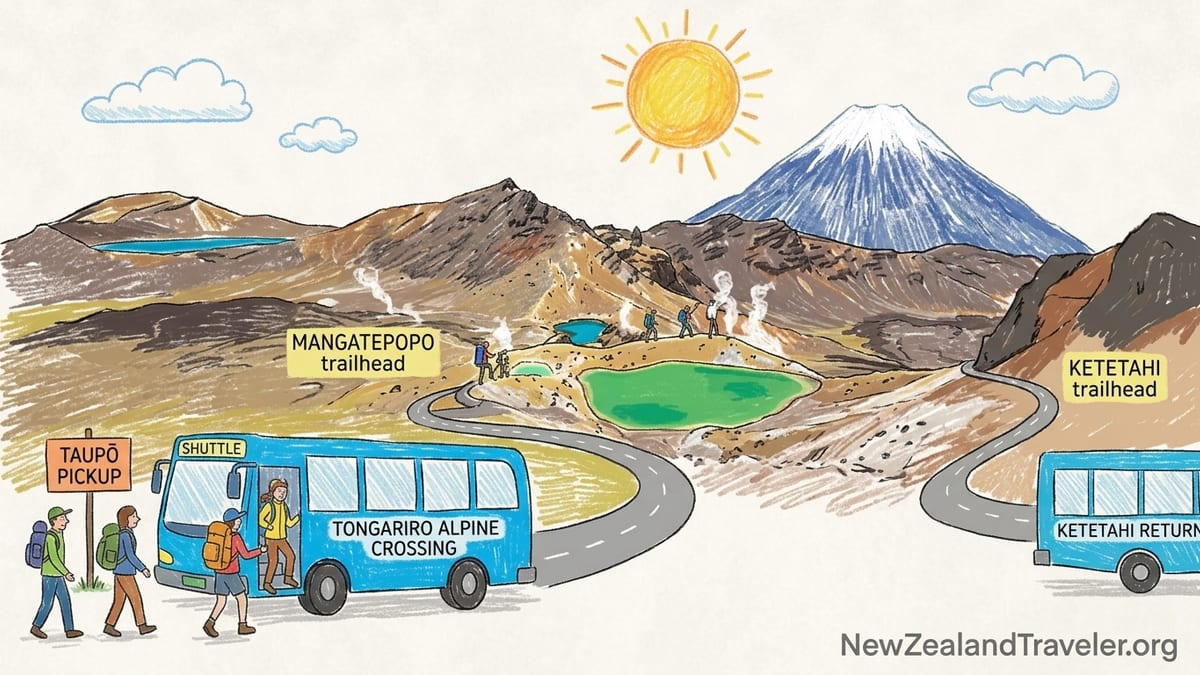
The Tongariro Alpine Crossing is a one-way, 19 to 20 kilometre track across an active volcanic landscape between Mangatepopo and Ketetahi in Tongariro National Park. The road distance between the two trailheads is roughly 20 kilometres, so if you simply drive to one end, your car will not be where you finish. That basic point-to-point layout is the root of most transport confusion for first-time visitors.
Adding to this, the Department of Conservation (DOC) now strongly recommends using shuttle transport rather than private cars for the full Crossing, particularly in the busy summer season. In practical terms, DOC guidance and local transport information highlight that there is no summer visitor parking at Mangatepopo for people doing the full Crossing, and that both Mangatepopo and Ketetahi have time limits or restrictions that make a full day traverse unrealistic if you park at either end. The experience of many recent hikers is that booking a shuttle is no longer optional convenience, but the standard way to access the track.
Taupō itself is about 86.5 kilometres by road from the track, so even a straightforward return drive adds nearly two hours of travel on top of a seven to eight hour hike. That distance is exactly why Taupō-based shuttle operators have built specific day-trip packages that bundle early-morning pickup, drop-off at Mangatepopo, and a flexible pickup from Ketetahi in the afternoon. Used well, these services solve both the parking restrictions inside the park and the one-way nature of the hike.
The final layer is safety. The Crossing traverses exposed alpine terrain where conditions can change quickly. DOC issues hazardous weather warnings when forecasts show high winds, poor visibility, heavy rain, snow or icy conditions that make the route unsafe for most day walkers. In early 2026, DOC even suspended a Tongariro transport operator’s concession for two weeks after it carried more than 100 people to the track despite a hazardous weather warning. That enforcement action underlines how seriously authorities now treat transport decisions when the weather turns bad.
Taupō Hotel Pickup and Return Shuttles Explained
Several concessioned operators run dedicated Tongariro Alpine Crossing shuttles from Taupō, with products typically branded as Taupō return shuttles or Taupō day trips. As of the 2025–2026 season, a typical advertised price for a Taupō return shuttle is around NZ$130 per adult. That usually covers pickup from central Taupō or selected accommodation, transport to the Mangatepopo trailhead in the morning, and collection from the Ketetahi end in the afternoon once you have completed the Crossing.
In practice, “hotel pickup” from Taupō often means two slightly different things. Some companies circulate around a set list of motels and hotels in central Taupō, collecting passengers curbside between about 5 and 6 a.m. before heading south to the national park. Others ask you to meet at a central Taupō pickup point such as the main visitor centre, where they gather all hikers before boarding one of several buses. When you book, you will be given a specific pickup time and location, and it is important to clarify whether the shuttle will stop directly at your accommodation or whether you need to walk a few minutes to a central point.
Return shuttles from Ketetahi are generally run on a “rolling pickup” schedule through the afternoon. Instead of one fixed bus at a precise time, operators may list a window, for example between 2 p.m. and 4:30 p.m., with buses arriving regularly as hikers finish. If you are reasonably on time, you simply walk off the track, check in with the driver or the small kiosk at the Ketetahi park and ride area, and board the next available bus back to Taupō. If you are delayed, reputable operators keep a manifest and will look for you before leaving, but it is still vital to carry enough gear and daylight margin to finish safely.
For Taupō visitors, an advantage of these return shuttles is that you do not need to drive mountain roads in the dark before dawn or when tired after the hike. Instead, you can walk out of your hotel, get on a bus, focus on the trail, and be brought back to the same area in the evening. Many travellers who do not enjoy alpine driving or are adjusting to New Zealand’s left-hand traffic find this peace of mind worth the extra cost compared with closer park-and-ride options.
Park and Ride: How Local Shuttle Hubs Actually Work
While Taupō is a popular base, many hikers prefer to drive part of the way and then use a park and ride system closer to the national park. The concept is straightforward. You drive your own vehicle to a designated car park near the Ketetahi road end or another local hub in villages such as National Park or Turangi, leave your car there all day, and catch a shuttle that drops you at the Mangatepopo start. You then hike the standard Mangatepopo-to-Ketetahi direction and finish back near your parked car.
For example, one major operator runs seasonal park and ride facilities near Ketetahi that switch location between winter and summer. From roughly November to April, their primary Tongariro Crossing park and ride operates at a spacious car park near the Ketetahi end, set up specifically to avoid congestion inside the national park car parks. At other times of year, the pickup may shift to a Ketetahi park and ride site that still allows all-day parking and secure access to the trail. Similar systems run from private properties or commercial lots in villages on the northern and western sides of the park.
These park and ride shuttles from within the region are often cheaper than Taupō return services. Recent pricing examples show one-way park and ride shuttle plus secure all-day parking packages at Ketetahi costing in the tens of dollars per person rather than over a hundred. For couples or small groups with a rental car, driving from Taupō to one of these hubs and then using a local shuttle can be more economical than paying return transport from Taupō itself, while still respecting DOC’s parking rules at Mangatepopo and Ketetahi.
Most operators require advance booking, especially between late October and April when the track is busiest and when summer parking restrictions are in force. Typically you will be asked to choose a shuttle departure time to Mangatepopo, often between about 6 and 9 a.m., and then use flexible return pickups from Ketetahi. Because the hike takes most fit parties 7 to 8 hours, it is usually safest to select one of the earlier morning departures so that unexpected delays, weather changes or long photo stops do not force you into the last returning bus of the day.
Parking Rules at Mangatepopo and Ketetahi: Why You Cannot Just Drive
Many visitors assume they can park at the start, hike the Crossing, and then worry about getting back to their vehicle later. The current rules make that approach unrealistic for anyone intending to complete the full traverse. DOC information for the 2025–2026 season states that during the main summer season there is no parking for Tongariro Alpine Crossing users at Mangatepopo car park, and that historic four-hour limits have been enforced at both Mangatepopo and Ketetahi to reserve space for shorter walks rather than full-day traverses.
In practice, that means you cannot legally leave a vehicle all day at Mangatepopo while you do the Crossing. Even at Ketetahi, time limits and congestion mean all-day public parking is restricted, and in busy periods vehicles left in breach of the rules risk being ticketed. Local visitors sometimes try to park along the roadside outside the official car parks, but this can create safety and access issues and is strongly discouraged. For many international visitors, fines, tow risk and uncertainty make this a poor trade-off compared with simply booking approved shuttle transport.
Some hikers get around the rules by using their car only for a shorter out-and-back walk. For example, a few recent visitors have parked at Mangatepopo, hiked up past Soda Springs or even to the Red Crater lookout, then turned around and returned to their car within a four hour window. This is permitted when limits are in place, because the shorter time respects the posted restrictions and keeps car parks turning over. However, it is not compatible with walking the full track through to Ketetahi, which almost always takes a full day rather than just a few hours.
From a planning perspective, the key is to separate two ideas. If your goal is the full Tongariro Alpine Crossing from Mangatepopo to Ketetahi, then you should assume you cannot rely on parking at either DOC car park for the whole day and must instead use shuttles or commercial park and ride facilities. If your goal is a shorter taster walk up one side of the route and back, then you may be able to use limited parking if you time your visit carefully and stay within the constraints. The majority of international travellers, however, come for the full Crossing, and for them, private-car-only plans seldom work under current rules.
Weather, Cancellations and DOC’s Tougher Stance on Safety
The Tongariro Alpine Crossing is exposed and high enough that weather is the single biggest variable in whether a trip goes ahead. Even in mid-summer, the route can experience gale-force winds, heavy rain, sleet or cloud that completely removes visibility around the exposed ridgelines. When conditions are forecast to be hazardous for typical day walkers, DOC issues hazardous weather warnings for the Crossing. These are not casual suggestions to think twice; they are strong signals that most independent hikers should not be on the track that day.
In February 2026, one Tongariro transport operator chose to run services despite such a hazardous weather warning. DOC later reported that more than 100 people were transported over multiple bus trips to the Crossing on that day, in apparent disregard of the forecast winds and poor conditions. In March 2026, DOC responded by suspending the operator’s concession to run in Tongariro National Park for two weeks. The public message from this enforcement action was clear. Ignoring hazardous weather warnings and taking people to the alpine environment anyway is not acceptable, and concession holders who do so face real commercial consequences.
For travellers, that tougher stance has two practical effects. First, reputable shuttle companies now typically align their operating decisions closely with DOC warnings and with their own risk assessments. If a hazardous weather warning is in place or forecast conditions cross their safety thresholds, they will cancel or shorten services, even on days when demand is high and buses are full. Second, cancellation policies have become more clearly defined. Many operators state that if they cancel due to weather, you will receive a full refund or be offered a transfer to another date. It is common practice to receive a text or email the evening before with a final go or no-go decision for early-morning departures.
Because of this, hikers should build flexibility into their wider itinerary. If you are staying in Taupō for several nights, keep at least two potential days free for the Crossing so a weather cancellation does not end your chances. On the morning of your hike, pay attention not just to whether the shuttle is running, but also to what the driver and operator staff say about expected conditions. If they warn of strong winds, cold temperatures or limited visibility near Red Crater and the lakes, take this seriously, carry proper gear, and be ready to turn back if conditions deteriorate. Your transport booking gets you safely to and from the track, but your own decisions on the day still matter.
Booking Your Shuttle and Managing the One-Way Logistics
Booking transport for the Tongariro Alpine Crossing is now almost as important as booking accommodation. On busy summer days, hundreds of walkers may be heading out, and shuttle capacity can sell out during peak holiday periods. The safest approach is to secure your preferred date and departure time at least a few days in advance, or earlier if visiting during public holidays or Christmas to late January.
When you book, you will usually choose between three broad options. First, a Taupō return shuttle that handles your transport door to door for around NZ$130 per adult, ideal if you are staying in Taupō and do not want to drive. Second, a regional park and ride option where you drive yourself from Taupō to a hub near the park, such as a Ketetahi park and ride or a hub in National Park village, then take a shuttle to Mangatepopo and hike back to your car. Third, if you are staying very close to the park, a local morning pickup and afternoon drop-off from accommodation in villages such as Whakapapa or Turangi.
A good booking workflow starts with your base. If you will sleep in Taupō, look first at Taupō return shuttles, compare departure times and weather policies, and then consider if cost savings justify driving yourself closer to the park for a park and ride service instead. If your accommodation is already in the national park area, then local shuttles and shorter drive times make more sense. Whichever you choose, check carefully what is included, including pickup points, whether hotel pickup is offered or only central locations, return pickup windows, and how late in the day buses continue to collect hikers.
On the day itself, the one-way logistics work best if you aim to be early. Starting from Mangatepopo between 6 and 7 a.m. gives you plenty of daylight, avoids the heaviest heat, and places you among the earlier arrivals back at Ketetahi. That in turn means more shuttle options and less pressure if you want to linger for photos or rest breaks. Keeping a paper or offline copy of your booking, and noting the name of your operator’s bus in case of multiple companies at the end, helps things go smoothly when many tired hikers cluster at the finish at the same time.
Why Driving to the Trailhead Does Not Solve the Transport Problem
It is tempting to believe that renting a car in Taupō and driving to Tongariro will save money and remove complexity. In reality, driving only shifts the problem; it does not solve it. The Crossing is a point-to-point walk, with start and finish more than 20 kilometres apart by road. If you drive to Mangatepopo and leave your car, you must still find a way back from Ketetahi at the end of the day. If you leave your car at Ketetahi, you must find a way to get to Mangatepopo before you begin.
Under past rules, some groups would attempt a car shuffle, leaving one car at each end of the track. With current restrictions around day parking at Mangatepopo and Ketetahi, that tactic has largely been squeezed out for the full Crossing, and it is rarely practical for visitors who only have a single rental vehicle. Attempting to hitchhike between trailheads is also unreliable and not recommended, especially now that shuttle buses are the main traffic using the access roads and that conditions on the mountain can deteriorate suddenly.
Even if you manage to park legally all day at one end, driving carries hidden costs and risks. On a busy summer day, the access roads and car parks can be congested early in the morning, and poor weather can create slippery surfaces and low visibility. After 7 to 9 hours of continuous hiking, the last thing many people want is a 90-minute drive back to Taupō over unfamiliar roads. By contrast, a return shuttle or park and ride means you can doze on the bus, warm up, and rehydrate without worrying about navigation or driver fatigue.
From a conservation perspective, relying on shuttles also reduces the number of vehicles using narrow alpine roads and shrinks the overall parking footprint inside Tongariro National Park. That aligns with DOC’s broader goals to manage visitor impact while still allowing access to iconic landscapes. For travellers, the trade-off is simple. Shuttles cost money and require forward planning, but they buy you convenience, legal compliance with parking rules, and a far safer and less stressful experience on one of New Zealand’s most celebrated day hikes.
The Takeaway
Planning the Tongariro Alpine Crossing from Taupō means planning your transport as carefully as your clothing and food. The track is point to point, parking at Mangatepopo and Ketetahi is limited or unavailable for full-day hikers in summer, and DOC now explicitly recommends using shuttle services and park and ride systems rather than relying on private cars for the full Crossing. Trying to improvise with a rental car almost always runs into either parking rules or one-way logistics that are harder to solve on the ground than they appear on a map.
The most straightforward option for many Taupō visitors is a dedicated return shuttle that includes hotel or central pickup, drop-off at Mangatepopo and collection from Ketetahi, typically around NZ$130 per adult. Those with their own vehicle can reduce costs by driving from Taupō to a regional park and ride near Ketetahi or in a nearby village, leaving their car there all day, and using a one-way shuttle to the start. In both cases, booking ahead in summer is essential, and you should pay close attention to each operator’s weather and cancellation policy.
Weather is not just a background concern but a central factor. DOC’s decision in March 2026 to suspend a transport operator that ignored a hazardous weather warning shows that authorities expect shuttle companies and hikers alike to treat forecasts and warnings seriously. Build flexibility into your Taupō itinerary, carry full alpine gear even in summer, and be prepared for cancellations or turn-backs when conditions deteriorate.
Handled well, transport becomes a smooth foundation for a remarkable day. By choosing shuttles that suit your base, respecting parking rules, and allowing weather to dictate your exact hiking day, you give yourself the best chance of enjoying Tongariro’s steaming vents, emerald lakes and sweeping volcanic panoramas without avoidable stress at either end of the track.
FAQ
Q1. Can I drive from Taupō and park at Mangatepopo for the full Tongariro Alpine Crossing?
In the main summer season there is no visitor parking at Mangatepopo for people doing the full Crossing, and time limits at both road ends make all-day parking impractical. For the full traverse you should plan to use a shuttle or park and ride service instead of relying on parking at Mangatepopo.
Q2. How much does a return shuttle from Taupō to the Tongariro Alpine Crossing cost?
As of the 2025–2026 season, a typical advertised price for a Taupō return shuttle that includes morning drop-off at Mangatepopo and afternoon pickup from Ketetahi is around NZ$130 per person. Prices can vary slightly between operators and seasons, so always check current rates when booking.
Q3. Does the Taupō shuttle pick me up directly from my hotel?
Some operators offer direct hotel or motel pickup within central Taupō, while others use a central meeting point such as the main visitor information area. When you book, confirm whether your specific accommodation is on the pickup route or whether you must walk a short distance to a designated stop.
Q4. What is the difference between a Taupō return shuttle and a park and ride service?
A Taupō return shuttle collects you in Taupō, takes you to Mangatepopo and brings you back to Taupō after the hike. A park and ride service expects you to drive yourself to a car park closer to the national park, often near Ketetahi or in a nearby village, leave your vehicle there all day, and then use a shuttle to reach the Mangatepopo start.
Q5. How do weather cancellations work for Tongariro Alpine Crossing shuttles?
If forecasts point to hazardous conditions such as very high winds, heavy rain or poor visibility, reputable operators will cancel or modify their services in line with DOC advice. In most cases, if your shuttle is cancelled for weather, you will be offered a full refund or a transfer to another available date, and you will be notified by text or email the evening before or early on the day.
Q6. What happened in March 2026 with DOC and a Tongariro transport operator?
DOC suspended a Tongariro Alpine Crossing transport operator’s concession for two weeks in March 2026 after the company transported more than 100 hikers to the track on a day when a hazardous weather warning had been issued. The suspension was intended to reinforce that concession holders must respect weather warnings and prioritise visitor safety.
Q7. Can I just hike part of the Crossing and turn back to my car?
Yes, some visitors park at Mangatepopo and take a shorter out-and-back walk, for example up to Soda Springs or towards Red Crater, returning to their car within any time limits. This is different from doing the full Mangatepopo to Ketetahi traverse, which takes most of the day and is not compatible with current parking restrictions at the road ends.
Q8. How long does the Tongariro Alpine Crossing take from start to finish?
The Crossing is roughly 19 to 20 kilometres one way and typically takes fit hikers 7 to 8 hours in summer conditions, not including transport time from Taupō or other bases. Less experienced walkers, or those who stop frequently for photos and breaks, should allow additional time and aim for early-morning starts.
Q9. Is it cheaper to rent a car from Taupō instead of using shuttles?
Renting a car can look cheaper at first, but once you factor in fuel, parking complications, possible fines and the need for either additional shuttles or informal solutions between trailheads, savings often shrink. For solo travellers or couples, Taupō return shuttles or regional park and ride services usually provide a better balance of cost, convenience and compliance with DOC’s parking rules.
Q10. When should I book my Tongariro Alpine Crossing shuttle from Taupō?
In the busy period from late October through April you should book at least a few days in advance, and earlier for peak holiday dates. If your schedule allows, keep two possible hiking days during your time in Taupō so that you can move your shuttle booking if weather forces a cancellation or postponement.