


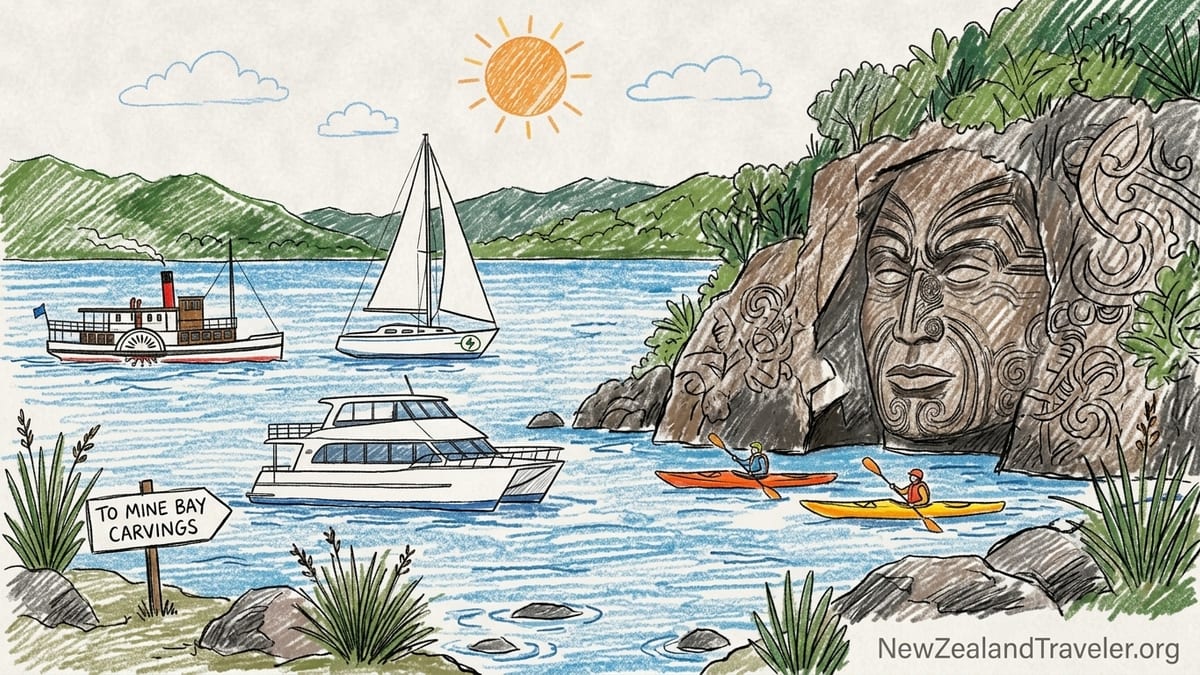
All roads to Taupō’s Ngātoroirangi Mine Bay Māori Rock Carvings lead across the water. The 14-metre high face of Ngātoroirangi and accompanying figures are carved directly into a sheer rock wall on Lake Taupō’s north-western shore, and the only way to see them close-up is by boat or kayak. That means visitors are not just choosing an attraction, but also choosing between several competing cruises and paddle tours that all promise front-row views of the same carvings. This guide breaks down the main options in practical, transactional detail, so you can decide which boat or kayak suits your time, budget and travel style.
Understanding the Mine Bay Māori Rock Carvings Experience
Ngātoroirangi Mine Bay Māori Rock Carvings sit on a lava cliff face near the northern end of Lake Taupō, New Zealand’s largest lake and the flooded caldera of an ancient volcano. The main carving, created in the late 1970s by artist Matahi Whakataka-Brightwell and collaborators, rises around 14 metres above the water, with smaller figures and motifs etched into the surrounding rock. There is no road, track or public access from land. Every close-up view you see in brochures is taken from a vessel or a kayak floating directly below the cliff.
In practice, that means every visitor faces the same decision: which operator to book for the same core experience. On offer are classic replica steamboats such as Ernest Kemp, eco sailing yachts like Sail Barbary, spacious motor catamarans run by Chris Jolly Outdoors and other operators, plus fully guided kayak tours that depart from the sheltered bays closer to the carvings. Each product targets slightly different travellers, and prices reflect comfort levels, inclusions and operating costs rather than access rights. No operator can land at the carvings or let you climb on them, but all mainstream cruises position you close enough to fill your camera frame with Ngātoroirangi’s face.
Because the trips are competing products to the same single attraction, details such as vessel style, degree of weather protection, trip length and group size matter. The difference between a 90-minute cruise on a covered power catamaran and a 2.5-hour eco sailing trip in changeable weather can be the difference between a relaxed highlight and an ordeal, especially if you have children, mobility concerns or a tight driving schedule. The sections below compare the main options on these specific points, so you can match the cruise or kayak to your exact travel priorities.
Ernest Kemp: Heritage Replica Steamboat With Full Shelter
Ernest Kemp is a compact replica steamboat that has been cruising Lake Taupō for several decades and trades on a classic, nostalgic atmosphere. As of late 2026, its standard Māori Rock Carvings & Lakefront Cruise is advertised as a relaxed 2-hour trip, typically departing at 10.30 am and 2.00 pm. That duration includes a scenic run along the lakefront, a loop through tree-lined bays and unhurried time right in front of the carvings for photographs. There are also occasional shorter 90-minute express or cocktail departures in peak season, but the core daytime product remains the 2-hour cruise.
Pricing sits at the lower end of the mainstream spectrum. Recent published rates for the main daytime cruise are typically around NZ$55 per adult, with a reduced senior price and a low children’s fare. Family passes are often available and land around NZ$130 for two adults and two children, making Ernest Kemp one of the better-value choices for families who want a “proper” lake outing without premium pricing. Third-party deal sites sometimes discount adult tickets further, but headline rates still cluster in the NZ$50 to NZ$60 band, comfortably inside the NZ$50 to NZ$85 range for standard cruises.
Where Ernest Kemp really stands out is weather protection and onboard amenities. The vessel offers fully enclosed indoor seating with large windows, outdoor decks when the weather plays ball, complimentary hot drinks and cookies, and a licenced bar. That makes it a safe bet in Taupō’s changeable conditions, especially in winter or on windy shoulder-season days. Because it is a motor vessel rather than a sailing yacht, it keeps to its timetable more reliably when the breeze drops or swings around, and the skipper can hold position under power close to the rock face for extended viewing.
For travellers who prioritise comfort and shelter over novelty, Ernest Kemp is the archetypal “everyone’s happy” choice. It works particularly well for multi-generational groups, older travellers, families with younger children and anyone who is nervous about being exposed to the elements but still wants to feel they have genuinely been out on Lake Taupō. The cruise atmosphere is friendly and informal rather than luxurious, which suits its mid-range price point.
Sail Barbary: Eco Sailing Yacht for Slower, Quieter Journeys
Sail Barbary offers one of the most distinctive ways to reach the carvings: a 2.5-hour eco sailing cruise aboard what is marketed as New Zealand’s first and only commercial electric sailing yacht. The daytime Māori Rock Carvings sailing typically departs at 10.30 am and 2.00 pm and runs for around 150 minutes. The longer duration compared with a 90-minute catamaran trip reflects the slower pace of travel under sail or electric power and the emphasis on a more immersive lake experience rather than simply a transfer to a viewpoint.
Adult prices for the standard daytime Sail Barbary cruise usually sit around NZ$59, with child fares lower and occasional seasonal specials for locals or shoulder periods. That positions Sail Barbary right in the middle of the NZ$50 to NZ$85 cruise range, slightly above the cheapest motor vessel products but well below the cost of private charters. A separate sunset sailing product typically carries a small premium, coming in around the upper end of the mainstream band for an evening departure that includes a complimentary drink and the chance of golden-hour light on the cliffs.
The vessel itself is a monohull yacht, so the experience is quite different from a covered catamaran or steamboat. Seating is mostly on deck or in a modest cabin area, and there is far more exposure to breeze and spray if the weather picks up. In fine conditions this is a major part of the appeal. Guests can help hoist the sails, take a turn at the helm under supervision, or stretch out on the deck while the electric motor hums quietly below. In stronger winds or cooler temperatures, however, travellers who feel the cold or prefer fixed seating may be less comfortable than on a fully enclosed boat.
The key selling points are environmental credentials and a genuine sailing feel. Because the yacht uses an electric drive and often sails part of the way, engine noise is minimal and the lake feels calm and quiet even with a full load of passengers. For visitors who like the idea of a slower, more hands-on trip, Sail Barbary turns the journey itself into the highlight rather than a mere transfer to the carvings. In direct comparison with Ernest Kemp and the larger motor catamarans, you trade some shelter and schedule certainty for a more intimate, eco-focused experience.
Chris Jolly and Kindred Spirit: Spacious Catamarans and Mainstream Comfort
Chris Jolly Outdoors operates some of the best-known Māori Rock Carvings cruises on Lake Taupō, using large motor catamarans designed with wide decks, covered seating and panoramic windows. The core carvings product is typically a 90-minute scenic cruise that includes commentary about the lake’s volcanic origins, a pass by the carvings with time to take photographs and a relaxed run back along the town frontage. As of mid to late 2026, advertised adult prices generally sit around NZ$65, with discounted child and senior fares and periodic specials on some departure times.
Trip length is where Chris Jolly’s main carvings cruises differ from Ernest Kemp and Sail Barbary. At around 90 minutes, the catamarans cover a similar distance in less time due to higher cruising speeds. For itineraries with tight driving windows or travellers who feel 2.5 hours on a boat might be too much, that shorter commitment is attractive. The trade-off is a slightly more utilitarian feel to the journey, with less time dawdling in bays or under sail and more of a direct run to and from Mine Bay, though there is still commentary and scenic viewing throughout.
Weather protection is excellent on these catamarans. Enclosed interior lounges, covered exterior decks and plenty of seating mean you can stay warm and dry even if rain comes through. In summer, upper decks and bow areas open up for sun and breeze. The stability of a twin-hull design also helps people who are prone to seasickness, although Lake Taupō is usually relatively calm compared with the open ocean. In rougher chop or cold southerly winds, a covered catamaran often feels like the most forgiving place to be on the lake.
Kindred Spirit and other luxury or semi-luxury catamarans on the lake tend to operate in a similar space but with smaller group sizes and more premium touches. Depending on the operator and season, these boats can run either shared departures that cost toward the top of the NZ$50 to NZ$85 range or private charters priced per hour rather than per person. Facilities might include plush seating, upgraded food and beverage options and more flexible routes. For travellers who want a carvings visit wrapped inside a more exclusive lake cruise without commissioning a full private yacht, these high-comfort cats are the main alternative to the larger mainstream boats.
Kayaking to the Carvings: Active and Weather-Dependent
Kayak tours to Ngātoroirangi Mine Bay offer a completely different style of visit. Instead of sitting on a deck, you are at water level in a stable sit-in or sit-on-top kayak, paddling yourself along the cliff line to the carvings with a guide. Most tours depart from a bay closer to Mine Bay rather than directly from the main Taupō town marina, and a shuttle from town to the launch point is often included in the price. Typical round-trip paddling time can be two to three hours, with additional time for safety briefing, gear fitting and rest breaks, so you should allow half a day.
Pricing for guided kayak experiences is noticeably higher than mainstream boat cruises. Recent advertised rates for standard group trips usually fall in the NZ$120 to NZ$145 per person range, with small discounts for children or off-peak days. That reflects the higher staffing ratio, equipment costs and the longer overall duration of the experience. For example, a half-day tour that includes transport, all gear, instruction, snacks and up to three hours on the water carries more overhead than a 90-minute cruise with dozens of passengers on a catamaran.
Weather and fitness requirements are the main considerations. On a calm summer morning, paddling across turquoise water beneath volcanic cliffs can be a highlight of a trip to Aotearoa. You sit low in the water, feel every ripple against the hull and approach the rock face at your own pace with a guide explaining the symbolism in the carvings. In wind, rain or winter cold, however, the same tour can be physically demanding and significantly less comfortable. Operators will cancel or modify trips if conditions are unsafe, but even marginal weather still means wet spray, numb fingers and an effortful paddle.
Kayaking suits active travellers who enjoy outdoor pursuits and want a more immersive, self-propelled encounter with the carvings. It is less appropriate for very young children, those with mobility or shoulder issues, or visitors who have a narrow driving window and cannot risk a weather cancellation. From a transactional point of view, you are paying a premium over boat cruises for intimacy, exercise and a stronger sense of achievement, not for a fundamentally different view of Ngātoroirangi’s face, which all options reach.
Side‑by‑Side Comparison: Duration, Vessel Style and Weather Protection
When you line the main options up side by side, several practical differences emerge that matter more in real life than on paper. In terms of duration, Chris Jolly’s carvings catamarans are typically around 90 minutes dock to dock. Ernest Kemp sits around 2 hours, combining carvings viewing with extra time along the bays. Sail Barbary’s eco sailing products extend to about 2.5 hours, depending on wind and conditions. Guided kayak tours effectively occupy a half day, once you factor in transport and briefing, even if the core paddling section is closer to two to three hours.
Vessel style drives both comfort and atmosphere. Ernest Kemp is a small, characterful replica steamboat that feels intimate and nostalgic. Sail Barbary is a monohull sailing yacht with an electric motor, where the journey feels quiet and hands-on. Chris Jolly’s boats and other catamarans are modern power cats with wide decks, multiple indoor and outdoor seating options and a more conventional sightseeing-cruise feel. Kindred Spirit and other luxury cats add more comfort and fewer passengers to that same basic layout. Kayaks are individual or tandem human-powered craft where your legs, arms and back supply all the propulsion.
Weather protection is strongest on the motor vessels. Ernest Kemp and the larger catamarans have enclosed cabins with windows, heaters in cooler months and covered outdoor spots. You can step outside for photos and retreat indoors between viewpoints. Sail Barbary has some sheltered space but is more exposed overall, especially if you choose to sit on deck to enjoy the sailing. Kayaks, by contrast, are fully exposed. Even on calm days you can expect some splash from your paddle, and wind chill is very noticeable on open water.
From a decision-making standpoint, visitors who are risk‑averse about weather will gravitate toward the enclosed motor boats at similar price points, while those who emphasise eco credentials or an active experience will accept more exposure in return for atmosphere. It is worth considering your actual travel month. A February afternoon often favours sailing or kayaking for warm breezes and swimming stops. A July morning in Taupō is cold on the lake, and the comfort of indoor seating with hot drinks becomes far more valuable than the romance of sails.
Price Points and Value: Matching Budget to Expectations
Across the mainstream market, Māori Rock Carvings cruises cluster between roughly NZ$50 and NZ$85 per adult, with variations by operator, season and time of day. Ernest Kemp tends to anchor the lower half of that range with adult fares around NZ$55 for a 2-hour cruise, making it one of the better-value ways to get a full lake experience with strong weather protection. Chris Jolly and similar catamaran operators often sit slightly higher, around NZ$65 for a 90-minute cruise, but they offer extra space, stability and more modern facilities. Sail Barbary generally sits in the same mid-50s to 60s band for daytime sailing, with a small premium for sunset departures.
Luxury catamarans such as Kindred Spirit can reach the upper mainstream range, especially when food and beverage service or smaller group sizes are included. While individual per-person prices may still fall under NZ$85 on shared departures, private charters will cost significantly more and are best viewed as an entirely different category. For many travellers, that premium is justified if the lake cruise itself is the main event of the day rather than one attraction among many.
Kayak tours occupy their own band, usually around NZ$120 to NZ$145 per person. That can be a surprise for travellers comparing only on the basis of “seeing the carvings.” However, when you consider the guiding ratio, transport, gear provision and longer duration, the price difference makes sense. In effect you are paying for both a guided outdoor activity and a carvings visit, rather than just transport and commentary. For budget-conscious visitors who only want a quick look at Ngātoroirangi, the cheaper boat options represent better transactional value. For those who see the paddle itself as the highlight, the extra cost is easier to justify.
Discounts are common across all boat operators during shoulder seasons, midweek and at less popular departure times, often shaving 10 to 20 percent off the standard adult fares. Families in particular should look for bundled passes, which can bring the per-person cost closer to the bottom of the NZ$50 to NZ$85 bracket. It is worth checking what is actually included in each fare. For example, free hot drinks and cookies, commentary, Wi‑Fi and the option of a swim stop may be standard on some trips but add-ons or absent on others.
Practical Booking Tips and How to Choose
Start by deciding what you value most, then narrow the field. If your key priority is weatherproof comfort and certainty of departure, a covered motor vessel such as Ernest Kemp or a Chris Jolly catamaran is the most straightforward choice. If you are drawn to sailing, eco credentials and a slower pace on the water, Sail Barbary or a similar sailing product deserves a closer look. If you want the carvings to be the endpoint of an active adventure, a guided kayak tour is the clear winner despite the higher cost.
Duration matters if you are on a tight itinerary. Travellers driving between Rotorua and Tongariro National Park in a single day may find a 90-minute catamaran cruise easier to fit than a 2.5-hour sailing trip, especially once you add check‑in time and a meal. Families with small children or people who are unsure about their sea legs often find that 90 minutes is about the right length: enough to feel like a proper outing without risking boredom or fatigue. Conversely, visitors staying several nights in Taupō may prefer the longer, more relaxed pacing of Ernest Kemp or Sail Barbary.
Booking patterns also differ slightly. In high summer and on holiday weekends, popular departures on all operators can sell out, especially midmorning or midafternoon sailings and evening sunset trips. If you are traveling in December, January or around school holidays, advance booking is wise, particularly for kayak tours and specialist products such as luxury catamarans or electric sailing. In winter and shoulder seasons, same‑day bookings are more realistic, but lake conditions can change fast, so remain flexible.
Finally, be honest about your group’s appetite for exposure and exertion. A kayak tour looks spectacular in photographs, but if half your group is anxious about capsizing or struggles with shoulder mobility, the reality may be stressful rather than memorable. Conversely, travellers who enjoy being hands‑on may find a 90-minute enclosed cruise too passive. Choosing the right product is less about chasing the single “best” boat on Lake Taupō and more about aligning a very specific experience with your personal comfort zone and travel style.
The Takeaway
Every route to Ngātoroirangi Mine Bay Māori Rock Carvings delivers the same essential moment: drifting at the base of a towering cliff, looking up at the chiselled face of an ancestor gazing out across Lake Taupō. The differences lie in how you reach that moment and how comfortable, active or indulgent the journey feels. Replica steamboats like Ernest Kemp offer value and shelter over a 2-hour loop. Eco yachts such as Sail Barbary stretch the trip into a quieter, more immersive 2.5-hour sail. Large catamarans from Chris Jolly and others provide speed, space and rock‑solid weather protection in 90 minutes. Premium cats such as Kindred Spirit add more comfort and exclusivity. Kayak tours command the highest per‑person price but deliver the most active, intimate experience.
In practical terms, visitors who want a dependable, all‑weather cruise at a fair price will be happy on Ernest Kemp or a mainstream catamaran. Those who view the lake and its volcanic landscape as something to be savoured slowly will appreciate Sail Barbary’s blend of sailing and electric quiet. Adventure‑oriented travellers with time, fitness and good weather on their side can justify a guided paddle. With prices that cluster into two clear bands for cruises and kayaks, the choice becomes less about cost and more about how you want to feel on the water on the day you finally meet Ngātoroirangi face to face.
FAQ
Q1. How long does it take to reach the Māori Rock Carvings by boat?
Most mainstream cruises take between 90 minutes and 2.5 hours in total, including scenic sections and time at the carvings. Fastest are the 90-minute catamaran trips, while eco sailing products tend to run closer to 2.5 hours.
Q2. Which option offers the best weather protection?
Enclosed motor vessels such as Ernest Kemp and the larger catamarans provide the most shelter, with indoor seating, covered decks and heaters in cooler months. Sailing yachts and kayaks are more exposed to wind and spray.
Q3. Are kayak tours suitable for beginners?
Most guided kayak tours are designed for reasonably fit beginners and include full instruction and safety gear. However, you should be comfortable with light to moderate exercise for several hours and confident on open water.
Q4. How close do the boats and kayaks get to the carvings?
All mainstream cruise operators and guided kayak tours approach right below the cliff at Mine Bay, close enough for detailed photos of the 14-metre main carving and surrounding figures, subject to safe lake conditions.
Q5. Is there a big price difference between cruises and kayaking?
Yes. Standard cruises typically cost around NZ$50 to NZ$85 per adult, depending on operator and season, while guided kayak tours usually fall between about NZ$120 and NZ$145 per person.
Q6. Do any cruises include swimming stops?
In warmer months and when lake conditions allow, some operators, including Ernest Kemp and certain sailing or catamaran trips, may offer a short swim stop away from the carvings. This is always at the skipper’s discretion.
Q7. Should I book my Māori Rock Carvings trip in advance?
Advance booking is strongly recommended in peak summer, on public holiday weekends and for sunset sailings or kayak tours. In winter and shoulder seasons, same‑day bookings are often possible, but departures can be weather‑dependent.
Q8. Which option is best for families with young children?
Enclosed motor vessels with flexible indoor seating, such as Ernest Kemp and large catamarans, usually work best for families. They offer shorter walk‑on boarding, toilets, snacks and the ability to move indoors if children get cold or tired.
Q9. Can I visit the carvings without joining a tour?
There is no public land access or road to the carvings, so you must be on the water. In practice that means booking a commercial cruise, joining a guided kayak tour or using a private vessel that you or your friends already operate on Lake Taupō.
Q10. What is the best time of day to see the carvings?
Calm morning conditions often provide smooth water and clearer reflections, while late afternoon or sunset trips can deliver warmer light on the cliff. In busy summer periods, off‑peak departures may also feel less crowded on board.