


Lake Taupō is one of New Zealand’s most popular holiday regions, and where you stay shapes the entire feel of your trip. The official tourism guidance points most visitors to Taupō town as the main base, then highlights nearby Acacia Bay, Wairakei, Kinloch and the quieter southern lake shore for those who prefer more space, nature and stillness. Choosing between them comes down to how much you value restaurants and walkability versus lake views, geothermal pools, golf, fishing and easy access to the Tongariro Alpine Crossing.
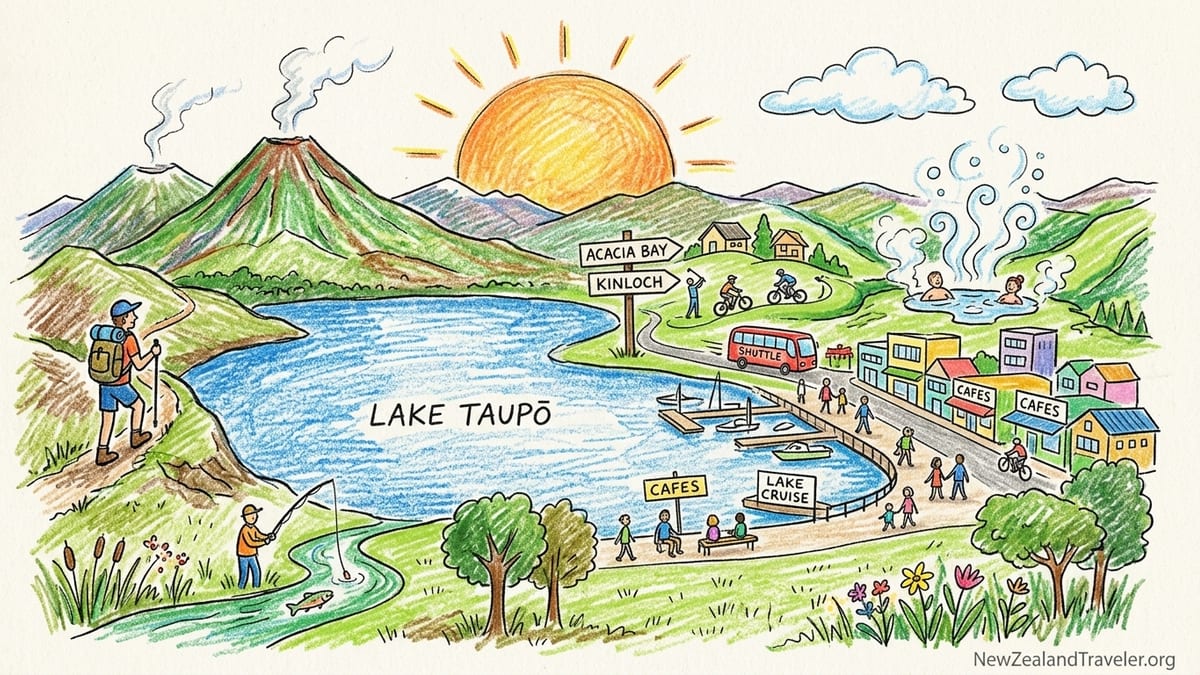
How to Choose the Best Area Around Lake Taupō
Before you book, decide what you want most from your stay: to step out to cafes and lakefront promenades, to soak in geothermal pools, or to wake up near fishing rivers and national parks. Taupō town sits roughly in the middle of the lake’s eastern shore and works as the region’s main hub, with the broadest choice of hotels, motels and apartments plus shuttles running to the Tongariro Alpine Crossing and other day trips.
Immediately around it are smaller communities that feel very different. Acacia Bay, only a short drive west of town, offers peaceful lake views and holiday homes tucked into the hills. Wairakei, just north, is defined by steaming valleys, hot pools and golf resorts. Kinloch is a quiet, upscale lakeside village with a serious golf course and access to some of the region’s best bike and walking trails. At the southern end of the lake, Tūrangi feels more like a fishing and hiking base, close to the Tongariro River and the national park trailheads.
For a first visit or a short stay, most travelers are best served by basing themselves in Taupō town and then day tripping to the surrounding areas. If you are coming back to the region, traveling in a group, or building your itinerary around specific activities like golf, mountain biking or the Tongariro Alpine Crossing, it can make sense to stay in one of the quieter bays or in Tūrangi instead.
Taupō Town & Lakefront: Best for First Timers, Food & Walkability
Taupō town is where most visitors stay, and for good reason. The compact centre stretches back from the lakefront along Tongariro Street and Ruapehu Street, lined with cafes, casual restaurants, bars and outdoor gear shops. You can arrive in the afternoon, park your car at your motel, and comfortably get everywhere on foot. That makes Taupō town especially appealing if you want an easygoing break with minimal driving in the evenings.
Accommodation here runs from simple backpacker hostels and motor inns through to lakefront hotels with lake and mountain views. A midrange motel a couple of blocks off the water typically offers self-contained studios or one-bedroom units with kitchenettes and parking, which suits road trippers and families. On the lakefront itself, you will find apartment-style hotels and boutique lodges where you can sit on a balcony looking across to the distant outline of Tongariro National Park.
Staying in town also simplifies day trips. Shuttle companies that service the Tongariro Alpine Crossing, Huka Falls jet boats, rafting outfits and scenic cruise operators all pick up from central Taupō and major hotels. If you are relying on tours and shuttles rather than your own car, basing yourself in town avoids early-morning transfers from more remote bays. After a long day of walking, you can simply wander to a nearby eatery for dinner rather than driving back on country roads.
The trade-off is that Taupō town feels busy in peak summer and on holiday weekends. The main lakefront road carries through traffic, and popular motels can book out well in advance. If you picture your stay as quiet evenings on a deck with only the sound of water and birds, you may prefer Acacia Bay or Kinloch. But if you want to step outside to a choice of restaurants and to join the evening promenade along the waterfront, Taupō town is the natural choice.
Acacia Bay: Quiet Lake Views a Short Hop from Town
Acacia Bay sits just west of Taupō on a sheltered arm of the lake, close enough that you can drive into town in roughly ten minutes but far enough that it feels like a separate lakeside community. The shoreline here curves around small rocky headlands and pockets of beach, with homes and holiday rentals rising up the hillside behind. When people talk about staying somewhere “near Taupō but quieter,” Acacia Bay is often what they mean.
Most accommodation in Acacia Bay is made up of holiday homes, apartments and bed and breakfasts rather than large hotels. In practice, that means kitchen facilities, multiple bedrooms and outdoor decks where you can cook for yourself and watch the changing light on the lake. It is a popular choice for families and small groups who prefer to self-cater and for couples who want space and views instead of being right in the town centre.
Services in Acacia Bay are limited to a small cluster of local conveniences, so you should expect to drive into Taupō for supermarkets and a wider choice of restaurants. That is part of the appeal for many visitors: you can enjoy a quiet coffee on your balcony in the morning, then head into town for lunch, activities or a lake cruise, before returning to a more tranquil base in the evening. The short distance means you still have easy access to shuttles and tours that operate from Taupō, while escaping some of the town noise and traffic.
If you are visiting in peak holiday periods and find that central Taupō properties are heavily booked or feel too busy, Acacia Bay can be a smart alternative. You retain proximity to everything the main town offers but end your day somewhere that feels more like a residential lakeside village than a resort centre.
Wairakei: Geothermal Resorts & Huka Falls Access
North of Taupō, the Wairakei area is defined by geothermal activity and rolling farmland. Accommodation here is less about town life and more about staying at a resort or lodge. Properties around Wairakei often incorporate hot pools, spa facilities and direct access to golf courses or walking tracks that weave through steaming valleys and forest. For travelers who want to build relaxation into their stay, this pocket can be very appealing.
One of the key draws of Wairakei is its proximity to Huka Falls and the Waikato River. From many Wairakei resorts it is a short drive, or in some cases a walk or bike ride, to viewpoints over the turquoise torrents plunging through the narrow gorge. Several operators run jet boat trips and river cruises from just downstream. Staying nearby means you can visit at quieter times of day, such as early morning or late afternoon, when tour groups are thinner and the light is softer.
Compared with Taupō town, dining options in Wairakei are usually centred on the resort restaurants themselves, which often serve multi-course dinners and breakfast buffets. You might pay a bit more per night than an equivalent standard motel in town, but you gain on-site hot pools, landscaped grounds and a sense of being on a contained retreat. For couples on a short break or road trippers wanting to break up long driving days with a proper rest stop, that can represent good value.
The compromise is that you will drive in and out of Taupō for lakefront walks, shopping or most off-site dining. If your priority is to be within walking distance of a range of cafes and bars, Wairakei will feel too removed. But if you like the idea of soaking in thermal pools under the stars and strolling back to your room without crowds, it is an excellent alternative to staying in town.
Kinloch: Upscale Lakeside Escape for Golf & Trails
Kinloch sits on a quiet bay near the northern end of Lake Taupō, roughly 15 to 20 minutes’ drive from Taupō town. Unlike Acacia Bay, which feels like an extension of Taupō, Kinloch has the character of a standalone village, with a sheltered beach, marina, and a small store and cafe near the water. It is particularly popular with New Zealand holidaymakers who return year after year, and a high proportion of houses function as holiday homes.
The area has built a strong reputation as an upscale outdoor escape. Above the bay rises a celebrated golf course designed with sweeping views across the lake, with luxury lodges, villas and high-end holiday homes dotted around its fairways and ridgelines. If you are imagining long evenings with a glass of wine on a terrace and early-morning tee times, Kinloch fits that picture. Some properties here routinely attract discerning golfers, small corporate groups and families who want a private, self-contained base.
Kinloch is also a hub for walking and mountain biking. Lakeside trails link the village to viewpoints along the shore and into the surrounding bush, and well-known tracks start or finish near the bay, rewarding effort with wide panoramas across Lake Taupō. Visitors commonly combine a morning ride or hike with a swim at the small local beach, then pick up fish and chips from the village store to eat at the waterfront. The pace is unhurried, and apart from the peak of summer, the bay tends to feel far quieter than Taupō town.
Because Kinloch is more self-contained, you should expect to drive into Taupō for larger supermarkets, a broad choice of restaurants, and many tour departures. That is easily manageable if you have a car and do not mind a scenic drive back after dinner. If you want a polished base with lake and fairway views, and you are happy to trade walkable nightlife for space and serenity, Kinloch is one of the region’s standout choices.
Tūrangi & the Southern Lake Shore: Gateway to Tongariro & Trout
Tūrangi sits at the southern end of Lake Taupō on the banks of the Tongariro River. The town is smaller and more workaday than Taupō, but it occupies an enviable position for anyone focused on the outdoors. Anglers know this area for its world-class trout fishing, both in the Tongariro River and on the southern reaches of the lake, while hikers use it as a natural base for exploring Tongariro National Park and the nearby forests.
Accommodation in and around Tūrangi runs from simple motels and holiday parks through to long-established fishing lodges and riverside bed and breakfasts. Many cater specifically to walkers and anglers, with early breakfasts, packed lunches and drying rooms for wet gear. Some lodge-style properties sit in spacious grounds by the river, with communal lounges and open fires that make them atmospheric in the cooler months when fishing and hiking are still in full swing.
For the Tongariro Alpine Crossing, Tūrangi has a major advantage: it is significantly closer to the track than Taupō, and several shuttle operators run daily services in season from local accommodation to the trailheads and back. That translates into shorter early-morning transfers and a quicker journey back to a hot shower or soak in local thermal pools after a long day. For visitors building their itinerary around a window of a few days for the Crossing, staying in Tūrangi or nearby National Park Village reduces time spent commuting.
The trade-off is that Tūrangi has a more limited dining and nightlife scene compared with Taupō. You will find pubs, takeaway outlets and a handful of cafes and restaurants, but not the same lakeside promenade or variety of wine bars. For many walkers and anglers who rise early and return tired, that is a reasonable compromise. If your main reason to be in the region is Tongariro or trout, and you do not mind a simpler town, the southern lake shore is a very practical base.
Where to Stay for the Tongariro Alpine Crossing
One of the key decisions visitors face is whether to stay in Taupō town and day trip to the Tongariro Alpine Crossing, or to move south to Tūrangi or a national park settlement the night before the hike. Both approaches work, but the best choice depends on your priorities, how you are traveling, and how many days you have in the region.
Staying in Taupō town gives you a livelier base with more to do on either side of your hike. In the days before your crossing, you can take lake cruises, visit Huka Falls, or relax at hot pools around Taupō, then join an early-morning shuttle from town to the Mangatepōpō road end. The road journey typically takes around 1.5 hours each way, so you should be prepared for a pre-dawn start and a late return. This can still be comfortable if you have at least two full days in Taupō and want to balance the crossing with other activities.
If your trip revolves around Tongariro and you want to minimize logistics on the day, staying in Tūrangi or near National Park Village usually makes more sense. Driving times to the trailheads are shorter, shuttle operators have more flexible schedules, and you avoid adding three hours of bus travel to an already demanding day on the mountain. Visitors often plan two or three nights in Tūrangi, aiming to walk on the best weather day and filling the others with shorter local hikes, river walks or fishing sessions on the Tongariro.
A hybrid approach can work particularly well. Many travelers spend several nights in Taupō at the start of their central North Island itinerary, enjoying the lakefront atmosphere, then move south to Tūrangi for one or two nights around their Tongariro Alpine Crossing window. After the hike, they either push on to their next destination or return to Taupō or Rotorua. This strategy means you enjoy both the region’s main resort town and the convenience of a base closer to the trail, spreading your time between lively and quieter stops.
Whatever you choose, it is worth building flexibility into your plans. Weather in Tongariro National Park can change quickly, and shuttles may not run on days with high winds or poor visibility. Staying somewhere with alternative activities nearby, such as Taupō, Tūrangi or Kinloch, gives you options if the crossing needs to be delayed by a day.
When to Pick Town, Bays or Southern Shore
For most first-time visitors with three or four nights to spend around Lake Taupō, the simplest plan is to base yourself in Taupō town and consider side trips. This suits couples who want restaurants and bars within walking distance, families who appreciate playgrounds, lakefront walking paths and easy access to supermarkets, and solo travelers who prefer the atmosphere of a proper town with hostels and tour desks. From here, you can drive out to Acacia Bay for an afternoon swim, visit Wairakei hot pools, sample mountain bike trails near Kinloch or join an early shuttle to the Tongariro Alpine Crossing.
If you are returning to the region, traveling in a group, or seeking a more low-key break, the bays and rural surrounds come into their own. A multi-bedroom holiday home in Acacia Bay with a barbecue and lake views can work out very cost-effective when split across several people. A stay at a golf-focused lodge in Kinloch is ideal for a special occasion or for travelers who plan to spend a large part of their time on the course or on nearby trails. A night or two at a geothermal resort in Wairakei breaks up a longer road trip and builds in time to slow down.
The southern lake shore around Tūrangi is the more functional choice, driven by specific activities. Anglers time their stays to coincide with seasonal trout runs, while hikers plan around a window for the Tongariro Alpine Crossing or other Tongariro National Park walks. Because this area is closer to the mountains, you are more likely to meet fellow travelers whose days revolve around early starts, weather forecasts and gear checks rather than lake cruises and long lunches.
Whichever area you choose, remember that distances around Lake Taupō are manageable by car. You can comfortably drive from Taupō town to Kinloch or Acacia Bay for dinner or an evening stroll, and from Taupō to Tūrangi in around an hour. Thinking of Taupō town as your central hub, with Acacia Bay, Wairakei, Kinloch and the southern lake shore as quieter satellites, is a useful way to plan the shape of your stay.
The Takeaway
If you want restaurants, bars and a walkable lakefront promenade on your doorstep, Taupō town is the most practical and popular base. It works especially well for first-time visitors, short stays and travelers who rely on shuttles and tours, and it keeps your evenings simple after full days on the water or in the hills.
For quieter stays that lean into lake views, hot pools, golf or fishing, the surrounding bays and the southern shore come into their own. Acacia Bay and Kinloch give you a gentler village feel and space to spread out in holiday homes, while Wairakei offers geothermal resorts close to Huka Falls. Tūrangi and its neighbours, meanwhile, serve as efficient gateways to Tongariro National Park and the Tongariro River, ideal if your trip is centered on the Alpine Crossing or trout.
The good news is that you rarely have to choose just one. Many travelers now split their time between Taupō town and a quieter base, or between the lake and Tūrangi, to experience both the energy of the main resort and the calm of the bays and southern shore. With some thought about your priorities and the shape of your itinerary, you can match your accommodation to the version of Lake Taupō you most want to discover.
FAQ
Q1. Is Taupō town or Tūrangi better for the Tongariro Alpine Crossing?
Taupō town offers more restaurants and things to do, but Tūrangi is closer to the track and has shorter shuttle times. If the Crossing is your main focus and you have limited days, Tūrangi usually makes more sense.
Q2. Can I stay in Taupō and still do the Tongariro Alpine Crossing in a day?
Yes, many visitors stay in Taupō and join early-morning shuttles that return in the late afternoon or evening. It does mean a longer day overall, so factor in the extra travel time on top of a full day of hiking.
Q3. Is Acacia Bay a good area for families?
Acacia Bay suits families who want space and lake views rather than a busy town centre. Holiday homes often have multiple bedrooms and decks, and Taupō’s supermarkets and attractions are an easy short drive away.
Q4. What kind of traveler is Wairakei best for?
Wairakei is ideal for couples or road trippers who want resort-style stays with hot pools, spa facilities and golf, and who do not mind driving into Taupō for shopping or a wider choice of dining.
Q5. Is Kinloch only for golfers?
Kinloch is a major draw for golfers, but it also appeals to walkers, mountain bikers and anyone who wants a quiet, upscale lakeside village. Trails and lake access make it attractive even if you never step onto the course.
Q6. Do I need a car if I stay in Acacia Bay or Kinloch?
In practice, yes. While you can walk around the bays themselves, you will need a car to reach Taupō town for supermarkets, most restaurants and many tours, as public transport is limited.
Q7. Is it noisy to stay on the Taupō lakefront?
The central lakefront can feel busy in peak season with through traffic and evening activity, but many lakeside motels and hotels are set back from the main road. If you are sensitive to noise, ask for a room toward the rear of the property or a street off the main strip.
Q8. How far is Taupō from the Tongariro Alpine Crossing trailheads?
Driving times vary with conditions, but you should allow around 1.5 hours each way from Taupō to the main trailheads. From Tūrangi or National Park Village, the drive is noticeably shorter, which is why many hikers base there.
Q9. Is Tūrangi safe and comfortable for a multi-night stay?
Tūrangi is a practical, outdoors-focused town with motels, holiday parks and lodges that routinely host walkers and anglers. It does not have the polished resort feel of Taupō, but most visitors find it friendly and comfortable for several nights.
Q10. Should I split my stay between Taupō and somewhere closer to Tongariro?
Splitting time works very well if you have four or more nights. Many travelers enjoy two or three nights in Taupō for lake activities, then move to Tūrangi or a national park village for one or two nights around their Tongariro Alpine Crossing window.