


Flying into Taupō Airport and planning to explore the heart of New Zealand’s North Island by road? Taupō is a compact airport with big advantages for self-drive travelers: multiple on-site rental desks, easy access to State Highway 1 and SH5, and fast connections to geothermal sights, ski fields and volcanic landscapes. This guide walks you through how to rent a car at Taupō Airport (TUO), when it is worth heading into town instead, what kind of vehicle to book for Central North Island roads, and how to handle one-way trips, insurance and after-hours logistics.
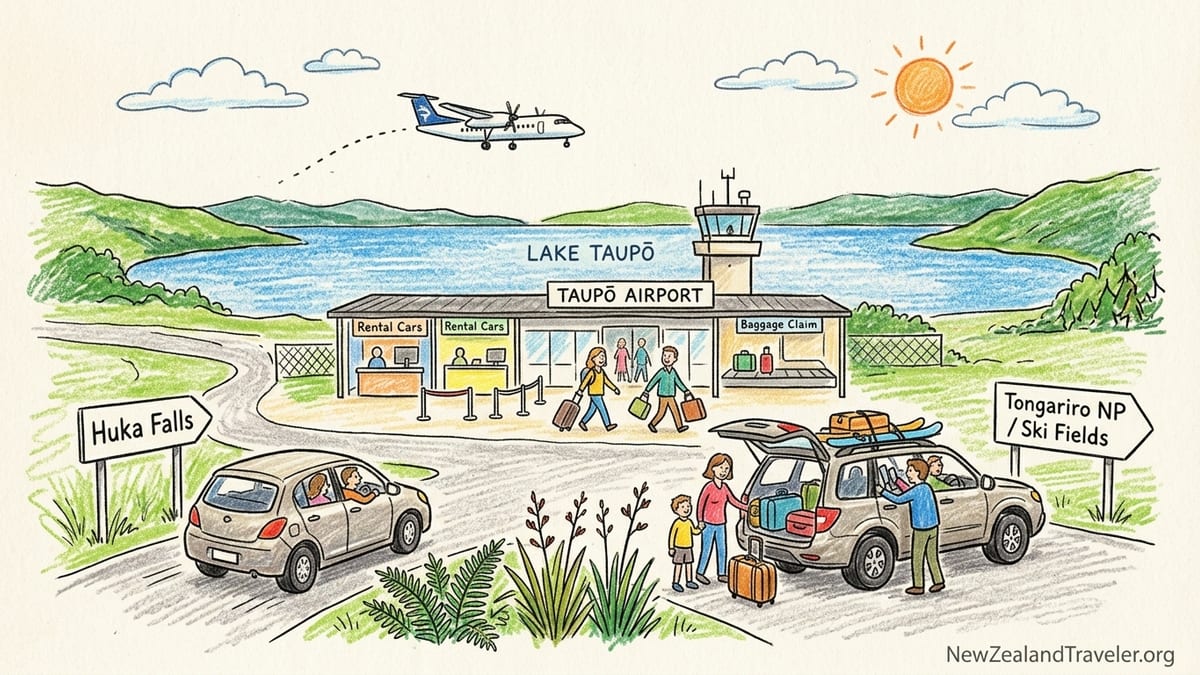
Taupō Airport at a Glance: Layout, Distance and On-Site Car Hire
Taupō Airport (TUO) is a small regional airport on the southeastern shore of Lake Taupō, about 8 to 10 minutes’ drive from Taupō town centre, depending on traffic. The terminal sits just off Anzac Memorial Drive, directly beside State Highway 1, which makes it straightforward to drive north toward Rotorua and Auckland or south toward Tūrangi and Wellington. The airport has a single compact terminal building, so walking distances are short and rental counters are easy to find.
Inside the terminal you will find rental desks for several major car hire brands, including Budget, Hertz, Avis, Thrifty and Ezi Car Rental. These counters are typically arranged near the arrivals area and baggage carousel, so most travelers can be at the counter within minutes of stepping off the aircraft. With such a small footprint, there is no shuttle bus; vehicles are usually parked in lots just outside the terminal, which keeps the total time from wheels-down to driving away comparatively low.
Most airport locations in Taupō keep fairly standard daytime operating hours. As an example, recent schedules show Hertz generally operating from early morning through late afternoon or early evening on weekdays, with reduced hours on Saturdays, while Ezi lists 8:30 am to 6:00 pm Monday to Friday and on-request service at weekends. Actual hours vary by season and day of the week, so it is important to check your specific provider’s Taupō Airport branch page and match your booking to your flight times.
Because Taupō Airport mainly handles domestic flights and a modest passenger volume, queues at car hire desks are usually shorter than at big hubs such as Auckland or Queenstown. At busy school holiday times, however, car rental demand in Taupō and across New Zealand can spike. It is common to see popular categories such as compact hatchbacks and small SUVs fully booked in peak periods. To avoid arriving to find limited or no choice, pre-booking is strongly recommended, especially if you need a particular size of vehicle for a family or ski gear.
Airport Pickup vs Town Pickup: Which Works Best?
With rental counters directly in the Taupō Airport terminal, airport pickup is the most convenient option for most visitors, particularly those landing mid-morning or mid-afternoon and heading straight out on the road. You step off the plane, collect your bag, sign the paperwork and walk out to your car. For travelers planning to drive on to places like Tūrangi, Ōhakune or Rotorua the same day, avoiding an extra transfer into town can save 30 to 45 minutes and the cost of a taxi or shuttle.
Town pickup can make sense under specific circumstances. Some brands operate additional depots in Taupō town, sometimes with slightly different fleets or pricing. On price comparison sites, it is not unusual to see town-based deals a little cheaper, especially for older economy models. If your accommodation is around Taupō’s lakefront and you are staying several days without long day trips, you could taxi from the airport into town, enjoy a car-free first day, then pick up a rental later only for a particular excursion. However, you will want to factor in the cost of two taxi rides, which can quickly eat into any savings from a marginally cheaper town rate.
Another scenario where town pickup works well is when flights arrive outside usual desk hours. If, for example, you land in the evening after airport desks close, you might pre-book a taxi to town, stay overnight, and collect a car from a depot that opens early the next morning. Some local independent operators in Taupō offer more flexible arrangements for key handover in town than at the airport, though this tends to change over time and must be confirmed directly with the provider.
For most short-stay visitors, the small size of Taupō Airport removes many of the hassles often associated with airport rentals elsewhere. Unless you are very focused on shaving a few dollars off the daily rate, or arriving at a time when airport desks are closed, the convenience of walking from baggage claim straight to your car usually makes TUO airport pickup the smarter choice.
Choosing the Right Vehicle: Compact vs SUV for Central North Island Roads
The Central North Island is easy to drive by international standards, with sealed highways and clear signage, but weather and terrain can still be challenging at times. This shapes the decision between a compact car and an SUV. Around Taupō town and the lakefront, a compact hatchback such as a Toyota Corolla or similar model is usually more than sufficient. It is easier to park in busy lakefront streets, uses less fuel, and is often available in the lowest price bands. Recent price snapshots show entry-level cars in Taupō starting from roughly 60 to 70 New Zealand dollars per day in shoulder seasons when booked in advance, with higher rates in peak summer and school holidays.
Once you start talking about visiting Ōrakei Kōrako, the thermal areas between Taupō and Rotorua, or driving south toward Tūrangi and the slopes of Mount Ruapehu, a small or midsize SUV begins to look attractive. Models commonly seen in New Zealand fleets include the Kia Sportage, Mitsubishi Outlander and Toyota RAV4. These vehicles offer higher ground clearance, better visibility and more space for luggage, outdoor gear and ski equipment. At Taupō Airport, it is typical to see SUVs priced above compacts, sometimes in the range of 100 to 180 New Zealand dollars per day depending on demand and season.
For most of Ōrakei Kōrako, Huka Falls, Craters of the Moon and the lakeside roads, you do not need a four-wheel drive or serious off-road capability. The access roads are sealed or basic gravel that any standard rental car can manage in normal weather, provided you drive cautiously. The main reason to choose an SUV is comfort and flexibility. If you are a couple with two small bags staying mainly in Taupō, a compact is perfectly fine. If you are a family of four with suitcases and plan at least one long day up to Tongariro National Park or down toward Wellington, the added space of an SUV can make a noticeable difference.
In winter, especially between June and September, conditions can change quickly on the Desert Road section of State Highway 1 and the roads leading to Whakapapa and Tūroa ski areas. Snow and ice are possible, and chains may occasionally be required on alpine access roads. Not every rental company allows their vehicles on ski field roads without restrictions. When you book in Taupō, check your rental’s terms regarding snow chains, ski field access and roadside assistance in alpine zones. An SUV with modern safety features, good tyres and the option to carry chains will be more reassuring than a small city hatchback if your plans revolve around ski trips.
When a Car Is (and Is Not) Necessary in Taupō
Whether you really need a rental car for a short stay in Taupō depends on what you plan to do. For a one- or two-night break focused on the lakefront, cafes and a couple of close-in attractions, a car is not strictly essential. Many accommodations cluster within a 10 to 20 minute walk of Taupō’s central dining streets. Popular spots like the main lakefront reserve and boat harbour are also walkable from central hotels and motels. Local taxis and occasional shuttles can bridge the gap from Taupō Airport to town for those stays.
If your plans centre on Huka Falls, the Aratiatia Rapids viewpoints or the Craters of the Moon geothermal area, not having a car starts to limit your options. While some tour operators run shuttle trips to Huka Falls and nearby attractions, they may operate on fixed timetables and only during busy seasons. Having your own vehicle lets you time your visit to Aratiatia Rapids to coincide with controlled dam releases, or to linger at Huka Falls early or late in the day when the paths are quieter.
The further you reach beyond Taupō, the more a car transforms what you can see. Ōrakei Kōrako Geothermal Park sits roughly 30 to 40 minutes’ drive from Taupō on the back road to Rotorua, with no routine public transport. From Taupō to Tūrangi is around 45 minutes by car, and from there it is another stretch to Whakapapa Village and the Tongariro Alpine Crossing shuttles. Buses in this corridor are limited and often scheduled for point-to-point transfers rather than flexible sightseeing. Travelers who want to photograph lesser-known hot springs, pause at viewpoints around Lake Taupō’s quieter bays, or take an impromptu swim on a calm day will find a rental car far more practical than tours.
A useful rule of thumb is that if your stay is mainly about strolling Taupō’s lakefront, soaking in a thermal pool and taking one or two organised tours, you can manage without a car. If your stay involves Ōrakei Kōrako, Tūrangi, Tongariro National Park, the Desert Road or continuing to Rotorua, Napier, Wellington or Auckland, a rental car quickly becomes less of a luxury and more of a core piece of your itinerary.
One-Way Rentals: From Taupō to Auckland, Wellington and Beyond
Taupō Airport works well as a starting point or midpoint for one-way road trips through the North Island. Many travelers fly from Auckland or Wellington into Taupō, pick up a rental at TUO and then drive onward in one direction, returning the car in another city rather than backtracking. Typical one-way patterns include Taupō to Auckland via Rotorua and the Coromandel, or Taupō to Wellington via Tūrangi, the Desert Road and either Whanganui or Palmerston North.
Most of the major airport brands with counters at Taupō, such as Budget, Hertz, Avis, Thrifty and Ezi, offer one-way rentals between branches in other North Island cities. The key detail is the one-way fee, sometimes called a relocation fee. This is often baked into the quote on comparison sites, but not always immediately obvious. For example, a compact car from Taupō to Auckland Airport might show a base daily rate similar to a round trip, yet the final total reveals an extra charge to cover the company moving the vehicle back to its original region. The amount varies by company, route and season. On popular corridors with steady demand in both directions, the fee can be modest; on less trafficked routes or at times when fleets are out of balance, it can be significant.
For long-distance travel, one-way rentals can still be good value compared with alternatives. A private transfer between Taupō and Auckland Airport for a couple or small family is often priced in the hundreds of dollars for a single trip, reflecting a driving time of roughly three and a half hours over about 275 kilometres. A rental car allows you to stop at Ōrakei Kōrako, Tirau or Hamilton Gardens along the way and use the vehicle for local exploring on either side of the journey. Similarly, a one-way drive from Taupō to Wellington lets you break the trip in Tūrangi, walk a short section of the Tongariro Alpine Crossing, or visit the volcanic plateaus around National Park Village.
When planning a one-way itinerary, read the fine print. Some companies specify minimum rental durations to qualify for lower or zero one-way fees on certain intercity routes. Others may restrict one-way hires at particular times of year, such as late summer when many cars are already concentrated in one region. Book as early as practicable if your dates are fixed, and be prepared for the total cost of a one-way rental to be noticeably higher than an identical round-trip booking.
Understanding Insurance, Excess and Road Conditions
Rental car insurance in New Zealand usually comes with a standard excess, which is the amount you must pay toward any damage before the rental company’s cover applies. For airport rentals in Taupō with mainstream brands, typical standard excess levels are often in the range of 3,000 to 4,500 New Zealand dollars for compact and midsize vehicles, and higher for larger SUVs and vans. To reduce this risk, desks at Taupō Airport will usually offer their own excess reduction or “full cover” products for an additional daily fee.
Buying the rental company’s full cover is the simplest option, because it is straightforward at the counter and administered by the same business that will handle any claim. However, the daily cost can add up quickly, sometimes rivalling the base rental cost itself. An alternative is a standalone rental car excess insurance policy, which can be purchased in advance from independent insurers. With these, you still pay the rental company’s excess up front if something happens, then claim reimbursement from the insurer later. Travelers rely on both approaches; which is better depends on your risk comfort, travel style and budget.
Whatever insurance route you choose, you need to drive with the Central North Island’s conditions in mind. Long, straight sections of State Highway 1 between Taupō and Tūrangi can tempt drivers to speed, but police enforcement is active and weather can change abruptly. Around Tongariro, fog, rain and snow can reduce visibility. Many popular photo stops and short walks are accessed via small gravel car parks or side roads. These are generally fine for standard rental cars if taken slowly, but check your rental’s terms regarding unsealed roads. Some companies state that driving on unsealed roads voids parts of the insurance coverage.
Given New Zealand’s high costs for panel repairs and windscreens, it is particularly important to check for existing damage during pickup at Taupō Airport. Walk around the car in good light, note even small stone chips or scratches on the condition report, and take clear time-stamped photos. This careful approach is not about expecting problems; it simply protects you if damage is later disputed. With a thorough walk-around, appropriate insurance and moderate driving on Central North Island highways, most travelers complete their trips with no incidents beyond a windblown hat at a lookout.
After-Hours Pickup, Returns and Practical Tips at TUO
Because Taupō Airport is relatively small, after-hours arrangements are more limited and more personal than at large international hubs. Some major brands will allow after-hours returns at TUO. This often involves parking the vehicle in a designated bay in front of the terminal and dropping the keys in a secure box at the rental counter or depot door. The exact procedure and whether it is permitted on your booking will be listed in your rental confirmation. If your departing flight leaves early in the morning before desks open, returning the car the previous evening can be a safer choice unless you have a clear written arrangement for after-hours drop-off.
After-hours pickup is trickier. At many small New Zealand airports, rental companies only hand over keys in person during opening hours, and may not be able to leave keys in a lockbox unless specific conditions are met. If you are arriving on the last flight of the day, it is essential to choose a company whose posted hours cover your arrival, and to enter your correct flight number when booking. For flights that might be delayed beyond closing time, some renters prefer to overnight in Taupō without a car, then collect their vehicle the next morning during normal hours.
Before leaving the airport, check fuel and parking arrangements. Some Taupō Airport renters like to note the location of the nearest petrol station for refuelling before return. Recent branch information for one operator points to a Mobil station on Lake Terrace as the closest option when driving back from town. For those returning from the south, it can be more convenient to refuel in Tūrangi or another town en route, then top up again if needed on the lakefront. Keep your final fuel receipt, as a few companies may ask for proof if there is a dispute over the fuel gauge position at check-in.
A final practical tip is to build some buffer time into your schedule on busy travel days. If you are driving from Tongariro or from further north back to Taupō Airport to catch a specific flight, roadworks or weather can slow traffic on State Highway 1. Aim to reach the airport earlier than strictly necessary, so that a minor queuing delay at the rental return does not put your onward connection at risk. With small terminal crowds and short walking distances, most Taupō departures are painless once you have handed back the keys.
The Takeaway
Taupō Airport is a particularly user-friendly gateway for self-drive trips through the Central North Island. With Budget, Hertz, Avis, Thrifty and Ezi operating desks inside the terminal, airport pickup is usually the most efficient option, especially if you are heading straight out on the highway to Ōrakei Kōrako, Tūrangi or Tongariro. Town pickups can occasionally offer slightly lower rates, but the savings often shrink once you add taxi fares and extra time into the equation.
For short, lakefront-focused stays, you can happily do without a car and rely on walking, taxis and occasional tours. The moment your itinerary broadens to include geothermal parks off the main bus routes, alpine hiking days or a one-way journey to Auckland or Wellington, a rental car becomes one of the most valuable tools in your travel kit. Choosing between a compact and an SUV comes down to passenger numbers, luggage and your appetite for winter driving around the central plateau.
With sensible planning around insurance excess, fuel and after-hours logistics, hiring a car at Taupō Airport is straightforward. The combination of a compact regional terminal and a wide network of onward roads means you can step off your plane and be on the lakeside, in the forest or among steam vents and hot springs in a remarkably short time.
FAQ
Q1. Is it better to rent a car at Taupō Airport or in Taupō town?
For most visitors, renting at Taupō Airport is more convenient, because desks for Budget, Hertz, Avis, Thrifty and Ezi are inside the terminal and cars are parked just outside. Town rentals can sometimes be slightly cheaper, but any savings may be offset by taxi fares between the airport and your accommodation.
Q2. Do I really need a car for a short stay in Taupō?
If you are staying one or two nights near the lakefront and mainly plan to walk, dine out and perhaps join a tour to Huka Falls, you can manage without a car. Once you add Ōrakei Kōrako, Tūrangi, Tongariro National Park or a longer road trip to your plans, a rental car quickly becomes the more practical option.
Q3. What type of car is best for Central North Island roads?
For lakefront driving and short local trips, a compact hatchback such as a Toyota Corolla or similar is usually sufficient. For families, winter visits, ski trips or longer itineraries that include Tongariro and the Desert Road, a small or midsize SUV with more space and higher ground clearance is often more comfortable and confidence-inspiring.
Q4. Are one-way rentals from Taupō to Auckland or Wellington easy to arrange?
Yes, most major brands with Taupō Airport desks allow one-way rentals to Auckland, Wellington and other North Island cities. You should expect a relocation or one-way fee on top of the daily rate, which varies by route, season and company. Booking early helps secure availability and clearer pricing.
Q5. How much should I expect to pay for a rental car in Taupō?
Prices fluctuate by season and demand, but compact cars in Taupō often start around 60 to 70 New Zealand dollars per day in quieter periods when booked ahead, with higher rates in peak summer, school holidays and for larger SUVs. Always compare several providers and look at the full trip total, including any one-way or insurance charges.
Q6. What should I know about rental car insurance and excess in Taupō?
Standard rentals in New Zealand typically include basic cover with a relatively high excess, often in the thousands of dollars. At Taupō Airport counters, you can pay extra per day to reduce the excess, or arrange separate excess insurance in advance. Whichever option you choose, read the conditions, check for exclusions such as unsealed roads, and record existing damage carefully at pickup.
Q7. Is it difficult to drive from Taupō to Tongariro or Ōrakei Kōrako?
The main highways are sealed and well signposted, and most confident drivers find the routes straightforward in normal weather. However, winter conditions around Tongariro can include snow and ice, and visibility can drop quickly. Plan extra time, check weather forecasts, and consider an SUV with appropriate equipment if you will be driving in mid-winter.
Q8. Can I pick up or return a rental car at Taupō Airport after hours?
Some providers allow after-hours returns using designated parking bays and key drop boxes at Taupō Airport, but this must be confirmed with your specific company. After-hours pickup is more restricted and usually requires your arrival time to fall within posted desk hours. If in doubt, choose flight times that align with opening hours or plan an overnight without a car.
Q9. How far is Taupō Airport from the town centre and lakefront hotels?
Taupō Airport is around 8 to 10 minutes’ drive from most central lakefront areas under normal traffic conditions. Taxi rides are relatively short but can add up if you are making multiple trips, which is one reason many travelers prefer to collect a rental car on arrival and use it for both transfers and sightseeing.
Q10. Are there any road restrictions or special rules I should be aware of?
New Zealand has strict speed limits, frequent mobile speed checks and zero-tolerance policies for drink-driving. Many rental contracts restrict using vehicles on certain unsealed roads or ski field access roads, and driving on beaches or off-road is usually prohibited. Take time to read your terms, obey speed limits and drive to the conditions, especially on the scenic but occasionally exposed highways around Lake Taupō and Tongariro.