


If you only have a few days in New Zealand’s central North Island, choosing where to base yourself quickly becomes a Taupō versus Rotorua dilemma. The two towns are only about 80 kilometres apart, but they offer noticeably different moods and experiences: Taupō is a laid-back lake resort and adventure hub, while Rotorua is the country’s geothermal and Māori cultural heartland. With limited time, where should you sleep, eat and plan your days from?
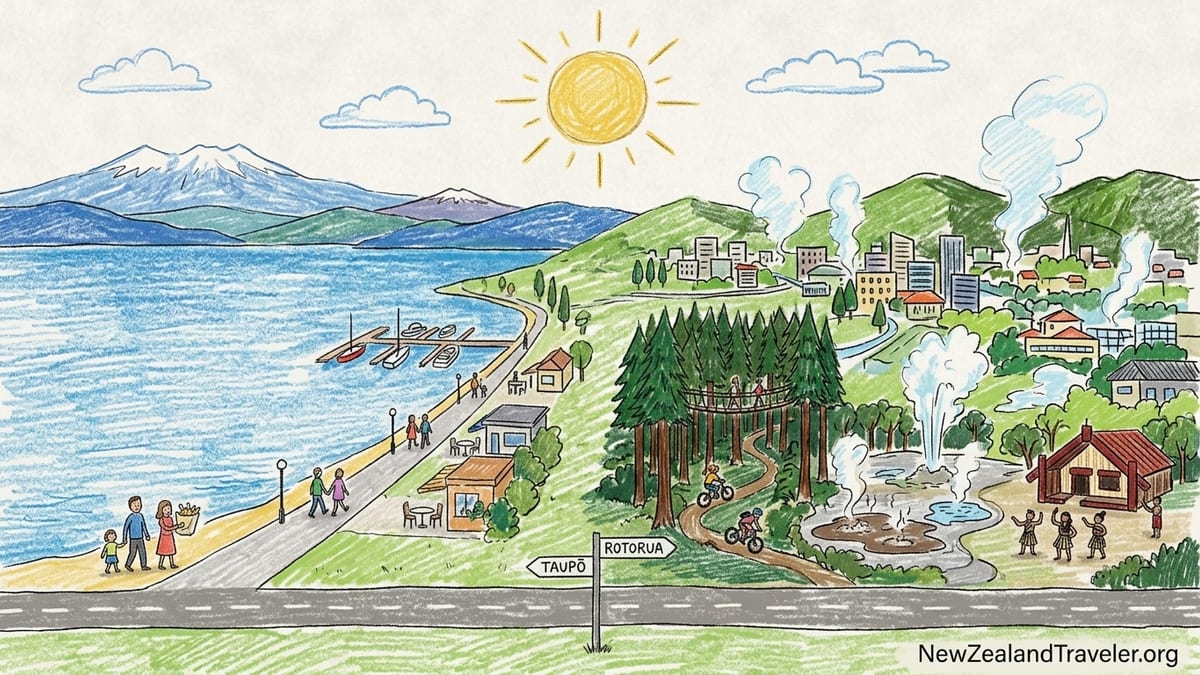
Big Picture: How Taupō and Rotorua Feel Different
Even before you factor in activities, the overall feel of each town can tilt your decision. Taupō spreads along the shore of Lake Taupō, a vast crater lake framed by distant volcanoes in Tongariro National Park to the south. The lakefront promenade, marina and wide-open water views give it a classic resort-town vibe. Cafés line the main streets near the water, and in the evening locals wander the lakefront with takeaway fish and chips or head to hot pools and pubs.
Rotorua, by contrast, feels more concentrated and urban, with suburbs spread around several small lakes and steaming geothermal pockets. You are rarely far from the smell of sulphur or a plume of steam curling from a park or backyard. Central Rotorua has more attractions within a short drive, from the Redwoods forest to major geothermal parks and Māori cultural villages, and it often feels busier, especially in high season and during events.
In practical terms, Taupō is the better base if you picture long lakefront walks, open horizons and day trips toward Tongariro or Napier. Rotorua is stronger if you want to dive deep into Māori culture, visit multiple geothermal parks, and add spa and wellness time to your days. Because the towns are only around a one-hour drive apart, some travellers even base in one and day-trip to the other, but for a short stay it helps to lean into one identity or the other.
Crime, traffic and visual polish also differ. Rotorua’s shoulder-season evenings can feel a little rough around the very centre, while Taupō’s compact core around the lakefront often feels more resort-like and walkable. That said, both are mainstream destinations with busy supermarkets, chain restaurants and tour desks, not remote wilderness outposts.
Scenery, Nature and Signature Sights
If scenery is your priority, Taupō usually wins for big horizons and classic lake-and-mountains views. On a clear day the snow-tipped peaks of Ruapehu, Tongariro and Ngāuruhoe line the southern skyline across the water. A simple lakefront stroll from the Taupō marina shows off the scale of the lake, and short drives lead to viewpoints like Acacia Bay or the lookout above the lake on the road toward Napier. Just outside town, Huka Falls channels the Waikato River into a narrow chasm, creating a roaring torrent of vivid blue water only a few minutes’ drive from the centre.
Rotorua’s beauty is more intimate and varied rather than wide-open. The Redwoods Whakarewarewa Forest offers soaring Californian redwoods with soft, needle-covered trails and a suspended treewalk after dark. A short drive leads to Lake Tikitapu, known as the Blue Lake, where you can walk a gentle loop track through forest and along small beaches. Other lakes such as Lake Tarawera and Lake Okareka offer sheltered bays and views to bush-clad hills and volcanic domes. Rotorua’s skyline may not be as dramatic as Taupō’s Tongariro peaks in the distance, but it excels at easy-access forest, short lakeside walks and atmospheric geothermal areas.
For a central North Island base focused on iconic North Island alpine scenery and the sense of a huge crater lake, Taupō is the stronger choice. If you value green forest trails, multiple swimmable lakes within 20 to 30 minutes and dramatic geothermal basins, Rotorua stacks up better. Many travellers combine them by basing in one town and using part of a day to see the other’s headline views.
Weather can influence the choice. On windy or cool days, Taupō’s exposed lakefront can feel chilly, whereas Rotorua’s forests and many hot pools provide natural shelter. In mid-winter, both towns become bases for ski trips to Mount Ruapehu, but Taupō is slightly closer to the western ski field at Whakapapa, while Rotorua makes more sense if skiing is secondary to geothermal soaking and cultural evenings.
Geothermal Wonders and Māori Cultural Experiences
Rotorua is New Zealand’s geothermal and Māori cultural capital, and that shows as soon as you arrive. Within a short drive of the town centre you can visit major geothermal parks such as Te Puia, Whakarewarewa Village, Wai-O-Tapu or Hell’s Gate. These parks typically feature smoking fumaroles, bubbling mud pools, vivid mineral terraces and, in some cases, geysers. Expect entry prices in the ballpark of 60 to 90 New Zealand dollars per adult for the larger parks with guided elements, with optional add-ons for cultural performances or carving workshops.
For Māori cultural experiences, Rotorua is clearly ahead. Evening experiences usually combine a kapa haka performance with storytelling, a hāngī meal cooked using geothermal heat or earth ovens, and sometimes a walk through a recreated pre-European village. These are not inexpensive, often running from around 150 to 250 New Zealand dollars per adult once transport and dinner are included, but they remain one of the most memorable ways to understand Aotearoa’s history and living culture in a short visit.
Taupō also sits within the wider Taupō Volcanic Zone, so it offers geothermal experiences, just fewer and on a slightly smaller scale. Craters of the Moon, a short drive north of town, provides a family-friendly boardwalk through steaming vents and craters for a relatively modest entry fee compared with the larger Rotorua parks. Wairakei Terraces combines stepped silica-like terraces with hot pools, typically with adult-focused, quieter soaking areas. Several Taupō holiday parks and hotels also pipe geothermal water into private or shared pools.
If your central North Island time is your one chance to immerse yourself in Māori culture and walk among world-famous geothermal landscapes, Rotorua deserves most or all of your nights. If you simply want one geothermal park, a couple of hot pool visits and otherwise prefer lake scenery and hiking, Taupō can deliver enough geothermal flavour without the intensity or higher concentration of parks.
Adventure, Hiking and Day Trips
Both Taupō and Rotorua have strong adventure and outdoor credentials, but the emphasis differs. Taupō is one of the country’s classic adrenaline hubs, known for skydiving over the lake, bungy jumping above the Waikato River and jet boating to Huka Falls. A standard tandem skydive over Lake Taupō often starts somewhere around 350 to 400 New Zealand dollars per person for lower jump heights, with higher altitudes costing more. Taupō bungy jumps and swings are typically a bit over 200 New Zealand dollars per person for the main products. Jet boat rides up to Huka Falls usually cost in the mid-100s per adult.
Rotorua offers plenty of action too, especially on land. The Skyline Rotorua gondola and luge complex is a full half-day for many travellers, with multiple luge track runs, a café and wine tasting at the top. Mountain biking in the Redwoods is hugely popular, from mellow forest loops to advanced downhill runs, with bike rental and shuttles available. Zipline experiences through native forest, canopy tours and off-road adventures such as 4WD or amphibious vehicles are also common, usually priced in a similar band to Taupō’s jet boating and other mid-range adventure activities.
Where Taupō clearly stands out is access to Tongariro National Park. From Taupō, it is common to arrange a shuttle to the Tongariro Alpine Crossing or other day hikes within the park, with the drive to key trailheads typically taking around 1.5 to 2 hours one way depending on the route and operator. Taupō-based tour companies regularly package early morning transfers, weather checks and return transport, which makes a one-day Alpine Crossing realistic from a two or three-night Taupō stay. Doing the same from Rotorua adds extra drive time on both ends of an already long hiking day.
As a base for wider day trips, Taupō is slightly more central for heading south to Tongariro, east to Hawke’s Bay wine country or west toward the Forgotten World Highway. Rotorua is better placed for day trips to Mount Maunganui’s beaches, the Bay of Plenty coast or short hops to additional geothermal valleys. With three to four days in the region, an adventure-focused traveller might spend two or three nights in Taupō for Tongariro and adrenaline activities and then one night in Rotorua purely for an evening cultural show and geothermal park.
Accommodation, Food and Typical Costs
Both Taupō and Rotorua offer a broad range of accommodation, from simple motels and holiday parks to lakeside lodges and full-service hotels. In practice, average nightly prices are fairly similar, with Rotorua’s median hotel price hovering around the 100 New Zealand dollar mark for simple hotels and motels in recent data, and overall averages around 110 to 120 New Zealand dollars per night for standard hotel stays, excluding peak events and holidays. Taupō often prices in a comparable band for mid-range motels near the lakefront, with lake-view apartments and boutique lodges climbing significantly higher.
Budget-conscious travellers in either town often choose classic New Zealand motels, which typically include kitchenettes, free parking and easy access to supermarkets. Expect ballpark figures of 120 to 180 New Zealand dollars per night for a central, comfortable motel for two people outside major holidays. Holiday parks with cabins or powered sites are common in both towns, with cabins often starting from around 80 to 120 New Zealand dollars per night depending on size and facilities. High-end options such as luxury lodges around Lake Taupō or boutique spa retreats near Rotorua’s lakes can easily run to several hundred dollars per night.
Food costs are also broadly comparable. A sit-down café breakfast in either town commonly falls in the 18 to 30 New Zealand dollar range per person including coffee. Pub meals and casual bistro dinners tend to cost around 30 to 45 New Zealand dollars for a main dish, with beer or wine on top. Self-catering with supermarket supplies can noticeably cut costs if you have a motel kitchen or cabin. Taupō has a particularly strong café and brunch culture along the lakefront, while Rotorua offers more takeaway options along its main strips plus a few standout restaurants that specialise in local game, hāngī-style cooking or modern New Zealand cuisine.
In terms of value, Rotorua can feel more “efficient” for attractions because many major sights are concentrated within a short drive, so you may spend less on fuel or shuttles. However, ticketed geothermal parks and cultural evenings can stack up, so it is easy to spend as much or more in Rotorua on activities than in Taupō, where walks, lake views and Huka Falls are free and costs concentrate around big-ticket adventure days.
Getting Around and Do You Need a Car?
Having a car makes both towns far easier to use as bases, especially if you want to reach trailheads, remote lakes or smaller geothermal parks. With a rental car, you can drive the roughly one-hour stretch between Taupō and Rotorua at your own pace, stopping at places like Wai-O-Tapu or smaller lakes along the Thermal Explorer Highway. Parking in both town centres and at most attractions is generally straightforward and often free or low cost compared with big-city standards.
Without a car, Taupō is more limiting. You can walk to the lakefront, marina, restaurants and some accommodation areas, and fit people can hike the riverside trail from Spa Thermal Park to Huka Falls in a few hours return. Boat cruises to the Mine Bay Māori rock carvings on Lake Taupō depart from the marina, and there are shuttles and tours to major activities like skydiving, bungy and jet boating. However, reaching Wairakei Terraces, Craters of the Moon, more distant viewpoints or Tongariro shuttle departure points usually requires either organised tours, shuttle buses, taxis or rideshares, which can add both cost and complexity.
Rotorua is somewhat friendlier to travellers without a car. Several geothermal parks offer shuttle options from central hotels or i-SITE stops, and organised tours commonly bundle multiple attractions. The Redwoods Forest is only a short drive or taxi ride from most central stays, and many hotels partner with local transport providers. You can fill two or three days using hotel pickup tours, local taxis and occasional rideshares, although hiring a bike or e-scooter for short hops can still be useful. If you plan to stick mostly to central Rotorua, nearby geothermal parks and organised cultural evenings, you can reasonably skip a rental car there.
For a trip that mixes both towns, a practical pattern is to pick up a rental car upon leaving a major gateway such as Auckland or Wellington and carry it through your central North Island days. Fuel costs in New Zealand are significant, but the flexibility to chase clear skies to Tongariro, nip to overlooked lakes at sunset or detour for a last-minute hot pool soak generally outweighs the daily rental fee for most travellers with tight schedules.
How Many Nights Each Town Deserves
With five or more nights in the central North Island, splitting time between Taupō and Rotorua makes sense for many travellers. With only two or three nights total, you are generally better off choosing one primary base and visiting the other as a day trip or short stop on your transfer day. Driving times are short enough that most itineraries can handle at least a lunch or half-day in the second town even if you sleep in only one.
For an itinerary built around Tongariro National Park, lake views and high-adrenaline activities, aim for two to three nights in Taupō and, if time allows, one or two nights in Rotorua at the start or end. This pattern lets you keep an eye on the weather for a Tongariro Alpine Crossing day, add a skydive or bungy session, and still have an afternoon for Huka Falls and the lakefront. A final night in Rotorua can then be reserved for an evening cultural experience and a geothermal park visit before you continue toward Auckland or the Bay of Plenty coast.
If your priority is Māori culture, geothermal landscapes and spa or wellness time, reverse that weighting. Plan two to three nights in Rotorua for at least one major geothermal park, an evening cultural show, a Redwoods forest walk or mountain bike ride and a long soak in lakeview or forest hot pools. Then add one night in Taupō for a change of scenery, a cruise to the Māori rock carvings and a quick visit to Huka Falls before looping back north or driving south toward Wellington.
Travellers with very limited time, such as two full days and three nights, should usually pick a single base. In this case, Rotorua is more efficient for varied activities without much driving, while Taupō is better if you crave space, lake horizons and a shot at Tongariro in good weather. Because the distance between the towns is short, you can still treat the other as a long half-day detour as you arrive or depart, but trying to sleep in both with only two nights can lead to more packing and unpacking than enjoyment.
The Takeaway
When you strip away marketing slogans, the choice between Taupō and Rotorua as a central North Island base comes down to priorities. Taupō excels at big-lake scenery, relaxed resort-town vibes and access to Tongariro’s volcanoes and high-country hikes. It is also the stronger base for classic adventure tourism, from skydiving and bungy to jet-boating against the thunder of Huka Falls. Many of its best experiences, from lakeside walks to river trails, cost little or nothing, which helps balance the price of big-ticket thrill days.
Rotorua, by contrast, is the obvious choice if you want your trip to revolve around Māori culture, geothermal parks and spa time. Few places in the country offer such an intense concentration of bubbling mud, geysers, hissing steam vents and indigenous storytelling within such short driving distances. A few days here can include a marquee geothermal attraction each morning, a forest walk or bike ride each afternoon and an evening spent in hot pools or at a cultural performance.
With four or more nights in the region, the ideal answer is often “both.” Spend several nights in Taupō for the lake, Huka Falls and Tongariro, then transfer to Rotorua for two nights of geothermal and cultural immersion, or reverse the order based on your flight route. With only two or three nights, lean into the town whose personality best matches your travel style and treat the other as a bonus stop. In either case, you will still experience the essence of New Zealand’s volcanic heartland, framed by steaming earth, deep lakes and the silhouettes of distant volcanoes.
FAQ
Q1. Is Taupō or Rotorua better if I only have two nights?
For just two nights, Rotorua usually gives more varied experiences with less driving, thanks to its dense cluster of geothermal parks, the Redwoods forest and Māori cultural evenings. Taupō is better if you mainly want lake scenery and a relaxed base with one or two major activities such as skydiving or a scenic cruise.
Q2. Can I visit both Taupō and Rotorua in one day?
Yes, the drive between them is roughly one hour, so you can travel between the two, stop at a geothermal park on the way and still have time for a short lakeside walk. However, trying to visit major attractions in both towns in a single day often feels rushed, so it is better to base in one and use the other as a focused half-day stop.
Q3. Which town is better for Māori cultural experiences?
Rotorua is the clear winner for Māori cultural experiences, with multiple evening shows, hāngī feasts and cultural villages offering guided tours, performances and storytelling. Taupō has important Māori history and art, including the rock carvings at Mine Bay, but not the same depth of structured cultural tourism.
Q4. Do I need a car to enjoy Taupō and Rotorua?
A car is very helpful in both towns, especially for reaching trailheads, remote lakes and smaller geothermal sites. You can manage without one more easily in Rotorua by relying on organised tours, shuttles and taxis to major attractions. In Taupō, you can walk to the lakefront and join some tours from town, but a car gives far more flexibility, especially for Tongariro day trips.
Q5. Which base is better for hiking the Tongariro Alpine Crossing?
Taupō is generally the better base for the Tongariro Alpine Crossing because it is closer to common shuttle departures and reduces total time spent in transit on an already long hiking day. Many operators run early morning return shuttles from Taupō, while starting from Rotorua adds extra driving both before and after the hike.
Q6. How do accommodation prices compare between Taupō and Rotorua?
Average prices for mid-range motels and hotels are broadly similar in both towns, with typical nightly rates for simple hotels often a little over 100 New Zealand dollars outside peak periods. Rotorua’s high concentration of attractions can sometimes make it feel like better value for activities in a short stay, while Taupō offers more free scenic walks and lakefront time to balance your budget.
Q7. Is Taupō or Rotorua better for families?
Both can work well for families, but Rotorua has a denser bundle of family-friendly attractions such as luge rides, farm shows, geothermal parks and canopy walks all within a short drive. Taupō offers easy lake access, playgrounds, simple walking tracks and hot pools, plus more space and a resort-town feel, which some families prefer for a slower holiday.
Q8. What is the best way to split my time if I have five nights?
With five nights, a common split is three nights in Rotorua and two in Taupō if you prioritise culture and geothermal landscapes, or three nights in Taupō and two in Rotorua if you are more interested in Tongariro hikes and lake-based adventure. This balance gives you at least one full day in each town plus an extra day to chase weather-dependent activities.
Q9. Which town has better hot pools and spa options?
Rotorua has a greater variety of developed spa complexes, from family-friendly public pools to quieter lakeview and forest-fringed hot springs, many using geothermal water. Taupō also has excellent hot pools, often focused around holiday parks and a few large complexes, and some visitors prefer its slightly calmer atmosphere, but Rotorua still offers the broader spa and wellness scene overall.
Q10. Is it safe to walk around Taupō and Rotorua at night?
Both towns are popular tourist destinations and most visitors experience no problems, but it is still sensible to take normal precautions. In practice, the lakefront and central dining areas in Taupō often feel like relaxed resort strips after dark, while some blocks in central Rotorua can feel a little rough later at night. Sticking to busy, well-lit areas, avoiding isolated back streets and using taxis or rideshares when unsure is a sensible approach in both places.