


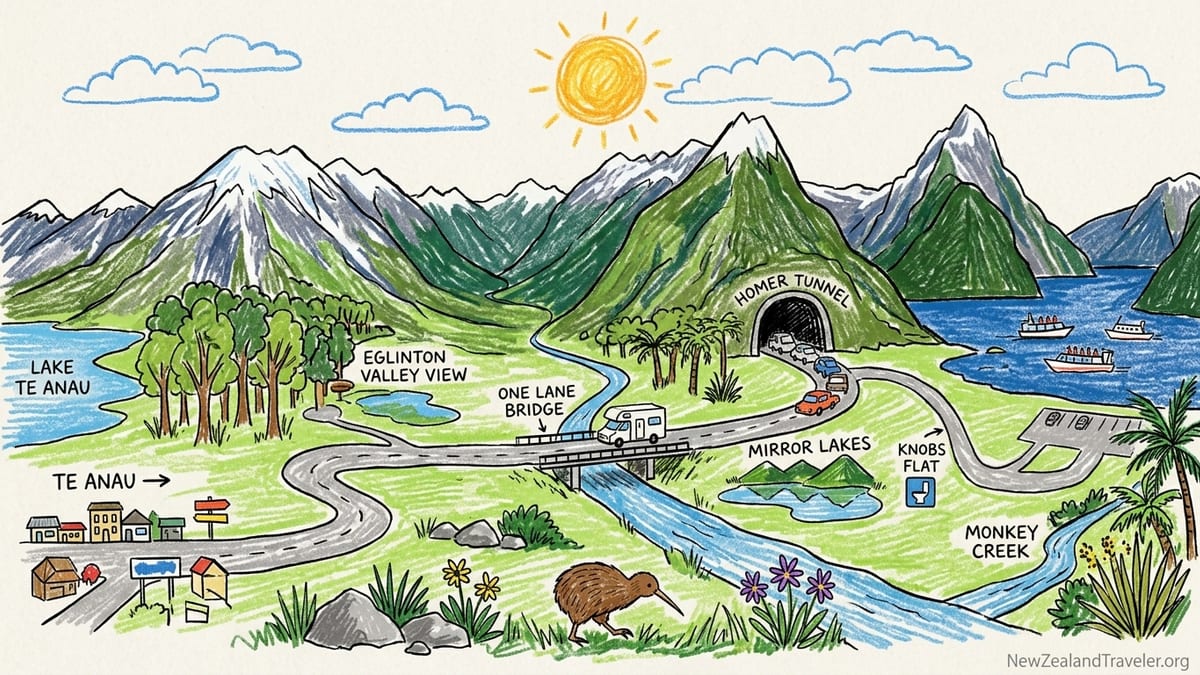
The 120 kilometre drive from Te Anau to Milford Sound on State Highway 94 is one of New Zealand’s great alpine roads. It is also far more demanding than the raw Google Maps estimate suggests. This is your definitive, practical guide to driving the Milford Road yourself, so you can enjoy the Eglinton Valley, Monkey Creek and the Homer Tunnel without risking a missed cruise departure at the end of the road.
How Long You Really Need From Te Anau to Milford
On paper, Te Anau to Milford Sound is about 120 kilometres one way. Official material from New Zealand’s Department of Conservation notes that the journey takes at least two to two and a half hours of pure driving in good conditions, with no sightseeing stops at all. In reality, almost nobody drives this road non stop, because many of the highlights, from Eglinton Valley to Lake Gunn and Monkey Creek, are right beside the highway.
Visit Fiordland and other regional tourism sources now suggest allowing around three hours from Te Anau to Milford if you plan to make several short stops for photos and quick walks. That figure is a much better reflection of an actual self drive day than the 1 hour 45 minute style estimate often shown by mapping apps. The gap comes from built in delays such as waiting for your turn through the one way Homer Tunnel, slowing for one lane bridges, or easing off behind campervans and tour coaches on the steeper sections.
For most self drivers, a simple rule works well: treat the road itself as a major attraction and give it the same respect you give the cruise. If you want to enjoy two or three short walks and several viewpoints on the way in, plan on at least three hours of travel time from Te Anau to Milford Sound. In winter, or if the forecast mentions snow, ice or heavy rain, add at least another 30 to 45 minutes in each direction.
When you factor in a two hour cruise and breaks at Milford itself, a relaxed Te Anau based day typically means seven to eight hours between leaving your accommodation and returning in the late afternoon. This is manageable if you are starting and ending in Te Anau, but it becomes a very long day if you are trying to continue directly to or from Queenstown on the same date.
Road Conditions, Safety and Why Google Is Misleading
The Milford Road is fully sealed, but it is not a simple highway run. After the relatively gentle first stretch along the side of Lake Te Anau, SH94 becomes a narrow, winding mountain road that crosses one lane bridges, runs beneath avalanche paths and climbs to the eastern portal of the Homer Tunnel. Waka Kotahi, the national transport agency, treats the upper section around the tunnel and Hollyford Valley as a specialist alpine route with active avalanche control and winter driving restrictions.
Google Maps and similar apps calculate driving time on speed limits and average traffic, but they cannot predict when you will meet a slow campervan, or how long you will wait at the traffic lights that control one way flows through the Homer Tunnel. In busy summer periods it is common for drivers to wait 10 to 15 minutes at the tunnel entrance. In winter, controlled convoys and checks on chain use can stretch that longer. None of this appears in a clean 1 hour 50 minute estimate on a phone screen.
Real world reports from recent travellers between Te Anau and Milford describe a non stop driving time of around two to two and a quarter hours in good summer weather, stretching to around two and a half hours when the road is wet or there is heavier traffic. Add even a couple of genuine stops and it becomes very easy for a supposed two hour journey to reach three hours. This is why many operators now urge private drivers to arrive in Milford at least 30 minutes before cruise check in.
Before you set off, make the official SH94 Milford Road status page and travel advice from Waka Kotahi and the Department of Conservation part of your routine. These sources carry live information about closures, controlled hours, chain requirements and avalanche zones. In heavy rain the road can close at the Cleddau River bridges near Milford, while in winter avalanche control around the Homer Tunnel can delay opening until late morning or close the road altogether. Treat these updates as mandatory pre departure reading rather than an optional extra.
Essential Logistics: Fuel, Food, Toilets and Mobile Coverage
There are no fuel stations between Te Anau and Milford Sound. The return journey is about 240 kilometres, plus any extra driving around Te Anau or side trips, so you should start with a full tank. Local rental car companies often remind customers that running out of fuel on SH94 leads to expensive recovery fees, because this is an isolated alpine route. If you are driving an electric vehicle, check current information about charging options in Te Anau and do not rely on charging at Milford itself.
Food and supplies are just as limited. Once you leave Te Anau there are no cafés or supermarkets on the Milford Road. The visitor facilities at Knobs Flat sometimes include seasonal accommodation and a small range of supplies, but you should not assume you can buy a fresh lunch or snacks there on any given day. The terminal area at Milford Sound offers cafés linked to cruise operators, but prices are significantly higher than in Te Anau and opening hours reflect cruise schedules rather than casual drop ins.
Public toilets are better distributed, but still require planning. There are flush toilets at Knobs Flat, at The Divide and at Milford Sound itself, along with some basic facilities at popular stopping points such as the Eglinton Valley and The Chasm when it is open. In peak season it is common to find queues at Knobs Flat just before mid morning as convoys of cars and buses arrive at similar times, so be prepared for short waits. Families travelling with young children often find it easier to plan a quick stop at every major facility rather than hoping to hold out until the next one.
Mobile coverage on SH94 is patchy to non existent for much of the drive. There is service in and around Te Anau, and some travellers report limited reception near Te Anau Downs and again closer to Milford, but vast stretches of the Eglinton Valley, Lake Gunn area, Hollyford Valley viewpoints and the Homer Tunnel have no signal at all. This means you cannot rely on streaming navigation, last minute email confirmations or calling a cruise company if you are running late. Download offline maps, screenshot booking details and agree a clear rendezvous time and place before you leave Te Anau.
Driving SH94: Chains, Campervans, Bridges and the Homer Tunnel
From June to around September, the Milford Road regularly experiences snow and ice. Waka Kotahi may require vehicles to carry snow chains, and on some days chains must be fitted to drive through the upper section near the Homer Tunnel. Check the live road information on the morning of your trip, and again before you leave Te Anau if the forecast is marginal. Rental car contracts often specify when and where you may use chains, so ask the rental depot staff in Queenstown or Te Anau to show you how to fit them before you head north.
Campervans and larger motorhomes are common on SH94, particularly between November and March. These vehicles climb more slowly on steep grades and take longer to brake on wet surfaces. Treat them as part of the rhythm of the road rather than an obstacle to be beaten. Where safe, use designated passing lanes and wide shoulders to let faster traffic by, and resist the temptation to overtake on blind corners in the Eglinton Valley or just before the tunnel. Local police and road crews regularly warn that impatient overtaking is one of the biggest safety risks on the Milford Road each summer.
Several one lane bridges break up the drive, especially in the middle section of the road. New Zealand’s standard give way signs show which direction has priority, but you should always slow right down and check that oncoming traffic has stopped before you cross. In heavy rain some of the smaller bridges can have surface water or debris on them, so reduce speed further and allow for the possibility of slippery patches. Drivers in unfamiliar rental cars often underestimate how much longer it takes to stop on wet chip seal compared with dry city asphalt.
The Homer Tunnel itself is a key feature of the road. It is about 1.2 kilometres long with a clear one way traffic light system. Approaching from the Te Anau side, the road climbs steeply to the portal and there is usually a line of cars and buses waiting for the next green phase. Turn your headlights on, leave a generous gap to the vehicle in front and be prepared for drips from the tunnel ceiling. Inside, the gradient changes and the road descends toward Milford. When you emerge on the Milford side, you reach some of the steepest hairpin bends of the entire route. Use low gear, particularly in a campervan, and keep speeds modest on the descent.
Geographic Guide: From Te Anau to Eglinton Valley and Mirror Lakes
Leaving Te Anau, the first 30 kilometres of SH94 track the eastern shore of Lake Te Anau. This stretch is relatively open, with farmland, lake views and the small harbour at Te Anau Downs, where boats depart for the famous Milford Track. Many drivers decide to push through this section without stopping so they can bank time for the more dramatic scenery further on, but a quick five minute pull in at Te Anau Downs works well if you want a last look back at the lake.
Shortly after Te Anau Downs, the road enters Fiordland National Park and joins the valley of the Eglinton River. The Eglinton Valley viewpoint, roughly 60 kilometres from Te Anau, is usually the first major stop of the day. A wide open grassed valley floor sits beneath steep, forested mountains on either side, and the roadside parking area gives easy access to sweeping views. You can enjoy the essence of the location in five to ten minutes, which makes it a good option if you are running slightly behind schedule but still want a sense of being in the heart of Fiordland.
A few minutes further on, Mirror Lakes offers one of the most photographed scenes on the Milford Road. A short boardwalk leads from the car park to a series of small lakes and reflective ponds under the Earl Mountains. When the air is still, the mountains and beech forest reflect almost perfectly in the water. Department of Conservation material suggests allowing about ten minutes here, but many travellers happily spend 20 to 30 minutes walking the loop and waiting for the breeze to drop. If you are working to a tight timetable for a late morning cruise, treat Mirror Lakes as a flexible stop that you can skip on the return journey if you prefer.
Between Eglinton Valley and Mirror Lakes there are several informal pull outs beside the road where operators sometimes pause for brief photo stops. If you are self driving, only use clearly formed laybys, not the soft shoulder. Park fully off the carriageway and keep children well away from moving traffic. The combination of distracted tourists and a narrow highway can make these spots more dangerous than they appear in postcards.
Knobs Flat, Lake Gunn, The Divide and Hollyford Valley
Continuing north, Knobs Flat is the main services hub on the Milford Road. It sits roughly halfway between Te Anau and Milford Sound and includes accommodation, a small information shelter and flush toilets. Some seasons see a small kiosk or reception area offering basic supplies, but availability can vary, so treat Knobs Flat primarily as a toilet and information stop. Most drivers spend around 10 to 15 minutes here. If you arrive to find a tour coach unloading passengers, consider stopping again on the way back when it is quieter.
Beyond Knobs Flat, the road tracks alongside Lake Gunn and Lake Fergus, with several signed parking bays that give access to Lake Gunn Nature Walk and other short trails. The Lake Gunn loop is a popular option for self drivers because it offers classic Fiordland beech forest and lakeside views in a compact package. The full circuit can take around 45 minutes, but you can also do a shorter out and back along the lakeshore in 20 minutes if you are watching the clock. For many visitors, this is the one stop where it truly makes sense to budget 30 to 60 minutes on the way to Milford, then focus on quicker viewpoints elsewhere.
The Divide, further along the highway, is the high point of SH94 and the trailhead for multi day walks like the Routeburn Track, as well as the popular Key Summit day walk. Facilities include a car park and toilets. If you are driving to a fixed cruise time, The Divide is not usually the place to start a long walk. The Key Summit return hike takes several hours for most people, which is better suited to a separate hiking day based in Te Anau or a one way bus and walking itinerary. For cruise focused drivers, a brief five to ten minute leg stretch and toilet stop at The Divide is usually enough.
Not far beyond The Divide, short detours and roadside viewpoints offer glimpses into the Hollyford Valley, one of Fiordland’s major river systems. Here the character of the road becomes more overtly alpine, with steeper slopes, sharper corners and more frequent warning signs about rockfall and avalanche zones. Pull outs here often sit beside sheer drops or tight bends, so only use the clearly marked areas and keep stops brief, in the order of five to ten minutes. This is a part of the drive where it can be better to simply slow down, open the windows and absorb the scenery as you roll rather than jumping in and out of the car repeatedly.
Monkey Creek, Homer Tunnel and The Chasm
Monkey Creek, set within the upper Hollyford Valley as you approach the Homer Tunnel, is another classic Milford Road stop. Crystal clear glacial water rushes past a car park framed by steep, snow streaked peaks. Interpretation panels explain the local geography and wildlife, including stories about the rare whio blue duck that sometimes inhabits the area. Many guided tours allow 15 minutes here, which is usually enough time for photos and a short wander without eating too far into your schedule. If you are keen photographers, budget 20 to 25 minutes, but keep an eye on the time so you do not arrive at the tunnel just as a long queue forms.
The stretch between Monkey Creek and the tunnel often has snow on the ground in winter and early spring, and roadside avalanche warning signs are prominent. If Waka Kotahi has chains required notices in place, road crews or electronic boards will advise where to fit them. Campervans in particular should follow these instructions carefully and avoid stopping anywhere in signed avalanche zones. Many drivers choose not to stop at all in this short section when snow conditions are active, and instead focus on safer viewpoints lower in the valley.
Once through the tunnel and down the Cleddau Valley’s hairpins, you reach the area that once provided access to The Chasm, a short forest walk to powerful waterfalls that plunge through sculpted rock. The Chasm track and car park have been closed in recent seasons because of storm damage and ongoing safety work, and at the time of writing there is no confirmed reopening date. Before your trip, check the current Milford Road area alerts from the Department of Conservation to see whether The Chasm has reopened. If and when it does, allow 20 to 30 minutes for the walk and viewing platforms. Until then, expect to drive directly past this point without stopping.
The final run into Milford from The Chasm area follows the Cleddau River through dense forest. There are a few unsigned pull outs used by locals and guides for short stops, but traffic can be heavy and space is limited. With the cruise terminal now only 10 to 15 minutes away, most self drivers prefer to continue directly into Milford, secure parking and check in, then worry about additional viewpoints on the way back toward Te Anau in the afternoon.
Milford Sound Parking, Terminal Walks and Ideal Cruise Times
Milford Sound has a managed parking system with paid and free options. The main paid car park, sometimes signed as Car Park A, is closest to the visitor terminal and wharves. From here, it is typically only a three to five minute walk along sealed paths to the check in desks of cruise companies such as RealNZ, Southern Discoveries or Jucy Cruise. Parking fees are charged by the hour and managed by the local tourism operator, with recent reports mentioning charges in the order of several New Zealand dollars per hour. Exact prices can change, so check the latest information before you go and carry a bank card for payment.
A second paid car park, often referred to as Car Park B, and a larger free car park at Deepwater Basin sit further from the terminal. The free parking area can involve a walk of around 25 to 30 minutes each way along the foreshore and access road. Some travellers describe this as a highlight of their visit on a fine day, with Mitre Peak and the fiord ahead, while others find it stressful when they have a cruise time looming or heavy rain sweeping in. If you know you will be using the free car park, add a full extra hour to your timetable to cover the walk in and back out, particularly if you are travelling with young children or older relatives.
In peak season the paid car parks can fill, especially before mid morning and around lunchtime when most bus tours arrive. That means a driver who was counting on a quick park near the terminal may instead find themselves directed to Deepwater Basin. The safest approach is to treat the paid car park as a bonus and assume you may need the longer walk. Aim to be physically parked at Milford Sound at least 45 to 60 minutes before your cruise check in time. This buffer covers the walk, a last toilet stop, and any delays in finding a space or paying for parking.
For travellers who want to enjoy the Milford Road rather than racing through it, cruise timetables matter. From a Te Anau base, a mid to late morning cruise, for example between 11:00 and 12:30, usually works well. Leaving Te Anau around 7:30 allows three hours of unhurried driving with several short stops, followed by time to park and stroll to the terminal. An early afternoon sailing can also work, but creates more pressure if you want to be back in Te Anau before dark in autumn or winter. Very early cruises may suit overnight guests at Milford Lodge or those arriving from coaches, but they often force self drivers to choose between skipping most stops or driving in pre dawn conditions.
Building Your Own SH94 Self Drive Itinerary
Putting all of this together, a realistic self drive itinerary from Te Anau might look like this. Leave Te Anau around 7:30 with a full tank and a packed lunch. Reach Eglinton Valley around 8:30 and spend five to ten minutes enjoying the open vistas. Continue to Mirror Lakes around 8:45, allowing 15 to 20 minutes for the boardwalk. Arrive at Knobs Flat by about 9:15 for a ten minute toilet and coffee thermos break, then drive on to Lake Gunn Nature Walk, reaching it close to 9:45 for a 30 minute forest and lake loop.
From there, a brief stop at The Divide or a Hollyford Valley viewpoint around 10:30 can break up the next section before you roll into Monkey Creek by about 10:45 for 15 minutes of photos. After that, you reach the Homer Tunnel queue, where you might wait ten minutes before driving through and descending into the Cleddau Valley. Even with this generous pattern of stops, you are likely to enter the Milford Sound parking area between 11:15 and 11:30, comfortably ahead of a 12:00 cruise check in.
On the way back, you can adjust based on weather and energy. If low cloud has hidden the peaks in the morning, you might find that the light has improved for photos in the early to mid afternoon. Many drivers choose different stops on the return journey, pulling into quiet laybys that were crowded on the way in, or revisiting favourites like Lake Gunn in softer light. Just remember that fatigue can set in after a full day of driving and a cruise, so share the driving where possible and allow time for a short break at Knobs Flat or in the Eglinton Valley on the way back to Te Anau.
If the idea of driving a winding alpine road after a long day feels daunting, consider mixing a self drive one way with a coach transfer the other, or simply booking a coach and cruise package from Te Anau. These trips often include several of the same stops covered here and remove the stress of parking, tunnel queues and time management. For confident drivers, though, the Milford Road remains one of the most rewarding self drive experiences in New Zealand when tackled with realistic timing, good planning and respect for the conditions.
FAQ
Q1. How long does it really take to drive from Te Anau to Milford Sound?
Most drivers should allow around three hours from Te Anau to Milford Sound, which covers normal traffic, a few short stops and likely delays at the Homer Tunnel.
Q2. What is the safest cruise time if I am driving myself from Te Anau?
A late morning cruise, roughly between 11:00 and 12:30, gives you enough time to leave Te Anau around 7:30, enjoy key stops on SH94 and still park without rushing.
Q3. Is there fuel or charging available anywhere between Te Anau and Milford?
No. There are no fuel stations or EV chargers on SH94 between Te Anau and Milford Sound, so you must start with enough fuel or charge for at least 240 kilometres.
Q4. Do I need snow chains to drive the Milford Road in winter?
In winter, Waka Kotahi sometimes requires vehicles on SH94 to carry or fit chains near the Homer Tunnel. Check the live road status page on the day you travel.
Q5. How bad is the mobile reception on the Milford Road?
Outside Te Anau and the Milford terminal area, mobile coverage is very limited. Expect long stretches with no signal and download maps and confirmations in advance.
Q6. Where are the main toilet stops between Te Anau and Milford Sound?
Key toilet locations include Knobs Flat, Lake Gunn or nearby sites, The Divide and the facilities at Milford Sound. Some viewpoints also have basic toilets in season.
Q7. How long should I plan to stop at places like Mirror Lakes and Monkey Creek?
Mirror Lakes usually takes 10 to 20 minutes, while Monkey Creek is often a 10 to 15 minute photo and viewing stop. Lake Gunn walks can take 30 to 60 minutes.
Q8. What is the parking situation at Milford Sound for private cars?
There are paid car parks close to the terminal, plus a free car park at Deepwater Basin that involves a 25 to 30 minute walk each way. Arrive early to secure a space.
Q9. Is it realistic to drive from Queenstown to Milford and back in one day?
It is possible but very long, often 10 to 12 hours door to door. Many travellers prefer to base in Te Anau and tackle the Milford Road from there instead.
Q10. What happens if the Milford Road is closed by weather or avalanches?
If SH94 closes, you cannot drive to Milford and cruises may be cancelled or adjusted. This is why checking the official Milford Road status page before departure is essential.