


Milford Sound is the cruise that defines Fiordland. When travelers search for Fiordland tours in 2026, Milford Sound sailings dominate the results, yet the choices on the water often look confusingly similar. Boats vary in size, passenger numbers, style of commentary, how close they push toward waterfalls and the Tasman Sea, and whether food is a quick snack or a full buffet. This guide unpacks those differences in plain language so you can match the right Milford Sound cruise to your budget, travel style and tolerance for crowds.
Understanding the Milford Sound Cruise Landscape in 2026
Milford Sound sits inside Fiordland National Park on New Zealand’s South Island and is reached by road from Te Anau in about two hours and from Queenstown in around four to five hours. Almost every visitor ends up on a boat, which is why Milford cruises dominate the wider Fiordland booking ecosystem. In 2026, the core players you will see again and again are Cruise Milford, Mitre Peak Cruises, Southern Discoveries and RealNZ, with a few smaller brands and charter operators filling gaps in the timetable.
For most travelers the first surprise is pricing. Verified 2026 comparisons put mainstream adult day-cruise fares between roughly NZ$165 and NZ$389, depending on season and whether transport from Queenstown or Te Anau is included. Cruise Milford positions itself at the premium small-boat end at about NZ$189 per adult for cruise-only departures from Milford, while Mitre Peak’s standard 2 hour cruise currently starts in the NZ$169 to NZ$179 range. Southern Discoveries lists its Milford Sound Nature Cruise from about NZ$179 for cruise-only, with coach-and-cruise packages from Queenstown starting around NZ$259. RealNZ’s Milford Sound Signature Cruise for self-drivers often starts close to NZ$199 per adult. Exact prices move with seasonal demand and discounts, but these anchor points are reliable planning figures.
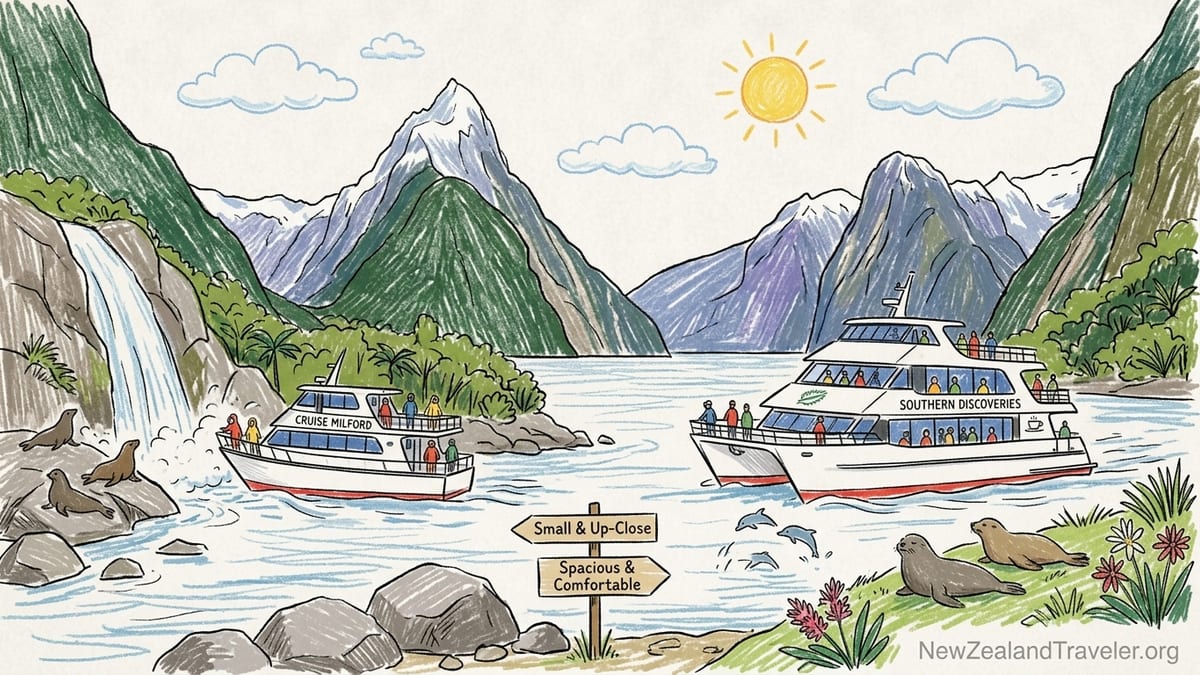
The second surprise is how different the on-water experience can feel despite those similar numbers on a booking page. Small boats like Cruise Milford and Mitre Peak typically cap passenger numbers around 60 to 75 people, with a significant share of open deck space and commentary delivered by a live nature guide on a single vessel that feels intimate. Larger nature-cruise operators such as Southern Discoveries and RealNZ run higher-capacity vessels with several indoor lounges, more structured commentary, and a broader range of food and package options. Your choice between those styles will shape whether Milford feels like a quiet wilderness encounter or a social, almost ferry-like sightseeing trip.
Finally, Milford Sound cruises differ in how far they travel. Some itineraries turn back from near the Tasman Sea, while others, including Mitre Peak’s 2 hour sailing and many nature cruises, push all the way out to the mouth when sea conditions allow. That is where passengers are more likely to feel ocean swell, which matters if you are prone to seasickness. All reputable operators prioritize safety and will modify the route on days when wind and wave conditions deteriorate.
Small Boat vs Larger Nature Cruise: What Really Changes
Small-boat cruises are the closest thing Milford has to a boutique experience. Cruise Milford and Mitre Peak Cruises are the names most independent travelers mention when they want fewer people and a better chance at unobstructed views. Both use vessels that are compact enough to hug the cliffs, nose into the spray of Stirling or Bridal Veil Falls, and swing close to seal colonies hauled out on the rocks. With around 60 to 75 passengers on board when full, it is possible for everyone who wants to be outside to find rail space at the bow or stern without jostling.
The trade-off with small boats is indoor comfort. While both Cruise Milford and Mitre Peak vessels offer heated cabins, toilets, and basic hot drinks or snacks, their lounges are smaller, and sheltered seating fills up quickly on busy or wet days. That matters in Milford, where heavy rain is common and sometimes relentless. On a stormy afternoon, a family with small children may prefer the larger warm lounge and more structured facilities on a big nature-cruise vessel, even if it feels less exclusive out on deck.
Larger nature cruises from Southern Discoveries and RealNZ lean into capacity and amenities. Their main Milford Sound vessels carry several hundred passengers at full load, spread across multiple decks and indoor viewing areas with full-height windows. Outdoors, there are broad forward decks and side walkways, but spaces at the very front can still feel busy at peak midday departures when several coach loads arrive all at once. These operators often include or upsell more substantial food, from cabinet snacks and barista coffee through to packed lunches and, on some premium or longer cruises, buffet-style meals.
Another key difference lies in commentary style. Small-boat crews tend to deliver informal, highly interactive narration, pointing out features like Sinbad Gully or the hanging valleys above Lady Bowen Falls as they appear, and answering questions directly. On many larger nature cruises, there is a mix of live guiding and pre-recorded commentary in multiple languages, sometimes supplemented by an onboard nature guide who roams between decks. If hearing detailed environmental interpretation in a language other than English matters to you, one of the larger operators may be more suitable, as they have invested in multilingual audio and mobile app commentary.
Departure Times: Beating the Day-Tour Crowds
Milford Sound’s daily rhythm is driven by buses from Queenstown and Te Anau. Coach tours leaving Queenstown early in the morning tend to reach Milford Sound in time for late-morning or early-afternoon departures, especially between about 11:30 and 14:30. That is when the car park is fullest, check-in queues are longest, and the largest vessels are scheduled to absorb the influx of passengers. If you book a midday sailing in peak season, particularly during the Southern Hemisphere summer from December through March, expect a busier terminal and more people on board, regardless of the operator.
Early-morning departures are the best way to sidestep those crowds. Self-drivers based in Te Anau can comfortably reach an 8:30 or 9:00 cruise by leaving town around 6:00 to 6:30, while Queenstown visitors who spend the night in Milford Sound or at accommodation closer to the road can also target the first boat of the day. Travelers repeatedly report that these early sailings feel noticeably calmer, with more space on deck, softer light on the cliffs, and an easier time positioning for photographs without competing elbows.
Late-afternoon departures offer another quieter window, especially for travelers who do not need to return to Queenstown the same night. Many Queenstown-based coach tours prioritize mid-afternoon cruises so that buses can clear the Homer Tunnel and reach the highway before dark. That leaves the last scheduled departures, often around 15:30 to 16:30 depending on season, less affected by large tour groups. For example, an independent self-driver who chooses a 16:00 sailing with a small-boat operator can often experience Milford with mostly like-minded independent travelers rather than the mid-day crowd spilling from multiple buses.
Morning versus afternoon also changes the mood on board. In the morning, especially outside high summer, temperatures can be cool on deck but the air is often still, and low-angled light can create dramatic shadows on Mitre Peak. Afternoon sailings may enjoy warmer air and, in settled weather, glowing late sun on the waterfalls. The main compromise is that cloud build-up and afternoon showers are more common, which is part of Milford’s character but might obscure some of the highest peaks. When planning, think first about how crowds and driving in the dark will affect your day, then refine by the sort of light you prefer for photos.
Self-Drive vs Coach-and-Cruise: Choosing How to Reach Milford
Once you have a sense of the boat style and departure time you want, the next decision is how to get to Milford Sound itself. A self-drive cruise means you book a cruise-only product with an operator such as Cruise Milford, Mitre Peak, Southern Discoveries or RealNZ, then make your own way along the Milford Road. This option offers the most flexibility for photo stops at places like Mirror Lakes or the Eglinton Valley and allows you to plan an early or late sailing that fits your personal schedule.
The trade-off is that driving Milford Road requires confidence in New Zealand conditions. The route includes narrow sections, one-way bridges, the Homer Tunnel and frequent rain or snow in the colder months. Travelers not used to mountain roads often report arriving at the terminal tired, especially after departing Queenstown before dawn to reach the first morning cruise. If you are even slightly unsure, a coach-and-cruise package can be the more relaxing and safer choice.
Coach-cruise packages are dominated by Southern Discoveries and RealNZ, each offering full-day trips from Queenstown and Te Anau. Southern Discoveries, for instance, sells a Coach and Nature Cruise from around NZ$259 ex Queenstown that bundles scenic stops, commentary and the 2 hour nature cruise. RealNZ runs similarly structured day trips from both towns, pairing a scenic coach journey with one of its Milford Sound cruise tiers. Small-group coach options also exist through specialist operators who then place you on a small-boat cruise at Milford, an attractive hybrid for travelers who want an intimate vessel but prefer not to drive.
For many visitors, the decision comes down to how often they plan to drive in New Zealand. If Milford will be your longest or only rural drive and you are nervous about winter conditions, the extra cost of a coach package can easily be justified by the ability to relax, watch the scenery and arrive fresh for your time on the water. If you are on a longer road trip with multiple alpine passes already on your route, self-driving saves money and lets you combine a cruise with walks or viewpoints before and after your sailing.
Wildlife, Waterfalls and the Tasman Sea: What to Expect on Board
Almost every Milford Sound cruise includes close approaches to the fiord’s major waterfalls and, when safe, a push out toward the Tasman Sea. The smaller boats and the larger nature-cruise vessels both usually detour to the base of Stirling Falls, where passengers on the open deck can feel the spray and, if they choose, get completely soaked in wet weather gear. On calmer days many captains will also nose toward other cascades and cliff faces so guests can see the depth of the glacial carving.
The open ocean is where the experience starts to diverge for some people. As boats approach the Tasman Sea, even a modest swell can translate into noticeable motion, especially at the bow and on the upper decks. If you are prone to seasickness, pick a mid-fiord vessel position close to the centerline, avoid looking down at your phone, and consider taking motion-sickness medication before boarding. The good news is that operators watch conditions carefully. On rough days they may turn back before the full open-water section, keeping the cruise inside the more sheltered fiord.
Wildlife is a highlight but never guaranteed. New Zealand fur seals are the most reliable, often seen basking on rocks near the mouth of the sound where both small boats and larger nature cruises pause for viewing. Bottlenose dolphins sometimes ride the bow wave of moving vessels, especially on days with fewer boats on the water, and rare Fiordland crested penguins, or tawaki, can be spotted during their seasonal visits in winter and spring. However, even the most wildlife-focused operators cannot promise sightings, so it is best to treat any animals you see as a bonus on top of the scenery.
Nature-focused cruises, particularly those branded as “Nature Cruise” or equivalent by Southern Discoveries and RealNZ, often carry an onboard nature guide whose primary job is to interpret wildlife and geology rather than simply narrate the route. They may slow down or linger longer at seal colonies, bird roosts or interesting rock formations than a basic sightseeing cruise pressed for time. Small-boat outfits like Mitre Peak and Cruise Milford, even when not labeled explicitly as “nature” departures, naturally behave like wildlife cruises because the entire trip is guided and there are fewer people to move around when something interesting appears.
Comfort, Food, Deck Space and Weather Protection
Milford Sound’s climate shapes the practical details of your cruise choice as much as price or departure time. Annual rainfall is among the highest in New Zealand, and multi-day rain events are common. That is part of the magic, as hundreds of temporary waterfalls appear on the cliffs, but it also means rain protection on board makes a real difference. Larger nature-cruise vessels have extensive indoor seating with floor-to-ceiling windows and multiple sheltered viewing decks. Families with young children, older travelers, or anyone who feels the cold will appreciate being able to step inside between photo sessions without surrendering views.
Small-boat cruises offer a more exposed but immersive experience. Open decks are closer to the water and often wrap around the vessel, which means you can shift easily between bow, sides and stern depending on where the action is. Rain jackets are usually recommended in all seasons, and on very wet days you should expect to spend at least part of the cruise outside in full waterproofs if you want the best photographs. Inside, cabins on these boats are warm but compact, so on a fully booked sailing you may find that prime window seats are taken quickly.
Food service varies by operator and product tier. On cruise-only small-boat departures, inclusions are usually limited to complimentary tea and coffee with additional snacks or light food available for purchase. You will want to eat breakfast or lunch beforehand or bring something simple with you. Larger operators often integrate food more fully into the product. Southern Discoveries sells add-on picnic-style lunches and, on some longer or premium itineraries, more substantial meals. RealNZ’s higher cruise tiers carry cabinet food, barista coffee and sometimes buffet spreads on select departures or overnight cruises. For travelers coming all the way from Queenstown on a day trip, pre-arranged meals onboard can be the difference between a comfortable afternoon and feeling ravenous halfway through the return coach ride.
Toilets are fitted on all mainstream Milford Sound cruise vessels, regardless of size, so basic comfort is not a differentiator. Where there is a difference is in how easy it is to move around. On a small vessel with 60 people, you can usually switch from indoor to outdoor spaces within a few steps, keeping an eye on wildlife and waterfalls without feeling you are commuting between decks. On the larger ships, especially in wet weather when outdoor stairways may be slippery, it takes more effort and time to move from rail to lounge and back again, something to keep in mind if you have reduced mobility.
Premium and Wildlife-Focused Experiences in Milford
Premium Milford Sound products sit above the standard day cruise and attract travelers who want extra comfort, more personal space or a different angle on the fiord. RealNZ has introduced a tiered approach with named cruise classes that step up from a classic sightseeing product to more curated, hosted experiences, and also operates an overnight cruise on the Milford Mariner for those who want to see the fiord in evening and early-morning light. Prices for these higher tiers and overnights are more substantial, but they achieve what many people want: quieter decks, upgraded food, and the sense that you are not sharing your view with a full ship of day-trippers.
Southern Discoveries has leaned into premium by developing longer “Discover More” style cruises and bundled packages such as Coach, Cruise and Farm Tour or Coach and Nature Cruise with scenic flights. A typical Coach and Nature Cruise day from Queenstown can stretch to roughly 13 hours of activity, combining the Milford Road journey, a 2 hour nature cruise, and an additional farm or lake experience, with prices climbing toward the higher end of the day-cruise range. For travelers visiting Fiordland only once, this kind of comprehensive package can make sense, concentrating multiple experiences into a single day at a predictable price.
Dedicated wildlife cruises as a separate product category are less common in Milford than nature-branded sailings that weave wildlife viewing into a general scenic program. Operators with strong naturalist guiding, such as Southern Discoveries on its Nature Cruise and RealNZ’s guided tiers, effectively function as wildlife-focused trips when conditions allow. Small-boat lines like Mitre Peak and Cruise Milford naturally emphasize wildlife and geology through their crew commentary, but they do not present themselves as guaranteed wildlife charters. If you want the highest chance of interesting wildlife behavior, shoulder seasons when crowds are thinner and animal activity can be higher along the fiord walls are worth considering.
Premium also appears in how you reach Milford. Flight and cruise combinations sold in partnership between cruise operators and flight companies from Queenstown allow you to experience the fiord from the air and the water in a single half or full day. Prices for fly-cruise or fly-coach-cruise packages typically sit in the high hundreds or more per adult, but they remove the long road leg and add a very different perspective on Fiordland’s glaciers and alpine valleys. These options are best suited to travelers with limited time on the South Island or those for whom Milford is the central highlight of their trip.
The Takeaway: Matching the Best Milford Sound Cruise to You
After comparing operators, departure times and boat styles, the most important question is simple: what kind of day do you want to remember when you think back on Milford Sound. Most cruises follow a similar route and last between 1 hour 45 minutes and 2 hours, so it is the atmosphere on board and around the terminal that shape your experience, not radical differences in scenery. Use price as a guide, but focus more strongly on group size, timing, and how you will get there.
For photographers, the sweet spot is usually a small-boat departure at the very start or end of the day. Mitre Peak or Cruise Milford on an early-morning or late-afternoon sailing put you in softer light with fewer people on deck, so you can move freely as cliffs, waterfalls and wildlife appear. Bring a weatherproof layer and expect to get wet near the waterfalls. If your budget stretches to it, combining a small-boat cruise with a flight component gives you aerial and water-level perspectives in one itinerary, which is particularly valuable for serious landscape photography.
For families, a larger nature-cruise vessel with spacious indoor lounges, full-height windows and more food options often works best. Booking a mid-morning or early-afternoon departure timed with a coach package from Queenstown or Te Anau keeps logistics simple and ensures toilets, snacks and seating are always within reach. Parents can rotate children between deck and lounge while still enjoying the scenery, and the chance of seasickness is easier to manage with more space to sit in the vessel’s middle where motion feels gentler.
For travelers who hate crowds, look for the first or last small-boat sailing of the day and, if possible, stay closer to Milford the night before so you are not bound by Queenstown bus timetables. Self-drive to an early Mitre Peak or Cruise Milford departure, or choose a later-afternoon sailing once most coaches have left. You will still share the boat with others, but the ratio of passengers to deck space will feel far more relaxed than at midday on a peak-season nature cruise.
For budget-conscious visitors, the priority is usually to secure a reliable standard cruise at the lower end of the fare range and then decide whether self-driving or a coach package costs less overall after fuel, parking and accommodation are considered. In shoulder seasons or on less popular time slots, you can often find competitive deals with mainstream operators like Southern Discoveries or RealNZ in the NZ$165 to NZ$200 bracket for cruise-only, especially if you are flexible on departure time. Saving by driving yourself from Queenstown for a midday cruise only makes sense if you are comfortable with a very long day on the road.
For people who expect to visit Milford only once, it is worth stretching slightly for an option that matches your style rather than picking purely on the lowest advertised fare. If you value intimacy and vivid memories of standing almost alone at the rail as dolphins surface near the bow, favor a small-boat operator even if the ticket is NZ$10 to NZ$20 higher. If you care more about comfort and minimal planning, choose a reputable coach-and-cruise nature product from Queenstown or Te Anau, where a single booking secures your transport, commentary and food. In either case, aim for a departure time that avoids the heaviest day-tour crush, and accept that Milford’s defining feature is its weather: rain, mist, sunlight and waterfalls shifting hour by hour over one of the world’s great fiords.
FAQ
Q1. What is the main difference between a small-boat Milford Sound cruise and a larger nature cruise?
Small-boat cruises like Cruise Milford and Mitre Peak limit passengers to roughly 60 to 75 people and focus on an intimate, up-close experience with more rail space and informal commentary. Larger nature cruises from operators such as Southern Discoveries and RealNZ carry more passengers, provide bigger indoor lounges and more food options, and offer a more structured sightseeing style with a mix of live and audio commentary.
Q2. How much does a Milford Sound cruise cost in 2026?
Verified 2026 prices for adult day cruises generally fall between about NZ$165 and NZ$389, depending on season, operator and whether coach transport from Queenstown or Te Anau is included. Cruise Milford sits around NZ$189 for cruise-only departures, Mitre Peak starts in the NZ$169 to NZ$179 range for its standard 2 hour cruise, Southern Discoveries lists its Milford Sound Nature Cruise from about NZ$179, and RealNZ’s self-drive Signature Cruise is often around NZ$199.
Q3. Which departure times are least crowded in Milford Sound?
The quietest times are usually the first departures of the day and the last sailings in the late afternoon. Midday and early-afternoon cruises, roughly between 11:30 and 14:30, tend to be busiest because they align with coach tours from Queenstown and Te Anau. If you value space and a calmer terminal, target an early-morning or later-afternoon cruise and, if possible, overnight closer to Milford to avoid rushing the drive.
Q4. Is it better to self-drive to Milford Sound or book a coach-cruise package?
Self-driving offers flexibility for scenic stops and allows you to choose quieter early or late sailings, which suits confident drivers on longer New Zealand road trips. Coach-cruise packages from operators such as Southern Discoveries and RealNZ cost more but let you avoid challenging driving conditions on Milford Road and arrive rested, with commentary and photo stops taken care of. If you are uneasy about mountain driving or visiting in winter, a coach package is often the safer and more relaxing choice.
Q5. Will I get seasick on a Milford Sound cruise?
Most of the cruise route is inside the sheltered fiord, where motion is usually gentle, but you may feel more movement as boats approach the Tasman Sea at the mouth of Milford Sound. Travelers prone to seasickness should choose a mid-ship seating position, avoid spending long periods at the bow or on upper decks when the vessel is in open water, and consider taking motion-sickness medication before boarding. On days with rougher conditions, captains may decide not to go all the way to the open ocean.
Q6. How likely am I to see wildlife such as seals, dolphins or penguins?
New Zealand fur seals are commonly seen around rocky outcrops near the mouth of the fiord, and both small-boat and larger nature cruises usually pause there for viewing. Dolphins appear less predictably but sometimes ride the bow wave of moving vessels, and Fiordland crested penguins, or tawaki, may be spotted in season along the cliffs. No operator can guarantee sightings, so treat wildlife as a welcome bonus rather than the sole reason for your cruise choice.
Q7. Which Milford Sound cruise is best for families with children?
Families often do well on larger nature-cruise vessels from Southern Discoveries or RealNZ because of the spacious indoor seating, multiple toilets, easy access to food and hot drinks, and sheltered viewing decks. A mid-morning or early-afternoon departure tied to a coach-and-cruise package simplifies logistics. Small-boat cruises can also work well for older children who enjoy being outside and do not mind getting wet, but they offer less indoor space to retreat to if the weather turns very wet or cold.
Q8. Which Milford Sound cruise should photographers choose?
Photographers generally benefit from small-boat cruises such as Mitre Peak or Cruise Milford scheduled at the start or end of the day. These sailings combine softer light with fewer passengers, making it easier to move freely along the rail and compose shots without crowded decks. If budget permits, combining a small-boat cruise with a scenic flight to or from Milford adds aerial perspectives on Fiordland’s peaks, glaciers and valleys.
Q9. What should I wear and bring for a Milford Sound cruise?
Regardless of season, plan for cold, wet and windy conditions on deck. A waterproof jacket with a hood, warm layers, beanie and gloves make time outside more comfortable. Non-slip footwear is important on wet decks, and a waterproof cover for your camera or phone helps protect gear near waterfalls. Even if your cruise includes food, carrying a refillable water bottle and a small snack is sensible, especially on longer day trips from Queenstown.
Q10. If I will visit Milford Sound only once, is a premium or small-boat cruise worth the extra cost?
If budget allows, many travelers find that paying slightly more for a small-boat cruise or a curated nature product with a strong guide presence is worthwhile for a once-in-a-lifetime visit. The extra cost usually buys more space per passenger, better access to rail positions, more immersive commentary and, sometimes, upgraded food and comfort. If those elements are important to how you remember the day, it can be worth spending a little more rather than choosing solely on the cheapest advertised fare.