


My first draft of a South Island itinerary had Te Anau circled in red with a single dismissive note: “Sleep before Milford.” On paper, it looked like a purely functional overnight between Queenstown and Milford Sound, a place to buy fuel, repack the car and set an early alarm. It was only when I slowed down and actually stayed in Te Anau, instead of treating it as a one-night layover, that I realised how different the trip feels when this small lake town becomes a base rather than a pit stop. If you are staring at your own spreadsheet wondering, “Is Te Anau worth staying in, or should I just push on from Queenstown?”, this is the decision you actually need to get right.
From “Just a Stop” to a Real Base
When I first plotted the drive to Milford Sound, I thought like many people do. Queenstown had the buzz and the marketing. Milford Sound had the drama and the cruises. Te Anau, halfway between, looked like the service town where you arrive at dusk, grab the first available motel, and leave again before sunrise. Two nights in Queenstown, one in Te Anau, then on to Milford and back again in a looping blur.
On that plan, Te Anau existed only to make the logistics work. It sits at the southern end of State Highway 94, the Milford Road, roughly 120 kilometres from Milford Sound along a two to two-and-a-quarter hour drive without stops. By contrast, Queenstown is around 290 kilometres from Milford by road, with tour companies regularly describing it as a four-hour run in each direction. That extra 170 kilometres of driving starts to matter the moment you picture 13-hour day trips and alarm clocks that begin with the number 5.
I only changed the booking when I started looking closely at the landscape around Te Anau. This was not just a fuel stop but the front door to Fiordland, with Lake Te Anau at its feet and three of New Zealand’s Great Walks accessed nearby. The more I read, the more it felt perverse to hurry past a national park gateway simply because my original spreadsheet gave Queenstown an extra night. I extended Te Anau from one night to three and cut Queenstown back. That single decision reshaped the whole Milford Sound experience.
So if you currently see Te Anau as a functional dot between “real” destinations, you are not alone. The real question, though, is what the town actually offers once you arrive, and what you lose if you do not give it the time to show you.
Lakefront First Impressions: More Than a Car Park
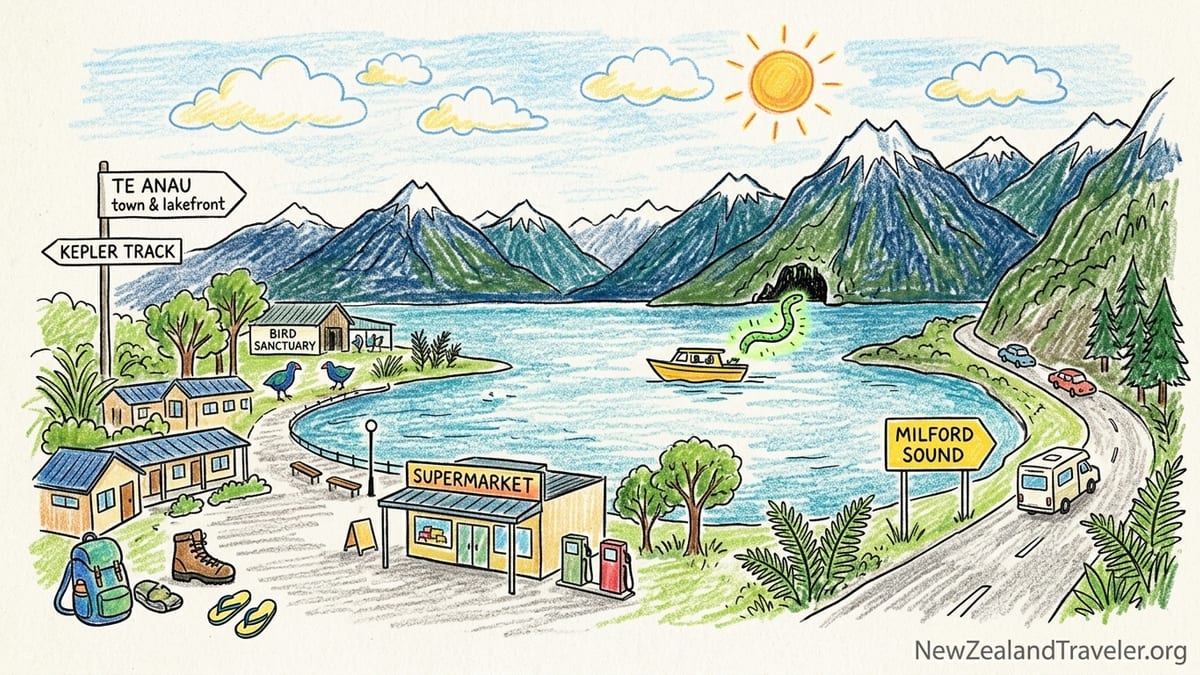
Te Anau’s lakefront is the first place that started to undermine my “just a stop” assumption. Lake Te Anau is the second largest lake in New Zealand and it comes right up to town. The main street ends practically at the water, where a simple promenade runs alongside the shore. On a calm evening the mountains sit as a dark sawtooth on the horizon, and the lake picks up pastel colours right through the long southern twilight in summer.
What struck me most was how easy it was to step out of a motel unit and be on that lakeside path in minutes. Accommodation clustered around the town centre is often described as being within walking distance of the lakefront, and in Te Anau that is literally true. Many motels and holiday parks sit only a short stroll from Lakefront Drive or the control gates road. I watched families walk down in jandals carrying takeaway pizza boxes, couples with supermarket picnic dinners, and hikers stretching sore calves after the Kepler Track, all sharing the same relaxed waterfront.
From the Fiordland National Park Visitor Centre on the shore, an easy lakeside walking track follows the edge of Lake Te Anau for about 3.5 kilometres one way. It passes the Te Anau Bird Sanctuary and continues toward the Kepler Track carpark and the control gates. It is graded as an easy walk, signposted, and within reach of almost any visitor who can manage an hour or so on their feet. As an introduction, it is hard to beat: no ticket required, no shuttle to organise, just step out of town and let the lake and mountains set your expectations for what Fiordland actually feels like.
This is also where you feel the scale shift compared to Queenstown. There are no jet-boat engines roaring past every few minutes and far fewer crowds pressing along the waterfront. Even at peak times, the lakefront in Te Anau stays relatively quiet once the day tours to Milford Sound have left. That quietness is either the very reason to stay or the sign you should be basing yourself elsewhere, depending on the kind of trip you want.
Eating, Stocking Up and Everyday Practicalities
The strongest argument for treating Te Anau as a base is that it functions as a genuine service town. The centre is small, essentially one main block of shops with side streets, but you can assemble everything you need for several days of Fiordland from there. A full-service supermarket operates in the town centre with standard New Zealand grocery pricing and a good range of fresh produce, bread and ready-to-cook items. A smaller Four Square supermarket sits even closer to the core of the shops for quick top-ups. For travellers self-catering on a road trip, this is where you stock up for Milford, the Kepler Track or longer drives deeper into Southland.
Food options cover a range that surprised me for a town this size. On one evening I walked from a simple takeaway counter doing burgers and fish and chips, past cafes that double as breakfast spots the next morning, to a character cottage restaurant offering contemporary New Zealand cuisine, local venison and Southland lamb, and a proper wine list. Other nights the choice was between an original Italian restaurant in town and a popular gastropub with outdoor seating. A handful of bakeries and cafes line the centre as well, catering to early departures with good coffee, pies and sandwiches.
You also find the slightly dull but deeply useful pieces that turn Te Anau from a scenic dot on the map into a base. Visitor information and booking desks line the main street. There is a fuel station close to the central junction for topping up before Milford. Outdoor gear shops sell waterproofs and extra layers for those who arrive underprepared for Fiordland weather. Pharmacies, ATMs, laundromats and holiday parks sit just off the centre. If you realise at 4 pm that you do not have enough snacks for the next day’s cruise or that your rain jacket is not up to hours of West Coast drizzle, Te Anau is the last convenient chance to fix that before you are reliant on much smaller roadside stops.
All of this matters because of the direction of travel. From Queenstown toward Milford Sound you pass through Te Anau and then into long stretches of national park road. There are scenic pullouts and basic facilities at some stops along the Milford Road, but there is nothing on the scale of a town. Staying in Te Anau means that when you turn north toward Milford in the morning, you are leaving from a place where you can get what you need, instead of trying to improvise far from any real services.
Quiet Nights, Glowworms and Low-Key Evenings
If your idea of a good night on holiday involves bar-hopping and live music until the early hours, Te Anau will probably disappoint you. Nightlife here is present but limited. Several pubs and hotel bars run through dinner and into late evening, and a lakefront bar and restaurant combination often draws the loudest crowd, especially in peak season. There is also a cinema in town that screens a well-known Fiordland film and current releases, paired with a bar that can keep you occupied for a relaxed night out.
What Te Anau does not have is a dense cluster of late-night bars or clubs. Most venues wind down by around 11 pm, and outside peak summer it is common to find some kitchens closing earlier. The streets go quiet fast once the last Milford day-trip buses have returned and the hikers have drifted back to their lodges. For some travellers this is the magic of the place: you can hear the lake from your motel balcony and watch the stars rather than the glow of neon signs. For others, especially those expecting Queenstown-style nightlife, it can feel too sleepy after more than a night or two.
One uniquely Te Anau evening experience, however, runs regardless of the town’s low-key nightlife. The Te Anau Glowworm Caves sit across the lake, reached by boat from a wharf close to the town centre. A long-running operator runs cruises that combine a scenic crossing of Lake Te Anau with a guided walk through limestone caves and a silent boat ride under thick clusters of glowworms. Departures usually include an evening option, which can become the centrepiece of a night in town, especially if you arrive from Queenstown mid-afternoon and want to make use of the first evening without driving further.
On another evening you might simply walk the lakefront after dinner, stepping away from the small knot of restaurants into near darkness within a few hundred metres. I remember one walk where the only sounds were quiet conversation from a lakeside bench and the soft slap of water on the stones. If your days have been filled with the noise of city centres or the long haul of driving, this gentle reset can be worth a night in itself.
Te Anau as a Hiking and Day-Trip Hub
Te Anau’s biggest strength, and the reason many people stay more than a single night, is its role as a hiking and day-trip hub. Three of New Zealand’s Great Walks are accessed from the wider Te Anau area. The Kepler Track effectively starts on the edge of town, with the main carpark at the control gates only about 5 kilometres by road from the centre and roughly a 50-minute walk along the lakefront from the Fiordland National Park Visitor Centre. Shuttle operators in season run regular transfers from accommodation to the track heads, so you can walk out the door in the morning and be on a Great Walk not long after.
Even if you are not doing the full multi-day Kepler circuit, several short sections make excellent half or full-day outings. A popular option is to walk from the Kepler carpark through beech forest and past beaches to one of the picnic spots along the lake, then return the same way. Fitter hikers can tackle the demanding climb from the carpark to Luxmore Hut for a taste of alpine ridgelines and wide views over Lake Te Anau, turning back the same day. For families or those with limited time, walking from the Te Anau bird sanctuary along the lakeside track toward the control gates gives a sense of the track without committing to long distances.
Beyond the Kepler, Te Anau is the practical staging point for the Milford Track and the Routeburn Track. Bookings, gear hire and shuttle logistics are typically handled by companies based in town, and buses connecting to Te Anau Downs or other trailheads depart from here. Even if you are only adding a single Great Walk day section to an otherwise standard South Island itinerary, basing in Te Anau simplifies your mornings and shortens your transfers.
There is also Manapouri, a quieter settlement about a 15 to 20-minute drive from Te Anau, which acts as the launch point for Doubtful Sound cruises. Staying in Te Anau gives you easy access to both Milford and Doubtful Sound experiences without constantly repacking bags and changing towns. In practice, many travellers will spend one long day north to Milford and another south toward Manapouri and Doubtful, returning to the same bed each night. If your trip is built around Fiordland’s fjords and walks, Te Anau is the natural hub that keeps your schedule sane.
The Milford Distance Advantage
All of these qualities matter, but for many planners the decision still comes down to one practical question. Is it better to visit Milford Sound from Queenstown or from Te Anau? The distances give a clear indication. The Milford Road from Te Anau to Milford Sound runs for roughly 120 kilometres through Fiordland National Park. Official guidance suggests allowing at least two hours and fifteen minutes of driving time in good conditions without stops. In reality, few people drive straight through without pausing at mirror lakes, short walks and scenic pullouts, so a one-way trip can easily become three hours or more with photo and toilet breaks.
By contrast, Queenstown sits around 290 kilometres from Milford Sound by road. Even if you allow only four hours each way, the arithmetic for a day trip begins to look tight. Many Queenstown-based tours advertise ten to thirteen-hour days, with early morning pick-ups and evening drop-offs. That can work if Milford is the highlight of your trip and you are comfortable with long days on a coach. But if you want to make your own stops, or if you are driving and unused to narrow, winding mountain roads, the prospect of eight hours behind the wheel in a single day is less appealing.
Staying in Te Anau usually cuts the driving time to and from Milford roughly in half. It turns a big day into a long but comfortable one, and it means you start that drive from a calmer place. Instead of leaving a busy Queenstown hotel in the dark, rushing to fill fuel and pick up breakfast, you can walk to a cafe in Te Anau at a reasonable hour, grab coffee and food, and roll out knowing the hardest part of the day is not simply getting there.
There is a second, subtler advantage too. Weather in Fiordland is famously changeable, with heavy rain and low cloud common in any season. If you stay in Te Anau for two or more nights you gain flexibility. If forecasts show torrential rain on your first day and partial clearing on the second, you can swap Milford and local walks around, choosing your cruise day with at least some input from the sky, rather than being locked into whatever the weather delivers on a single Queenstown-based excursion.
The Downsides: Small Town Limits and Weather Reality
To judge Te Anau fairly, you also need to acknowledge what it cannot be. This is a small town on the edge of a huge national park, not a resort city. The compact centre that makes it easy to navigate also means that after a couple of loops you will have seen almost every cafe, restaurant and shop on offer. If you enjoy browsing different neighbourhoods or hunting through multiple wine bars and boutiques, you may find yourself running out of new corners to explore quite quickly.
Nightlife, as already mentioned, is limited. Outside the main summer season, some venues reduce hours or close on certain nights. If your stay includes a shoulder or winter period, expect to check opening hours rather than assume everything runs late every day. There is usually at least one lively pub or bar open for a drink after dinner, often with sports on television or occasional live music, but not a strip of late-shutting venues to pick from.
Weather is the other unavoidable reality. Fiordland receives some of the highest rainfall in New Zealand, and that does not stop at the national park boundary. Te Anau itself is less wet than the deep fjords, but you should still anticipate grey, drizzly days and low cloud at times, even in months many visitors think of as summer. This is not the place for guaranteed sunlounger afternoons by the water. If your mood depends completely on clear blue skies, one or two nights might be enough, using Te Anau primarily for logistical convenience rather than extended lingering.
Prices in Te Anau also reflect its status as a tourism gateway. Accommodation, especially in peak season from roughly December through February, can feel expensive for a town of its size. Restaurant mains often sit in similar price bands to Queenstown, and some guided activities, such as glowworm cave tours and lake cruises, carry rates that reflect both operating costs and strong demand. You are paying for access to one of the world’s great landscapes, and the bill can add up quickly if you stack several paid activities in a row.
What If You Are Not a Hiker?
A final and important question is how Te Anau feels if hiking is not a central part of your trip. The town is often described as the walking capital of the world, at least by its most enthusiastic promoters, and many of its standout experiences involve lacing up boots. If that is not you, the town’s appeal becomes more compact, and you need to be realistic about that when deciding how long to stay.
If you are not planning to walk full days, Te Anau still offers several gentle experiences. There are easy lakefront walks suitable for almost all ability levels, the bird sanctuary within a short stroll of town, the glowworm cave cruises across the lake, and scenic flights or lake cruises that let you see the scale of Fiordland without serious exertion. Cafes, bookshops and the cinema offer slower-paced ways to spend an afternoon if the weather is unkind. A day trip to Manapouri and back fills another day in a relaxed way, especially if you pair it with a Doubtful Sound excursion.
However, if you imagine long, unstructured days in Te Anau without the anchor of a hike or an organised trip, you might feel you have exhausted the town fairly quickly. After you have walked the lakefront, visited the bird sanctuary, taken a glowworm tour and perhaps done one fjord cruise, the number of new low-effort activities in town itself becomes limited. At that point, Te Anau works best as a base from which you venture out each day, rather than a place to simply sit for multiple days in a row without clear plans.
In that sense, Te Anau rewards intentional travellers. If you arrive with a loose set of ideas that include some combination of walking, cruising, scenic driving and simply resting between big days, the town’s scale and calmness are assets. If you arrive expecting a resort with endless built-in entertainment, you will likely decide after a night or two that you are ready to move on.
The Takeaway: One Night, Two Nights or Three Plus?
So, is Te Anau worth visiting, and for how long? The answer depends less on the town itself and more on the kind of trip you are building around Fiordland and Milford Sound.
Choose one night in Te Anau if you are on a tight schedule, driving from Queenstown and want to avoid doing the entire Queenstown to Milford and back loop in a single day. In this scenario you might arrive from Queenstown mid to late afternoon, stock up at the supermarket, have dinner in town and enjoy a short lakefront walk or an evening glowworm cave trip. The next morning you drive to Milford Sound for a cruise and either continue north to the West Coast or return to Queenstown. Te Anau has still been more than a fuel stop, but its role has stayed largely functional.
Two nights in Te Anau suits most travellers who want a more humane Milford day and at least one additional Fiordland experience. With two nights you can dedicate one full day to Milford Sound without rushing, including stops along the Milford Road, short walks and a mid-day cruise, then return to the same bed that evening. Your second day can hold either a Doubtful Sound trip from nearby Manapouri, an extended section of the Kepler Track, or simply a combination of lakefront wandering, the bird sanctuary and glowworm caves. This is the sweet spot for many visitors: enough time to feel the town’s rhythm without needing a long list of extra activities.
Three or more nights in Te Anau make sense for travellers whose trip is built around Fiordland itself. If you are planning to walk the full Kepler Track, to add day walks on the Routeburn or Milford areas, or to book both Milford and Doubtful Sound cruises with weather flexibility, a longer stay pays off. It lets you respond to forecasts, insert rest days between big hikes, and experience Te Anau beyond the through-traffic hours. Photographers, slow travellers and anyone craving a quieter base than Queenstown also tend to value three to four nights here, using the town as a home base while they explore a large radius of the region.
In the end, I was glad I did not treat Te Anau as a one-night refuelling stop. It did not replace Queenstown’s energy or Milford Sound’s drama. It did something arguably more important. It turned a rushed, logistics-heavy corner of the trip into a sequence of days where the driving distances made sense, the evenings were calm, and Fiordland felt less like a sight to be ticked off and more like a landscape to live in for a while. If that is what you want from this part of New Zealand, Te Anau is not just worth staying in. It is the place that makes the rest of the itinerary work.
FAQ
Q1. Is Te Anau worth staying in if I only care about seeing Milford Sound?
If your sole priority is Milford Sound and your time is short, a single night in Te Anau still makes sense, because it cuts the drive to Milford roughly in half compared with basing in Queenstown. You avoid a very long return day on the road and have a calmer start to your Milford cruise day.
Q2. How many nights should most travellers plan in Te Anau?
For most itineraries, two nights is the practical sweet spot. It gives you one full day for Milford Sound and another for either a Doubtful Sound trip, a substantial Kepler Track walk, or a mix of shorter local activities without feeling rushed.
Q3. Is Te Anau a good base if I am not a hiker?
Yes, as long as you arrive with a few specific plans. You can enjoy lakefront walks, the bird sanctuary, glowworm cave tours, scenic cruises and fjord trips without serious hiking. However, if you want constant entertainment without organised outings, you may find two nights enough.
Q4. How does Te Anau compare with Queenstown for nightlife?
Te Anau has a handful of pubs, bars and restaurants that stay open into the evening, plus a small cinema, but it does not offer late-night clubbing or a large bar scene. Queenstown is much livelier after dark, so if nightlife matters to you, treat Te Anau as your quieter base rather than your main going-out destination.
Q5. Are services like supermarkets and fuel easy to access in Te Anau?
Yes. The town centre includes at least one full supermarket, a smaller grocery store, fuel stations, cafes, restaurants, pharmacies, outdoor gear shops and laundromats, all within a compact area. It is the last place before Milford Sound where you have that full range of services in one stop.
Q6. What is the drive from Te Anau to Milford Sound actually like?
The drive is roughly 120 kilometres along a scenic but sometimes narrow and winding road through Fiordland National Park. You should allow at least two to two-and-a-half hours for the one-way trip, more if you plan to stop for short walks, photos and viewpoints along the Milford Road.
Q7. Is Te Anau a good place to stay for the Kepler Track?
Yes. The main Kepler Track carpark at the control gates is only a short drive from town, and there is an easy lakeside walking route from the Fiordland National Park Visitor Centre to the track start. Shuttles run during the Great Walks season, so Te Anau works very well as a base before and after the Kepler.
Q8. What should I expect to pay for food and accommodation in Te Anau?
Prices are broadly in line with other popular South Island destinations. In high season you can expect to pay moderate to high rates for motels and lodges, especially with lake views, and main courses in sit-down restaurants are usually priced similarly to those in Queenstown. Budget options exist through holiday parks and simpler eateries, but Te Anau is not a low-cost secret.
Q9. Does the weather in Te Anau justify multiple nights?
Fiordland’s weather changes quickly, and rain is common. Staying in Te Anau for at least two nights gives you more flexibility to pick a better day for Milford or Doubtful Sound and to swap activities around forecasts, rather than relying on a single fixed day from Queenstown.
Q10. Who should book three or more nights in Te Anau?
Travellers planning multi-day hikes, those wanting both Milford and Doubtful Sound experiences with weather flexibility, photographers seeking varied light and conditions, and anyone craving a quieter base than Queenstown benefit most from three or more nights. For them, Te Anau becomes the calm centre of a Fiordland-focused trip rather than just a convenient stop.