


I thought the Routeburn Track would be simple to plan: three days of walking, a few hut bookings and I would be done. Instead, the hardest part was not the steep zigzags to Harris Saddle but getting myself, my luggage and a rental car between two trailheads separated by about 33 kilometres of track and roughly 325 kilometres of road. The Routeburn is a transport puzzle disguised as a short Great Walk, and I underestimated almost every piece of it.
Why Routeburn Transport Is So Awkward
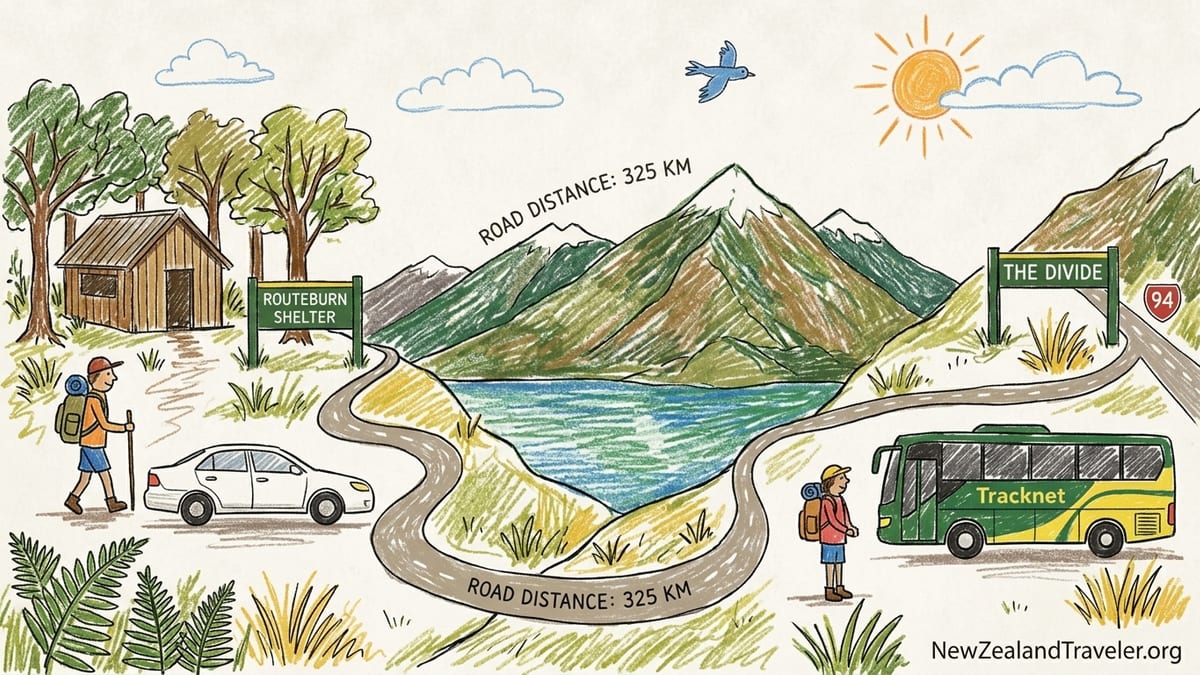
The Routeburn Track itself is only around 33 kilometres one way, usually walked in 2 to 4 days between Routeburn Shelter near Glenorchy and The Divide on the Te Anau–Milford Highway. The Department of Conservation describes it as 33 kilometres long and explicitly warns that the road distance between trailheads is about 325 kilometres, so you cannot just walk a convenient loop and step back into your car at the end.
Those numbers matter in practice. Routeburn Shelter is about 25 kilometres along a narrow rural road from Glenorchy, which itself sits roughly 45 to 50 kilometres from Queenstown. On the western side, The Divide trailhead is on State Highway 94, approximately 85 kilometres north of Te Anau. When you put those together you get the 325 kilometre road swing around Lake Wakatipu and across Southland and Fiordland. Any transport solution is working with that reality, whether you feel it as bus tickets, car relocation fees or half a day lost to shuttles.
Another reason Routeburn transport feels surprisingly complicated is that it has become a distinct tourism product in its own right. Local coach operators like Tracknet promote dedicated Great Walk timetables and Routeburn-specific packages for the 1 November to 1 May Great Walk season, listing the track alongside Milford and Kepler rather than as a side job tacked onto normal intercity routes. That is a sign that the market recognises the gap between what walkers expect and what the geography delivers.
Finally, the Routeburn does not have the same loop convenience as the Kepler Track, nor the neat boat-in boat-out structure of the Milford Track. With Routeburn you must solve a full A-to-B problem: people, luggage and car all starting and ending in different places unless you plan very carefully. The transport feels disproportionate to the actual walking distance, especially if you are used to loop hikes at home.
My Actual Transport Plan: What I Did, Step by Step
On my most recent Routeburn walk I decided to go east to west, from Routeburn Shelter to The Divide, and to keep a rental car for flexibility. I flew into Queenstown, spent a night there, then tried to stitch together a transport plan that would let me avoid a frantic final day. In hindsight, I overcomplicated things and still ended up rushing.
The day before starting the track I picked up a rental car in Queenstown and drove to Glenorchy, then on to Routeburn Shelter to check the road and parking. I returned to Glenorchy for the night, which kept the pre-hike morning short. My car stayed at Routeburn Shelter for the duration of the walk, parked in the main gravel car park that DOC signage indicates is suitable for multi-day parking. The idea was to hike through to The Divide and use a bus to loop me back around to my car at the end.
For the west side I booked a Tracknet coach from The Divide to Te Anau on my finishing day, using their Fiordland Great Walks timetable. From Te Anau I had a connecting Tracknet service back to Queenstown, with a same-day transfer onto an Info & Track shuttle that would drop me in Glenorchy. That entire chain depended on finishing the walk in time for a mid-afternoon pickup at The Divide.
Luggage was an afterthought, which was a mistake. I carried everything I needed on the track but still had a small suitcase with city clothes. I ended up leaving that bag in Queenstown at my original accommodation, which was willing to store it. That meant finishing the track at The Divide, riding buses to Te Anau and Queenstown, collecting the stored bag in the evening and finally driving back to Glenorchy late at night to be positioned for retrieving the car and starting the rest of my trip the next morning. On paper it worked. In reality it felt like a transport marathon glued onto a three day walk.
Where I Underestimated the Problem
The first thing I misjudged was time. I looked at the Routeburn brochure and saw average stage times of five to seven hours per day, then assumed I could easily reach The Divide for a mid-afternoon bus even with breaks for photos and weather. What I did not factor in was real-world behaviour: late starts in communal huts, slower descents on wet rock and the temptation to linger at viewpoints. On my final day from Lake Mackenzie Hut to The Divide, I left with a group at around 8:30 in the morning, thinking that three to four hours of walking would leave a comfortable margin for a 2:30 to 3:00 p.m. pickup. My actual walking time, with breaks and wet conditions over the forested section, pushed close to five hours. I reached The Divide car park feeling more relieved than triumphant.
Second, I underestimated how much of a day the road transfers consume. The 325 kilometre gap between trailheads is not just a number. My Tracknet and partner services combination involved The Divide to Te Anau, a short layover, Te Anau to Queenstown, then a further connection up the lake. It essentially wrote off my entire afternoon and evening. By the time I was back in Queenstown collecting stored luggage it felt as if the walk was already a day behind me and I was still not reunited with my car.
The third surprise was cost. Using indicative summer season prices from recent Tracknet timetables, a one way Routeburn Shelter to Queenstown sector has been around the equivalent of the lower three-figure New Zealand dollar range for an adult, and The Divide to Te Anau or Queenstown sectors add more cost on top. By the time I had paid for shuttles between Queenstown, Te Anau and Glenorchy, my transport spend for one person was in the ballpark of a few hundred New Zealand dollars, not including fuel for the rental car. A car relocation service would not have been cheap either but would have consolidated some of those separate tickets.
Finally, I underestimated how mentally tiring it is to finish a Great Walk on a schedule dictated by bus timetables. On that last day my mind was more occupied with calculating pace and checking the time than with absorbing the forest and waterfalls below Lake Howden. The risk is that a fixed pickup window nudges you toward unsafe rushing over potentially slippery terrain, simply because missing the coach would strand you at The Divide with no immediate backup.
Comparing the Main Transport Options
For most independent Routeburn walkers there are three realistic approaches to transport between the trailheads: shuttle packages, car relocation, or using Queenstown or Te Anau as a base and building a chain of buses around that. Each has strengths and weaknesses that only became obvious to me after doing the track once.
Shuttle packages are the most straightforward to book. Operators such as Tracknet sell Routeburn-specific products that link Queenstown or Te Anau with either trailhead in time to match a typical three day itinerary. For example, you might catch an early morning coach from Queenstown to The Divide, hike west to east and finish at Routeburn Shelter in time for an afternoon shuttle back to Queenstown or Glenorchy. The upside is simplicity: one or two bookings and you have both ends covered. The downside is that you are bound to their timetable. If the only westbound bus departs The Divide at around mid-afternoon you must plan your final day around that fixed point.
Car relocation services such as Trackhopper and Easyhike operate on a different logic. You drive your own car to the starting trailhead, hand over keys under a documented procedure and they move your vehicle by road to the other end while you walk. When you finish, your car is waiting in the car park and you are free to leave on your own schedule. This approach is particularly attractive for small groups where a relocation fee, which can be several hundred New Zealand dollars, begins to compare reasonably with multiple individual coach fares across the same distance. The trade-off is trust and timing. Your car must share the same narrow roads as buses and tourist traffic and services may be constrained by weather and booking cut-off times.
The third model is to treat Queenstown or Te Anau as a hub and accept that you will lose half a day before and after the walk to transfers. This is effectively what I did. You stay in Queenstown, use a shuttle such as Info & Track to access Routeburn Shelter, then finish at The Divide and return to Te Anau or Queenstown on a Great Walks timetable service before continuing your wider trip the following day. It is a workable plan but it fragments your journey with multiple handovers and makes luggage storage more complicated because you are rarely finishing where you started.
There are also lower profile options, such as informal car swaps with another party walking in the opposite direction, or hitchhiking one side of the journey. These can work in shoulder season when there are fewer people on the track and more locals driving the Milford Road, but they introduce uncertainty that many international visitors are not comfortable with, especially when hut bookings and flights are locked in months in advance.
Queenstown vs Te Anau: Where to Start and Base Yourself
One constant point of debate among Routeburn planners is whether to start from the Queenstown side or the Te Anau side, and where to spend nights immediately before and after the walk. My experience, and later comparison of options, suggests that your choice here drives most of your transport complexity and cost.
Starting from the Queenstown side, either in Queenstown itself or Glenorchy, has the advantage of a short pre-walk transfer to Routeburn Shelter. Info & Track and similar services run shuttles up the lake and along the Routeburn road, and if you are already staying in Queenstown you can leave excess luggage securely with your accommodation. The disadvantage is that you will likely finish at The Divide and then need a long haul coach ride back along the Milford Road and across Southland to reach Queenstown again, which can take most of an afternoon.
Starting from the Te Anau side at The Divide reverses the pain. Tracknet and other operators run morning services from Te Anau to The Divide as part of their Fiordland Great Walk timetables, so you can wake up close to the trailhead, ride for around an hour and begin walking east. When you finish at Routeburn Shelter you then face either an afternoon shuttle back to Queenstown or Glenorchy, or a more expensive package that carries you all the way back to Te Anau. For travellers whose wider itinerary focuses on Fiordland and Milford Sound, starting and ending in Te Anau may keep the picture simpler even if one of the legs is longer.
On my trip I based myself in Queenstown because of flight timings and the desire to have restaurants and supermarkets handy before and after the walk. In retrospect, I would still fly into Queenstown but I would position myself in Te Anau for the night before starting, then use The Divide as my starting point. That would allow me to finish at Routeburn Shelter, drive or shuttle back to Queenstown on my own schedule and fly out without another long land journey at the end of a tiring hike.
The Hidden Costs: Early Departures, Waiting and Wasted Half Days
The more I dug into Routeburn transport options, the more I realised that the hidden costs are not just dollar amounts on a booking page but early alarms and empty hours spent waiting for connections. Tracknet’s own summer timetables for recent seasons show that many Great Walk services leave very early in the morning to get walkers to trailheads in time for a first hut. A 7:00 a.m. coach from Te Anau to The Divide, or an early departure from Queenstown up to Glenorchy, can mean a 5:30 a.m. breakfast, last minute packing in the dark and a rushed checkout from accommodation.
Similarly, fixed afternoon pickups can create dead time. On some timetables a bus from Routeburn Shelter back to Queenstown may depart early to mid-afternoon, while the connecting service from Queenstown to Te Anau or elsewhere does not leave until late afternoon. That leaves you loitering in car parks or town centres in sweaty hiking clothes, watching your final half day in the mountains evaporate. When I traversed in the opposite direction I spent nearly two hours in Te Anau between services, time that could have been used for a meal and shower if I had structured my route differently.
Financially, the price of those gaps is not trivial either. A single adult can easily spend a sum equal to one or two nights of mid-range accommodation on Great Walk coach tickets alone, especially if you need both a Queenstown to trailhead sector and a Te Anau or Milford Road sector in the same trip. When you multiply that by two or three travellers, car relocation starts to look more attractive, even if its headline fee causes initial sticker shock.
The cumulative effect is that Routeburn transport stretches your trip’s time footprint. A nominal three day hike quietly expands into a five day commitment once you account for pre-walk positioning and post-walk extraction. If you have a tight holiday window or are juggling other South Island activities, acknowledging that expansion upfront is essential.
Avoiding Unsafe Rushes on the Final Day
If there is one message I would emphasise to anyone planning Routeburn logistics, it is to never let a booked pickup push you into rushing the last stage. The section between Lake Mackenzie Hut and The Divide, or its equivalent on the eastern side, passes through steep, sometimes slippery forest, and the area’s weather is notorious for heavy rain and sudden changes. Trying to “make” a 2:15 p.m. coach because missing it would blow up your onward plans is not a mindset you want to carry onto a mountain track.
On my walk I saw several parties leaving huts earlier than they would have liked because they were watching the clock, not the sky. One group skipped a planned side trip and cut rest stops short purely to satisfy a shuttle booking. By contrast, walkers using car relocation, or whose accommodation in Te Anau or Glenorchy was flexible, moved more naturally at their own pace that final day and had the freedom to slow down when the track surface deteriorated.
The safest approach is to build redundancy into your transport plan. That can mean booking a later coach where possible, staying the night in Te Anau or Queenstown after the walk instead of trying to reach an evening flight, or choosing car relocation so that you control your own departure from the trailhead. It can also simply mean acknowledging that small delays at swing bridges, photo stops or shelter breaks are normal, and padding your schedule accordingly rather than shaving margins to the minimum.
Weather-related closures are another reason to avoid razor-thin connections. Fiordland regularly experiences intense rainfall and DOC has warned that bridges on alpine faces can be removed in winter to avoid avalanche damage. Even in the core summer season, heavy rain or wind may slow you significantly or force a change of plan. Tying yourself to an inflexible same-day bus and flight chain on your exit day is asking for stress. The modest cost of an extra night in Te Anau or Queenstown is a good investment against that risk.
The Transport Setup I Would Use Next Time
Having now experienced the Routeburn with a patched together mix of shuttles and stored luggage, the next time I would prioritise simplicity and safety over saving every dollar. My ideal setup would be to rent a car in Queenstown, start walking from The Divide and finish at Routeburn Shelter with a car relocation in between.
Practically, that would look like this. I would fly into Queenstown and spend one night there to shop for food and final gear. The next morning I would drive to Te Anau, spend the afternoon visiting the DOC visitor centre and checking the latest track conditions, then stay overnight in Te Anau. On Day 1 of the walk I would drive from Te Anau to The Divide, meet a car relocation provider early at the trailhead, hand over the keys and start walking east toward my first hut.
While I am on the track, the relocation company would drive my car the long road loop via Te Anau, Mossburn and Queenstown to Routeburn Shelter. When I finish my last day’s walking at the eastern trailhead, my own vehicle would be waiting in the car park. I could change into clean clothes from a small luggage bag locked out of sight, enjoy the short scenic drive down to Glenorchy and Queenstown and either spend a final night there or continue my South Island road trip without another bus in sight.
Luggage under this model becomes much simpler. Everything stays with the car except what I carry on my back, removing the need for left-luggage arrangements at hostels or hotels and eliminating a whole layer of coordination. The price of relocation would likely be similar to, or a little more than, the combined coach fares for two people travelling the same distance, but the gain in flexibility and reduction in stress is worth it to me. Most importantly, there is no final-day dash to meet a departure time. If it is raining, if my knees are sore or if I want an extra hour at a viewpoint, I can take it, knowing the only schedule I risk is my own.
FAQ
Q1: Is it possible to walk the Routeburn Track as a loop without transport?
Not realistically. The walking track is about 33 kilometres one way between Routeburn Shelter and The Divide, but the road distance between those trailheads is roughly 325 kilometres. There is no practical loop on foot that brings you back to your car without some form of vehicle transfer.
Q2: How far are the Routeburn trailheads from the nearest towns?
Routeburn Shelter is around 25 kilometres from Glenorchy along a narrow sealed and gravel road, with Glenorchy itself about 45 to 50 kilometres from Queenstown. The Divide is roughly 85 kilometres north of Te Anau on State Highway 94 toward Milford Sound.
Q3: What are the main transport operators for the Routeburn Track?
Tracknet runs dedicated Great Walk services linking The Divide and Te Anau, and connecting on to Queenstown in season. Info & Track is a key operator for shuttles between Queenstown, Glenorchy and Routeburn Shelter. Car relocation services such as Trackhopper and Easyhike move private vehicles between trailheads while walkers are on the track.
Q4: How much should I budget for Routeburn transport?
Prices change with each season, but you should expect to pay at least a low to mid three-figure sum in New Zealand dollars per person for a combination of buses between Queenstown or Te Anau and the trailheads. Car relocation for one vehicle can cost several hundred New Zealand dollars, which may be competitive for two or more people compared with multiple individual coach fares.
Q5: Is car relocation safe for my vehicle and luggage?
Reputable relocation companies are established businesses that follow documented procedures, hold keys securely and use insured drivers. Many walkers leave spare luggage locked out of sight in the boot. However, you should avoid leaving valuables or irreplaceable items in the vehicle and check each provider’s terms and conditions for how they handle damage or delays.
Q6: Should I start the Routeburn from Queenstown or Te Anau?
If your trip is centred on Queenstown and you want a short pre-walk transfer, starting from the Routeburn Shelter side makes sense. If you plan to spend more time in Fiordland, starting from The Divide after a night in Te Anau can simplify logistics. The choice mainly affects where you spend extra nights before and after, since you will still need to traverse the 325 kilometre road gap one way or another.
Q7: How can I avoid rushing to catch a bus on the last day?
Choose a transport plan that gives you schedule control at the end, such as using car relocation or staying overnight in Te Anau or Queenstown after the walk instead of trying to reach an evening flight. When using buses, book the latest sensible pickup, allow generous walking time based on DOC estimates and avoid planning critical onward travel immediately after your Great Walk coach.
Q8: What happens if bad weather delays me and I miss my shuttle?
If severe weather slows you down or forces you to wait at a hut, you may miss a booked coach. Operators will move you to the next available service where possible, but in peak season seats can be limited and you may need to stay an extra night in Te Anau or Queenstown. Travel insurance that covers missed connections and flexible post-walk plans are both important safeguards.
Q9: Can I store extra luggage while I am on the Routeburn Track?
Many Queenstown and Te Anau accommodations will store luggage for guests who return after a Great Walk. Some transport companies also offer baggage transfers or storage between towns. You should confirm arrangements with your accommodation or operator before departure, and keep essentials and valuables with you on the track.
Q10: Is hitchhiking a realistic option between the Routeburn trailheads?
Some walkers do hitchhike sections of the Milford Road or the Glenorchy road outside of peak bus times, but it is unpredictable and can involve long waits, especially in poor weather or outside the busiest summer weeks. Given the distance between trailheads and the need to meet hut bookings or flights, most international visitors find that pre-booked buses or car relocation provide a far more reliable solution.