


Before my most recent trip to Fiordland, almost every conversation about Milford Sound or the great walks eventually turned into a sandfly horror story. Friends talked about clouds of insects at Sandfly Point, guides joked that the sandflies were the true locals, and online forums made it sound as if you would be eaten alive the moment you stepped out of the car. After two weeks around Te Anau, Manapouri, Milford Sound, Lake Marian and several huts and campsites, the reality turned out to be more nuanced. The sandflies were sometimes genuinely bad, sometimes barely noticeable, and with the right tactics they were annoying rather than trip-ruining.
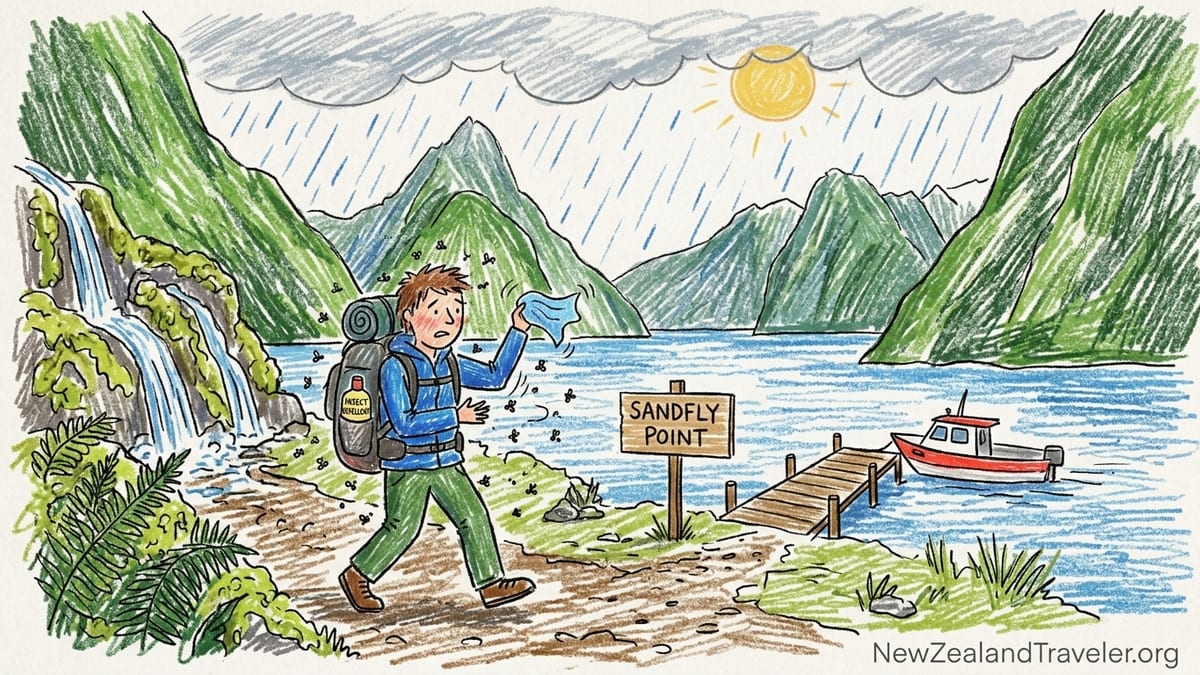
Why Fiordland Has Such a Sandfly Reputation
New Zealanders use the word sandfly for several species of native blackfly that breed in clean, flowing water and damp bush. Te Ara, the national encyclopedia, notes that the West Coast and Fiordland are infamous for them, especially around rivers, waterfalls and shaded forest margins. This matches the geography of Fiordland very closely. Milford Sound and the wider national park sit on the wettest side of the Southern Alps, where rain and snowmelt pour down steep valleys into streams and fiords almost year-round.
The Department of Conservation (DOC) warns that sandflies are prominent throughout Fiordland National Park and specifically advises visitors to carry insect repellent on its Fiordland information pages. That advice is not theoretical. The classic Milford Track literally ends at Sandfly Point, a small jetty at the edge of Milford Sound whose name is not a joke. Many walkers finish the 53.5 kilometre trail there each summer and describe being mobbed within seconds if they are not covered or sprayed while waiting for the boat.
It is worth putting the health risk into perspective. Health authorities in Aotearoa New Zealand describe local sandflies as a nuisance rather than a public health threat. They bite aggressively and the itching can be intense, but unlike some sandfly species overseas, New Zealand’s native blackflies are not known for transmitting human disease locally. For most travellers the real issue is comfort and enjoyment, not long-term illness.
Understanding why sandflies flourish here helps you predict when they will be worst. They favour damp, sheltered, low-lying spots near water. They are much less active in strong wind, heavy rain or on exposed headlands and ridges. They are usually most noticeable in the first hours after sunrise and in the late afternoon and evening when temperatures are milder and the air is often calm.
Trailheads, Car Parks and Milford Foreshore: First Encounters
My first real Fiordland sandfly test came not deep in the wilderness but at the standard Milford Sound village car park. Mid-morning on a still, cloudy summer day, I opened the car door, stepped out in shorts, and felt the first nip on my ankle before I had even finished tying my boot laces. Within about thirty seconds there were a dozen insects around my legs. They were not a black cloud, but enough that I changed my behaviour on the spot: I shut the door, sprayed exposed skin with repellent, and only then went back to sorting gear in the open.
Along the Milford foreshore itself the pattern was similar but very dependent on wind. On a breezy afternoon the air off the fiord kept sandflies almost entirely at bay. I walked the short foreshore track, lingered on the gravel beach near the car park and sat for twenty minutes watching a cruise boat nose under Stirling Falls with almost no bites. Two days later, in calm conditions after overnight rain, the same spot felt completely different. The sandflies were present as soon as I stopped moving, and standing still for photographs meant watching them land on my hands and neck within fifteen to twenty seconds.
Trailheads exposed to wind were often surprisingly comfortable. At the popular Routeburn Track side trips accessed from the Milford road, such as the Key Summit trailhead, there was usually enough breeze through the open valley that I barely noticed insects while getting ready, especially early in the day. By contrast, lower, more enclosed car parks next to forest and river flats required more vigilance. At the Lake Marian track car park in the Hollyford Valley, an area hedged in by bush with a rushing river nearby, sandflies appeared on bare legs and hands almost immediately if I dawdled near the vegetation.
In practical terms this meant building new habits around the car. I started keeping my repellent in the front door pocket so I could spray ankles and hands before stepping out. I avoided leaving doors or boot lids open longer than necessary, and I did boot checks and pack adjustments either inside the vehicle with windows mostly up or out in the open but in small, quick bursts so I was not a stationary target for long.
On the Tracks: Lake Marian, Milford Track Sections and Hut Surrounds
Once moving on the tracks, the sandfly situation changed noticeably. Hiking up through the beech forest towards Lake Marian, I was conscious of the odd insect but not constantly fending off bites. The combination of steady movement, cooler air and intermittent breezes over the suspension bridges kept them from settling on my skin. I did not bother with a head net on the ascent and wore a light long-sleeved shirt with breathable hiking trousers, which seemed to strike a good balance between comfort and protection.
The moment I stopped for a drink beside the river, however, sandflies made themselves known. At shaded, mossy rest spots close to the water, they typically took less than half a minute to find exposed skin, even in the middle of the day. On several short breaks I experimented with timing. If I sat down without repellent, I usually felt the first bite within thirty to forty seconds and could see a dozen or more insects around bare calves by the two-minute mark. After applying repellent to ankles, wrists and neck, I could often enjoy a five to ten minute snack break with only occasional landings and no bites.
Near huts and designated rest shelters, the story was similar. In the Manapouri and Te Anau basin, which is slightly drier and more open than coastal Milford, I noticed sandflies most around hut clotheslines and water taps where damp ground and low wind created the right conditions. Around mid-summer dusk they would congregate under eaves and on handrails. DOC hut wardens often reminded people to keep screen doors closed and not to prop them open while cooking. Following this advice made a real difference. On nights when everyone kept doors and windows screened, there might be a handful of sandflies inside; on evenings when doors were left open for ventilation, dinner became an exercise in absent-minded scratching.
Sections of the Milford Track that crossed open river flats or climbed into more exposed terrain tended to be far more comfortable. The notorious point was the forested, low-lying approach to Sandfly Point at the very end. Several walkers I spoke with who had recently finished the full track described identical experiences. Sandflies were manageable along much of the route, particularly on breezy days across Clinton Valley, but built to a peak around the final shelter and jetty, where dense bush and still air created ideal conditions.
Sandfly Point and Campsites: Where They Were Genuinely Bad
Sandfly Point lived up to its reputation for me and everyone I compared notes with. The DOC shelter is set in dense coastal bush only a few metres from the tidal edge of Milford Sound. On the day I finished that section it was warm, overcast and almost windless. I watched a group of walkers arrive at the shelter, drop their packs and pull out phones. Within perhaps ten seconds you could see them swatting at legs and ankles, and by a minute or two most of them were dancing on the spot to keep the insects from settling.
Waiting for the boat at Sandfly Point without protection would have been miserable. Even with long trousers and sleeves, any exposed skin on hands, neck and face attracted attention. This was one of the few places where nearly everyone, including New Zealanders well used to insects, had clearly come prepared with repellent. Some also wore head nets over hats, and while it looked slightly extreme, they were also the people standing still comfortably enough to admire the end-of-track sign and take group photos.
Campsites near lakes and rivers showed a similar pattern. At DOC vehicle campsites near Lake Te Anau the breeze across the water usually kept numbers down during the day. Late afternoon and evening were the danger periods when wind dropped. At one lakeside campsite I could potter around the tent in shorts at midday with almost no problem. By 6 pm, in the same location, I had to switch to long layers and top up repellent before starting to cook. The sandflies did not form impenetrable swarms, but they were persistent enough that cooking in sandals and shorts would have meant a dozen bites before dinner was ready.
In more sheltered bush campsites set back from open water, they were worse. Anywhere with damp ground, long grass or overhanging shrubs seemed to act as a magnet. I quickly learned not to pitch my tent right next to dense vegetation, even if it looked picturesque. Choosing a slightly more open spot with better airflow made a noticeable difference from late afternoon onwards.
Te Anau and Manapouri: Where They Were Barely Noticeable
The surprise of the trip was how livable the main Fiordland gateway towns felt from a sandfly perspective. Te Anau, on the shore of Lake Te Anau, is the main service hub for the region, and Manapouri is the smaller, quieter settlement on the edge of Lake Manapouri. Guidebooks routinely mention sandflies in both places, but in practice I found town centres far less troublesome than Milford Sound or bush camps.
In Te Anau itself I could sit at an outdoor café table on the main street or on the lakefront lawn in the early afternoon without more than the odd bite. Locals I spoke with joked that there are enough people and enough breeze that the sandflies have to work harder. That light breeze off the lake and the more open, built-up environment seem to reduce their numbers. I still carried repellent in my day pack, but I did not need to bathe in it to stroll the lakefront or wander to the supermarket.
Manapouri felt slightly buggier right on the lake edge, especially in the evening when the air went calm. On a still, warm night I did collect several bites on my feet while standing barefoot on the grass watching the light fade across the lake. As soon as I stepped back onto the gravel car park or the jetty itself, with more exposure to wind, the pressure dropped sharply. Inside accommodation with decent screening and closed doors, sandflies were almost a non-issue.
The takeaway from both towns is that fear of sandflies should not prevent you staying in Fiordland’s gateway settlements. You can comfortably make Te Anau or Manapouri your base and only encounter serious sandfly pressure when you head into sheltered bush or out to Milford Sound on calm days. For many visitors this balance is ideal. You enjoy hot showers, cafés and lake views with relatively few insects, then accept that trips deeper into the national park mean dealing with a more intense sandfly environment.
What Actually Worked: Clothing, Repellent and Simple Habits
Over the course of the trip I experimented with several common-sense strategies. The combination that worked best for me was long, light clothing plus a modern repellent containing either DEET or picaridin, supported by basic behavioural changes like avoiding standing still beside damp vegetation and keeping doors and screens closed. None of this is revolutionary, but Fiordland’s conditions make it worth spelling out the details.
Clothing turned out to be the simplest line of defence. I wore light synthetic hiking trousers rather than shorts on almost all Fiordland days, even when the temperature was in the low twenties Celsius. On my upper body I favoured a breathable long-sleeved sun shirt. This immediately removed most of my skin from the sandflies’ menu without feeling heavy or sweaty. On the few occasions I hiked in shorts for comfort, bites on the backs of my calves and around sock lines increased noticeably, especially on shady, low-lying sections of track.
On the repellent side, I tried both a DEET-based and a picaridin-based product sold in New Zealand outdoor stores. New Zealand health and environmental agencies note that DEET has long been the standard active ingredient and that picaridin is an effective alternative, and a recent local assessment of repellents recommended both DEET and picaridin along with oil of lemon eucalyptus as suitable options for biting insects in the country. In practice, on my skin in Fiordland, the difference came down to feel and reapplication frequency. A medium-strength DEET lotion at around 20 to 30 percent concentration kept my ankles and hands bite-free for several hours, even at Sandfly Point, but felt slightly greasy. A similar-strength picaridin spray felt lighter and was nicer to wear around town, though I usually topped it up a little more often during long, sweaty hikes.
I carried a head net but only used it twice. Both occasions were while waiting in a very sheltered spot for transport: once at Sandfly Point while our boat was delayed by about twenty minutes, and once at a still, damp campsite while cooking dinner in very calm conditions. In both cases the head net made the wait far less distracting. It is light, inexpensive and takes almost no space, so for anyone who reacts strongly to bites, packing one for Fiordland is an easy decision.
Behavioural adjustments were at least as effective as gear. I avoided lingering beside damp fern banks, long grass and slow eddies in rivers when the air was still. Rest breaks happened either in more open sections of track or on rocks with some airflow. Around huts and accommodation, I kept doors and windows screened or closed, and I did not sit in open doorways at dusk with interior lights blazing, which would have been an invitation to every sandfly in the valley.
Health, Itch and Recovery: Annoying but Not Dangerous
Even with prevention, I still collected a modest sprinkling of bites, mostly on ankles and wrists. They followed a predictable pattern. The immediate bite was a sharp prick, often easy to miss in the moment, followed by an itch that built over an hour or two. By evening, a day’s bites had usually become small, red, raised bumps. For me they were less dramatic than moderate mosquito bites in tropical destinations, but several lasted for several days and tempted scratching, especially at night.
New Zealand public health information classifies local sandflies as a nuisance rather than a serious health risk. There are about a dozen or more native sandfly species, but only a handful bite humans, and they are not associated with local transmission of diseases such as leishmaniasis that can be spread by related insects in other parts of the world. The main risks are secondary infection from scratching and simple loss of sleep or enjoyment if you react strongly and have many bites at once.
For bite care, simple measures were enough. Washing the area with soap and water at the end of the day and applying an over-the-counter anti-itch cream or a mild hydrocortisone ointment kept swelling and irritation in check. Travellers who know they react badly to insect bites might want to carry an oral antihistamine, which is easy to find in New Zealand pharmacies. If swelling becomes dramatic or signs of infection appear, such as increasing redness, heat or pus, local medical centres in Te Anau or Queenstown can provide further care.
The key point is that while Fiordland sandflies can make you uncomfortable, they are not a reason to stay away on health grounds. With realistic expectations and simple precautions, most people can enjoy the region’s tracks, cruises and viewpoints without more than temporary itching and a few memorable stories.
The Takeaway: How Much Repellent to Pack and Should Sandflies Affect Your Plans
After two weeks in Fiordland during the warmer months, including multiple days around Milford Sound, Lake Marian, Manapouri and hut areas, my packing verdict is clear. For one person spending about a week in Fiordland, I would pack roughly one 100 millilitre bottle of a medium-strength DEET or picaridin repellent as the main line of defence. That amount was more than enough for generous daily use on ankles, wrists and neck, with some left over. For a couple or small family, two such bottles shared between you is sensible, especially if you plan multi-day hikes or know you will reapply often.
I would also include a light pair of long hiking trousers, a breathable long-sleeved shirt and, if space allows, a simple head net. These do more to reduce your overall exposure than any amount of extra chemical repellent. Around accommodation or town, keeping doors and insect screens closed and avoiding standing still in sheltered, damp corners at dusk will further reduce unwanted encounters.
Should fear of sandflies influence your decision to visit Fiordland at all? In my view, absolutely not. They are part of the landscape, just as heavy rain, slippery roots and changeable mountain light are part of what makes Fiordland such a powerful place. There were moments, especially at Sandfly Point and in a couple of bushy campsites, when they were genuinely bad and demanded concentration. There were far more hours, from breezy lakefront lunches in Te Anau to ridge-top viewpoints and boat decks in Milford Sound, when they were barely noticeable or absent.
If you picture Fiordland as a place where you will be constantly swarmed the moment you step outside, you will likely be pleasantly surprised. Treat sandflies as an important planning factor rather than a looming disaster. Pack sensible clothing, one or two bottles of reliable repellent, a small head net if you are cautious, and a realistic attitude. In return you get waterfalls pounding into black fiords, mist drifting through beech forest and some of the most dramatic mountain and sea scenery on the planet, with sandflies as a manageable footnote rather than the main story.
FAQ
Q1. Are Fiordland sandflies dangerous to my health?
Fiordland sandflies are irritating biters but current New Zealand public health advice considers them a nuisance rather than a serious disease risk for humans. They can cause intense itching and swelling, and scratching can lead to infection, but they are not known for transmitting major human diseases locally.
Q2. When during the day are sandflies worst in Fiordland?
They tend to be most noticeable in the first hours after sunrise and in the late afternoon and evening, especially on warm, calm days. In the middle of the day, strong wind, bright sun or heavy rain often reduces their activity, although shaded, sheltered spots near water can still have plenty of insects at any time.
Q3. Are sandflies bad in Te Anau and Manapouri, or only at Milford Sound?
In my experience, sandflies were modest in Te Anau town and moderate in Manapouri on still evenings, but they became much more intense in sheltered bush and at Milford Sound, particularly around Sandfly Point and forested foreshore areas. Staying in the gateway towns is usually comfortable, with serious sandfly pressure mostly appearing on day trips and hikes into more enclosed parts of the national park.
Q4. Do sandflies bother you while walking, or only when you stop?
They are far more of a problem when you are stationary. While hiking at a steady pace I rarely had issues, even on shaded tracks like Lake Marian, but as soon as I stopped beside damp vegetation or water, sandflies found exposed skin within half a minute. Planning rest breaks in breezier, more open locations makes a big difference.
Q5. What type of insect repellent works best on Fiordland sandflies?
Repellents containing DEET or picaridin worked reliably for me on ankles, wrists and neck. A medium-strength DEET lotion at around 20 to 30 percent offered several hours of protection, while a similar-strength picaridin spray felt more pleasant on the skin but needed slightly more frequent top ups on hot, sweaty days. Oil of lemon eucalyptus products are also regarded as effective by some New Zealand health authorities, though I did not test them personally on this trip.
Q6. How much repellent should I pack for a week in Fiordland?
For one adult, a single 100 millilitre bottle of a DEET or picaridin repellent was comfortably enough for a week of regular use, including multiple days in high-sandfly areas like Milford Sound and Lake Marian. A couple or small group might want to bring two bottles to avoid running short, especially if anyone reacts strongly to bites and prefers frequent reapplication.
Q7. Do I really need long sleeves and trousers, or will shorts be fine?
Shorts are fine in theory, but in practice I had noticeably more bites on my legs when I wore them on Fiordland tracks. Light, breathable long trousers and a long-sleeved shirt dramatically reduced the number of bites without feeling overly hot, even on mild summer days, and meant I could use less chemical repellent.
Q8. Are sandflies a problem inside huts, lodges and campervans?
They can be if doors and windows are left open without screens, especially at dusk near water. In huts where everyone kept screen doors closed and did not prop them open, I encountered very few sandflies inside. In accommodation or campervans, using insect screens and avoiding bright interior lights with open doors in the evening kept indoor spaces mostly insect free.
Q9. Is a head net worth packing for Fiordland?
For most people a head net is optional but comforting. I only used mine at Sandfly Point and in one very still campsite, yet in those moments it made waiting for transport or finishing cooking much more pleasant. Because head nets are cheap, light and pack down small, I would recommend one if you are anxious about insects or expect to spend long periods standing still in sheltered bush.
Q10. Should I change my Fiordland plans because of sandflies?
In my view, no. Sandflies are part of the Fiordland experience but they do not need to dictate your itinerary. With sensible clothing, a bottle or two of effective repellent, and simple habits like avoiding standing still in damp, sheltered spots, you can hike, camp and cruise comfortably. The scenery and wilderness experience far outweigh the inconvenience of a few itchy bites.