


Seeing Fiordland from the air is one of those big-ticket New Zealand splurges that many travelers debate right up until the evening before. After years of visiting Te Anau by road and water, I finally decided to find out what Fiordland really looks like from above by booking a seaplane scenic flight with Wings & Water from the lakefront in Te Anau. What followed was 20 minutes of concentrated drama that felt completely different to any cruise, drive or hike I have done in this part of the country.
The Exact Flight I Took: Operator, Aircraft, Route, Duration and Price
For this review I booked Wings & Water’s 20-minute Fiordland scenic flight from Te Anau, a short seaplane trip that runs from the town’s lakefront ramp on Lake Te Anau. At the time of flying in September 2026, the published rate on the operator’s own material for this 20-minute option was about NZD 315 per adult, with a shorter 15-minute sampler around NZD 190. I chose the longer version because I wanted enough time to see both the main body of Lake Te Anau and the more remote country toward Lake Manapouri and the Kepler Mountains without feeling rushed.
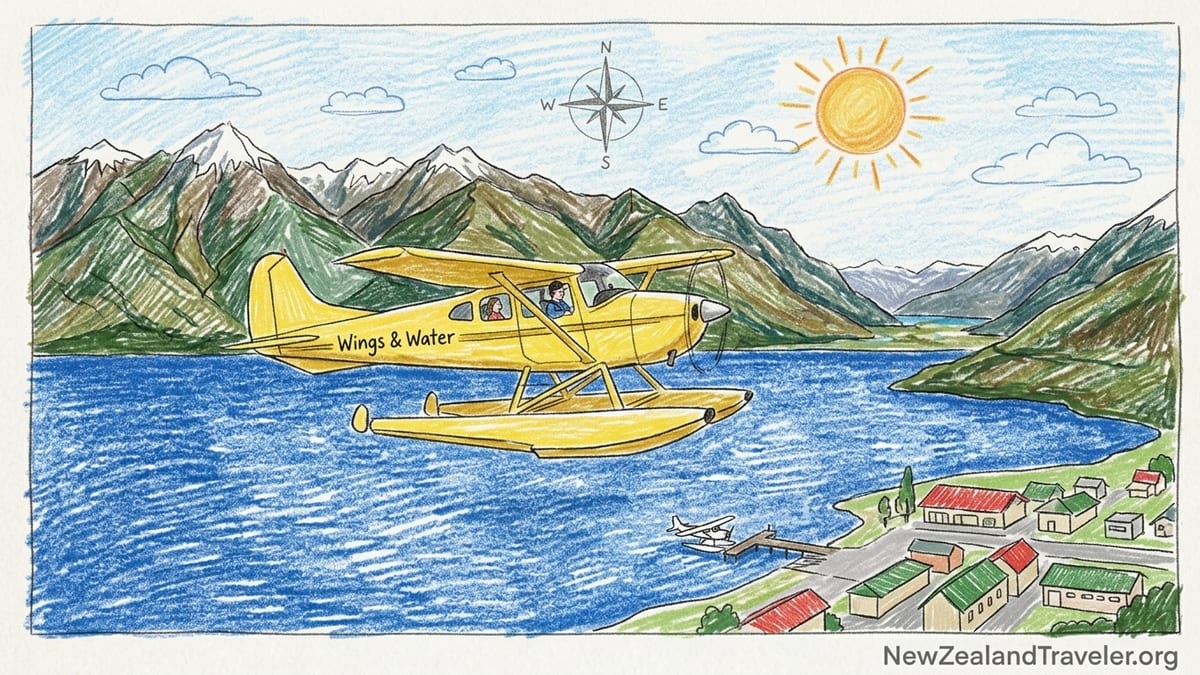
Wings & Water operates classic floatplanes on Lake Te Anau, using amphibious aircraft that can land on water. On the day of my flight the aircraft was a high-wing Cessna seaplane configured with three rows of seats, including the pilot’s row. The high wing is important in Fiordland because it means the view is primarily downward and sideways rather than trying to peer past a low wing. It also keeps the propeller noise slightly ahead of you instead of directly beside the cabin.
The route that afternoon was a loop rather than a straight out-and-back. We taxied out from the Te Anau lakefront, accelerated along the bay in front of town, climbed over the eastern shoreline, then tracked the length of the northern arm of Lake Te Anau. From there we crossed over the Kepler Mountains, glanced across to the remote South Fiord and toward the rugged country behind Lake Manapouri, then returned along the western side of Lake Te Anau before landing back in front of Te Anau’s main esplanade. Total time from takeoff to splashdown was just under 21 minutes on my watch.
Importantly, this was a flight-only product rather than a fly-cruise package to Milford Sound or Doubtful Sound. Those longer itineraries are also possible from the region, including one-hour Milford flights or roughly 40-minute Doubtful Sound flights at higher price points that start from around NZD 349 to NZD 530 per adult, but my aim here was to test whether a shorter, mid-range Fiordland flight from Te Anau itself feels worthwhile in its own right.
Check-in, Briefing and Weather Decisions in Te Anau
Check-in for the flight was low-key but reassuringly procedural. Wings & Water operates from a small office a short walk from Te Anau’s main lakefront cafes, with the floatplane tied up at a small jetty directly across the road. I arrived 25 minutes before departure, completed a quick weight check, confirmed my booking, and listened as staff explained the day’s weather picture. Fiordland is notorious for rapidly changing conditions, so this part of the experience matters more than it does for many other scenic flights.
On the day I flew, a westerly front had passed through overnight and left broken cloud around 4,000 feet over the main ranges, with lighter scattered cloud hanging in some of the side valleys. Visibility over the lake itself was excellent, with a slightly hazy horizon. The pilot explained that this was a “yes, but” kind of day for flying: perfectly fine for local scenic trips over Lakes Te Anau and Manapouri, but not clear enough to justify pushing all the way out to the outer fiords like Doubtful or Dusky. That honesty mattered, because the walls of Fiordland look dramatic in photos even on moody days, but a flight is only worth the price if you can actually see down into the valleys.
Weather cancellations and postponements are a real feature of Fiordland aviation. In the days leading up to my flight I checked the operator’s logboard in the office and counted two full afternoons in the previous week when no flights left the water because of low cloud and wind. Staff were upfront that if the cloud dropped again before our departure they would either shorten the route to stay over the lake basin or cancel entirely and offer a refund or rebooking. For travelers, that means building some flexibility into your Te Anau stay and not trying to squeeze a scenic flight into your last possible hour in town.
The pre-flight briefing covered the basics: seat belts, life jackets under the seats, keeping clear of the propeller when boarding, and where to brace if we needed to make a “glassy water” landing. Fiordland’s safety culture has tightened in recent years, and it showed here. The briefing felt matter-of-fact, not theatrical, but it did make me more aware that this is remote mountain flying, not a sedate city helicopter joyride.
Turbulence, Motion Sickness and What It Felt Like in the Air
Once we were secured on board, the floatplane taxied away from the ramp like an unusually noisy boat. There was a short pause to line up with the chop on the lake, the engine surged, and the hull began to plane. For the first 10 to 15 seconds the movement felt bouncy in a playful way, more like a jet boat than a commercial aircraft. When we lifted off, there was a brief, steep-feeling climb before the pilot leveled out above the town. Anyone who is nervous about turbulence might find this part intense, but it was over quickly.
In terms of actual turbulence, this 20-minute circuit was fairly moderate. We bumped through a few ripples of thermals where the afternoon sun had been warming the darker slopes of the Kepler Mountains, and there were one or two moments where my stomach lifted slightly as the aircraft crossed a patch of descending air. It was noticeable but far less than the lurching you might experience in a small fixed-wing aircraft flying the more exposed Queenstown to Milford route in marginal weather.
If you are prone to motion sickness, the key is to sit by a window, keep your gaze on the horizon and avoid looking through the camera viewfinder for the entire flight. I took a motion sickness tablet an hour beforehand as a precaution and felt fine in the air. Another passenger who had skipped any medication said afterwards that he felt “lightly queasy” right at the start when we were still climbing through a slight crosswind, but that things settled down once we leveled off and the pilot slowed the aircraft for viewing.
Compared with a bus trip on the twisting Milford Road, this flight felt shorter and more manageable from a motion perspective. The bumps come in quick, shallow waves rather than the long rolling sway of a coach on hairpin bends. However, if you truly hate flying or feel anxious in small aircraft, the combination of noise, vibration and being able to see out both sides of the cabin may still feel confronting, especially if clouds are building over the ranges.
Windows, Seating and How the Views Really Look From a Seaplane
One of the most decisive factors for any scenic flight is where you sit and how clean the windows are. In the Wings & Water floatplane, all passengers get a window seat because of the narrow cabin layout. On my flight there were four passengers plus the pilot, with two of us behind the cockpit and two in the third row. I was in the rear left-hand seat, which turned out to be excellent for seeing up the main basin of Lake Te Anau on departure and along the Kepler range on the return leg.
The high-wing design makes a noticeable difference to visibility. Unlike some low-wing fixed-wing aircraft that can block downward views on one side, this seaplane allowed clear sightlines straight down to the forest canopy and shoreline, as well as sideways to the more distant peaks. The windows were reasonably large, with rounded corners that help reduce distortion when you are taking photographs. There were some light scratches from years of use, but nothing that ruined the view unless you tried to shoot directly into the low afternoon sun.
The pilot did a good job of banking the aircraft slightly to both sides at key moments so that each row had a chance to look straight down into valleys and over ridgelines. Over the South Fiord arm he turned right to give the starboard side a better view of the remote inlets, then banked left so my side of the cabin could stare down into an unnamed hanging valley studded with tarns. If you are traveling as a couple or family, you will probably be seated together in a row, but it is worth asking at check-in whether you can sit on the lake-facing side for departure or on the side that will have the best light for the time of day you are flying.
Noise is another practical reality. This was not an especially quiet aircraft, and everyone wore noise-canceling headsets similar to what you might use in a small helicopter. I could hear the pilot’s commentary clearly, but conversation between passengers required raised voices. It added to the sense that we were in backcountry aviation rather than on a sedate sightseeing bus, but those sensitive to sound should be aware that this is not a whisper-quiet cabin.
Landscapes That Felt Dramatically Different From Cruise, Road or Trail
From the air, Fiordland reorders itself completely. On the water, you experience the national park as a series of narrow, vertical-sided corridors: Milford Sound, Doubtful Sound, the Eglinton Valley, the Waiau River. From the air above Te Anau, those corridors shrink into seams in a single, immense, folded landscape, and you understand why the region is best described as a wilderness of ridges and hanging valleys rather than a collection of separate attractions.
The first shock came within three minutes of takeoff, when the town of Te Anau itself dwindled to a neat rectangle of streets pressed up against an expanse of dark water. From lake level, the eastern shoreline feels gently rolling and hospitable, with farmland, walking tracks and a coasting road. From 2,000 to 2,500 feet, the same shoreline reads as a narrow ribbon between lake and rising foothills, with only a handful of farm clearings interrupting the bush. The human imprint in this basin is far smaller than it seems from a car.
Crossing the Kepler Mountains was the moment when the flight justified its price tag for me. I have walked sections of the Kepler Track and admired the views from the Luxmore Hut area, but from the air the range takes on a completely different character. Instead of a simple ridge with views across the lake, you see the Kepler as a set of interlocked spines dotted with dozens of high tarns and snow gullies. A glacier-scoured basin behind the main ridge, which would take days of hiking and climbing to reach, slid beneath us in less than 30 seconds, with its outlet creek plunging into an almost hidden gorge.
Looking toward Lake Manapouri was another surprise. From ground level, visitors mostly see Manapouri from its boat pier or from the short lakeside walks near town. From the seaplane, the western arm of Manapouri appeared as a deeply indented maze of peninsulas and coves. You could trace the likely route of Doubtful Sound cruises as a thin silver line amid thick beech forest, and the power station site showed up only as a tiny scar at the water’s edge. All of this made it very clear that even a full-day coach and cruise outing only touches a fraction of the park, and that the sense of scale from the air is something you simply cannot get from any road or boat.
Photography Challenges: Glare, Reflections and Short Flight Times
Fiordland from the air is spectacular, but it is also hard to photograph well through aircraft windows, especially in a seaplane. Between the curved plexiglass, surface scratches, and internal reflections from the light-colored cabin, there are plenty of ways to come home with disappointing images if you treat the flight like a standard sightseeing cruise where you can move around the deck and change your angle at will.
I flew in mid-afternoon with the sun sitting just above the western skyline. That meant that the windows facing the sun picked up strong glare, while the shadow-side windows offered richer color and better contrast. The trick was to time my shots for moments when the pilot banked the aircraft slightly and the sun slid out of the frame. I pressed my lens hood gently against the window to cut reflections, wore a dark top rather than a white one to reduce mirror-like glare from inside the cabin, and avoided using any filters that might introduce additional reflections.
The biggest challenge is simply the pace. On a 20-minute flight you are constantly torn between wanting to watch with your eyes and wanting to capture photographs. Each valley or ridge appears, peaks and drops away in seconds. I found that choosing two or three specific scenes to focus on worked best: the first wide shot over Lake Te Anau and town on departure, a series of oblique shots of the Kepler ridges and tarns, and a final set as we lined up to land with the town framed beneath the wing. Trying to document every twist and turn is a recipe for frustration.
Was 20 minutes enough time to feel like I had photographed Fiordland from the air? For a first-timer with moderate expectations, yes, particularly if you are realistic about what window photography can deliver. If I were a professional landscape photographer chasing gallery-quality images, I would consider booking a longer, private charter flight that allows for circling key locations multiple times and possibly flying at different times of day. For most travelers, though, the balance between duration, cost and the sheer thrill of taking off and landing on water felt appropriate.
How This Compares With Helicopters, Longer Flight-Cruise Combos and Staying on the Ground
Te Anau is not short of options for seeing Fiordland. Helicopter companies based at nearby Te Anau Airport Manapouri operate longer alpine flights and Milford Sound itineraries with glacier or alpine landings. Some operators sell 30-minute heli-tasters from Te Anau that include a short landing by a mountain tarn or snowy ridge, as well as premium trips that continue out to the coastal fiords. Separate fixed-wing companies based in Queenstown and other South Island towns also run fly-cruise-fly products to Milford, where you combine a scenic flight with a boat cruise on the sound itself.
The seaplane flight I took is fundamentally different from those helicopter and longer fixed-wing experiences in several ways. First, it emphasizes the lake basin and the near ranges rather than trying to reach Milford Sound itself. That might sound like a limitation, but it means you spend almost the entire 20 minutes within sight of Lake Te Anau and Lake Manapouri rather than burning time on a higher, straighter cruise leg to the coast. Second, the water takeoff and landing add a sense of novelty that even many seasoned travelers have never experienced.
In value terms, the 20-minute seaplane flight sits in the middle tier of Fiordland air experiences. Shorter 15-minute floats are slightly cheaper and work well as an add-on to another activity, while helicopter flights with alpine landings often cost two or three times as much per person but deliver the chance to stand alone on a remote ridge, feel the wind, and hear the silence when the rotors wind down. Fly-cruise-fly Milford packages cost more again and involve a full or half day, but you get the drama of the fiord cliffs from both the air and the water.
If you have the budget and time for only one premium Fiordland experience, it becomes a question of priorities. If you want to understand the scope of the landscape as a whole and you are based in Te Anau, a short seaplane or fixed-wing flight from town is a compact, high-impact option. If you dream of waterfalls and sea cliffs specifically, a Milford or Doubtful Sound cruise, potentially combined with a flight one way if funds stretch, will deliver more of that classic postcard scenery. For hikers, the seaplane flight can actually deepen your appreciation of the tracks you are walking by showing how those valleys connect and where the ridgelines you climb sit in the wider geography.
Would I Spend the Money Again, and Who Gets Real Value From It?
Looking back a few weeks later, I do not regret spending the money on the 20-minute Wings & Water seaplane flight from Te Anau. It gave me an aerial mental map of Fiordland that years of driving and cruising had never quite assembled. The sensation of lifting off from the lake with the town dropping away, then watching the country fold outward in all directions, is something that has stayed with me more vividly than many longer days on the road.
If I were returning to Fiordland with the same budget, would I book the identical flight-only product again or upgrade to something more involved? Given what I know now, I would be tempted to invest in a slightly longer flight-plus-cruise combination or a helicopter flight with at least one alpine landing. The added time and the chance to stand in the landscape rather than just look at it would, I suspect, justify the extra cost, especially if I were traveling with someone who had never seen Fiordland before.
That said, there is a very clear audience for the shorter flight I took. It suits travelers who are short on time, want a memorable highlight without sacrificing a full day to a longer excursion, or feel uneasy about longer flights over the exposed coastal ranges. It is particularly good for those staying two or three nights in Te Anau who have already locked in a Milford or Doubtful Sound cruise by road or coach but want one additional viewpoint on the region.
Who might not get enough value from a flight-only experience? Travelers on very tight budgets who have not yet done a single cruise or serious walk in Fiordland would probably be better served putting their money toward a full Milford or Doubtful Sound day trip instead. Likewise, serious photographers who dream of slow, deliberate shooting will find the 20-minute circuit frustratingly brief. For them, chartering a longer helicopter or fixed-wing flight with more control over timing and routing would be a better use of funds.
The Takeaway
Seeing Fiordland from the air is not essential in the way that a first visit to Milford or Doubtful Sound by water is, but it does offer something qualitatively different. The 20-minute Wings & Water seaplane flight from Te Anau turned Fiordland from a chain of famous sights into a single, comprehensible wilderness in my mind. It highlighted just how small the footprint of human activity is in this corner of New Zealand and how quickly steep, trackless country takes over once you leave the lakeside towns behind.
Weather will always be the wild card. If your travel dates are inflexible and you can only fly on one particular afternoon, you may find that low cloud or strong wind forces a cancellation or reduces the route to the immediate lake basin. Operators in Te Anau are used to this and typically offer clear options to rebook or refund, but it does mean that you should treat any scenic flight as an aspirational bonus rather than the sole pillar of your Fiordland itinerary.
For many visitors, especially those who already have a cruise booked and at least one half-day walk planned, a short scenic flight from Te Anau is the missing piece that makes the whole geography make sense. It is a premium purchase for a relatively short time in the air, but the concentration of new perspective, the sensory novelty of a water takeoff and landing, and the ability to see both Lake Te Anau and the first ranks of the ranges in one sweep combine to create an experience that feels bigger than the minutes suggest.
If you value understanding landscapes in three dimensions, enjoy small-aircraft experiences, and can accept that weather may have the final say, then a Fiordland scenic flight from Te Anau is money well spent. Next time I return, I will almost certainly fly again, either by extending the seaplane experience into a longer flight-plus-cruise day or by joining a helicopter flight with a landing high above the lakes. Either way, I now know that Fiordland from the air is not just a luxury add-on, but a distinct way of meeting one of the world’s great wild places.
FAQ
Q1. Which exact scenic flight did you take from Te Anau?
The flight was a 20-minute Fiordland scenic seaplane flight with Wings & Water from the Te Anau lakefront, focusing on Lake Te Anau, the Kepler Mountains and views toward Lake Manapouri.
Q2. How much did the scenic flight cost and how long was it in the air?
At the time of flying in September 2026, the published adult price for the 20-minute option was about NZD 315, with just under 21 minutes from takeoff to landing on my watch.
Q3. What type of aircraft was used for the flight?
The flight used a high-wing Cessna floatplane configured for small-group scenic flights, operating from the surface of Lake Te Anau rather than from a land runway.
Q4. How bad was the turbulence and is it suitable for nervous flyers?
Turbulence on my flight was moderate, with a few light bumps crossing the ranges but nothing severe. Nervous flyers may find the water takeoff and tight cabin intense, but the short duration helps.
Q5. Is motion sickness a problem on Fiordland scenic flights?
Some passengers can feel queasy during takeoff and when crossing thermals. Sitting by a window, focusing on the horizon and taking motion sickness medication in advance can reduce discomfort.
Q6. How easy is it to take photos through the aircraft windows?
Photography is possible but challenging because of glare, window scratches and the quick pace. Wearing dark clothing, shooting at an angle to the glass and choosing a few key scenes helps.
Q7. Was 20 minutes in the air really enough to feel worthwhile?
For a first-time Fiordland flight, 20 minutes felt surprisingly full and provided a strong sense of the landscape. Dedicated photographers or aviation enthusiasts may prefer a longer flight or charter.
Q8. How often do weather cancellations happen and what if my flight is canceled?
Weather-related cancellations and route changes are common in Fiordland, especially in unsettled seasons. Operators usually offer to rebook you on another flight or provide a refund if they cannot fly.
Q9. How does a short seaplane flight compare with a helicopter trip?
A seaplane from Te Anau emphasizes the lake basin and near ranges and includes a water takeoff and landing, while helicopters often cost more but can land on remote ridges or snow for time on the ground.
Q10. Who will get the most value from a Fiordland scenic flight from Te Anau?
Travelers staying at least one or two nights in Te Anau who already plan a Milford or Doubtful Sound cruise and want an additional, big-picture perspective of Fiordland’s landscape will benefit most.