


On my Fiordland trip I thought I had played it safe. I booked Milford Sound and the Milford Track for what guides call a “settled” spring window, packed solid waterproofs and checked the forecast obsessively. Instead of blue reflections in postcard water, I met low cloud, cold wind and hours of hard rain. It turned out to be one of the best weather mistakes I have ever made. In Fiordland, bad weather really can improve parts of the experience, as long as you arrive prepared for water rather than waiting for a perfect forecast that may never come.
Setting the Scene: Why I Expected Fiordland to Behave
My Fiordland trip ran from 27 October to 3 November 2025, at the tail end of New Zealand’s spring. I based myself in Te Anau with a four day Milford Track booking in the middle and day trips either side. I chose those dates because past climate data calls late October “relatively settled” and several Queenstown and Te Anau operators described it as a good compromise between long daylight and fewer peak summer crowds.
In the week before flying from Auckland to Queenstown, I watched the forecasts for Te Anau, Milford Sound and the Milford Track intently. Three days out, the MetService forecast promised scattered showers, light southwesterlies around 10 to 15 kilometres per hour and temperatures between 6 and 15 degrees Celsius along the Milford corridor. The Milford Sound outlook suggested morning cloud breaking to fine in the afternoon, with “moderate confidence” of only brief showers.
Those forecasts sat comfortably with Fiordland’s reputation for regular but often short-lived rain. Milford Sound is famously wet, with local tourism sources noting that it receives roughly 6 to 7 metres of rain a year and has topped 9 metres in extreme years. Visit Fiordland and other regional information agree that the wider Fiordland National Park often exceeds seven metres of annual rainfall in parts of the park. That level of rain sounded impressive but, on paper, I expected my particular week to thread a usable gap between fronts.
I knew that the Milford Track itself is no place to expect dryness. New Zealand trail information and guiding companies routinely point out that the track sees rain on around 180 to 200 days each year, and that Fiordland as a region records a similar number of rainy days. I planned for at least some wet walking but still pictured clear passes and distant mountain views. The reality was more complicated and more dramatic.
What the Forecast Promised vs What Actually Happened
I arrived in Te Anau on 27 October to broken cloud and cool sun. The Te Anau lakefront was calm, around 13 degrees Celsius, and by evening the updated forecast for Fiordland still showed only passing showers. The complete reversal began overnight. A slow moving front picked up more moisture than expected from the Tasman Sea and stalled over the Southland and Fiordland ranges.
On 28 October, when I was due to drive the Milford Road for a day cruise, the rain began just after dawn and did not properly stop for nearly 20 hours. Instead of the predicted 1 to 3 millimetres of showers, local rainfall gauges at Milford Sound eventually reported tens of millimetres through the day, edging toward what forecasters classify as heavy rain. In Te Anau the rain felt constant from about 7 a.m. through to the early hours of the next morning.
The cloud ceiling also stayed much lower than forecast. The night before, the aviation forecast for Milford Sound Aerodrome suggested a broken cloud layer around 2,000 to 2,500 feet. In reality the base dropped closer to 1,000 feet or lower inside the fiord. The sheer walls of Piopiotahi disappeared into uniform grey only a third of the way up, and iconic peaks like Mitre Peak never clearly emerged from the murk during my first day there.
Wind was less violent than I had feared, but still a factor. The forecast 10 to 15 kilometre per hour southwesterlies occasionally gusted over 30 kilometres per hour funnelled through the fiord, especially as squalls came in. The temperature stayed pinned between 6 and 9 degrees Celsius, several degrees cooler than the earlier forecast. It was not dangerous, but with constant spray the chill sank deep if you were not properly layered.
Cancelled Flights, Slippery Roads and a Rearranged Itinerary
The most immediate impact of the changing weather came through cancelled scenic flights. I had not booked one myself, but at Te Anau Airport on 28 October small operators quietly scrubbed their morning departures. The combination of low cloud and mountain obscuration made the helicopter and fixed wing flights through the Fiordland ranges unsafe. Staff told walk-in guests that they were hoping for a late afternoon clearance, but the weather never cooperated. Several travellers ended up rescheduled for later in the week or refunded altogether.
On the ground, the Milford Road remained open but carried a road snowfall and surface water warning for higher sections near the Homer Tunnel. The rain never quite turned to snow at road level during my visit, but the Department of Conservation information centre in Te Anau shared that in similar events the road sometimes closes because of landslip risk or ice. Electronic signs along State Highway 94 flashed “Drive with care: surface flooding, heavy rain.” Some of the small unofficial roadside parking areas that had looked inviting in photos were half submerged or too muddy to consider.
This mattered for my schedule because I had planned to drive from Te Anau to Milford Sound, take an afternoon cruise, then linger on the return drive for short walks like the Lake Marian track on the way back. With heavy rain and low visibility, I reversed the emphasis. I stuck to the cruise, where the captain had radar and local knowledge, and skipped extended stops at exposed viewpoints on the return drive. Other travellers in the car park made similar calls, with several abandoning the idea of visiting higher lookouts that would have offered only a wall of grey.
Three days later, conditions on the track itself forced further changes. On 31 October, as I started the Milford Track, the Department of Conservation rangers briefed our group that rain in the preceding 36 hours had left sections of the Arthur River and Clinton River margins saturated and that some side streams were running high. They warned of knee deep sections near minor creek crossings and made it clear that in Fiordland, heavy overnight rain can quickly lead to partial closures or delays. A storm a week before my trip had already caused temporary suspensions of independent walkers while guided groups adjusted departure times.
Walking Wet: Milford Track in Persistent Rain
Across my four days on the Milford Track, 31 October to 3 November, I had rain on parts of every single day. On day one, boat from Te Anau Downs to Glade Wharf and the gentle walk up the Clinton River valley, showers came and went for maybe five hours of otherwise dry walking. The cloud ceiling hung well below the valley rims, which meant almost no big mountain views but an intimate feel along the mossy track.
Day two, from Clinton Hut to Mintaro Hut, brought the heaviest sustained rain of the trip. It started just after breakfast and continued for roughly eight hours with varying intensity. DOC rain gauges later showed that this period delivered what they classed as a “significant rain event” but not a full closure level storm. On the ground that meant ankle to shin deep water in long stretches of the track, minor streams pushing hard across the path, and several spots where you felt the force of the runoff as you stepped carefully through.
The climb to Mackinnon Pass on day three began in cloud so thick that visibility dropped to less than 50 metres in places. Gusts at the pass hut hit what the ranger described as “strong breeze to near gale” for short periods, probably in the 40 to 60 kilometre per hour range. Temperatures hovered around 3 to 5 degrees Celsius, and wind chill took that below freezing on exposed sections. Any hope of sweeping views across the Clinton and Arthur valleys vanished into driving mist. On the descent toward Dumpling Hut, the track turned into a series of flowing channels.
My last day, from Dumpling Hut to Sandfly Point and the short boat ride to Milford Sound, eased a little. The rain shifted to squally showers with drier breaks lasting 30 to 60 minutes. The cloud ceiling climbed enough that waterfalls like Sutherland Falls revealed at least parts of their full drop. Even then, the track remained soaked, with extended muddy sections. The net result was four days of walking where “wet” was a constant baseline rather than an occasional inconvenience.
Gear Under Real Fiordland Rain: What Worked and What Failed
On paper, I had packed properly for Fiordland. My main shell was a mid-range three layer Gore Tex hiking jacket rated at 28,000 millimetres of hydrostatic head, backed by waterproof overtrousers from a major tramping brand, leather boots with a waterproof membrane, and lightweight gaiters. I carried a rain cover for my 50 litre pack and used dry bags for key items. That combination copes easily with typical spring showers in many parts of New Zealand. Fiordland’s water proved more searching.
During the eight hour rain on day two, the jacket kept out direct rain and windblown spray, but after around five hours I felt cold seeping into the shoulders and arms. It was difficult to tell where sweat condensation ended and seepage began, but by the time I reached Mintaro Hut my base layer was damp at the shoulders and forearms. The overtrousers performed slightly better; water began to creep in from the cuffs and through the thigh area where the fabric had been rubbing while stepping through flooded sections.
Boot performance was the clearest lesson. My boots remained dry inside for the first day and the start of the second. Once the track itself filled and I was wading through calf deep water, their waterproof membranes simply could not compensate for the constant immersion. By midday on day two my socks squelched, and they stayed damp for the rest of the track despite hut drying rooms. Fellow walkers in more flexible trail runners, which drain and dry faster but lack ankle support, reported cold feet but less persistent sogginess. In these conditions, “water resistant” really meant “water delayed.”
The pack system mostly succeeded. The external rain cover shed the bulk of the water, and items in dry bags stayed usable. Anything left simply in standard stuff sacks, such as spare snacks in side pockets, emerged a little soft around the edges. Around the huts, I was grateful for simple extras like a separate hut set of clothes vacuum packed in a heavy duty plastic bag and light camp shoes to escape saturated boots. More than once, someone with only basic rain gear mentioned they would have turned back on a non-booked walk. On the tightly controlled Milford Track you simply commit and walk through it.
When Bad Weather Makes Fiordland More Beautiful
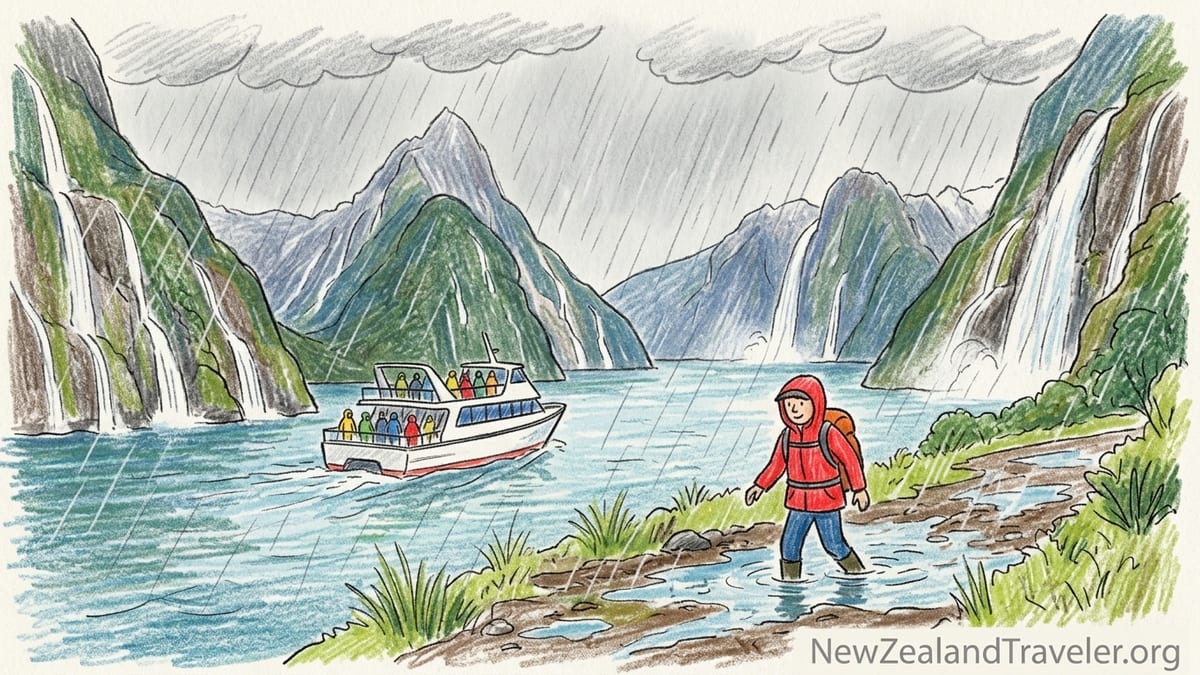
For all the discomfort, the rain transformed Fiordland’s scenery in ways that clear skies never could. Milford Sound on 28 October was almost unrecognisable from brochure shots. The permanent waterfalls like Stirling and Bowen roared at several times their typical flow, flanked by hundreds of temporary white threads pouring down every available gully.
From the deck of the cruise boat, the captain explained that after heavy rain the cliffs produce countless ephemeral waterfalls that may only last hours. In dry conditions many of those rock faces appear bare or only faintly streaked. On this day the entire basin was alive, with a continuous curtain of water that blurred the line between fiord walls and sky. When the boat nosed into one of the falls, spray blasted across the bow like horizontal rain.
Inside the rainforest, the same rain amplified Fiordland’s atmosphere. On the lower parts of the Milford Track, moss gardens glowed an almost unreal green in the diffuse light. Tree trunks steamed very slightly as cold rain met the warmth stored in the wood. Every fern seemed edged with droplets. The forest smelled rich and earthy, a mix of wet bark, soil and leaf litter. In clearer weather that subtlety can get lost in bright contrast and crunchier underfoot conditions.
Rivers and side streams gained a sense of power that photos from dry days do not fully convey. The Clinton River, which can run calm and glassy, churned chalky green and white, with visible boils and eddies as the water rushed between boulders. At Sutherland Falls, the volume of water crashed into the plunge pool with a deep, unbroken roar that you could feel in your chest. Several hikers remarked that although their cameras struggled with the mist, the live experience felt more cinematic in the storm than any postcard view.
Activities That Shine in the Rain vs Those That Need Clear Skies
After a week of rearranging plans, I came home convinced that Fiordland visitors should divide activities into those enhanced by wet weather and those that genuinely require clear or at least high cloud conditions. It is a more practical framework than simply asking “what is the best month to visit.” In a place that records around 6 to 7 metres of rain each year and rain on roughly 200 days, planning only for sunshine is a recipe for frustration.
Milford Sound cruises belong firmly in the “rain friendly” column. Heavy rain multiplies waterfalls and deepens the fiord’s mood. Operators run in most conditions except when extreme wind or road closures intervene. Even with low cloud, you can see the lower halves of the cliffs, watch waterfalls in full spate, and often spot wildlife like fur seals and dolphins. A decent waterproof jacket and a warm hat are more important than a clear forecast.
Short rainforest walks along the Milford Road or near Te Anau also reward rainy conditions. Tracks like the Milford Foreshore Walk, the first hour or so of the Routeburn on the Fiordland side, or small DOC nature loops off State Highway 94 feel especially atmospheric under soft grey light. Mud and puddles are a given, but the forest floor looks richer and bird calls carry differently without the distraction of bright sun.
On the other hand, some experiences really do need better weather. Scenic flights over the fiords and the Southern Alps are borderline useless if low cloud obscures everything below the aircraft. Operators will not fly in unsafe conditions, and even if a flight technically goes ahead, cloud in the wrong places can turn it into an expensive tour of grey. The classic view from Mackinnon Pass on the Milford Track likewise depends on a cloud ceiling high enough to reveal the surrounding peaks. If that particular panorama is a bucket list shot, you either need luck or several spare days to wait for a window.
How Many Flexible Days You Should Build In
Because Fiordland’s weather can shift so quickly, the smartest decision is not to chase a single “best” month but to build flexibility into your itinerary. For my eight day window from 27 October to 3 November, three days delivered very low visibility and hard rain, three were mixed with showers and bright breaks, and only two were mostly clear. That ratio aligns with the statistics for a region where rain dominates roughly half the days of the year.
For travellers aiming to visit Milford Sound without committing to a multi day hike, I would now recommend at least three nights in Te Anau or Milford Sound Lodge if your budget allows it. That gives you two or three full days to choose the best weather for your key activity, whether it is a cruise, kayak trip or short walk, and still experience a properly wet day when the waterfalls go wild. Many visitors try to squeeze Milford into a single day trip from Queenstown, which ties you to whatever conditions happen to prevail during that 12 hour loop.
If you plan to walk the Milford Track or another Great Walk in Fiordland, the need for flexibility shifts earlier in the booking chain. DOC hut bookings for the Great Walks season often sell out months in advance, and your four day window is largely fixed. The best you can do is add at least one, preferably two, buffer days in Te Anau or Queenstown before and after the walk. That way, if the road closes briefly ahead of your start date, or if you finish soaked and need time to dry gear, your onward travel is not derailed.
Financially, that may mean adding an extra couple of nights of accommodation at prices that can range from budget backpacker beds around Te Anau to mid range motels or lodge rooms closer to Milford. But compared with the cost of international flights and domestic transport, those buffer nights buy the most valuable resource in Fiordland: options when the clouds refuse to move.
The Takeaway
Looking back on that week in October and November 2025, my strongest conclusion is that Fiordland rewards travellers who prepare carefully for water rather than for a specific forecast. Milford Sound and the Milford Track exist in one of the world’s wettest inhabited landscapes. With average rainfall measured in metres and rain falling on around 200 days a year, waiting for a guaranteed dry window is unlikely to succeed and might even rob you of Fiordland at its most dramatic.
If I could redesign my itinerary with hindsight, I would still book a Milford Sound cruise even with heavy rain in the forecast, but I would skip prepaying for any scenic flights unless I had several spare days and fully flexible dates. I would keep my four day Milford Track booking while accepting that full mountain views from Mackinnon Pass are a bonus, not a promise. Around the edges, I would add one more rest day in Te Anau to enjoy a clear weather walk or to simply sit by the lake after the storm.
On the packing side, I would invest in an even more robust rain shell with longer hem and better pit zips, consider lighter footwear that drains faster, and add an extra set of dry base layers stored in a truly waterproof bag. I would also plan hut routines more deliberately, knowing that drying rooms fill quickly and that small items like spare socks and gloves are worth their weight in gold after a day in Fiordland rain.
Most of all, I would adjust my mindset. Rather than chasing sunny postcards, I would travel to Fiordland expecting to be rained on, probably hard, and look forward to what that rain does to the landscape. Temporary waterfalls, brooding cloud wrapped peaks and saturated rainforest colour are not consolation prizes; they are core parts of what makes this corner of New Zealand special. Build in flexible days, choose a mix of rain friendly and clear sky activities, and prepare to get wet. In Fiordland, bad weather does not just happen around the experience. Often, it is the experience.
FAQ
Q1. Is it worth visiting Milford Sound if heavy rain is forecast?
Yes. Heavy rain often makes Milford Sound more spectacular by creating hundreds of temporary waterfalls and amplifying existing falls, as long as the road remains open and wind is not extreme.
Q2. How many days should I allow in Te Anau for a Milford Sound visit?
Plan at least three nights in Te Anau if possible. That gives you several chances to choose a good weather window for your key activities and still experience Fiordland in the rain.
Q3. Does the Milford Track really get rain on about 200 days each year?
Regional climate data and New Zealand hiking information indicate that both the Milford Track and Milford Sound experience rain on roughly half to two thirds of the days in a typical year.
Q4. What activities are best on a rainy Fiordland day?
Milford Sound cruises, short rainforest walks near the Milford Road or Te Anau, and cosy time in lakeside cafés or lodges all work very well in wet conditions.
Q5. Which Fiordland activities need clear or high cloud conditions?
Scenic flights over the fiords, extensive mountain views from passes like Mackinnon, and long photography stops at high lookouts are far better with clearer skies and higher cloud.
Q6. What kind of waterproof gear should I bring for Fiordland?
Bring a quality waterproof jacket with a hood, waterproof overtrousers, footwear you are happy to have wet all day, pack rain cover, and multiple dry base layers in true dry bags.
Q7. Can I still cruise Milford Sound if flights are cancelled?
Often yes. Flights are cancelled when cloud and visibility make flying unsafe, but boats can still operate within the fiord as long as wind and sea conditions remain within safe limits.
Q8. How cold does it feel on the Milford Track in the rain?
In spring and autumn, air temperatures may sit between about 3 and 12 degrees Celsius, but wind and constant wet clothing can make it feel close to freezing on exposed sections.
Q9. Should I wait to book Milford Sound until I see a perfect forecast?
Not usually. Because rain is so frequent, you may wait a long time for a flawless forecast. It is better to book, build in flexible days, and pack for wet conditions.
Q10. How many flexible days should I add around a Milford Track booking?
Add at least one, preferably two, buffer days in Te Anau or Queenstown before and after the track to absorb any weather related delays and to rest and dry out afterward.