


On a wet Fiordland afternoon when the mountains around Te Anau had disappeared into low cloud, I finally booked the Te Anau Glowworm Caves. I had read the brochures countless times, but I wanted to know what the NZ$150‑plus ticket actually bought in real time: How long would I really spend under the glowworms, what would the stairs and low ceilings feel like after days of hiking, and would crossing Lake Te Anau to sit in the dark with strangers actually feel worth it. This review walks through the exact experience I had, step by step, so you can decide whether to put the caves on your own Te Anau shortlist.
Checking In On The Lakefront
The Te Anau Glowworm Caves tour is operated by RealNZ, and everything starts at their visitor centre on the lakefront in central Te Anau. I arrived about 30 minutes before the scheduled departure, which matched the check in advice given at booking. Inside, check in was straightforward: staff confirmed my name, issued a printed boarding pass sized ticket, and weighed a few daypacks to keep heavy bags off the boat and out of the cave. There were around 40 people booked on my departure, split into two groups that would alternate between the cave and the waiting area on the far side of the lake.
The building itself felt like a small ferry terminal. There were bathrooms, a waiting lounge with picture windows looking over Lake Te Anau, and a large screen looping short clips of glowworms and the cave river. This preview mattered more than I expected because, with photography banned inside the real cave, that pre tour video is one of the few images you actually see of the grotto on the day. It set expectations for a fairly intimate, low key experience rather than a big theatrical show.
When boarding was called, the crew gave a concise safety briefing. They checked footwear and reminded anyone with mobility issues that there would be stairs and uneven surfaces inside the cave, and that those unsure could choose to stay on the lake shore instead. Nobody opted out on my sailing, but you could tell the staff were used to fielding questions from visitors in their seventies who were deciding on the spot.
Payment had been taken at booking, and the adult price on the day was in line with the advertised rate of roughly NZ$150 to NZ$160 per person, which includes the return cruise across Lake Te Anau as well as the guided cave visit. It feels like a premium for what is, in total, around two and a half hours of activity, so going in I was keenly aware of the price tag.
The Lake Te Anau Crossing: Weather, Views And Group Size
We boarded a purpose built sightseeing vessel moored directly in front of the RealNZ building. Seating was a mix of indoor airline style rows and outdoor benches on the stern. On my departure about two thirds of the seats were filled, so my group was roughly 40 guests, a typical load outside the absolute peak of summer. That number matters because once you reach the caves, it splits into smaller subgroups of about 12 to 14 inside the tightest sections.
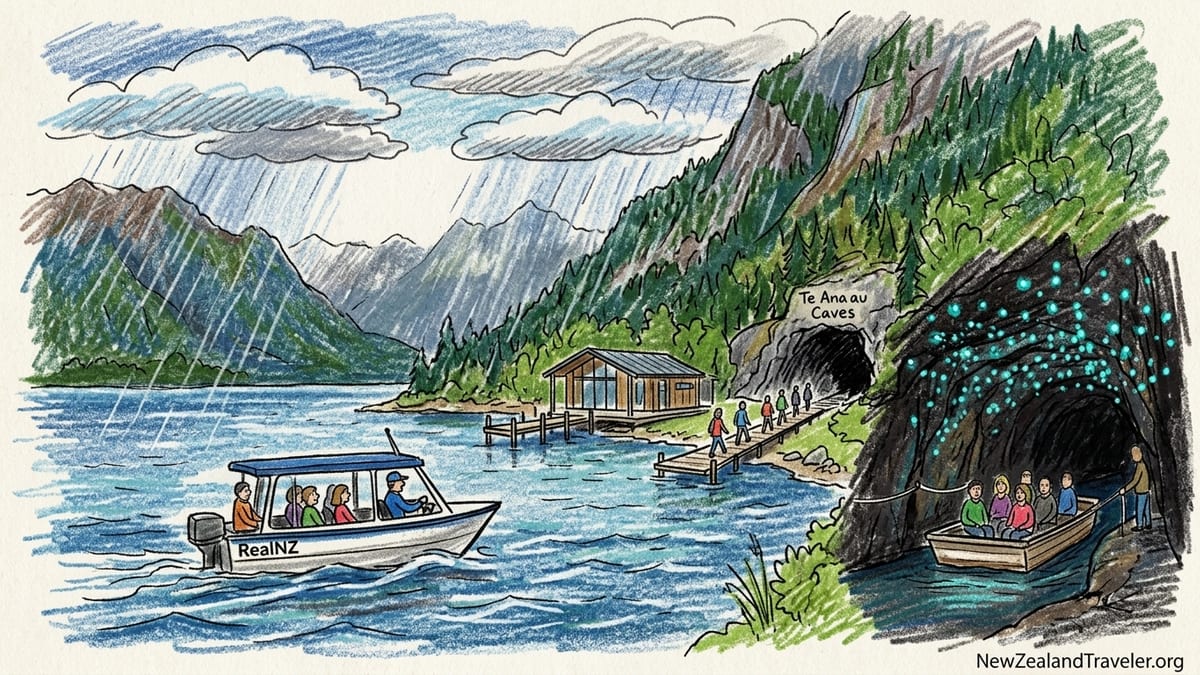
The weather that afternoon was archetypal Fiordland: low ceiling cloud, light wind, and intermittent drizzle with air temperatures in the low teens Celsius. On a clear day you would see the Murchison Mountains rising sharply from the western shore. Instead, we crossed under a grey sky, with the slopes on both sides disappearing periodically as curtains of rain moved across the lake. It was still atmospheric, and many people stayed out on deck with jackets zipped, watching waterfalls streak down gullies when the cloud lifted.
The lake crossing took a little over 30 minutes in each direction. On the way out, a guide on the microphone delivered commentary about the formation of the lake, local conservation projects, and the history of the Te Ana au cave system. It was not a constant monologue; there were long quiet stretches where all you heard was the hum of the engines and the slap of small waves on the hull. Anyone prone to motion sickness should know that Lake Te Anau can develop some chop in strong winds, but on my trip the movement was gentle and no one looked uncomfortable.
The cruise component felt like more than just a shuttle. You really are leaving the township behind and heading for a roadless, forested shoreline. That sense of going somewhere remote is part of what you are paying for. It also means the overall tour time is heavily weighted to transport, something to keep in mind when you think about value for money later.
Arriving At Cavern House And Entering The Cave
The boat pulled in at a simple jetty on the western shore and we walked a short, mostly flat path through dripping temperate rainforest to Cavern House, a timber and glass building that acts as base camp for the caves. Inside, there were bathrooms, a small cafe counter serving basic hot drinks, and information panels on glowworms and cave geology. The staff split us into two groups here. My group entered the caves first while the other remained at Cavern House to watch a short film and enjoy tea and coffee.
From Cavern House to the cave mouth was only a few minutes on a gravel and boardwalk trail. You can hear the cave long before you see it. As we approached, the dull roar of the underground river rose above the rain and birdsong outside. At the entrance, the guide paused to let everyone put on extra layers and talked about the active nature of the system, estimated to be around 12,000 years old. The rules were repeated: no food, no loose items that could fall into the water, and absolutely no photography or video inside.
Stepping into the cave, the temperature drop was immediate. Outside it had been cool and damp. Inside, it felt like a consistent 8 to 12 degrees Celsius, which matches RealNZ guidance. I was glad of a light down jacket and a beanie. The air was very humid, and within a few minutes any exposed skin felt chilled by the combination of breeze flowing along the river passage and spray from nearby cascades.
The initial section involved a series of metal grated walkways and staircases that hugged the right side of the roaring stream. The guide asked anyone with knee issues to take their time. There are handrails the entire way, and the non slip mesh underfoot felt secure even with constant dripping water. You are never scrambling on rock, but you are absolutely navigating a real, wet cave rather than a polished concrete tunnel. The noise is the first thing most people commented on. Conversation happened in raised voices, and the sound of the water masked everything else.
Inside The Active Cave: Stairs, Bending And Underground Noise
The path climbed and descended repeatedly, following the contours of the passage as it wound past waterfalls, pools and narrow constrictions. In total, I counted roughly the equivalent of three to four flights of stairs broken into smaller sections. None of them were particularly steep, but together they would be a challenge for anyone with limited mobility, serious knee pain, or who is unsteady on their feet. There are no lifts, ramps or alternate routes inside the cave. If you cannot manage stairs, this tour will not be accessible to you.
Low ceilings are another factor. There were several points where even an average height adult needed to duck slightly and a couple of places where taller visitors bent much further at the waist. The guides warned us ahead of every low section, shining their torches on the rock to show where to watch our heads. Helmets are not provided, so you need to pay attention. I saw one man around 190 centimetres tall tap the rock lightly despite the warning, which was more of a surprise than a serious bump, but it showed how easy it would be to hit your head if you were distracted.
The sound level inside the cave is hard to overstate. At one viewing platform beside a waterfall, the rushing water was loud enough that the guide had to stand close and almost shout to be heard. People in my group instinctively moved to grip the handrails a little tighter as the walkway vibrated slightly from the force of the water nearby. Anyone sensitive to loud, constant noise or who dislikes dark, confined spaces might find this section stressful, even though the path itself is secure.
There were intermittent pauses for explanation, where the guide pointed out scalloped rock walls, whirlpool pots in the stream, and the marks showing how floodwaters sometimes reach several metres above the current walkway. These stops were informative, but they also served a practical purpose, giving slower walkers space and allowing everyone to acclimatise to the conditions before we went further in and the lighting levels dropped.
The Glowworm Boat: Darkness, Silence And Actual Time Under The Lights
Eventually the metal walkway ended at a small underground wharf beside a calm, dammed section of the river. Here, under dim red light, our group of about 13 people boarded a flat bottomed boat with bench seating along each side. The guide repeated the rules one final time: no talking, no lights, no phones, and no cameras. Once everyone was aboard, they pushed us off and used a system of overhead ropes to guide the boat into the deeper section of the grotto.
As soon as the last trace of the entry light faded, the darkness became almost total except for the glowworms. The first impression was not a single huge chamber, but a series of narrower passages with clusters of blue-green pinpricks overhead. As your eyes adjusted, whole panels of rock resolved into dense constellations. It truly did feel like a starry sky compressed to just above arm’s reach. The boat moved very slowly, sometimes almost drifting in place while the guide allowed us to soak in the view in complete silence.
In terms of timing, I watched my wristwatch because I was curious how the glowworm section would compare with the full tour. From leaving the little wharf to returning to it, our boat ride took just over ten minutes, perhaps edging towards twelve. The most intense part of the glowworm viewing, where we were furthest from the entry light and surrounded on several sides, lasted six to eight minutes by my clock. Compared with a door to door tour length of a little over two hours and fifteen minutes, that means the signature experience occupies a relatively small slice of the outing.
Those ten to twelve minutes, however, felt slow and oddly expansive. Without the ability to photograph or video, everyone in the boat seemed fully present. You could hear tiny drips and the faint lap of water on the hull. Twice a child inhaled sharply in surprise before remembering the request for silence. The enforced no camera rule began to make sense here. Rather than a forest of phone screens, your only reference point was the soft glow above and the sense of shared stillness in the dark.
No Photos Allowed: How The Camera Ban Changes The Experience
Photography and video are strictly prohibited once you enter the actual cave system. Guides were clear that this was not only about flash damaging the display or disturbing wildlife, but also about maintaining safety and an atmosphere of calm in tight, slippery passages where people need to watch their footing. In practice, I did not see a single person attempt to test the rule. Guides were visible enough that it would have felt awkward to sneak a shot, and peer pressure in a small group is real.
The absence of cameras created a different dynamic from many modern attractions. At Cavern House and on the lake boat, people filmed constantly. Inside the cave, every phone disappeared into pockets. Without the urge to document everything, conversations shifted. People asked more questions of the guide in the lit sections. In the glowworm grotto itself, the shared silence felt deliberate instead of enforced. Afterwards, emerging into the dim safety lighting at the underground wharf, several people in my group immediately said some variation of, "I wish I could take this home," but in the next breath admitted that not being able to had sharpened their attention.
From a practical perspective, the no photo rule also means you will not come away with your own images of the glowworms unless you buy a souvenir print from RealNZ or use previously shot promotional material for your trip photos. For some travellers, especially content creators, that might feel like a drawback. On the other hand, if you already feel fatigue at attractions where everyone is watching through a screen, the Te Anau caves will be a rare chance to experience something fragile without the constant flicker of cameras and phones.
Because this article is based on that real world visit, it also means you are reading description rather than seeing a gallery of borrowed imagery. The sensory memories from that ten minute boat ride are strong: the way the glowworms seemed to thicken where trickles of water fed their silk threads, the slight sway of the boat when someone shifted a little too abruptly, and the instant, almost physical jolt when the guide finally pulled us back towards the faint amber light of the landing.
Accessibility, Young Children And Who This Tour Suits
Accessibility is where the Te Anau Glowworm Caves experience draws its clearest line. There are multiple stair sections, uneven walking surfaces, and low ceilings. The environment is damp, and surfaces can be slippery despite the grating on the walkways. There is no option to remain at lake level and still see the glowworms. If you cannot comfortably manage several short flights of stairs, duck under low rock, and stand for stretches of up to ten minutes at a time, this tour will be difficult or impossible.
RealNZ notes that the caves are not suitable for wheelchairs or mobility scooters, and on my visit I did not see any guests using walking frames inside the cave system itself. Those with mild mobility challenges managed with support from companions and the handrails, but the guides were candid in advising one older visitor with very limited mobility to remain at Cavern House instead of attempting the cave. That option at least means nobody has to sit back in town while the rest of their group crosses the lake.
Families with young children face a different question. Official materials describe the trip as a family friendly activity, but experience and third party information highlight some caveats. Infants and very young toddlers are strongly discouraged because of the need for several minutes of total silence in the grotto and the physical realities of carrying a small child along wet stairs and walkways in low light. In my group, the youngest child was around four or five, walking independently and closely supervised. They coped well but clearly struggled with staying entirely quiet in the darker sections.
If you have a particularly energetic preschooler or a baby who dislikes being held quietly for more than a minute or two, consider whether the limited time actually under the glowworms is worth the stress of keeping them calm in an echoing, pitch black chamber. For school aged children who can follow instructions and are curious about nature, the tour can be memorable. One nine year old near me whispered afterwards that it was "like being in space," which felt accurate and gave their family a shared reference point for the rest of their Fiordland trip.
Cost Versus Value: Was NZ$150+ Justified
On the day I travelled, the adult price sat in the mid NZ$150 range. That put the Te Anau Glowworm Caves roughly in line with other premium South Island activities such as half day lake cruises and some shorter guided walks, though still cheaper than a full Milford Sound or Doubtful Sound trip. The total experience took about two hours and fifteen minutes from check in to returning to the Te Anau lakefront, with approximately one hour and a half spent away from town including the lake crossings.
Breaking that down, you spend roughly 60 to 70 minutes on the boat across Lake Te Anau and back, 20 to 30 minutes walking inside the active cave passages, another 10 to 15 minutes at Cavern House, and around 10 to 12 minutes in the glowworm boat itself. In other words, the dazzling, silent glide under the glowworms occupies perhaps ten percent of your overall door to door time. Whether that feels like good value depends entirely on what you are seeking.
If your priority is simply to see glowworms, you can do so in various free or low cost settings around New Zealand, from roadside cuttings to small forest walks, and in other commercial caves that may be cheaper or offer longer time underneath the lights. However, none of those combine a lake cruise in Fiordland, an active water carved cave system, and a controlled, low light boat ride in quite this way. As a combined package, the Te Anau experience felt priced at a premium but not out of line with other curated nature encounters in this part of the country.
Personally, did it feel worth NZ$150 plus. Inspecting the glowworm timings beforehand might have made me hesitate, but in the moment, the seamless choreography of check in, the atmospheric lake crossing in bad weather, the sensory overload of the active cave, and the unusually quiet, camera free finale tipped it into the "yes" column. It did not feel like a bargain, yet I did not leave resenting the cost either. For budget constrained travellers, this is one of those activities to pick instead of rather than in addition to another major paid experience.
Is It Worth It On A One Night Stay Or In Bad Weather
Te Anau is often treated as a single night stop on the way to Milford Sound or as a base for Great Walks like the Kepler Track. If you only have one night in town, you will have to choose between the glowworm caves and more conventional activities such as short lakeside walks, the local bird sanctuary, or simply resting between long drives. In that situation, I would only prioritise the glowworm caves if you are particularly interested in caves, geology, or glowworms themselves, or if this is your only realistic chance to see glowworms in New Zealand.
For hikers who have already booked full day or multi day tracks, the cave tour makes most sense as an afternoon or evening activity that contrasts with open air walking. My departure worked well on a day when persistent rain and low cloud made views from ridgelines underwhelming. Because the tour is largely sheltered once you board the lake boat, and fully protected from the weather once inside Cavern House and the cave, it is one of the few Fiordland attractions that functions almost identically in sunshine or steady rain.
From a weather planning perspective, the glowworm caves are an excellent bad weather fallback. When wind warnings or heavy rain make outdoor activities like kayaking or all day hikes less appealing, the tour provides a structured, safe outing where the elements become more of an atmospheric backdrop than an obstacle. On my crossing, the drizzle and cloud actually accentuated the sense of crossing into a quieter, hidden part of the lake.
If you have two nights in Te Anau, it becomes far easier to justify setting aside half a day for the caves, especially if your other day is devoted to Milford Sound or the Kepler Track. With only one night, the decision becomes a finer balance between this paid, curated experience and the many free, lower key options around town. The caves will not replace Milford Sound on a tight itinerary, but they can enrich a stay for travellers who appreciate varied textures in their trip.
The Takeaway
The Te Anau Glowworm Caves deliver a tightly managed, quietly powerful experience rather than a high drama spectacle. From the efficient check in on the lakefront through the moody cruise across Lake Te Anau, into the chilly roar of the active cave, and finally into the hushed glowworm grotto, the tour unfolds with a sense of considered pacing. The stairs and low ceilings make it unsuitable for travellers with significant mobility constraints, and the need for several minutes of silence in pitch darkness challenges families with very young children. For those who can physically manage the cave and who are willing to embrace the no camera rule, the reward is a rare, immersive encounter with a living underground system and its tiny bioluminescent inhabitants.
In strict value terms, only a small fraction of the tour time is spent in the iconic glowworm boat section. The rest is transport, context, and environmental build up. Whether that composition feels fair for a ticket around NZ$150 to NZ$160 depends on your priorities. If your main goal is to collect as many glowworm sightings as possible for the least money, this is not the most economical choice. If, instead, you want to fold a short, evocative cave experience into a broader Fiordland stay, especially when low cloud and rain make long hikes less attractive, the Te Anau Glowworm Caves earn their place on the itinerary.
Would I prioritise it on a one night stay in Te Anau. If I already had a separate plan to see glowworms elsewhere in New Zealand, probably not. If I were travelling with older children or adults intrigued by caves who might never return to Fiordland, I would. Either way, knowing in advance exactly how much of the outing is about the grotto itself, and how much is about everything that surrounds it, will help you decide if this atmospheric underground detour is the right fit for your time and budget.
FAQ
Q1. How long does the Te Anau Glowworm Caves tour take door to door
The standard experience runs for a little over two hours, including the lake cruise, time at Cavern House, the guided cave walk, and the glowworm boat ride.
Q2. How much time is actually spent under the glowworms
On my visit, the silent boat ride beneath the glowworms lasted just over ten minutes, with six to eight minutes in the most densely lit section of the grotto.
Q3. How cold is it inside the Te Anau Glowworm Caves
Inside the active cave the air felt around 8 to 12 degrees Celsius, cool, very humid, and breezy near the waterfalls, so a warm layer and closed shoes were useful.
Q4. Are the Te Anau Glowworm Caves suitable for people with limited mobility
The tour includes multiple stair sections, uneven walkways, and low ceilings, and is not accessible for wheelchairs or anyone unable to manage several short flights of stairs.
Q5. Can young children or infants join the glowworm cave tour
Families are welcome, but infants and very young toddlers are discouraged because of safety considerations and the requirement for complete silence in the grotto section.
Q6. Is photography allowed anywhere on the Te Anau Glowworm Caves tour
You can take photos on the Lake Te Anau boat and around Cavern House, but photography and video are completely prohibited once you enter the cave system itself.
Q7. What should I wear and bring for the cave and boat sections
Wear warm layers, a waterproof outer shell, and sturdy closed footwear; you do not need special caving gear, and large backpacks or tripods are best left behind.
Q8. Will I feel claustrophobic inside the Te Anau Glowworm Caves
The passages are relatively narrow, with low ceilings and loud rushing water, so anyone very sensitive to confined, noisy, or dark spaces may find parts of the tour uncomfortable.
Q9. Is the Te Anau Glowworm Caves tour worth it if I am already doing Milford Sound
Milford Sound focuses on dramatic fiord scenery, while the caves offer an intimate underground experience, so many travellers see them as complementary rather than overlapping.
Q10. Is the tour a good option in bad weather when hikes are less appealing
Yes, the lake cruise and cave are largely sheltered, so the tour works particularly well on wet or low visibility days when long outdoor hikes feel less rewarding.