


Patea / Doubtful Sound is not simply Milford Sound’s quieter cousin. It is a deeper, longer and significantly more remote fiord, hidden behind Lake Manapouri and the rugged Wilmot Pass in the heart of Fiordland National Park. Choosing between a full-day wilderness cruise and a considerably more expensive overnight voyage is one of the biggest decisions many South Island travelers will make. This guide explains exactly what to expect from each option, how the logistics from Manapouri, Te Anau and Queenstown work in practice, and who will genuinely benefit from paying to sleep out on the fiord.
Why Doubtful Sound Deserves Its Own Trip
Doubtful Sound, officially Patea / Doubtful Sound, lies in a remote corner of Fiordland National Park on the southwest coast of New Zealand’s South Island. It stretches about 40 kilometers from Deep Cove to the Tasman Sea and drops to around 421 meters deep, making it one of the longest and deepest fiords in the country. This scale is roughly three times the length and more than ten times the surface area of nearby Milford Sound, and the surrounding mountains rise steeply to well over 1,000 meters, creating a true wilderness amphitheatre of dark water and sheer rock.
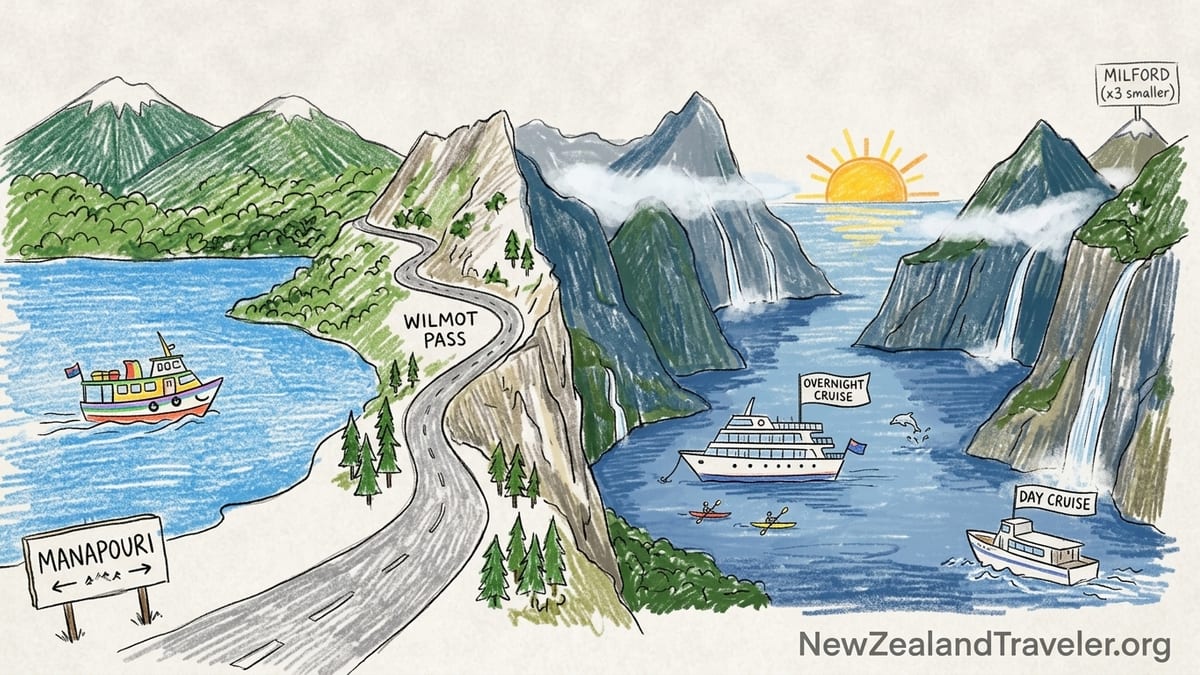
Crucially, there is no road directly to Doubtful Sound. Visitors start at the lakeside settlement of Manapouri, cross Lake Manapouri by boat to West Arm, then travel over the 22 kilometer Wilmot Pass road by coach to reach Deep Cove. That multi-leg journey acts as a natural filter on crowds. While Milford Sound can see heavy day visitor traffic in peak summer, Doubtful typically has only a small number of vessels on the water, and when overnight guests settle in, it often feels like you have the fiord to yourself.
The environment here is also subtly different from Milford. Doubtful receives similar heavy rainfall, often quoted at around six meters a year, which feeds dozens of waterfalls that burst into life after storms. However, its greater size means the fiord has long, sheltered arms and side fiords where boats can turn off engines and drift in near silence. Under the dark, tannin-stained surface is a rare marine ecosystem where deep-sea species like black coral can live unusually close to the surface, part of the reason operators are careful about anchoring and wildlife interactions.
Because of these differences, Doubtful trips are marketed and priced separately from Milford by major operator RealNZ and by smaller expedition-style companies. The entry-level RealNZ wilderness day cruise from Manapouri is currently advertised from about NZD 359 per adult for the full nine-hour experience, while overnight products start from around NZD 749 per adult for shared accommodation, with higher rates for private ensuite cabins and multi-night sailings. Those price gaps matter, and understanding what you actually get for each tier will help you decide whether a day or overnight cruise fits your style and budget.
Understanding the Manapouri Departure and Wilmot Pass Journey
Every standard cruise to Doubtful Sound, whether day or overnight, begins at Manapouri. Manapouri itself is a small lakeside village about 20 minutes’ drive south of Te Anau and roughly two hours from Queenstown in light traffic. For RealNZ and similar operators, check in is usually at the Manapouri visitor centre at Pearl Harbour, where travelers pick up boarding passes and can grab a coffee or last-minute snacks from the small café downstairs before departure.
The first leg is a catamaran crossing of Lake Manapouri, taking about 45 minutes. On a clear morning, the lake crossing can be a highlight in its own right, with views back toward the Kepler Mountains and forested islands sliding past. Even in rain, the low cloud and mist give the lake an atmospheric feel that sets the tone for Fiordland. Seating is mostly indoors with large windows and outdoor decks for photography when the weather plays ball. This boat leg is included in both day and overnight tickets, so you do not pay extra for it.
At West Arm, passengers step ashore and transfer to coaches for the traverse of the Wilmot Pass road. This 22 kilometer road was originally built to service the Manapouri power station and is often described as one of New Zealand’s most expensive roads per kilometer due to the engineering challenges and lack of direct land access. The journey over the pass normally takes around 45 minutes to an hour with commentary stops. On the climb, coaches often pause at viewpoints to look down on Doubtful Sound far below when weather allows, though heavy rain or fog can obscure the view.
The destination is Deep Cove at the head of the fiord, where the cruise vessels are moored. For day cruises, passengers step directly onto a larger day boat. For overnight trips, guests board traditional-style vessels such as the Fiordland Navigator or similar overnight ships, which combine accommodation, dining areas and open deck space. At this point, your luggage is already on the coach with you, but operators usually ask overnight guests to bring only a small overnight bag and leave big suitcases in secure storage in Manapouri or on the coach due to limited onboard space.
Doubtful Sound Day Cruise: Schedule, Inclusions and Feel
The RealNZ wilderness day cruise currently runs as an approximately nine-hour round trip from Manapouri, including the lake crossing, Wilmot Pass transfer and three hours or so on the fiord itself. When booked with coach transfers from Te Anau or Queenstown, the overall day can stretch to about nine hours from Te Anau or up to twelve hours from Queenstown door to door, depending on the exact schedule and season. Operators generally offer early-morning and late-morning departures from Te Anau in high season so travelers can choose between being on the fiord mid-morning or around midday.
On the water, the day boat typically travels the length of Doubtful Sound from Deep Cove out toward the Tasman Sea, turning into side arms where conditions permit. Guides provide natural history commentary on the geology, rainfall, forest and wildlife, pointing out notable features like the hanging valleys cut by glaciers or the scars of historical tree avalanches. There is usually a dedicated moment when the captain cuts the engines and asks passengers to stand quietly on deck, listening to the sounds of waterfalls, bird calls and wind in the forest. That “sound of silence” ritual is a signature of Doubtful trips and tends to be a highlight for many visitors.
Food on day cruises is comparatively simple. Many day tickets are sold as cruise-only, with passengers bringing their own packed lunch from Te Anau or Queenstown, although boxed lunches can often be added at the time of booking for an extra charge. Onboard cafés typically sell hot drinks, basic snacks and sometimes soup or pies, but not a full restaurant-style menu. There are toilets on board and indoor seating, but no showers or cabins because the vessel is configured for day passengers only. Most travelers attend in hiking or casual outdoor clothing with a waterproof layer, sturdy shoes and a warm hat or beanie.
For many visitors, particularly those short on time or budget, the day cruise is enough to capture the scale of Doubtful. You still experience the lake crossing, the Wilmot Pass, the full sweep of the fiord and a real chance of seeing waterfalls in flow and mist clinging to the cliffs. If you are driving yourself to Manapouri from Te Anau, you also retain full control over your schedule and can keep costs contained by self-catering your meals.
Overnight Cruises: A Slower Wilderness Experience
Overnight cruises on Patea / Doubtful Sound change the nature of the trip from a long day excursion into an immersive wilderness stay. RealNZ’s flagship product is the Doubtful Sound Overnight Cruise aboard the Fiordland Navigator or sister vessels, with current pricing for shared accommodation starting around NZD 749 per adult and private ensuite cabins costing more. Some departures operate as one-night sailings, while shoulder or winter seasons may see two-night itineraries that spend longer exploring out toward the Tasman Sea and neighboring fiords.
The logistics of reaching the overnight boat are the same as for the day cruise. You still depart from Manapouri, cross Lake Manapouri and travel the Wilmot Pass road to Deep Cove. The difference is what happens after mid-afternoon. Instead of turning back toward Manapouri with the day trippers, your vessel anchors overnight in one of the fiord’s sheltered arms. The crew reduces lighting on deck, the sound of generators is muted and the boat gently swings on its moorings. On clear nights guests can stargaze from the upper deck, with minimal light pollution and the chance to see the Milky Way arching over the silhouette of the peaks.
Overnight itineraries also build in more unhurried time for activities. In settled weather, the crew typically launches kayaks and small tender craft in a sheltered cove so guests can paddle or take a guided small-boat exploration along the shoreline. Kayaking is generally included in the fare rather than sold as a paid add-on, subject to conditions and safety briefings. For those less comfortable in kayaks, tender craft offer a stable way to get closer to waterfalls or observe the forest at water level without paddling.
Perhaps the biggest difference is the rhythm of the day. Overnight guests see Doubtful Sound at sunset and sunrise, times of soft light and often dramatic cloudscapes that day trippers simply cannot reach. Mornings can deliver mirror-still reflections if the wind is calm, while evenings may have low cloud sliding between ridges or rain curtains revealing waterfalls that were dry only hours earlier. Because the overnight boat is not pressed to meet a same-day return coach schedule, the captain has more flexibility to linger in side arms or change course in response to wildlife sightings.
Cabins, Showers and Food on the Overnight Boats
Accommodation standards on Doubtful Sound overnight boats are closer to a comfortable floating lodge than to a luxury cruise liner. On RealNZ’s Fiordland Navigator and similar vessels, you can usually choose between shared bunk-style cabins with communal bathrooms and smaller private cabins with ensuites. Shared options are more affordable and might be configured for four passengers, making them popular with friends or families traveling together, whereas couples often prefer the privacy of an ensuite cabin even at a higher price point.
All cabins come with made-up beds, duvets, sheets and towels. There are hot showers in the communal bathrooms and private ensuites, which are welcome after time spent on deck in Fiordland’s cool, damp conditions. Storage space is compact, so guests are advised to bring a soft overnight bag with just the essentials. Heavier luggage can usually be stored securely in Manapouri or left on the coach, which does not travel on to other destinations overnight.
Meals are a major part of the overnight experience and help justify the higher fare. Dinner is typically a generous buffet featuring hot dishes, salads, breads and a dessert selection, often with local produce where possible. Dietary requirements can be catered for if advised at booking. A licensed bar sells New Zealand wine, beer and non-alcoholic drinks, although these are usually at standard New Zealand tourism prices rather than discounted. Breakfast the following morning is usually served as a hot and cold buffet, with items like eggs, grilled tomatoes, cereal, fruit and pastries.
For single-night itineraries, lunch is generally not provided on the first day, so travelers are encouraged to eat in Te Anau or Manapouri before boarding, or to bring snacks for the lake and coach segments. On some two-night itineraries, a simple lunch is included on the full day spent exploring the fiord. Complimentary tea and coffee are usually available throughout, which is welcome when standing on deck in windy conditions. The dining saloon and lounge areas are communal, and many travelers find that the shared meals create a relaxed, sociable atmosphere, particularly on calm evenings when people linger over dessert and trade stories of their South Island itineraries.
Weather, Waterfalls and Wildlife: What You May See
Fiordland is famous for its rain, and Doubtful Sound is no exception. Annual rainfall is often quoted at around six meters a year, making wet weather more likely than clear blue skies at any given time. For visitors, this can be a blessing. Heavy rain triggers hundreds of temporary waterfalls that stream down the cliffs, while mist and low cloud create an eerie, cinematic atmosphere. In long dry spells the fiord’s permanent waterfalls still flow, but the dramatic veils that appear after rain are less frequent.
Day and overnight cruises both operate in most wet weather conditions, although extremely strong winds or rare severe storms can disrupt schedules. Travelers should bring a proper waterproof jacket, warm layers, a hat and gloves even in summer, since wind chill on deck can be significant. In winter, snow on the surrounding peaks adds to the visual drama, and overnight trips often become two-night sailings, both because of shorter daylight hours and because operators adjust their schedules outside the peak season.
Wildlife is one of Doubtful Sound’s major drawcards, but no species can be guaranteed. The fiord is home to a small, resident population of bottlenose dolphins that are sometimes seen near the bow wave of cruise vessels, but sightings are never promised. New Zealand fur seals haul out on rocky islets, especially closer to the Tasman Sea entrance, and Fiordland crested penguins, known in te reo Māori as tawaki, breed in the wider Doubtful Sound complex. Depending on the season, lucky travelers may glimpse tawaki porpoising through the water or resting on rocks, but again, operators stress that these are possibilities rather than certainties.
Birdlife along the forested slopes includes native species such as tui, bellbirds and sometimes kea at higher altitudes, though birds are more often heard than clearly seen from the boat. Below the waterline, the fiord’s dark surface layer shields delicate species like black coral and sponges, which is why fishing and anchoring are strictly limited in parts of Fiordland and why cruise captains are careful about their routes. Passengers on tender craft or kayaks may be able to see jellyfish or small fish in the water on clear days, though the tannin staining usually turns the surface an inky shade of brown.
Getting to Manapouri from Te Anau and Queenstown
Logistically, the choice between a day trip and an overnight cruise is tied closely to where you plan to stay on either side of your Doubtful Sound experience. Many travelers base themselves in Te Anau, which sits about 20 kilometers north of Manapouri and functions as the main service town for Fiordland. From Te Anau, the drive to Manapouri takes around 20 minutes, and petrol stations, supermarkets and gear shops in Te Anau make it easy to stock up on food and waterproof clothing before heading south.
RealNZ and other major operators typically offer coach and cruise packages from Te Anau and Queenstown. From Te Anau, coach departures are often around 6:45 am and 9:45 am for day trips in peak season, connecting passengers to the catamaran on Lake Manapouri without needing to self-drive. These coach add-ons increase the total ticket price but remove the fatigue of driving back after a long day on the water. Travelers staying in motorhome parks around Te Anau commonly drive themselves to Manapouri, park near Pearl Harbour and join the cruise from there to save money.
From Queenstown, the commitment is greater. The road distance to Manapouri is roughly 170 kilometers, and touring coaches typically allow about four hours each way to include short rest stops. As a result, a Queenstown to Doubtful Sound day trip can stretch to around twelve or even thirteen hours door to door. Pickup times can be as early as 6:00 am, with returns into Queenstown in the early evening. For this reason, many visitors who want Doubtful Sound and Milford Sound in the same itinerary choose to relocate to Te Anau for a few nights, shortening the Doubtful day and making an early start to Milford the following morning more realistic.
Overnight cruise passengers often find Te Anau or Manapouri an even better base. Staying in Te Anau the night before departure cuts the early-morning travel time significantly and allows for last-minute gear rental if needed. After returning from the overnight, it is possible to drive onward to Queenstown in the afternoon, but some travelers prefer to book a second night in Te Anau in case weather or road conditions delay their return. Because Fiordland’s roads can be affected by snow, slips or heavy rain, especially in winter and early spring, building some flexibility into your itinerary is prudent.
Who Should Choose a Day Cruise vs an Overnight Stay
With such a large price difference between a day trip and an overnight cruise, the decision is rarely casual. A RealNZ wilderness day cruise from Manapouri starting around NZD 359 per adult, plus any transport from Te Anau or Queenstown, represents a full but manageable splurge for many travelers. The overnight products, starting from about NZD 749 per adult for shared accommodation and more for private ensuites or longer itineraries, fall into a much more premium category and can become one of the costliest single line items on a New Zealand itinerary.
The day cruise is the natural choice for travelers short on time, those on tighter budgets and anyone who prefers to be back on land at night. If you are traveling with young children who sleep poorly in unfamiliar beds, or if you know you are prone to seasickness and prefer not to commit to a moving platform overnight, the day option offers the full scenic experience of Doubtful’s cliffs and waterfalls without the added pressure. Self-drivers based in Te Anau also appreciate the ability to bring their own food, control their schedule and return to a larger choice of restaurants and accommodation that evening.
The overnight cruise, by contrast, suits travelers who value atmosphere and quiet as much as ticking off sights. Photographers, keen nature enthusiasts and couples on once-in-a-lifetime trips are often willing to pay the premium to experience dusk and dawn on the fiord. People who have already seen Milford Sound on a day cruise sometimes choose Doubtful as an overnight for a deeper, contrasting experience. The slower pace, included meals, structured activities like kayaking and the chance to disconnect from mobile coverage for a night all add intangible value that some find more memorable than another high-speed day of driving.
Age and mobility are factors too. Overnight cruises involve stairs between decks, narrow gangways and occasional wet, slippery surfaces when boarding kayaks or tenders. Operators state that guests need a reasonable level of mobility for safety. Active older travelers who are comfortable with this often rate the overnight as a highlight of their trip, but anyone who struggles with stairs or balance in moving environments should consider whether a day trip, with fewer hours onboard and more predictable routines, may be a better fit. If you become anxious at the idea of being far from shore at night with limited exit options, that is another sign that a day cruise may provide more enjoyment than extending the stay.
The Takeaway
Doubtful Sound is a distinctive destination in its own right, not simply a backup for Milford Sound when the weather looks grim or bookings are tight. Its remoteness behind Lake Manapouri and the Wilmot Pass, the long, branching fiord system and the combination of heavy rainfall and near-silence create an atmosphere that many travelers remember long after their trip. Whether you choose to experience it in a single long day or as an extended overnight voyage depends less on abstract rankings and more on your budget, time, appetite for immersion and comfort level at sea.
For travelers with limited days in Fiordland, a day cruise from Manapouri delivers the classic double transfer, three hours of wilderness cruising, a real chance of waterfalls and wildlife, and a comfortable return to Te Anau or Queenstown that evening. For those with more time and money to invest, the overnight cruise deepens the encounter, layering in sunset and sunrise, kayaking opportunities, sociable shared meals and the rare feeling of sleeping in near-total darkness beneath steep, forested walls.
In either case, the most important step is to treat Patea / Doubtful Sound as a primary destination when planning your South Island itinerary. Book early in peak summer months, build in a weather buffer if possible, pack proper rain gear and choose the style of trip that matches your own travel personality. Do that, and you are far more likely to come away feeling that the journey to this remote fiord was time and money well spent rather than simply an add-on to Milford.
FAQ
Q1. How long does a Doubtful Sound day cruise from Manapouri actually take door to door?
From Manapouri, the standard wilderness day cruise takes about nine hours including the lake crossing, Wilmot Pass transfer and cruise on the fiord. If you add coach transport from Te Anau, allow around nine hours in total from pickup to drop-off, and from Queenstown the day can stretch to roughly twelve hours including road travel.
Q2. What is the current price difference between a Doubtful Sound day cruise and an overnight cruise?
As of late 2026, RealNZ advertises its Doubtful Sound wilderness day cruise starting around NZD 359 per adult from Manapouri, with higher prices when including coach transfers from Te Anau or Queenstown. Overnight cruises on the Fiordland Navigator and similar vessels start from about NZD 749 per adult for shared cabin accommodation, with private ensuite cabins and multi-night itineraries costing more.
Q3. Are meals included on Doubtful Sound trips?
On day cruises, meals are generally not included by default. Many travelers bring their own packed lunch, and operators often sell boxed lunches as an optional extra along with snacks and drinks onboard. On overnight cruises, a substantial buffet dinner and breakfast are included in the fare, and some two-night itineraries also include lunch on the full day spent exploring. Tea and coffee are usually complimentary, while alcoholic and soft drinks from the bar are extra.
Q4. What type of cabins and bathrooms can I expect on an overnight cruise?
Overnight vessels on Doubtful Sound usually offer a mix of shared bunk-style cabins with communal bathrooms and private cabins with ensuites. All beds are made up with duvets, sheets and towels, and hot showers are available in both communal and private facilities. Space is compact compared with a hotel room, so small overnight bags are recommended instead of large suitcases.
Q5. How likely am I to see dolphins, seals or penguins on a Doubtful Sound cruise?
The fiord is home to a resident population of bottlenose dolphins, New Zealand fur seals and the Fiordland crested penguin, or tawaki, but wildlife sightings are never guaranteed. Day and overnight cruises both have realistic chances of seeing these animals at different times of year, and captains will slow or adjust course when wildlife is spotted, but reputable operators describe these encounters as possibilities, not promises.
Q6. Does the weather need to be fine for a good experience on Doubtful Sound?
No. Fiordland is one of the wettest regions in New Zealand, and rain often enhances the experience by creating countless temporary waterfalls and moody cloudscapes. Cruises operate in most wet conditions, and many travelers rate rainy days as more atmospheric than clear skies. Only severe wind or storm events are likely to disrupt operations, in which case operators arrange refunds or rebooking.
Q7. Is the water on Doubtful Sound rough, and will I get seasick?
Most of the cruise takes place inside the sheltered fiord, where water is typically calm to moderately choppy depending on wind. Some itineraries briefly reach the Tasman Sea, where swell can be stronger, but captains can turn back if conditions are uncomfortable. Travelers prone to motion sickness may still wish to take precautions such as medication or wristbands, but many report that the fiord feels gentler than open ocean.
Q8. Should I stay in Queenstown or Te Anau if I plan to visit Doubtful Sound?
You can reach Doubtful Sound from either, but Te Anau or nearby Manapouri are usually more practical bases. From Te Anau the drive to Manapouri is about 20 minutes, turning the trip into a manageable day. From Queenstown, coach journeys to Manapouri take around four hours each way, making for very long days. Many travelers split their time, staying in Queenstown first and then moving to Te Anau for Doubtful Sound and Milford Sound.
Q9. What should I pack and wear for a Doubtful Sound cruise?
Regardless of season, bring a waterproof jacket, warm layers, sturdy closed shoes, a hat and gloves, plus sunscreen and sunglasses for brighter days. For overnight cruises add sleepwear, toiletries, any medications and a change of clothes in a small soft bag. Cameras and binoculars are useful, but remember there is often spray on deck, so protect electronics with dry bags or covers.
Q10. How far in advance should I book a Doubtful Sound overnight cruise?
In the peak summer season from December to February, overnight cruises often sell out weeks or even months ahead, especially for private ensuite cabins. Booking as early as you can fix your travel dates is wise. Shoulder season departures in spring and autumn can offer more flexibility but still fill on popular dates, while winter two-night itineraries have fewer sailings and also benefit from advance booking.