


Stewart Island / Rakiura is one of the few places in New Zealand where seeing a wild kiwi is a realistic possibility, not just a hopeful dream. Tourism New Zealand highlights the Rakiura tokoeka, a subspecies of southern brown kiwi, as a defining wildlife attraction of the island and a reason many travelers make the extra journey south. For visitors whose main goal is to meet kiwi on their own terms, choosing the right tour is crucial. This guide compares the main options, from guided night walks and wildlife cruises with evening shore trips to Ulva Island excursions and broader nature tours, so you can book confidently and set your expectations wisely.
Understanding Rakiura’s Wild Kiwi
Rakiura is renowned across New Zealand as one of the best places in the country to see wild kiwi. The Stewart Island tokoeka lives in relatively high densities across the island’s forests and coastal scrub, and Department of Conservation information notes that this subspecies is more likely to show some daytime activity than other kiwi, although night remains the prime time for encounters. Rakiura National Park surrounds the small settlement of Oban, placing visitors on the doorstep of extensive kiwi habitat almost as soon as they step off the ferry or plane.
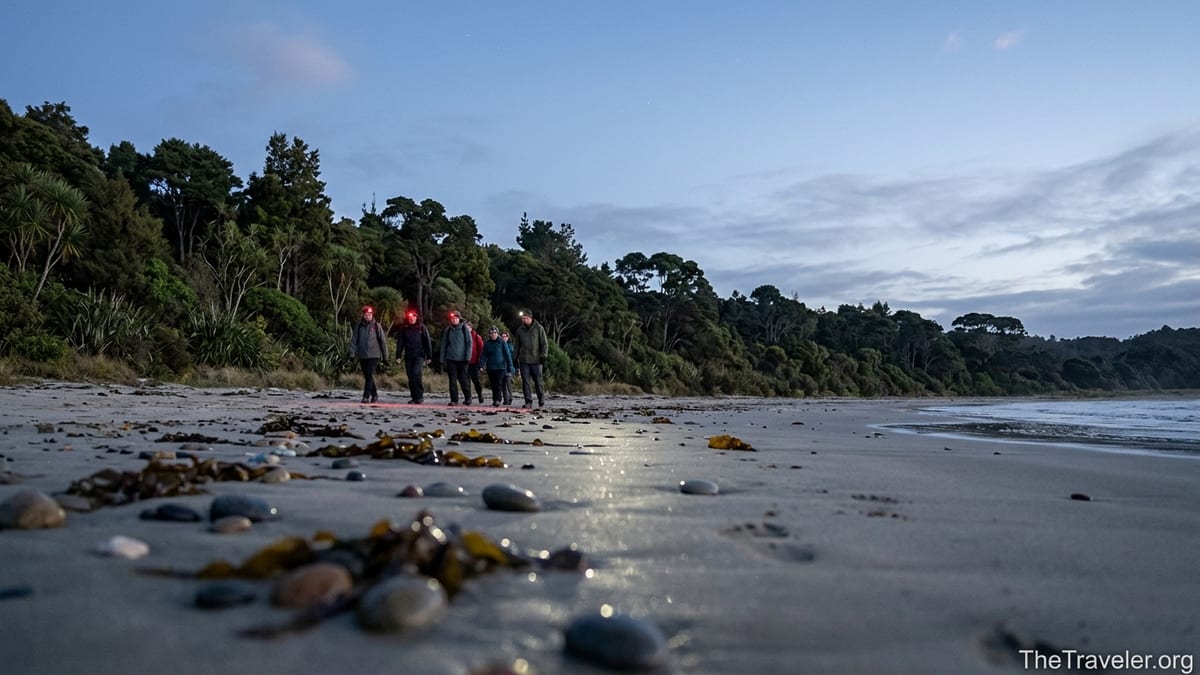
Unlike captive experiences on the mainland, where kiwi are viewed in nocturnal houses, Rakiura kiwi encounters take place in the bird’s own environment. That means walking in dark, often damp coastal forest, listening for rustles and snuffling sounds rather than following a spotlighted animal in an enclosure. Operators and local guides are acutely aware that they are guests in kiwi territory. Responsible tours move slowly, keep to tracks or open shorelines and use carefully controlled red-filtered torches to minimise disturbance.
It is important to remember that kiwi are wild animals with their own routines. Even on the best-managed outings, sightings are never guaranteed. However, the combination of high kiwi numbers, experienced guides who know local territories and calm evening conditions means that success rates on dedicated kiwi tours are typically strong across the main viewing months. Travelers who arrive prepared for a patient, low-key wildlife search are often rewarded with surprisingly intimate moments as birds probe for invertebrates just metres away.
Guided Night Kiwi Walks: The Classic Choice
For most visitors whose top priority is seeing kiwi, a guided night walk is the most targeted and efficient option. Several local operators based in Oban offer evening kiwi-spotting experiences, often branded as wild kiwi encounters or kiwi spotting tours. These generally begin with a short briefing in town or at a nearby wharf before a vehicle transfer or short boat ride to a concession area where kiwi are known to feed regularly, such as private forest reserves or predator-controlled coastal headlands.
Typical departure times vary by season but often fall between about 7.30 pm and 9.30 pm in summer, when sunset is late, and slightly earlier in autumn and spring. Total tour duration usually runs from 2.5 to 4 hours, including transfers. Walking distances are often modest, commonly in the range of 1 to 4 kilometres on undulating tracks, beaches or open grassland. Terrain can feel uneven underfoot, with exposed roots and muddy patches, so these outings are generally classed as easy to moderate rather than gentle strolls, and are not always suitable for visitors with limited mobility.
Group sizes on guided night walks are intentionally kept small to maximise everyone’s chances and minimise impact. Many operators cap numbers at around 8 to 12 guests per guide, and some use even smaller parties in more sensitive areas. Prices vary by provider and season but visitors can expect to pay in the vicinity of a substantial half-day guided activity elsewhere in New Zealand, reflecting the specialist guiding and the small-group format. These tours concentrate almost entirely on kiwi, with guides focusing on listening for calls, reading tracks on the beach and interpreting kiwi behaviour as birds emerge to feed.
Wildlife Cruises With Evening Shore Walks
Another popular way to search for kiwi is as part of a combined wildlife cruise and shore-based evening walk. Companies operating from Oban’s Halfmoon Bay and nearby wharves run boat trips that first explore the coastline and outlying islands, often in the late afternoon or early evening. During the cruise component, guests might watch mollymawks following the vessel, see New Zealand fur seals hauled out on rocks or, in season, look for little penguins or yellow-eyed penguins coming ashore.
After the marine wildlife viewing, boats commonly land at a quieter beach or jetty on Rakiura or a nearby island, where the kiwi search begins. The shore section of these tours is usually shorter than a stand-alone night walk, perhaps one to two hours with slow walking along a beach and into adjacent forest margins. This format particularly suits travelers who want variety: the chance to experience Rakiura from the water and still have a realistic opportunity to see kiwi after dark.
Because these itineraries involve a vessel and may carry more people overall, group sizes on the kiwi component can be slightly larger than on purely land-based night walks. However, operators often break passengers into smaller guided subgroups for the shore portion, each with its own guide and flashlight to keep noise and disturbance to a minimum. From a kiwi-encounter perspective, the chances can be very good, especially on routes with long-established viewing areas, though the overall focus of the tour is shared between birds, marine life and scenery rather than exclusively on kiwi.
Ulva Island Excursions: Birdlife First, Kiwi a Bonus
Ulva Island / Te Wharawhara is one of New Zealand’s most celebrated open sanctuaries and is often described as a birdwatchers’ paradise. Regular water taxis, small tour boats and guided walks operate from Oban, transporting visitors across Paterson Inlet to this predator-controlled island where native birds such as kākā, kākāriki, saddlebacks, Stewart Island robins and mōhua are commonly seen at close range. The Department of Conservation notes that kiwi are present on Ulva and that some visitors are lucky enough to glimpse them, particularly at dawn, dusk or on rare daytime foraging forays.
However, travelers whose main reason for coming to Rakiura is seeing kiwi should be careful not to treat a standard Ulva Island day trip as equivalent to a dedicated kiwi-search tour. Most Ulva excursions run during daylight hours, typically between about 8.30 am and 4.30 pm, when birdsong is at its peak and forest light is best for photography. The emphasis is on a rich diversity of native species, botany and conservation stories, not on nocturnal wildlife. Guides will always celebrate a kiwi encounter if it happens, but they generally present it as an unexpected highlight rather than an anticipated outcome.
Walking on Ulva Island is usually easy to moderate, following well-formed tracks with short hills. A typical guided visit involves 2 to 3 hours of slow-paced walking, stopping frequently to watch birds feeding or to discuss the island’s restoration. Group sizes are often small, regularly in the range of 8 to 12 guests per guide. For keen birders or families interested in an accessible taste of pre-human New Zealand forest, Ulva is unmissable. For kiwi-focused travelers, it works best as a complementary experience: a superb daytime birding and nature outing to pair with a separate night-time kiwi search on Rakiura itself.
Broader Nature and Multi-Day Tours Including Kiwi Spotting
Many travelers now experience Stewart Island kiwi as part of a broader package or small-group itinerary rather than a single stand-alone ticket. Several New Zealand tour companies offer multi-day Rakiura trips that bundle together the ferry or flights from the mainland, accommodation in Oban, a guided Ulva Island visit and an evening kiwi-spotting tour. A typical three-day package might include an Ulva Island walk on day two and a night-time kiwi search either that evening or on the previous night, giving guests two distinct wildlife experiences with different rhythms and habitats.
Other itineraries wrap kiwi encounters into themed trips. For example, small-group “dark sky” journeys timed around the southern aurora viewing season may include an evening kiwi-spotting walk after a local dinner, allowing guests to combine stargazing with nocturnal wildlife. These packages often run outside the peak summer season, in cooler months with earlier nightfall and potentially quieter tracks, conditions that can work in favour of kiwi viewing for visitors happy to rug up in extra layers.
Broader nature tours generally operate on a fixed timetable, which means less flexibility to choose or change the exact kiwi operator. However, they simplify logistics by pre-booking key elements during busy periods when individual kiwi tours can sell out. Group sizes on such packages can be larger overall, but kiwi outings themselves are typically conducted in small subgroups with specialist guides. For travelers who value convenience and a curated itinerary over fully independent planning, these packages can be an efficient way to ensure a place on a quality kiwi encounter.
Where Kiwi Encounters Are Most Likely
When comparing kiwi-focused activities on Stewart Island, it helps to think in terms of probability. Dedicated guided night walks, whether entirely land-based or paired with a short boat transfer, are designed from the ground up around kiwi behaviour. Guides target known territories, choose routes with open sightlines and time departures to match peak feeding periods. In settled weather and during core viewing months, these tours generally offer the strongest chances of seeing birds at reasonably close range, sometimes watching them forage along beaches or probe for food in patches of seaweed.
Wildlife cruises with evening shore walks tend to deliver slightly broader experiences. On some evenings kiwi may appear quickly along the beach or track, leading to excellent viewing, while on others the highlight may be albatross soaring behind the boat or penguins coming ashore with little or no kiwi activity. For travelers keen on both seabirds and kiwi but with limited time, these combination tours can offer a satisfying balance, though the kiwi-specific odds may be marginally lower than on a tour that spends the entire evening on land in a prime territory.
On Ulva Island daytime excursions, kiwi are present in the ecosystem but much less likely to be encountered, simply because most visits do not coincide with the birds’ most active hours. Visitors are almost guaranteed memorable views of other species such as kākā, robins and tīeke, and some years lucky individuals or small groups do see kiwi poking around in the undergrowth. Still, many Ulva visitors will leave without a kiwi sighting and remain delighted, as the island’s overall birdlife and forest atmosphere are exceptional on their own terms. For kiwi-focused travelers, the most reliable strategy is to treat Ulva as a premium birding trip plus the small chance of a bonus kiwi, then separately book a night-time kiwi search on Rakiura proper.
Walking Difficulty, Weather and What to Wear
Conditions on Stewart Island can change quickly, and even in summer evenings can feel cool and damp compared to mainland cities. For night kiwi walks and evening shore excursions, visitors should plan for temperatures that can drop close to single digits in cooler months and for frequent showers at any time of year. Tour operators will normally proceed in light rain if it is safe to do so, and kiwi often continue feeding in drizzle and mist, so a willingness to dress appropriately can be the difference between a comfortable, successful outing and a chilled, distracted one.
For clothing, sturdy waterproof or water-resistant footwear with good tread is essential. Tracks and beaches can be muddy, slippery or strewn with wet seaweed. Lightweight hiking boots or solid walking shoes work better than sneakers with smooth soles. Long trousers help protect against wet vegetation, and a quick-drying base layer under a warm mid-layer is advisable even in summer. A waterproof jacket with a hood is highly recommended; umbrellas are rarely practical in forest or on boats and may interfere with other guests’ sightlines.
Most operators provide hand-held lights or headlamps with a red filter and will ask guests not to bring their own powerful white torches, as these can startle wildlife. It is worth checking in advance whether walking poles are allowed or recommended, especially for visitors who appreciate extra support on uneven ground. On Ulva Island daytime trips, clothing can be a little lighter but layers and a rain jacket are still wise, as showers can roll across Paterson Inlet without much warning. In all cases, insect repellent can be useful around sheltered bays and forest edges, particularly in still, humid weather.
How to Book and Plan Your Kiwi-Focused Visit
Because kiwi are a marquee attraction and group sizes are intentionally small, it is sensible to book kiwi tours in advance, especially from December through March and during New Zealand school holiday periods. Many visitors choose to confirm at least one kiwi-focused activity at the same time they reserve accommodation in Oban. Those with two or three nights on the island often book their kiwi tour for the first evening, leaving spare nights as a buffer in case of cancellation due to strong winds or heavy rain.
When comparing operators, consider more than just price. Look at maximum group size, whether the tour is land-based or combined with a cruise, the type of terrain involved and pick-up and drop-off times in relation to your dinner and ferry or flight schedules. Travelers who tire easily may prefer a shorter 2 to 3 hour sortie close to Oban, while keen walkers may enjoy outings that cover a little more ground in wilder settings. Accommodation providers in Oban are generally familiar with local tours and can often advise which options suit children, older travelers or guests with specific mobility needs.
Payment is usually taken in New Zealand dollars, either online at the time of booking or in person in Oban before departure. Some operators provide basic wet-weather gear or can arrange last-minute clothing hire in town, but in practice it is easier and more comfortable to arrive equipped. If your main reason for coming to Rakiura is wild kiwi, it is worth budgeting for both a dedicated night walk and a daytime Ulva Island excursion if time permits. Together, they present two very different but complementary sides of the island’s birdlife: one under starlight in hushed forest, the other in bright green canopy full of song.
The Takeaway
For travelers structuring a Stewart Island itinerary around the dream of seeing kiwi in the wild, the most reliable route is clear. A guided night kiwi walk, preferably on your first available evening, offers the strongest chance of a close, ethical encounter with Rakiura’s iconic birds. Wildlife cruises with evening shore walks provide a rewarding mix of seabirds, scenery and potential kiwi viewing, while Ulva Island day trips excel as immersive native bird and forest experiences where any kiwi sighting should be treated as an unexpected bonus rather than a core promise.
Rakiura’s combination of high kiwi densities, experienced local guides and relatively low visitor numbers gives it a reputation within New Zealand as a standout destination for wild kiwi encounters. At the same time, the island’s changeable weather, uneven terrain and the inherent unpredictability of wildlife mean that patience, flexibility and good preparation are essential. Visitors who arrive with appropriate clothing, realistic expectations and a willingness to move quietly through the dark often come away with some of the most memorable wildlife moments of their travels, whether that is a kiwi shuffling along a moonlit beach or a kākā calling above a sun-dappled trail on Ulva Island.
FAQ
Q1. Is Stewart Island really the best place in New Zealand to see kiwi in the wild?
Many New Zealanders, guides and conservation agencies regard Rakiura as one of the country’s most reliable locations for viewing wild kiwi, thanks to its substantial kiwi population and extensive protected habitat. Sightings are never guaranteed, but the odds on a well-run night walk are generally higher than at most mainland sites.
Q2. Do I need to book a kiwi tour in advance or can I wait until I arrive?
Booking in advance is strongly recommended, particularly in summer and during school holidays, because kiwi tours use small groups and can sell out. If you are staying several nights, securing a place on your first evening gives you flexibility to reschedule if weather or sea conditions cause changes.
Q3. How difficult are the night walks for someone of average fitness?
Most kiwi night walks involve easy to moderate walking over 1 to 4 kilometres at a slow pace. Tracks can be muddy and uneven, with roots and short slopes, but guides typically set a gentle speed with frequent stops. Travelers comfortable with basic bush tracks and stairs should manage, while those with significant mobility issues should seek operator advice in advance.
Q4. Can children join kiwi tours on Stewart Island?
Many operators accept children above a certain age, often around 10 years, provided they can walk quietly in the dark for several hours. The stillness and late finish can be challenging for younger kids, so parents should discuss suitability with the operator and consider shorter or more flexible options if traveling with primary-school-age children.
Q5. Will an Ulva Island day trip guarantee a kiwi sighting?
No, Ulva Island day tours focus on a broad range of native birds and forest ecology, not specifically on kiwi. Although kiwi live on the island and are occasionally seen, most visitors will not encounter one during standard daytime excursions. Treat Ulva primarily as an exceptional bird and nature experience, with any kiwi sighting as an unexpected bonus.
Q6. What should I wear and bring for a night kiwi tour?
Wear sturdy closed footwear with good grip, long trousers, warm layers and a waterproof jacket. Operators usually provide suitable lights, so you typically do not need to bring your own torch. A small backpack, a hat, light gloves in cooler months and insect repellent are also sensible. Cameras should be used sparingly and never with flash.
Q7. Are kiwi tours affected by weather?
Yes, strong winds, heavy rain or hazardous sea conditions can lead to changes or cancellations, particularly for boat-based tours. Light rain rarely stops kiwi or guides, but operators may adjust timing or location to keep guests safe and comfortable. Having more than one evening on the island provides useful flexibility if conditions are poor on your first night.
Q8. How long should I stay on Stewart Island if my main goal is seeing kiwi?
A minimum of two nights is advisable if your schedule allows, giving you at least one planned kiwi outing and a backup evening in case of bad weather. Three nights offers more leeway to combine a dedicated night walk with an Ulva Island trip and unhurried time to enjoy Oban and short local walks.
Q9. Can I look for kiwi on my own instead of joining a tour?
It is possible to encounter kiwi independently on Rakiura, especially for those staying in outlying cottages or walking tracks at dawn and dusk. However, going with an experienced guide significantly improves your chances, reduces the risk of accidentally disturbing wildlife and ensures that viewing is done in line with local conservation guidelines.
Q10. Are there any special rules or etiquette I should follow around kiwi?
Yes, guests should move quietly, stay close to the guide, keep to tracks and open areas and avoid sudden movements. Never use flash photography, shine bright white lights at birds or attempt to approach or touch wildlife. Following guide instructions helps protect kiwi and ensures ethical, low-impact encounters for future visitors.