


Reaching Stewart Island / Rakiura feels like the final leap to the edge of New Zealand, and how you make that leap shapes the start of your trip. Most visitors arrive either by the one hour catamaran ferry from Bluff or by a short scenic flight from Invercargill. Both options are reliable and well established, but they suit different kinds of travellers, budgets and itineraries. Understanding the trade-offs around price, comfort, baggage and connections will help you choose the right way to cross Foveaux Strait.
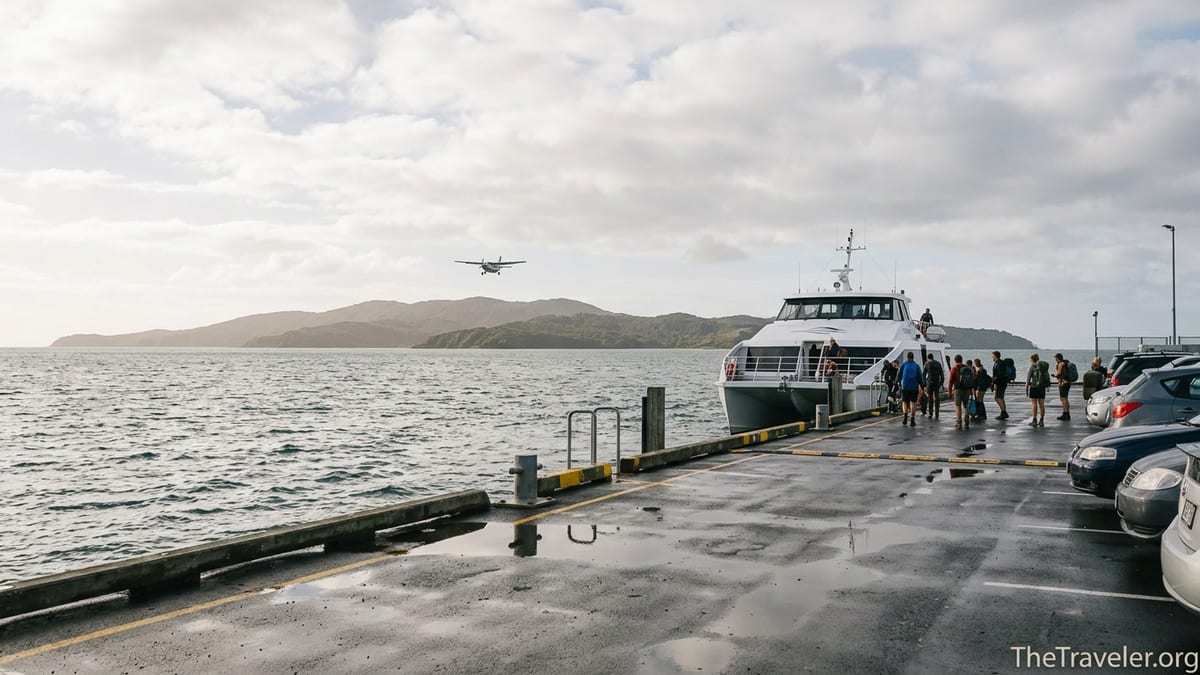
Ferry vs Flight at a Glance
Stewart Island is linked to the South Island in two main ways: the fast catamaran ferry from Bluff and small fixed-wing aircraft from Invercargill Airport. The ferry is operated by RealNZ’s Stewart Island Ferry service and takes around one hour to cover the roughly 39 kilometre crossing of Foveaux Strait between Bluff Harbour and Oban. Services typically run morning and late afternoon year-round, with extra sailings in peak summer.
Flights are operated by Stewart Island Flights, using small aircraft between Invercargill Airport and Ryan’s Creek Aerodrome just above Oban. The flight time is about 20 minutes, with scheduled services up to three times a day in winter and more in the busy summer months. The airline promotes 365 day operations, and extra flights are often added when demand is high.
In practice, most travellers choose based on seasickness tolerance, budget and where they are coming from in the South Island. For example, someone finishing a road trip in a rental car in Invercargill might find the Bluff ferry simplest, while a Queenstown-based hiker with limited time might prefer the speed of flying from Invercargill and back the same way.
Importantly, you do not have to commit to one method for both directions. Many visitors choose to sail one way and fly the other, which can give you both the viewpoint from the sea and the aerial perspective over Rakiura’s forests, beaches and inlets.
Journey Time and Overall Door-to-Door Travel
On paper, flying is faster than taking the ferry. The actual flight between Invercargill and Stewart Island is around 20 minutes, compared with roughly one hour on the ferry. However, what often matters more is the total door-to-door time, including driving and check-in.
If you are already in Invercargill, reaching the airport usually takes less than 15 minutes by taxi or shuttle from central accommodation. Stewart Island Flights asks passengers to check in around 30 minutes before departure. Once you arrive at Ryan’s Creek, a short included transfer brings you into the Oban township in a matter of minutes. All up, it is quite realistic to go from a hotel in central Invercargill to a lodge in Oban in about 1.5 hours, assuming good weather and on-time flights.
The ferry involves a 20 to 30 minute drive from Invercargill to Bluff, depending on traffic and whether you are driving yourself or using a shuttle. RealNZ asks passengers to be at the Bluff terminal ahead of departure for check-in and boarding. The crossing itself is about one hour and you arrive right at the waterfront in Oban, a short walk or quick transfer from most guesthouses. Door-to-door from central Invercargill to Oban by shuttle plus ferry typically takes around two to two and a half hours.
From Queenstown or Te Anau, the picture changes again. A rental car drive from Queenstown to Invercargill takes about two and a half hours in good conditions, and from Queenstown to Bluff about three hours. When you add check-in and buffer time, both ferry and flight options will consume much of a day, so what really matters is which schedule lines up more neatly with your existing plans.
Price, Value and Typical Costs
Prices change regularly, but some broad patterns hold. The Bluff to Stewart Island ferry is often priced as the more budget-friendly choice, especially if you are travelling in a group or as a family. Third-party booking platforms in mid 2026 show one-way adult fares in the ballpark of 70 to 80 New Zealand dollars for the one hour crossing, with return tickets and off-peak deals sometimes working out a bit cheaper per leg.
Flights between Invercargill and Stewart Island are typically more expensive on a per-seat basis than the ferry. Travellers often report return fares that are noticeably higher than equivalent return ferry tickets, especially during peak summer months when demand is strong. However, for some visitors the time saved, the experience of a scenic flight and the avoidance of seasickness justify the premium.
It is also worth considering how your broader itinerary affects value. If the ferry schedule lines up perfectly with your arrival into Invercargill by long-distance bus or a drive down from Queenstown, then a cheaper ferry can be excellent value. On the other hand, if you are short on time and a flight lets you squeeze an extra day of walking the Rakiura Track or visiting Ulva Island, the extra cost may feel like money well spent.
Families and groups should also run the numbers on airport transfers versus parking. In Bluff, paid parking is available close to the ferry terminal, which works well if you are leaving a vehicle on the mainland. In Invercargill, you will need to factor in airport parking or taxi/shuttle costs if you are using the flights.
Luggage Limits, Hiking Gear and Outdoor Equipment
Luggage policies are one of the most important differences between flying and taking the ferry, especially for hikers carrying camping equipment or photographers travelling with bulky gear. Stewart Island Flights sets a standard checked baggage allowance of around 15 kilograms per fare-paying customer, plus a small cabin item such as a day pack or laptop bag. Excess baggage may be accepted, but it is strictly subject to aircraft weight and balance on the day and can be delayed to a later flight if there is not enough capacity.
This means that a tramper heading to the Rakiura Great Walk with a 16 kilogram backpack, plus food for three days, might need to redistribute items, wear heavier clothing or be prepared for some gear to travel later. Items like large camera tripods, fishing rods or collapsible pack-rafts can all fit, but staff may treat them as oversized items that only fly when space allows. Certain items are prohibited altogether on scheduled flights, such as camping gas canisters, so you would need to buy fuel on the island or choose alternative cooking arrangements.
By contrast, the ferry behaves more like a coastal passenger ship. There is no strict personal weight limit in the same way as a light aircraft, although there are still sensible limits for safety and handling. In practice, hikers routinely board with large tramping packs, full food barrels and even chilly bins for longer stays in holiday homes. If you are planning a long stay in a self-catering bach or carrying specialist equipment such as diving gear, the ferry is usually the more forgiving option.
For travellers with mobility aids, such as wheelchairs, both operators are used to handling these, but the small-aircraft environment does require more coordination. Ferry boarding is via gangway and the terminals are accustomed to helping passengers with limited mobility, while flights may need prior notice so staff can accommodate aids and plan seating.
Seasickness, Comfort and Weather Disruption
Foveaux Strait has a reputation for being choppy. The fast catamarans used on the Bluff to Stewart Island run are purpose-built for these waters and complete the crossing in about an hour, but conditions can range from glassy calm to very rough. Many travellers who are not usually prone to motion sickness find the ferry perfectly manageable on moderate days, while those sensitive to sea travel may feel unwell even in fairly average swell.
If you know you are prone to seasickness, flying is usually the safer option. The 20 minute hop in a small aircraft is not immune to turbulence, but many travellers who struggle on boats report arriving in much better shape by air. On windy or gusty days the take-off and landing can feel lively, yet the short duration and absence of rolling motion can still be easier than an hour on a pitching catamaran.
Weather disruption is a reality for both modes. Strong winds, low cloud or heavy rain can cause delays or cancellations for flights, and very rough seas or high winds can do the same to the ferry. Local operators are experienced at making conservative calls around safety, so it is sensible to avoid critical onward connections on the same day. For example, do not book the last possible afternoon ferry and then expect to catch an evening flight from Queenstown the same night without any buffer.
In shoulder seasons and winter, when fronts cross the Southern Ocean more frequently, disruption risk rises. Travellers planning multi-day hikes like the Rakiura Track should consider building in at least one spare night on the mainland or in Oban at the start or end of the trip, in case a storm temporarily halts crossings.
Connections from Queenstown and Around the South Island
Most international visitors reach Stewart Island as part of a broader South Island circuit, and the logistics of connecting from Queenstown, Te Anau or elsewhere can significantly influence whether ferry or flight works best. Queenstown is roughly two and a half hours’ drive from Invercargill and around three hours from Bluff in good conditions. The route via State Highway 6 is straightforward but can be busy in summer and affected by ice or snow in winter, particularly around the higher sections near Kingston.
A practical pattern is to leave Queenstown in the morning, drive to Invercargill around lunchtime and then either board an afternoon flight or continue directly to Bluff for the late afternoon ferry. For example, you might check out of a Queenstown hotel at 8 am, have an early lunch in Invercargill at midday, then check in for a 1 pm or 4 pm Stewart Island Flights departure, or push on to Bluff for a 4.30 pm ferry. The key is building in buffer time for rest stops, roadworks or slower driving in wet or icy conditions.
Travellers using public transport need to pay even closer attention to timetables. Long-distance buses to Invercargill tend to arrive mid to late afternoon, which often means an overnight stay before an early ferry or morning flight. In that case, the choice between ferry and flight can be shaped by where your accommodation sits. If you are staying near central Invercargill, flying from the airport might be more convenient. If you are happy to shuttle directly to Bluff in the morning, the ferry becomes attractive.
Those coming from Dunedin face a similar calculation. The drive from Dunedin to Invercargill is about two and a half hours, and to Bluff slightly longer. It is possible to leave Dunedin after breakfast and catch a late afternoon ferry from Bluff or evening flight from Invercargill in one day, but fatigue and winter driving conditions should be factored in.
Mixing Ferry and Flight in One Trip
One of the most enjoyable ways to experience Rakiura is to sail one way and fly the other. This combination gives you the chance to see the island’s forested hills, bays and offshore islands from the water on the way over and from the air on the way back. Many travellers, for example, take the morning ferry from Bluff to Oban, settle into their accommodation, and then fly back to Invercargill on an afternoon or next-day flight.
Combining modes is also a practical strategy for managing seasickness risk while still enjoying a classic Foveaux Strait crossing. Someone who feels anxious about rough water might plan to take the ferry in the direction most likely to coincide with calmer weather, then keep a flight booked or held as a backup in the other direction. If a large weather system is forecast, you may be able to adjust your bookings with the help of local agents in Invercargill or Oban, subject to availability and change fees.
Another reason to mix modes is when your South Island itinerary is not a simple loop. For instance, you might drive a rental car from Christchurch down the east coast to Bluff, leave the car in long-term parking, take the ferry to Stewart Island, and later fly back to Invercargill for a domestic flight to Wellington. In that scenario, using the ferry on the leg that matches your car drop-off point and the flight for the leg that lines up with your onward air travel makes logistical sense.
When planning a mixed itinerary, pay attention to baggage rules across both bookings. If you will fly one way, pack your hiking gear so that critical items, such as boots and waterproofs, can fit within the 15 kilogram allowance, and treat any extra luxuries as items that may need to travel separately or be left on the mainland.
Which Option Suits Hikers and Outdoor Travellers Best
For hikers, hunters, birdwatchers and other outdoor travellers, the decision between ferry and flight often comes down to gear. Multi-day trampers on the Rakiura Track usually carry a pack in the 12 to 18 kilogram range once food and water are included. That weight technically fits within a typical flight allowance, but any extras like camera gear, fishing tackle or a second bag can push you into the realm of excess baggage and uncertainty.
Because the ferry is much more tolerant of bulky or heavy gear, it is generally the safer choice for those carrying full camping setups, including large tents, cooking equipment and multi-day food supplies. You simply check in your pack at the terminal, board, and collect it again in Oban with little fuss. If you are tackling more remote routes, such as fly-in and hike-out trips to beaches like Mason Bay, you might combine an initial flight directly to a remote airstrip with a later ferry back from Oban once you have walked across the island.
On the other hand, ultralight hikers with compact gear may find flying entirely practical. A walker carrying a 9 kilogram base weight plus food can easily keep within 15 kilograms total, especially if heavier layers are worn onto the plane. For these travellers, the appeal of a 20 minute flight and arriving early enough in the day to start hiking immediately is significant.
For wildlife and birding enthusiasts planning early morning outings to places like Ulva Island, both ferry and flight can work, but you should think about how your arrival time lines up with guided tours or water taxi departures. An early morning flight might let you land on Stewart Island in time for a late morning trip to Ulva, while the first ferry of the day may mean shifting the excursion to the following day.
The Takeaway
There is no single “best” way to reach Stewart Island / Rakiura. The Bluff ferry and Invercargill flights each have clear strengths, and your ideal choice depends on where you are coming from, your tolerance for rough seas, your budget and how much gear you are carrying. The ferry tends to win on cost and baggage flexibility, and it offers a classic maritime experience across Foveaux Strait. Flights win on speed and comfort for those wary of seasickness, and they provide an unforgettable aerial introduction to the island.
For many travellers, the smartest strategy is to use both: perhaps sail down from Bluff as you wind up a South Island road trip, then fly back to Invercargill in time for a domestic connection. Whichever option you pick, build in some flexibility for weather, avoid tight same-day onward bookings, and pack with luggage rules in mind. Done right, the crossing to Rakiura becomes more than just a transfer: it is the prologue to your time at the far southern edge of Aotearoa.
FAQ
Q1. Is the Stewart Island ferry or flight more reliable in bad weather?
The ferry and flights can both be disrupted by strong wind or poor visibility. Operators are conservative around safety, so travellers should avoid tight same-day onward connections and allow at least one buffer day in winter or shoulder seasons.
Q2. How far in advance should I book the ferry or flight to Stewart Island?
In peak summer and during New Zealand school holidays, it is wise to book at least several weeks ahead, especially for flights, which have limited seats. In quieter months you may find same-week or even same-day availability, but advance bookings still give more choice of departure times.
Q3. Can I take gas canisters and stove fuel for hiking on the plane?
Standard camping gas canisters are generally not allowed on scheduled Stewart Island flights for safety reasons. Travellers who fly usually plan to buy fuel in Oban where available, or adjust their cooking setup. The ferry is typically more accommodating of camping fuel, subject to standard safety rules, so check current guidance when booking.
Q4. Is there parking available at Bluff for the ferry?
Yes, vehicle parking is available near the Bluff ferry terminal, and many road trippers leave their cars there while staying on Stewart Island. You should factor parking costs into your budget and avoid leaving valuables in the vehicle.
Q5. Which option is better if I get seasick easily?
If you are prone to motion sickness, flying is usually the better choice. The short 20 minute flight avoids the rolling motion of a one hour ferry crossing in choppy seas. If you must take the ferry, consider medication and choose a sailing on a day with calmer weather if possible.
Q6. Can I travel one way by ferry and return by flight?
Yes, many visitors choose to sail one way and fly the other. You book each leg separately with the relevant operator and then plan your mainland transport so that one direction aligns with Bluff and the other with Invercargill Airport.
Q7. How early should I arrive for check-in on the ferry or flight?
For flights, aim to arrive at Invercargill Airport at least 30 minutes before departure to allow for check-in and briefings. For the ferry, it is sensible to be at the Bluff or Oban terminal well before departure, following the latest guidance from the operator when you book.
Q8. What is the best choice for hikers on the Rakiura Track carrying full packs?
Hikers with heavy or bulky packs usually find the ferry more convenient because it is more flexible with luggage size and weight. Ultralight trampers with compact gear often manage comfortably within the typical 15 kilogram flight allowance and may enjoy the speed and views of flying.
Q9. How do I connect from Queenstown to catch the ferry or flight?
Driving from Queenstown to Invercargill takes around two and a half hours, and to Bluff about three hours. Many travellers leave Queenstown in the morning, reach Invercargill around midday, then either fly in the afternoon or continue by road to catch a late afternoon ferry, building in extra time for traffic or winter road conditions.
Q10. Are there shops and services in Oban when I arrive?
Yes, Oban has small grocery stores, cafes, accommodation providers and tour operators, though services are limited compared with larger towns. It is a good idea to arrive with essentials like prescription medications already packed, but you can usually top up basic food items and outdoor supplies once you are on the island.