


The rain started an hour from the hut, the kind of fine West Coast drizzle that soaks everything without you quite noticing. By the time the orange roof appeared through the trees, my shoulders ached, my boots squelched and I was questioning why anyone would choose to sleep in a remote New Zealand backcountry hut with a dozen strangers. Twelve hours later, as the fire died to embers and the last snorer found their rhythm, I finally understood why the Department of Conservation’s hut network is so central to tramping culture here.
Meeting New Zealand’s Backcountry-Hut Culture
New Zealand’s backcountry-hut system is not an add-on to tramping; it is the backbone. The Department of Conservation (DOC) manages more than 950 huts scattered across mountains, forests and river valleys, and most of them are not on the country’s famous Great Walks. These are the simple, utilitarian shelters used by generations of deer cullers, hunters and trampers, now shared by visiting hikers from all over the world.
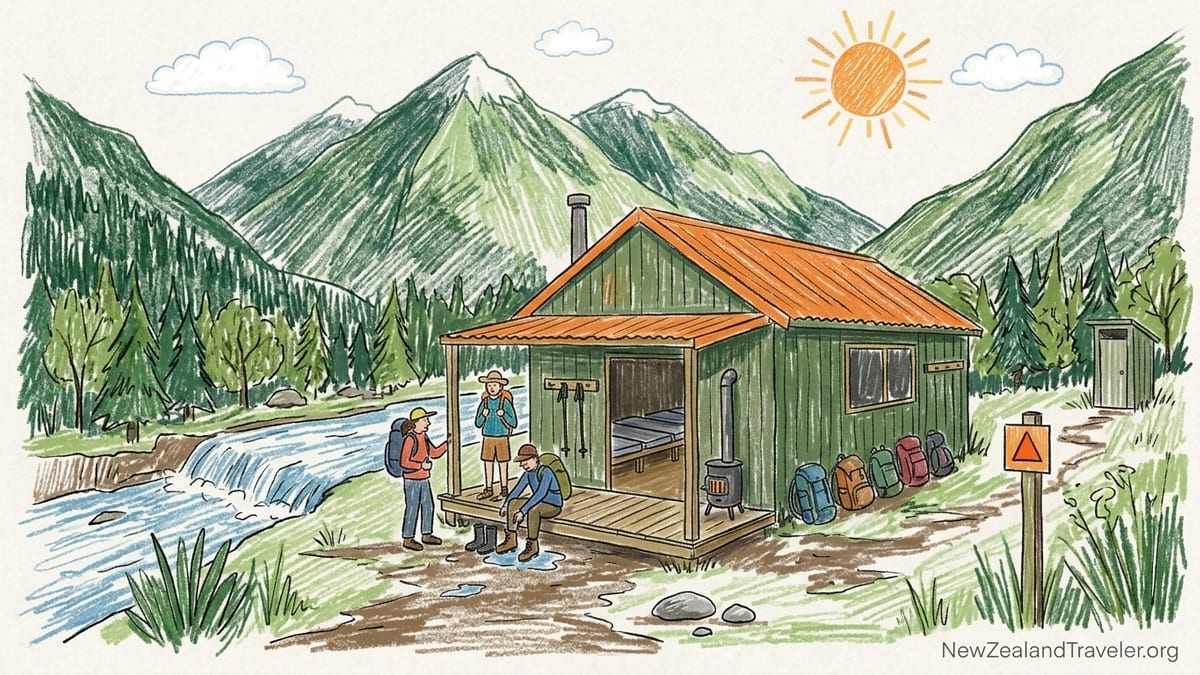
For my first hut night, I deliberately skipped the Great Walks and chose a standard DOC hut on a popular weekend track, one of the non-bookable huts you reach after three to four hours of steady walking from a gravel road end. It had the classic look: a small, weathered building, painted DOC green with an orange roof, sitting just above a river terrace. No sign of a car park, café or cellphone coverage. Just a cluster of walking poles by the door and a low murmur of voices inside.
Stepping over the threshold felt a little like walking into a shared flat where everyone already knew the rules except me. Boots off on the porch. Packs along one wall. Wet jackets hanging from every hook and nail. A row of bunk platforms at the back, a long table and benches down the center, and a potbelly stove taking pride of place near the door. It was basic, but it was also undeniably welcoming.
That mixture of rough practicality and quiet camaraderie is what defines New Zealand’s backcountry huts. You bring your own food, stove and sleeping bag, accept that comfort is relative, and in return you get a dry roof in a wild place that would otherwise require a tent and a lot more commitment.
The Walk In: Wet Socks, Orange Triangles and First Impressions
My chosen hut sits at the easier end of the spectrum: around three hours on a marked track through beech forest, climbing gradually beside a river. Like many entry-level huts, it is close enough to a road to be realistic for a first overnight tramp, but far enough that the sound of traffic disappears within the first half hour. The route is typical of non-Great-Walk tracks. Instead of manicured gravel and swing bridges, there are muddy sections, tree roots and a couple of straightforward river crossings. The orange triangle markers nailed to tree trunks and posts are your constant reassurance that you are still on the right line.
DOC grades these kinds of routes as tramping tracks rather than Great Walk standard. You are expected to be comfortable with uneven ground, occasional windfall and maybe a short scramble up or down a bank. On a wet West Coast afternoon, that translated into slick roots, the sweet smell of damp leaf litter, and the steady white noise of rain on the canopy. Every hour or so, there was a pause for a snack, a pack adjustment, and a quick mental calculation of how far we had come.
What surprised me most was how quickly the presence of other trampers became part of the experience well before the hut came into view. We leapfrogged with a father and teenage son who were out for their first overnighter, chatted briefly with a solo tramper from Germany, and were overtaken by a fast-moving local carrying what looked like half a supermarket in his pack. There were no trail signs announcing a hut village at the end, but it was clear that everyone was converging on the same small building in the bush.
By the time the trees thinned and the hut appeared, my expectations had shifted. This was no wilderness hotel with private rooms and hot showers. It was a shared shelter that you earned, three hours and a pair of damp socks at a time.
Inside the Hut: Bunks, Mattresses and the Reality of Shared Space
Non-Great-Walk DOC huts are divided into three main categories: basic, standard and serviced. Basic huts are usually free and may have just a couple of bunks and a dirt floor. Standard huts, like the one I stayed in, have bunks or sleeping platforms with mattresses, a toilet and water supply, but no fuel provided for heating. Serviced huts step things up with a more substantial building, mattresses, toilets, water and usually a wood burner with firewood supplied, sometimes along with gas for cooking.
My hut was a stock-standard, eight-bunk shelter. Along the back wall, two wooden platforms were divided loosely into "bunks" with thin foam mattresses laid out in a row. Each mattress was about as wide as a regular single bed, covered in a heavy-duty vinyl that crinkled loudly every time someone turned over. There were no pillows, no bedding, and no guarantee that the mattress you chose would be perfectly flat or entirely free from the odd mysterious stain. That is where your own sleeping bag and inflatable pillow earn their place in your pack.
Sleeping in a DOC hut means sharing that space closely with whoever else turns up. On our night, we ended up with ten people: three trios of friends, the father and son we had met on the track, and the German tramper. Packs lined the narrow strip of floor, boots sat in a jumbled pile by the door, and every spare hook or nail was quickly claimed for drying wet socks. There is an unspoken choreography as everyone claims a bunk, arranges their sleeping gear and compares which section of the track felt the steepest.
What startled me was how quickly personal space becomes a luxury. At home, an eight-person bedroom would feel like a dormitory. In the hut, once darkness fell and headlamps flicked off one by one, the sounds of breathing, snoring and the occasional whispered conversation merged into the soundtrack of the night. A pair of good earplugs, which I had almost left behind, turned out to be more valuable than my second spare T-shirt.
Facilities: Toilets, Water, Cooking and Heating
The functional heart of a DOC backcountry hut is not the bunks; it is the cluster of simple facilities that allow the hut to work without staff or running water. Standard and serviced huts almost always have a long-drop or composting toilet in a separate little building a short walk away. In our case, a narrow path led to a classic corrugated-iron outhouse perched above a drum. There was a toilet seat, sawdust in a bucket, and a view of tree ferns through the gap under the door. There was also no toilet paper, which is typical. Everyone brings their own, and everyone learns very quickly why.
Water for most non-Great-Walk huts comes from a rainwater tank or an intake pipe feeding from a nearby stream. A single cold tap on the side of the hut or a covered barrel by the door is the norm. Our hut had a square galvanised sink and bench outside, stained from years of use. The water ran slightly brown at first after the day’s rain, then cleared. DOC signs recommend treating all hut water, and almost everyone did, either by boiling, filtering or using purification tablets. Inside, aluminium pots and cups were spread across the central table as evening meals took shape.
Unlike Great Walk huts, most standard huts do not provide gas stoves. Everyone cooks on their own small hiking stove. On our night, there was a little gallery of burners and pots along one end of the table: compact canister stoves humming away under packets of instant noodles, a small liquid-fuel stove rattling softly under a pot of rice, and a tiny alcohol stove that took longer but seemed to fascinate every gear nerd in the room. If you are used to serviced European refuges with full kitchens, the level of self-sufficiency needed in a New Zealand hut is a rude but satisfying shock.
Heating is the final variable. Some standard huts have a stove but no supplied fuel; others rely entirely on the warmth of bodies and sleeping bags. Serviced huts will usually have a wood burner and an official wood pile, sometimes with a DOC sign explaining how to use the stove and how much wood to burn. In our hut, a simple potbelly stood unused. There was no stacked firewood, only a note explaining that any deadfall collected from the surrounding bush should be cut small and burned sparingly. After a wet day, the wood we gathered hissed and smoked more than it warmed. Most of us retreated early to our sleeping bags, wearing hats and extra layers. My romantic hope of drying everything by a roaring fire met the reality of a lukewarm stove and a heavy reliance on my puffer jacket.
Paying for Your Stay: Tickets, Passes and the Shift Online
While basic huts are usually free, almost all standard and serviced DOC huts charge a small fee per person per night. At the time of writing, standard huts cost NZ$15 per adult per night, and serviced huts cost NZ$25. Those fees contribute to maintaining the hut network, from helicoptering in building materials to replacing mattresses and maintaining toilets. For frequent trampers, DOC sells a 12-month Backcountry Hut Pass for NZ$160, which covers most eligible standard and serviced huts for the duration of the pass.
On my first hut night, the system was still old-school. Everyone who had paid individually carried small paper Backcountry Hut Tickets, each one valid for a single night in a standard or serviced hut. After dinner, people pulled them out of ziplock bags and wrote the hut name and date on the back before posting them into a metal honesty box on the wall. The hut pass holders simply wrote their pass number in the intentions book with the same air of quiet superiority as frequent-flyer members walking past the check-in queue at an airport.
This is changing. From 1 November 2026, DOC is moving Backcountry Hut Tickets for non-bookable huts onto its online booking system. You will buy an electronic ticket for a specific hut and date, then save the confirmation on your phone or print a copy before you head into the hills. Physical paper tickets will still be accepted for a 12-month transition period, until 1 November 2027, but the default will be digital. The price for a standard Backcountry Hut Ticket is staying at NZ$15 per adult per night, with serviced huts requiring a NZ$25 ticket, mirroring the existing fee structure.
It is important to understand what the new electronic tickets and the existing Backcountry Hut Pass do not do. Neither reserves you a specific bunk in a non-bookable hut. The system is still first-come, first-served. If more people turn up than there are mattresses, late arrivals may end up on the floor or, in some cases, pitching a tent outside. The ticket and pass system is about paying your share, not securing a private room. For international visitors used to fully bookable hut networks, that distinction can be surprising.
Night in the Hut: Food, Snoring, Mice and Morning Routines
Evening in a backcountry hut follows a surprisingly predictable pattern. Packs explode onto bunks as people claim spots, then slowly reassemble into some kind of order as cooking gear emerges. Stoves fire up as soon as enough space opens on the table. For me, dinner was as simple as it gets: dehydrated pasta, a small block of cheese and a mug of tea. Around me, I watched an entire spectrum of hut cuisine. One group produced fresh vegetables and a packet of chorizo from the depths of a huge pack. The father and son team made instant noodles with added salami, complete with a commentary about how this beat any takeaways back home. The German tramper, wonderfully minimalist, ate couscous and tuna directly from the pot.
The smell of food, damp wool and wet boots hung in the air. Conversation flowed easily, anchored by the shared experience of getting there. Hut talk ranges from gear comparisons and route plans to stories of past trips and slightly alarming accounts of storms. It is one of the things that most surprised me: how quickly a room full of strangers becomes a temporary community. People offered to share boiling water or spare gas. Someone handed around a bag of lollies. Another produced a deck of cards, and a quiet game began in a corner.
Once the light faded, headlamps took over. The hut intention book came out, and each party scribbled a short entry: who they were, where they had come from, and where they were going next. This ritual is partly safety measure, partly storybook. Then, one by one, people climbed into their sleeping bags. Snoring started earlier than I expected. In a small hut, with bunks side by side, even a modest snorer sounds impressive. Earplugs muted the worst of it, but I still woke several times as someone shuffled out to the toilet, the door squeaked, or a gust of wind rattled the walls.
Mice are an almost universal feature of older huts, and everyone behaves as if they are present whether they appear or not. Food never stays on the floor. It either goes into hard-sided containers, sealed plastic tubs in a communal area, or directly into your pack with the zips firmly closed. A trampers’ tale about a mouse chewing through a sleeping bag to reach a stray chocolate bar tends to concentrate the mind. In some higher alpine and coastal areas, kea or weka are the bigger risk outside. People double-check that the porch is clear of boots and anything salty or shiny that could tempt an inquisitive bird.
Morning begins early. By 6 am, the first stoves hiss into life as people make porridge and coffee under the yellow circle of their headlamps. The hut smells briefly like a café, then like wet socks again as yesterday’s laundry is inspected to see what has dried. There is no expectation of a cooked breakfast, although some ambitious souls do fry-up in serviced huts with reliable stoves. Most of us ate quick oats, muesli or instant coffee and bars. Then comes the practiced dance of packing: compressing sleeping bags, deflating mats, rolling up fleeces and rain jackets, and leaving the hut as you found it. Windows are checked, rubbish is packed out, and a last glance at the hut book confirms that everyone who came in is listed as heading out.
What I Carried In (and What I Should Have Left Behind)
A first hut night is as much a lesson in packing as it is an introduction to hut culture. DOC’s own advice for non-Great-Walk huts is straightforward: you need to be self-sufficient. That means a sleeping bag, sleeping mat if you want extra comfort, a stove and fuel, cooking pot and utensils, headlamp, warm clothing, rain gear, first aid kit and enough food for your trip plus a margin for delays. You also need your means of payment, whether that is an electronic hut ticket confirmation or a Backcountry Hut Pass, and personal items like a toothbrush and any medications.
My pack reflected equal parts research and anxiety. I carried a three-season down sleeping bag, a lightweight inflatable mat, a compact gas stove, a one-litre pot, a titanium mug and spoon, 2.5 litres of water capacity, a full set of thermal base layers, fleece, puffer jacket, waterproof jacket and overtrousers, hat and gloves, first-aid kit, map and compass, power bank, headlamp, small paperback book, notebook, toiletries and three full meals plus extra snacks. It all fitted neatly into a 50-litre pack, but there was not much room to spare.
Some of it was perfect. The warm sleeping bag, down jacket, and earplugs were worth every gram. So were the sandals I packed as hut shoes, which meant I could take off my boots and still nip to the toilet without stepping into wet grass barefoot. The paperback book came out once the hut quietened down; reading by headlamp on a top bunk felt like pure nostalgia. My simple one-pot meals were easy and quick, leaving more time to talk and less time washing up.
Other items were firmly in the “unnecessary” column. I brought a full-size power bank for my phone in a place with no reception, simply out of habit. I also carried more water than I needed for a track with multiple clean streams and a tank at the hut. A second spare T-shirt and an extra pair of socks never left the pack. On a return visit, I would strip back the electronics, trust the hut’s water source more and be more ruthless about spare clothing. The hut provided a roof, walls, bunks and a sense of safety that made some of my just-in-case items feel overcautious.
The crucial things I would never leave behind are less glamorous: toilet paper, hand sanitiser, a small rubbish bag for packing out waste, and a lightweight pack liner or dry bags to keep my sleeping gear dry no matter what the weather does. In a non-bookable hut without staff, you are part of the maintenance crew simply by being there. Cleaning up after yourself and leaving the place better than you found it is part of the unwritten contract.
Is a Hut Night Realistic for a First-Time International Hiker?
After that first night, as we shouldered our packs and turned back down the track, I asked myself the question I am now asked most often by overseas friends: is a DOC backcountry hut stay realistic for a first-time international visitor, or is it an experience you should save until you are more seasoned?
The answer depends less on your passport and more on your comfort with basic conditions and shared spaces. For someone who has done day hikes but never slept in a tent or shared a dorm, a non-Great-Walk hut can be a stretch but a rewarding one. The key is to choose the right hut and track. Look for an easier standard or serviced hut that takes three to four hours to reach on a well-marked tramping track, rather than a remote basic hut that might require route-finding, river crossings or exposure to alpine weather.
Good beginner-friendly examples include standard huts reached by valley tracks near major centres, or bookable serviced huts that operate outside the Great Walk system. These often have clearer information on access, elevation gain and facilities, and may attract more families and beginner trampers rather than hardened mountaineers. Talking to staff at a DOC Visitor Centre before you commit is invaluable. They can suggest specific huts that match your fitness and the season, explain the current track conditions and clarify whether you need to carry extra water or have any special skills.
If I were sending a cautious first-timer out for their first hut night, I would pick a standard or serviced hut within a few hours of a road end, ideally below the bushline and without major river crossings. The hut should have bunks with mattresses, a reliable water source and a long-drop toilet, and preferably a history of attracting families and novice parties on weekends rather than just hunters or climbers. I would also encourage them to go with at least one more experienced tramper if possible. The combination of simple facilities and a room full of strangers can feel confronting on night one, but most people wake up the next morning wondering why they waited so long.
FAQ
Q1. Do I need to book a non-Great-Walk DOC hut in advance?
For most backcountry huts outside the Great Walk system, you do not reserve a bunk. You pay using hut tickets or a Backcountry Hut Pass, but space is first-come, first-served unless the hut is specifically listed as bookable.
Q2. What does it cost to stay in a DOC backcountry hut?
At the time of writing, standard huts cost NZ$15 per adult per night and serviced huts cost NZ$25. Basic huts are usually free. A 12-month Backcountry Hut Pass costs NZ$160 and covers most standard and serviced huts.
Q3. From when do electronic Backcountry Hut Tickets apply?
From 1 November 2026, Backcountry Hut Tickets for DOC’s non-bookable backcountry huts will be available online. You will select the hut and date, then carry a saved or printed confirmation into the hills.
Q4. Do electronic hut tickets or a Backcountry Hut Pass guarantee me a bunk?
No. Tickets and passes are proof of payment, not reservations. At non-bookable huts, bunks are allocated on a first-come, first-served basis, and late arrivals may sleep on the floor or camp outside.
Q5. What facilities can I expect in a standard DOC hut?
A standard hut typically has bunks or sleeping platforms with mattresses, a long-drop or composting toilet, a water source such as a tank or nearby stream, and a basic shelter with tables and benches. You bring your own stove, fuel and bedding.
Q6. Do I need to worry about mice or kea in backcountry huts?
Many older huts have mice, so keep all food sealed and off the floor. In some alpine or coastal areas, kea or weka may investigate anything left outside, so store boots, packs and food indoors or securely.
Q7. What should I definitely pack for a first hut night?
Bring a warm sleeping bag, sleeping mat if you like extra comfort, a reliable rain jacket, warm layers, a headlamp, stove and fuel, pot and utensil, toilet paper, hand sanitiser, a small rubbish bag, and your hut tickets or Backcountry Hut Pass.
Q8. Are DOC huts suitable for children and families?
Many easier-access standard and serviced huts are popular with families, especially those reached in three to four hours on well-marked tracks. Staff at DOC Visitor Centres can recommend specific huts that work well for children.
Q9. Is there mobile phone coverage at DOC backcountry huts?
Some huts near towns or on ridgelines have patchy reception, but many backcountry huts have no signal at all. Always plan as if you will be out of coverage and use a map, compass or GPS for navigation.
Q10. Should a first-time international visitor try a hut night or start with day walks?
If you have basic hiking fitness and are comfortable with simple shared accommodation, an overnight trip to an easier standard or serviced hut is realistic and rewarding. Nervous first-timers might do a few day walks first, then choose a beginner-friendly hut recommended by DOC staff.