


New Zealand’s national parks are the heart of most road-trip dreams, and for many visitors the perfect way to experience them is from a campervan. Yet by 2026 the rules around where you can camp, how you book, and what counts as a self-contained vehicle have changed significantly. To enjoy alpine sunrises at Aoraki/Mount Cook or beachside nights in Abel Tasman without fines or frustration, you need to understand how DOC campsites, holiday parks and freedom camping really work together on a modern New Zealand road trip.
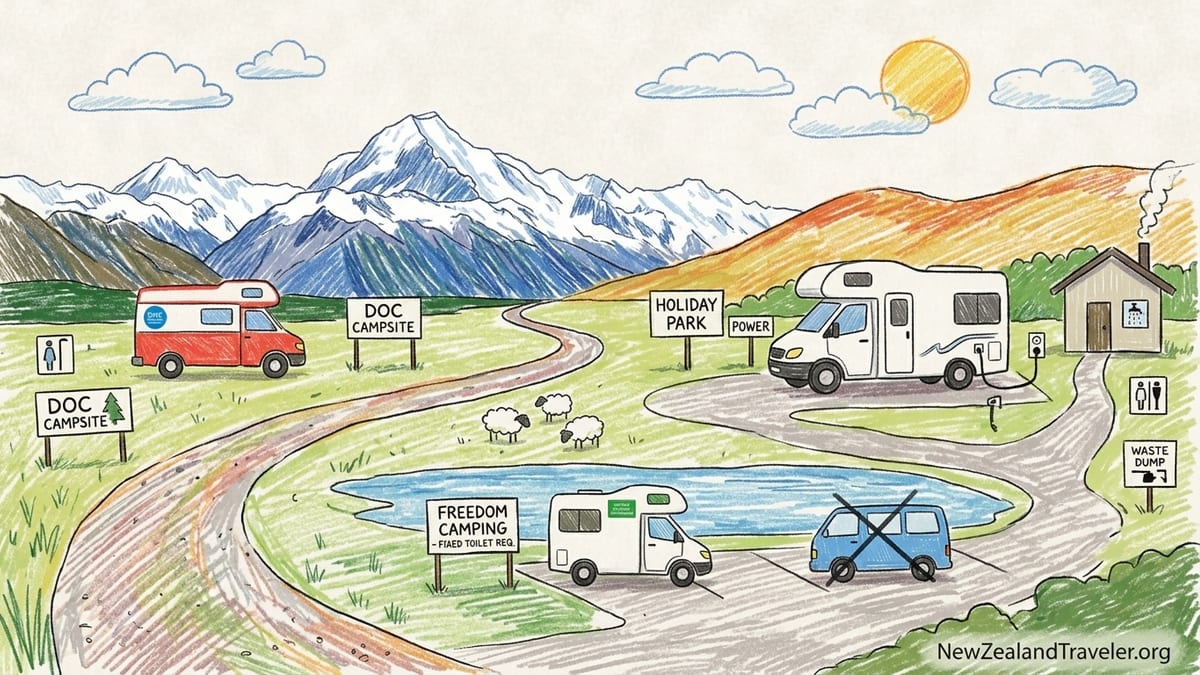
DOC, Holiday Parks and Freedom Camping: How They Fit Together
The starting point for any national park campervan trip in New Zealand is understanding the three main ways people actually stay overnight near the parks. The Department of Conservation (DOC) manages more than 300 conservation campsites around the country, with over 250 that can be reached by vehicles. These are usually the closest legal places to sleep inside or right on the edge of national parks such as Aoraki/Mount Cook, Fiordland, Tongariro or Arthur’s Pass. They range from grassy meadows at the end of gravel roads to large coastal campgrounds like Tōtaranui in Abel Tasman National Park.
Holiday parks are privately run campgrounds, often in or near towns that act as gateways to the parks. In Te Anau, Franz Josef, Turangi or National Park Village, for example, you will find commercial holiday parks with powered sites, hot showers, full kitchens, laundries and Wi-Fi. Road-trippers often combine DOC sites for scenery and price with holiday parks every few days to recharge batteries, dump waste, restock food and enjoy long hot showers. Many rental campervan operators quietly expect you to plug in at holiday parks regularly so fridges, heaters and onboard batteries stay healthy.
Freedom camping is the third category and also the one that causes the most confusion. Freedom camping means staying overnight in a vehicle on public land that is not a paid campground, where it is specifically allowed. It never means that you can simply pull over on the nearest road shoulder in a national park and sleep wherever you like. Freedom camping is controlled by national law and by local council bylaws, and these rules sit on top of DOC’s own regulations. Even if you have the right vehicle, you still must be in a place where freedom camping is expressly permitted and obey any time limits or signposted conditions.
On a practical two or three week circuit of the South Island, a typical pattern might be to stay near popular national parks mostly in DOC campsites, dip into a holiday park every third or fourth night, and use designated council-run freedom camping areas to bridge long driving days between park regions. Thinking of these three options as a toolkit rather than competitors will make it much easier to plan a legal and comfortable itinerary.
New 2026 Self-Containment Rules and the Green Warrant
The biggest rule change affecting campervan road trips in 2026 is the new definition of a self-contained vehicle and the shift from the old blue stickers to the new green warrant. Under legislation passed in 2023, vehicles that want to use most vehicle-based freedom camping spots now have to meet stricter self-containment standards. During a transition period, older blue-warrant vehicles could still be used, but that grace period ends on 7 June 2026. From that date onward, if a site is marked as restricted to certified self-contained vehicles, your vehicle will need to carry the new green warrant card.
The most important practical difference is that vehicles relying on a portable toilet no longer qualify as self-contained for freedom camping. To meet the new green warrant standard, your campervan, caravan or motorhome must have a fixed toilet plumbed into the vehicle. The certification itself has to be issued through the national plumbing regulator, and enforcement officers can request to see your warrant card. That means common budget setups like small vans with a removable cassette toilet or a fold-out chemical toilet no longer count as self-contained at restricted freedom camping areas after 7 June 2026.
This does not stop you using DOC campsites or holiday parks. Basic DOC campsites with toilets, and private campgrounds with full facilities, are open to all types of vehicles and tents as long as you pay the fee and follow the rules. What it changes is your flexibility to stay at roadside lakes, harbours or council-owned car parks that are signed for certified self-contained vehicles only. If you are planning a 2026 or 2027 road trip and want to use many of the classic freedom camping spots around places like Lake Pukaki, the Catlins or the West Coast, you will need to either rent a vehicle with the new green warrant or adjust your plans to rely more on formal campgrounds.
For visitors hiring campervans from 2026 onward, one practical tip is to ask your rental company very directly whether the vehicle carries the green self-containment warrant and whether it has a fixed toilet. Many rental fleets updated their vehicles ahead of the deadline, but cheaper older models might not qualify. If a staff member is vague, assume the vehicle is not certified for restricted freedom camping and plan to book DOC and holiday park sites instead of counting on free lakeside stops.
DOC Campsites Inside and Around National Parks
DOC conservation campsites are the backbone of most national park-based road trips. They place you closer to trailheads, lakes and viewpoints than almost any other accommodation type. At Aoraki/Mount Cook National Park, for example, White Horse Hill campground sits at the valley head with direct walking access to the Hooker Valley Track and views of the Southern Alps. In Fiordland, the Cascade Creek and Lake Gunn campgrounds on the Te Anau to Milford Sound highway make it realistic to drive to early morning cruises without leaving town in the dark. Around Tongariro National Park, campsites such as Whakapapa Holiday Park’s DOC-managed neighbour and smaller lakeside DOC sites provide access to day walks and the Tongariro Alpine Crossing shuttle services.
DOC divides its vehicle-accessible sites into broad categories that signal how many facilities to expect. At the top end are serviced or “scenic” campgrounds, often with flush toilets, tap water suitable for treatment or boiling, picnic shelters and sometimes barbecues. Tōtaranui in Abel Tasman National Park is a prime example, a large coastal campground that takes advance bookings and fills through summer with both tents and campervans. At the other end are basic or “standard” campsites that may only offer long-drop toilets and a flat piece of ground beside a gravel access road. In regions like Arthur’s Pass, Westland Tai Poutini and Mt Aspiring national parks, these simple sites put you in remote valleys or by braided rivers that would otherwise require a long drive from the nearest town.
Because DOC campsites sit on conservation land, they are also shaped by environmental realities rather than commercial convenience. Sandflies are part of everyday life on the West Coast and Fiordland, and campsites such as Lake Gunn, Cascade Creek and some Haast Pass campgrounds are notorious for them on still summer evenings. Road access can range from sealed highway at White Horse Hill or Tōtaranui’s more developed access, through to narrow, corrugated gravel like the road into Gillespies Beach near Fox Glacier or the northern bays of Abel Tasman. Large motorhomes and rental campervans can usually make it, but drivers should be prepared for slower travel and to check local road conditions, especially after heavy rain.
Generators are another point of difference from holiday parks. Many DOC campgrounds either discourage or prohibit generator use, especially at night, to preserve the natural soundscape. If you rely on a generator for power, expect to limit operating times to daylight hours where it is allowed at all, and consider upgrading to larger onboard batteries or solar panels for multi-night stays in national park campsites. Quiet enjoyment is taken seriously, and rangers do patrol to enforce rules during busy periods.
Booking, First-Come Sites and the DOC Campsite Pass
One of the biggest practical questions for national park travellers is whether you need to book campsites or can simply show up. DOC now runs a unified online booking system for huts, lodges and many of its more popular campsites. Many of the highest demand vehicle-accessible sites are bookable, including iconic national park locations such as Tōtaranui in Abel Tasman and White Horse Hill in Aoraki/Mount Cook. DOC’s booking calendar typically opens well ahead of the summer season, with peak dates over Christmas, New Year and long weekends selling out quickly. For these marquee campgrounds, especially if you are driving a rental campervan in January, advanced bookings are strongly recommended.
Alongside bookable sites, DOC still manages a large number of first-come, first-served campgrounds. These non-bookable sites work on a simple system: drive in, pick a space, and pay via self-registration or to a camp host if one is present. The fee is usually paid either with cash into an honesty box or via an online payment using campsite details on the DOC website or signage. Once a campsite reaches its vehicle limit, late arrivals are expected to move on to another location rather than squeeze in. During February or March outside major holidays, many road-trippers report arriving at DOC campgrounds in mid afternoon and finding spots without booking, but in popular areas it is wise to keep a backup option in mind.
DOC’s Campsite Pass offers another layer for long road trips focused on conservation campsites. Available in one-month and one-year versions, the pass gives pre-paid access to most DOC conservation campsites across New Zealand, both bookable and non-bookable, though a small number of premium or concession sites are excluded or charge a surcharge. The pass must be linked to bookings where required, so even pass holders still need to reserve spaces at bookable campgrounds rather than simply turning up. For visitors spending several weeks touring multiple national parks and relying mainly on DOC sites rather than holiday parks, the pass can represent good value, particularly across the South Island where there is a dense network of standard and scenic campgrounds.
Whether you rely on a pass or pay per night, it is vital to understand that DOC staff and camp hosts do check payments and bookings. Parking in a DOC campsite without paying because there is no gate or boom arm is treated the same as failing to pay a hotel bill. During busy periods like late December or Waitangi Day in early February, rangers may also enforce maximum stay limits or turn away new arrivals from full sites. Flexible itineraries work best when you pair broad plans with the willingness to adapt based on daily availability.
Facilities, Dump Stations and What “Basic” Really Means
Facilities are where DOC campsites and holiday parks differ most clearly, and where misconceptions can create uncomfortable nights for new visitors. In a typical holiday park near a national park gateway town such as Te Anau, Wanaka or Turangi, you can expect powered sites, hot showers, flushing toilets, shared kitchens with fridges and cooktops, often a lounge, laundry and Wi-Fi. Many parks also have children’s playgrounds and communal barbecue areas. These comforts come at a higher nightly price but significantly reduce what you need to carry in your vehicle.
By contrast, the word “basic” on a DOC campsite description should be taken literally. A basic or standard DOC site will almost always have toilets, but these are often long-drop or composting toilets rather than flush systems. Tap water may not be treated, and DOC signage may advise boiling or treating water before drinking. There are usually no powered sites, no showers, no communal kitchen buildings and no rubbish collection. Campers are expected to carry out their rubbish and manage their own cooking on gas stoves. A shelter, if present, may be as simple as a roofed picnic area without walls, which is invaluable in Fiordland rain but does not replace an indoor kitchen.
Dump stations for grey and black water are another critical consideration for campervans and motorhomes. Many DOC campsites do not have dump stations on site, especially the smaller basic ones deep inside national parks. Instead, dump points are commonly located in gateway towns, at larger holiday parks or at some council-run facilities beside main highways. For example, travellers heading into Aoraki/Mount Cook National Park usually empty their tanks in Tekapo or Twizel before driving the long valley road to White Horse Hill, and then empty again after returning to town. In the Abel Tasman region, many campers use dump stations in Motueka or Takaka before heading out to coastal DOC sites. Planning your tank capacities around where legal dump points are located is just as important as booking your campsite.
Showers and cooking shelters sit somewhere between luxury and necessity, depending on your vehicle. Smaller vans and tent-based setups may rely on DOC’s simplest shelters to escape sandflies or wind while cooking meals on portable gas stoves, while larger self-contained motorhomes with internal kitchens can be more self-reliant. However, even in bigger vehicles most travellers appreciate a periodic stop at a holiday park to enjoy long, hot showers, do laundry and reset before another few nights of basic DOC campsites. Alternating between the two types of campground allows you to balance budget, scenery and comfort over a multi-week national park itinerary.
Freedom Camping Near National Parks: Myths and Realities
One of the most persistent misconceptions about New Zealand is that visitors can simply sleep for free anywhere inside a national park as long as they are inside a vehicle. In reality, freedom camping is tightly controlled, and national park travellers need to pay close attention to signage, online maps and local bylaws. The national Freedom Camping Act defines freedom camping and gives DOC, local councils and other land managers the power to restrict or prohibit it in specific areas. On top of that, individual councils publish bylaws and maps that show exactly where freedom camping is allowed, for how long and in what type of vehicle.
Near many flagship national parks, councils have significantly restricted casual roadside camping because of previous problems with rubbish and waste. Around Queenstown and Wanaka, which act as gateways to Fiordland and Mount Aspiring national parks, large areas of lakeshore and town streets are prohibited for overnight stays except in marked freedom camping sites or paid campgrounds. In Canterbury and Mackenzie District on the approach to Aoraki/Mount Cook, many scenic lay-bys and lakeside car parks have “No overnight camping” signs. Even if a spot looks quiet and remote at dusk, parking there overnight may still be illegal and subject to fines.
The new 2026 self-containment rules also sharply limit who can use the remaining vehicle-based freedom camping locations. Where signage or council bylaws state that only certified self-contained vehicles may stay, you must have a green self-containment warrant and a fixed toilet on board from 7 June 2026. Smaller vans without fixed toilets, rooftop tent setups and standard cars are restricted to either holiday parks, DOC campgrounds that permit non self-contained vehicles, or specially designated areas that explicitly allow non self-contained freedom camping. These designated sites are less common near national park boundaries than in some rural or coastal areas, so anyone travelling in a non self-contained vehicle should base their planning around formal campgrounds rather than casual freedom camping.
For national park enthusiasts who enjoy the idea of waking beside a river or lake away from big holiday parks, the realistic approach from 2026 onward is to combine DOC conservation campsites, some of which are very close to “freedom camping” in feel, with carefully chosen council-designated freedom locations. For example, you might spend nights at DOC sites like Lake Gunn on the Milford Road or Kidds Bush on Lake Hawea for a wild feel, then use a nearby town’s designated freedom camping area when you are between parks, provided your vehicle meets the self-containment rules in force. Ignoring bylaws because “everyone else is doing it” risks fines and contributes to pressure for even tighter regulations.
Tent, Small Camper, Self-Contained Van or Motorhome: What Works Best?
Choosing the right type of accommodation on wheels shapes how you experience New Zealand’s national parks. Travelling with a tent and a standard car offers maximum flexibility for driving rougher access roads and keeping rental costs low, but it also limits where you can stay. Without a self-contained vehicle, you will be relying almost entirely on DOC and private campgrounds rather than freedom camping, and you must be ready for variable weather. In alpine regions such as Aoraki/Mount Cook or Arthur’s Pass, strong winds and rapid temperature drops are common, so a robust tent and good sleeping gear are essential. On the plus side, many DOC campsites charge lower per-person fees for tent sites than powered motorhome pads elsewhere, and you are free to explore hiking tracks without worrying about manoeuvring a large vehicle.
Small campers, such as converted minivans with a bed platform and basic kitchen, remain popular with budget-conscious travellers, but the 2026 rules significantly change how they fit into the landscape. If the van does not have a fixed toilet and the new green self-containment warrant, it will not qualify for most restricted vehicle-based freedom camping areas after 7 June 2026. That means owners and renters of these simple vans will need to rely heavily on DOC campsites and holiday parks, just like tent campers. The upside is that a compact van is easier to drive on narrow DOC access roads, cheaper on fuel than a full motorhome, and often able to tuck into smaller sites at conservation campgrounds.
Certified self-contained campervans with the new green warrant occupy the middle ground. Typically built on the chassis of a long-wheelbase van, they include a fixed toilet, freshwater and greywater tanks, a basic kitchen and sleeping for two or three people. For national park travel, they provide enough independence to spend several nights at a basic DOC campsite without external facilities, while still fitting down winding access roads such as those into Gillespies Beach or remote lakes around Nelson Lakes National Park. Their key advantage in 2026 and beyond is access to many freedom camping areas between parks, where council rules restrict stays to certified self-contained vehicles. That said, even with a green warrant, you still need to respect local bans and posted limits.
Large motorhomes and bus-style conversions suit travellers who prioritise comfort and space. These vehicles usually come with full-height interiors, separate beds, larger kitchens and sometimes onboard showers. For visiting national parks, they are ideal for longer-term stays at larger DOC sites such as Tōtaranui or at commercial holiday parks just outside park boundaries. The trade-off is that some tight or rough DOC access roads become impractical for long, heavy vehicles, especially in wet conditions. Before driving a large motorhome into remote conservation campsites, it is wise to check recent road reports, talk to DOC visitor centres about access, and consider leaving the vehicle at a more accessible base while day-tripping into narrower valleys by car or on foot.
The Takeaway
By 2026, campervan travel through New Zealand’s national parks is still one of the most rewarding ways to experience the country, but it requires more planning and awareness of rules than it once did. DOC conservation campsites remain the closest and most atmospheric places to sleep near many trails and viewpoints, while holiday parks deliver the hot showers, powered sites and laundries that keep long trips comfortable. Freedom camping continues to exist, but under much tighter controls, especially once the new green self-containment warrant becomes mandatory for most restricted sites from 7 June 2026.
The best national park road trips treat these options as complementary tools. You might spend a few nights at White Horse Hill beneath Aoraki/Mount Cook, swing through a holiday park in Twizel to reset, explore Fiordland from DOC campsites on the Milford Road, and then link regions using designated freedom camping areas if your vehicle qualifies. Understanding the difference between bookable and first-come DOC sites, how the Campsite Pass works, where to find dump stations and what “basic” really means will prevent surprises and allow you to focus on the landscapes rather than logistics.
For many travellers, the key decision is what kind of vehicle or setup to choose. Tent and small camper travellers should plan around DOC and private campgrounds and be ready for weather, while those hiring or buying a certified self-contained van or motorhome with a fixed toilet gain more flexibility at designated freedom camping spots. Whatever you drive, taking the time to learn local bylaws, respect signage, manage waste properly and keep noise down at night helps protect fragile national park environments and ensures campervan access remains possible for future seasons.
If you build your 2026 itinerary around realistic driving distances, a mix of DOC and commercial campgrounds, and a clear understanding of the new self-containment rules, you will be well placed to enjoy sunrise coffees under snow-capped peaks, star-filled skies over quiet lakes and the satisfaction that comes from travelling responsibly through some of the world’s most remarkable protected landscapes.
FAQ
Q1. Can I still freedom camp anywhere in a national park if I have a self-contained campervan?
Even with a certified self-contained vehicle, you can only freedom camp where DOC and local council bylaws explicitly allow it. Many national park roadsides, car parks and lakeshores are signposted as no overnight camping, and these rules are enforced with fines.
Q2. What changes on 7 June 2026 for freedom camping in vehicles?
From 7 June 2026, vehicles using freedom camping areas that are restricted to certified self-contained campers must hold the new green self-containment warrant, and the vehicle must have a fixed toilet. Portable toilets no longer qualify a vehicle as self-contained for these sites.
Q3. Can I still stay at DOC campsites if my van does not have a fixed toilet?
Yes. Most DOC conservation campsites are open to vehicles without fixed toilets as well as to tent campers, provided you pay the required fee and follow site rules. The self-containment rules mainly affect where you can freedom camp outside formal campgrounds.
Q4. Do I need to book DOC campsites in advance?
Some DOC campsites, especially popular ones near national parks like Tōtaranui or White Horse Hill, are bookable and can fill in peak periods, so advance bookings are recommended. Many others remain first-come, first-served and work on self-registration, particularly outside holiday peaks.
Q5. What is the DOC Campsite Pass and is it worth it?
The DOC Campsite Pass is a prepaid pass available for one month or one year that covers camping fees at most DOC conservation campsites. It is generally worthwhile if you plan to stay at DOC campgrounds frequently over several weeks, but you still need to make bookings at bookable sites where required.
Q6. How basic are basic DOC campsites in practice?
Basic DOC campsites usually offer a flat place to park or pitch a tent and a long-drop or composting toilet. There are typically no powered sites, no showers, limited or untreated water supply and no rubbish collection, so you must be self-reliant and pack out your waste.
Q7. Where can I empty my campervan’s waste tanks near national parks?
Many smaller DOC campsites do not have dump stations. Instead, you will find them in gateway towns, at larger holiday parks and at some council-operated facilities along main highways. It is important to plan your route so you can legally empty tanks before and after stays in remote park areas.
Q8. Are generators allowed at DOC campsites inside national parks?
Generator use is often restricted and sometimes prohibited at DOC campsites to protect the natural sound environment. Where they are allowed, operating hours are usually limited to daytime. Always check site information and be prepared to rely on batteries and solar for quiet overnight power.
Q9. Is a large motorhome suitable for narrow DOC access roads?
Many national park access roads are sealed and manageable for large motorhomes, but some DOC roads are narrow, steep or unsealed, which can be challenging for big vehicles. Check current road conditions, talk to DOC visitor centres and be ready to leave large vehicles at more accessible bases when necessary.
Q10. How often should I plan to use holiday parks on a national park road trip?
Many travellers alternate several nights at DOC campsites with a night in a holiday park every few days. Holiday parks provide powered sites, hot showers, laundries and dump stations, which help reset batteries, restock supplies and make extended stays near national parks more comfortable.